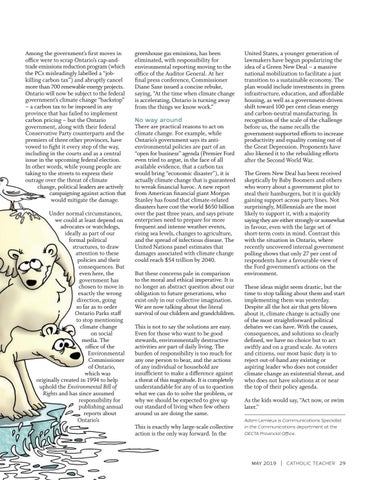
Among the government’s first moves in office were to scrap Ontario’s cap-andtrade emissions reduction program (which the PCs misleadingly labelled a “jobkilling carbon tax”) and abruptly cancel more than 700 renewable energy projects. Ontario will now be subject to the federal government’s climate change “backstop” – a carbon tax to be imposed in any province that has failed to implement carbon pricing – but the Ontario government, along with their federal Conservative Party counterparts and the premiers of three other provinces, have vowed to fight it every step of the way, including in the courts and as a central issue in the upcoming federal election. In other words, while young people are taking to the streets to express their outrage over the threat of climate change, political leaders are actively campaigning against action that would mitigate the damage. Under normal circumstances, we could at least depend on advocates or watchdogs, ideally as part of our formal political structures, to draw attention to these policies and their consequences. But even here, the government has chosen to move in exactly the wrong direction, going so far as to order Ontario Parks staff to stop mentioning climate change on social media. The office of the Environmental Commissioner of Ontario, which was originally created in 1994 to help uphold the Environmental Bill of Rights and has since assumed responsibility for publishing annual reports about Ontario’s
greenhouse gas emissions, has been eliminated, with responsibility for environmental reporting moving to the office of the Auditor General. At her final press conference, Commissioner Diane Saxe issued a concise rebuke, saying, “At the time when climate change is accelerating, Ontario is turning away from the things we know work.” No way around
There are practical reasons to act on climate change. For example, while Ontario’s government says its antienvironmental policies are part of an “open for business” agenda (Premier Ford even tried to argue, in the face of all available evidence, that a carbon tax would bring “economic disaster”), it is actually climate change that is guaranteed to wreak financial havoc. A new report from American financial giant Morgan Stanley has found that climate-related disasters have cost the world $650 billion over the past three years, and says private enterprises need to prepare for more frequent and intense weather events, rising sea levels, changes to agriculture, and the spread of infectious disease. The United Nations panel estimates that damages associated with climate change could reach $54 trillion by 2040. But these concerns pale in comparison to the moral and ethical imperative. It is no longer an abstract question about our obligation to future generations, who exist only in our collective imagination. We are now talking about the literal survival of our children and grandchildren. This is not to say the solutions are easy. Even for those who want to be good stewards, environmentally destructive activities are part of daily living. The burden of responsibility is too much for any one person to bear, and the actions of any individual or household are insufficient to make a difference against a threat of this magnitude. It is completely understandable for any of us to question what we can do to solve the problem, or why we should be expected to give up our standard of living when few others around us are doing the same. This is exactly why large-scale collective action is the only way forward. In the
United States, a younger generation of lawmakers have begun popularizing the idea of a Green New Deal – a massive national mobilization to facilitate a just transition to a sustainable economy. The plan would include investments in green infrastructure, education, and affordable housing, as well as a government-driven shift toward 100 per cent clean energy and carbon-neutral manufacturing. In recognition of the scale of the challenge before us, the name recalls the government-supported efforts to increase productivity and equality coming out of the Great Depression. Proponents have also likened it to the rebuilding efforts after the Second World War. The Green New Deal has been received skeptically by Baby Boomers and others who worry about a government plot to steal their hamburgers, but it is quickly gaining support across party lines. Not surprisingly, Millennials are the most likely to support it, with a majority saying they are either strongly or somewhat in favour, even with the large set of short-term costs in mind. Contrast this with the situation in Ontario, where recently uncovered internal government polling shows that only 27 per cent of respondents have a favourable view of the Ford government’s actions on the environment. These ideas might seem drastic, but the time to stop talking about them and start implementing them was yesterday. Despite all the hot air that gets blown about it, climate change is actually one of the most straightforward political debates we can have. With the causes, consequences, and solutions so clearly defined, we have no choice but to act swiftly and on a grand scale. As voters and citizens, our most basic duty is to reject out-of-hand any existing or aspiring leader who does not consider climate change an existential threat, and who does not have solutions at or near the top of their policy agenda. As the kids would say, “Act now, or swim later.” Adam Lemieux is Communications Specialist in the Communications department at the OECTA Provincial Office.
MAY 2019 | CATHOLIC TEACHER 29