VIEWPOINT
WHY I MARCHED Men of quality don’t fear equality By John Pecsenye
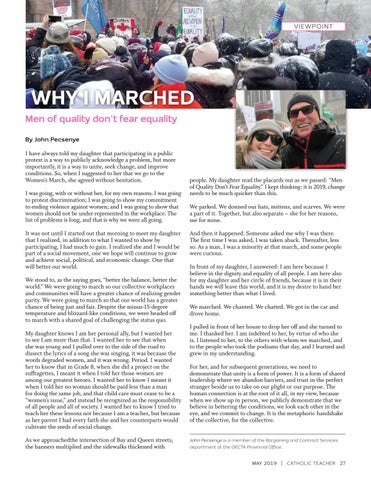
I have always told my daughter that participating in a public protest is a way to publicly acknowledge a problem, but more importantly, it is a way to unite, seek change, and improve conditions. So, when I suggested to her that we go to the Women’s March, she agreed without hesitation. I was going, with or without her, for my own reasons. I was going to protest discrimination; I was going to show my commitment to ending violence against women; and I was going to show that women should not be under-represented in the workplace. The list of problems is long, and that is why we were all going. It was not until I started out that morning to meet my daughter that I realized, in addition to what I wanted to show by participating, I had much to gain. I realized she and I would be part of a social movement, one we hope will continue to grow and achieve social, political, and economic change. One that will better our world. We stood to, as the saying goes, “better the balance, better the world.” We were going to march so our collective workplaces and communities will have a greater chance of realizing gender parity. We were going to march so that our world has a greater chance of being just and fair. Despite the minus-15-degree temperature and blizzard-like conditions, we were headed off to march with a shared goal of challenging the status quo. My daughter knows I am her personal ally, but I wanted her to see I am more than that. I wanted her to see that when she was young and I pulled over to the side of the road to dissect the lyrics of a song she was singing, it was because the words degraded women, and it was wrong. Period. I wanted her to know that in Grade 8, when she did a project on the suffragettes, I meant it when I told her those women are among our greatest heroes. I wanted her to know I meant it when I told her no woman should be paid less than a man for doing the same job, and that child care must cease to be a “women’s issue,” and instead be recognized as the responsibility of all people and all of society. I wanted her to know I tried to teach her these lessons not because I am a teacher, but because as her parent I had every faith she and her counterparts would cultivate the seeds of social change. As we approachedthe intersection of Bay and Queen streets, the banners multiplied and the sidewalks thickened with
people. My daughter read the placards out as we passed: “Men of Quality Don’t Fear Equality.” I kept thinking: it is 2019, change needs to be much quicker than this. We parked. We donned our hats, mittens, and scarves. We were a part of it. Together, but also separate – she for her reasons, me for mine. And then it happened. Someone asked me why I was there. The first time I was asked, I was taken aback. Thereafter, less so. As a man, I was a minority at that march, and some people were curious. In front of my daughter, I answered: I am here because I believe in the dignity and equality of all people. I am here also for my daughter and her circle of friends, because it is in their hands we will leave this world, and it is my desire to hand her something better than what I lived. We marched. We chanted. We chatted. We got in the car and drove home. I pulled in front of her house to drop her off and she turned to me. I thanked her. I am indebted to her, by virtue of who she is. I listened to her, to the others with whom we marched, and to the people who took the podiums that day, and I learned and grew in my understanding. For her, and for subsequent generations, we need to demonstrate that unity is a form of power. It is a form of shared leadership where we abandon barriers, and trust in the perfect stranger beside us to take on our plight or our purpose. The human connection is at the root of it all, in my view, because when we show up in person, we publicly demonstrate that we believe in bettering the conditions, we look each other in the eye, and we commit to change. It is the metaphoric handshake of the collective, for the collective. John Pecsenye is a member of the Bargaining and Contract Services department at the OECTA Provincial Office.
MAY 2019 | CATHOLIC TEACHER 27