CATHOLIC CONNECTION
TEACHERS’ AID
A LENTEN REFLECTION By Shannon Hogan
No need to recall the past, I am doing a new deed – even now it springs up – can you not see it? I am building paths in the wilderness And streams in the wild To give drink to my chosen people The people I formed for myself. ISAIAH 43:18-20
Over the centuries, Catholics have taken many approaches regarding the most appropriate way to observe the Lenten fast. When reading some of the methods of Lenten self-denial prescribed by many writers in the medieval church, my childhood attempts of giving up potato chips or red pop seem pale in comparison. Admittedly, while feeling a bit embarrassed at my sevenand-a-half-year-old self’s understanding of the Lenten fast, I also remember how significantly the shortness of life and the length of eternal damnation loomed over us all. Even the smallest of sins, venial in those days, took on mammoth proportions during the Lenten observance. And as the poet Al Pitman wrote, “I was a much bigger sinner at seven-and-a-half years old.” Given the centuries of evolving understanding of penance, fasting, and Lent, we are invited to look with new eyes at this time, when the universal Church invites us to a period of selfreflection through self-denial. With
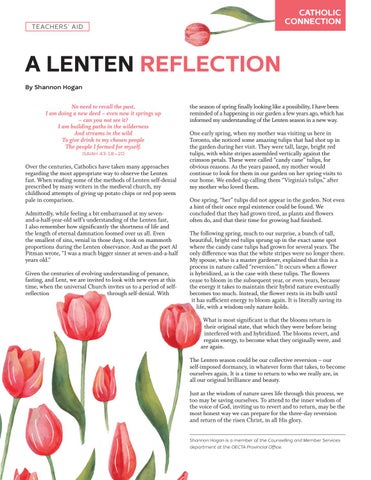
the season of spring finally looking like a possibility, I have been reminded of a happening in our garden a few years ago, which has informed my understanding of the Lenten season in a new way. One early spring, when my mother was visiting us here in Toronto, she noticed some amazing tulips that had shot up in the garden during her visit. They were tall, large, bright red tulips, with white stripes assembled vertically against the crimson petals. These were called “candy cane” tulips, for obvious reasons. As the years passed, my mother would continue to look for them in our garden on her spring visits to our home. We ended up calling them “Virginia’s tulips,” after my mother who loved them. One spring, “her” tulips did not appear in the garden. Not even a hint of their once regal existence could be found. We concluded that they had grown tired, as plants and flowers often do, and that their time for growing had finished. The following spring, much to our surprise, a bunch of tall, beautiful, bright red tulips sprung up in the exact same spot where the candy cane tulips had grown for several years. The only difference was that the white stripes were no longer there. My spouse, who is a master gardener, explained that this is a process in nature called “reversion.” It occurs when a flower is hybridized, as is the case with these tulips. The flowers cease to bloom in the subsequent year, or even years, because the energy it takes to maintain their hybrid nature eventually becomes too much. Instead, the flower rests in its bulb until it has sufficient energy to bloom again. It is literally saving its life, with a wisdom only nature holds. What is most significant is that the blooms return in their original state, that which they were before being interfered with and hybridized. The blooms revert, and regain energy, to become what they originally were, and are again. The Lenten season could be our collective reversion – our self-imposed dormancy, in whatever form that takes, to become ourselves again. It is a time to return to who we really are, in all our original brilliance and beauty. Just as the wisdom of nature saves life through this process, we too may be saving ourselves. To attend to the inner wisdom of the voice of God, inviting us to revert and to return, may be the most honest way we can prepare for the three-day reversion and return of the risen Christ, in all His glory. Shannon Hogan is a member of the Counselling and Member Services department at the OECTA Provincial Office.