OECD: Measuring the transformation of the economy - green growth Indicators
To ensure effective policy design supporting green growth, sound information on physical characteristics of the natural capital and its interactions with other forms of capital is needed. Experiences from the OECD’s work on Green Growth Indicators can help countries to implement a measurement framework to ensure that the necessary data are collected.
balanced coverage of the key features both the “green” and “growth” dimensions, with particular attention to indicators capturing the interface between the two. Indicators should be analytically sound and benefit from a consensus about their validity.
Besides being measurable, indicators have to be policy-relevant, meaning that they should provide a
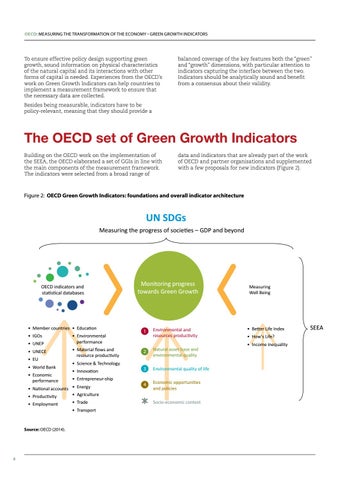
The OECD set of Green Growth Indicators Building on the OECD work on the implementation of the SEEA, the OECD elaborated a set of GGIs in line with the main components of the measurement framework. The indicators were selected from a broad range of
data and indicators that are already part of the work of OECD and partner organisations and supplemented with a few proposals for new indicators (Figure 2).
Figure 2: OECD Green Growth Indicators: foundations and overall indicator architecture
UN SDGs Measuring the progress of societies – GDP and beyond
OECD indicators and statistical databases
• Member countries • Education • IGOs • UNEP • UNECE • EU • World Bank • Economic performance
• Environmental performance • Material flows and resource productivity • Science & Technology • Innovation • Entrepreneur-ship
• National accounts • Energy • Agriculture • Productivity • Employment
Source: OECD (2014).
4
• Trade
• Transport
Monitoring progress towards Green Growth
1
Environmental and resources productivity
2
Natural asset base and environmental quality
3
Environmental quality of life
4
Economic opportunities and policies Socio-economic context
Measuring Well Being
• Better Life Index • How's Life? • Income inequality
SEEA