OECD: Measuring the transformation of the economy - green growth Indicators
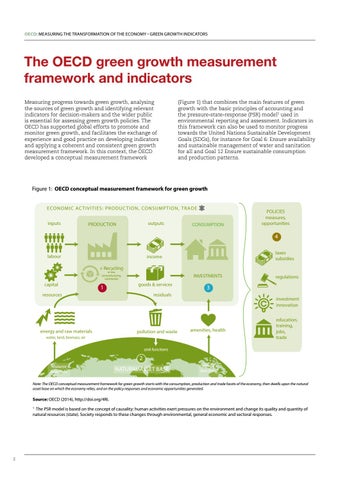
The OECD green growth measurement framework and indicators Measuring progress towards green growth, analysing the sources of green growth and identifying relevant indicators for decision-makers and the wider public is essential for assessing green growth policies. The OECD has supported global efforts to promote and monitor green growth, and facilitates the exchange of experience and good practice on developing indicators and applying a coherent and consistent green growth measurement framework. In this context, the OECD developed a conceptual measurement framework
(Figure 1) that combines the main features of green growth with the basic principles of accounting and the pressure-state-response (PSR) model1 used in environmental reporting and assessment. Indicators in this framework can also be used to monitor progress towards the United Nations Sustainable Development Goals (SDGs), for instance for Goal 6: Ensure availability and sustainable management of water and sanitation for all and Goal 12 Ensure sustainable consumption and production patterns.
Figure 1: OECD conceptual measurement framework for green growth E CO NO MIC AC T I V I T I ES : P R O D U C T I O N , CONSU M PT ION, T R ADE inputs
outputs
PRODUCTION
CONSUMPTION
POLICIES measures, opportunities
4 labour
taxes subsidies
income + Recycling re-use, remanufacturing, substitution
capital
1
INVESTMENTS goods & services
resources
energy and raw materials
3
residuals
pollution and waste
regulations
investment innovation
amenities, health
water, land, biomass, air
education, training, jobs, trade
sink functions
2 resource functions
NATURAL ASSET BASE
service functions
Note: The OECD conceptual measurement framework for green growth starts with the consumption, production and trade facets of the economy, then dwells upon the natural asset base on which the economy relies, and on the policy responses and economic opportunities generated.
Source: OECD (2014), http://doi.org/4f6. The PSR model is based on the concept of causality: human activities exert pressures on the environment and change its quality and quantity of natural resources (state). Society responds to these changes through environmental, general economic and sectoral responses.
1
2