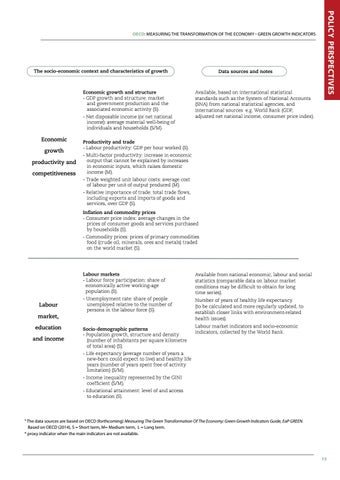
The socio-economic context and characteristics of growth
Economic growth and structure - GDP growth and structure: market and government production and the associated economic activity (S). - Net disposable income (or net national income): average material well-being of individuals and households (S/M).
Economic growth productivity and competitiveness
Data sources and notes
Available, based on international statistical standards such as the System of National Accounts (SNA) from national statistical agencies, and international sources e.g. World Bank (GDP, adjusted net national income, consumer price index).
policy Perspectives
OECD: Measuring the transformation of the economy - green growth Indicators
Productivity and trade - Labour productivity: GDP per hour worked (S). - Multi-factor productivity: increase in economic output that cannot be explained by increases in economic inputs, which raises domestic income (M). - Trade weighted unit labour costs: average cost of labour per unit of output produced (M). - Relative importance of trade: total trade flows, including exports and imports of goods and services, over GDP (S). Inflation and commodity prices - Consumer price index: average changes in the prices of consumer goods and services purchased by households (S). - Commodity prices: prices of primary commodities food (crude oil, minerals, ores and metals) traded on the world market (S).
Labour
Labour markets - Labour force participation: share of economically active working-age population (S).
Available from national economic, labour and social statistics (comparable data on labour market conditions may be difficult to obtain for long time series).
- Unemployment rate: share of people unemployed relative to the number of persons in the labour force (S).
Number of years of healthy life expectancy (to be calculated and more regularly updated, to establish closer links with environment-related health issues).
market, education and income
Socio-demographic patterns - Population growth, structure and density (number of inhabitants per square kilometre of total area) (S).
Labour market indicators and socio-economic indicators, collected by the World Bank.
- Life expectancy (average number of years a new-born could expect to live) and healthy life years (number of years spent free of activity limitation) (S/M). - Income inequality represented by the GINI coefficient (S/M). - Educational attainment: level of and access to education (S).
The data sources are based on OECD (forthcoming) Measuring The Green Transformation Of The Economy: Green Growth Indicators Guide, EaP GREEN. Based on OECD (2014), S = Short term, M= Medium term, L = Long term. * proxy indicator when the main indicators are not available.
1
15