OECD: Measuring the transformation of the economy - green growth Indicators
The environmental quality of life life. Not only do people benefit from environmental services, such as access to clean water and nature, but their choices are also influenced by environmental amenities.
Environmental outcomes are important determinants of human health and well-being. They demonstrate that production and income growth may not always be accompanied by a rise in well-being. Degraded environmental quality can result from and cause unsustainable development patterns. It can have substantial economic and social consequences, from health costs and lower labour productivity to reduced agricultural output, impaired ecosystem functions and a generally lower quality of life.
The main aspects of importance to green growth include:
Environmental conditions affect human health through exposure to air and water pollution, hazardous substances and noise, as well as through indirect effects from climate change, variations in water cycles, biodiversity loss and natural disasters that affect the health of ecosystems and damage people’s property and
•
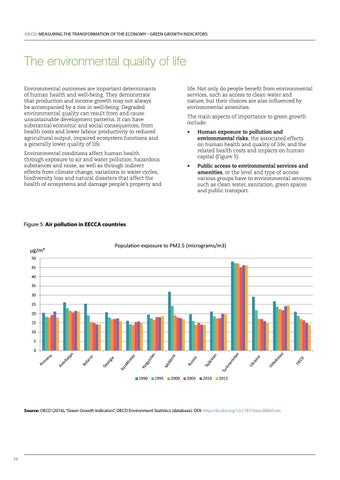
Human exposure to pollution and environmental risks, the associated effects on human health and quality of life, and the related health costs and impacts on human capital (Figure 5).
•
Public access to environmental services and amenities, or the level and type of access various groups have to environmental services such as clean water, sanitation, green spaces and public transport.
Figure 5: Air pollution in EECCA countries Population exposure to PM2.5 (micrograms/m3)
μg/m³ 50 45 40 35 30 25 20 15 10
1995
2000
2013
Source: OECD (2016), “Green Growth Indicators”, OECD Environment Statistics (database). DOI: http://dx.doi.org/10.1787/data-00665-en.
10
OE CD
kis ta n Uz be
e ra in Uk
en ist an
2010
Tu r 2005
km
kis tan
ssi a
Ta ji
Mo
Ru
1990
ldo va
yz sta n Ky rg
hs ta n Ka za k
or gia Ge
Be lar us
ba ij
ia
en
m Ar
Az er
0
an
5