Towards Green Growth? Tracking Progress K E Y F I N D I N G S A N D R E C O M M E N D AT I O N S
Four years after the launch of the OECD Green Growth Strategy, Towards Green Growth? Tracking Progress draws lessons from country experience and examines how to enhance policy design to deliver green growth
42
signatory countries to the OECD Declaration on Green Growth
3
pillars of growth: productivity growth, green growth, inclusive growth
•DEF OECD brochure English.indd 2
130 OECD green growth-relevant publications since 2011
80
OECD country surveillance reports with green growth recommendations (70%)
28-05-15 16:41
Taking stock to move the green growth agenda forward The 2011 Green Growth Strategy: 'green' and 'growth' must go hand-in-hand. In 2009, OECD Ministers asked the OECD to develop a Green Growth Strategy to help OECD and partner-country governments alike achieve economic recovery along with environmentally and socially sustainable growth. The 2011 Green Growth Strategy responded to this mandate. It sets a framework for governments to foster economic growth and development, while ensuring that natural assets continue to provide the resources and environmental services vital to human well-being. In addition to the need for Green Growth: fostering economic greater productivity growth, a growth agenda must growth and development; take account of the consequences of productivity ensuring that natural assets growth for the supporting physical environment. The continue to provide resources and need to ensure that growth is inclusive is a further environmental services vital to pillar for growth. human well-being
Towards Green Growth? Tracking Progress takes stock of country experience in implementing green growth since 2011. It assesses common challenges experienced by OECD countries and partner economies since 2011 in aligning economic and environmental priorities for green growth. The report seeks to accelerate progress by highlighting where there is broad scope to heighten the ambition and effectiveness of green growth policy, to help countries draw lessons from implementation efforts to date and seize available economic opportunities. Opportunities can arise from the expansion of markets for green technologies and services, improved market confidence from environmental policy clarity, incentives for innovation, efficient management of natural resources and other productivity gains. Revisiting the Green Growth Strategy to enhance well-being. The 2011 Green Growth Strategy recognised green growth policy design as work in progress; OECD work has deepened across the many relevant disciplines since 2011. Towards Green Growth? Tracking Progress surveys the work undertaken and considers the extent to which the Green Growth Strategy can be reviewed and strengthened by the analysis performed, as well as lessons from country implementation efforts to date. Great strides have been made in mainstreaming green growth, but progress is uneven. The OECD has made a concerted and sustained effort to integrate green growth across its work programme; its experience shows that institutional settings matter. To implement green growth, governments will need to drive institutional changes to integrate economic and environmental decision-making, and ensure co-ordination across core policy areas similar to those being implemented by the OECD. That makes the OECD’s experience instructive. The ultimate aim of the report is to accelerate countries’ implementation of green growth policies by providing more targeted and coherent policy advice. This brochure brings together the main findings of the report, delivered to the OECD Ministerial Council Meeting in June 2015, and corresponding recommendations for governments. The OECD’s Green Growth Strategy fully recognises the role of natural capital in economic growth and human well-being. As such, Towards Green Growth? Tracking Progress forms part of the Organisation’s broader input to major environmental policy milestones, including the United Nations Conference on Climate Change and negotiation of the Post-2015 development agenda, as well as environmental work being undertaken in the context of other international forums, such as the G20.
1
•DEF OECD brochure English.indd 1
28-05-15 16:41
countries are taking steps towards green growth; much more determined ef forts are needed to integrate environmental priorities into economic agendas Four years on from release of the Green Growth Strategy, governments have taken steps towards green growth. Most countries have implemented some measures to start to price pollution and provide incentives for efficient resource use, such as pricing instruments, regulatory measures and subsidies. Around a third of OECD countries and a number of OECD partners have adapted, or are adapting, the Green Growth Strategy’s indicator framework, to help evaluate and monitor progress towards national green growth objectives. Much more concerted efforts are needed to meaningfully align economic and environmental priorities. To drive green growth, governments must embed environmental challenges at the heart of economic policy making, by linking environmental and economic reform priorities in a consistent set of objectives. Finance and economic ministries have a major role to play. A number of countries have taken relevant measures, including developing green growth strategies and interministry committees coordinating elements of green growth policy. There are several examples including green growth policies in the United States that emphasise the advantages of technology leadership, and China’s 12th 5-year plan that focuses on green development. Portugal’s Green Growth Commitment sets out 13 quantitative green growth goals to be reached by 2020 and 2030. Ireland’s framework for sustainable development focuses on transitioning to a resource efficient, low-carbon and climate resilient future, and the Nordic Prime Minister’s Initiative for Green Growth aims to improve regional green growth infrastructure and increase market size. Yet, no country has comprehensively linked environmental and economic reform priorities. Measurability also remains a challenge. Many countries lack data over sufficient time periods to enable effective assessment of policies. OECD advice since 2011 demonstrates that the transition remains a work in progress. Since 2011, green growth considerations have been integrated into the OECD’s core policy advice to countries. The most commonly identified challenges relate to implementing market instruments to price pollution and natural-resource use; orienting tax systems to advance green growth; designing environmentally relevant subsidies; and gearing sectoral policy towards green growth. They are set out in Figure 1. The challenges are not exhaustive and will not necessarily apply to all countries, but demonstrate where main opportunities to improve the effectiveness of green growth policy implementation lie across countries.
Much more work is needed to demonstrate economic opportunities and trade-offs associated with green growth
Much better understanding of the opportunities and trade-offs of green growth policies is fundamental for progress. If governments do not have a clear grasp of the economic opportunities created by environment policy – or the potential feedbacks of environmental damages on GDP growth – it is difficult to articulate how economic and environmental priorities can be aligned to establish green growth objectives. Important analysis has emerged since 2011, but much more work is needed to demonstrate economic opportunities as well as improved environmental outcomes of policies designed to enhance green growth.
Governments should
depart from business as usual policies that leave environmental costs unaccounted for and implement green growth policies in recognition that, in the long-run, economic and environmental performance is inseparable advance understanding of the complementarities and trade-offs between economic and environmental goals, to better inform economic and environmental reform priority setting.
2
•DEF OECD brochure English.indd 2
28-05-15 16:41
121 billion USD government spending on renewable energy subsidies, 2013
60 jurisdictions with or considering carbon pricing
4
%
GDP average social cost of outdoor air pollution, OECD countries
2 0
%
average share of GDP from environmentally-related taxes, OECD countries
impact on productivity levels from environmental policy tightening 1990-2012, OECD countries 3 3
•DEF OECD brochure English.indd 3
28-05-15 16:41
F igure 1 – Eight most common green growth challenges in OECD country surveillance
NUMBER OF RECOMMENDATIONS Reviews of Innovation Policy 50
Investment Policy Reviews Environmental Performance Reviews Economic Surveys
45
40
35
30
25
20
15
10
5
0
n to m ul en i en ies rgy rmf s urd ntally nts r greent yste th bon subsidng outs a e b s r g eneents h a x m m n n w c i n g i e a e e e y u o t o i l s i m g t t t o n r r l n r i i t m s t a d a n p t t a o m i o i g a s h o s a e sy nt the iron axa nov een g in d w rice managgies/p e sub Suppdevel eler rov me tax ting env ed t icin e an licit p g in for gr Acccy imp e ron ies in lo rvers y r n i l i o u v t e Shif our of relat ing pr , wast p t n n a c x iv e h t e panc cien stru Orien fav an e Effect en tec tally p ing ent ort effi e en nat discre nfra lem transp enting i r i p g m i m Im for n te El lem mo iro Imp pro env
4
•DEF OECD brochure English.indd 4
28-05-15 16:41
Public trust is a central pillar for reform: governments must nurture it Direct pricing of environmentally harmful activity is indispensable to green growth, but political opposition is a fundamental challenge. Although it is more economically-efficient to tax externalities directly, opposition to such measures means that taxing the inputs or outputs of environmentallydamaging activities, such as motor vehicle fuels or electricity, remain far more prevalent than explicit pricing mechanisms. Country experience demonstrates that green growth is likely to continue to encounter political opposition without more concerted effort to tackle political challenges associated with reform. Further policy experimentation is needed, with rigorous ex post evaluation and rapid dissemination of results through, for instance, case studies. Experience in jurisdictions such as Ireland and the Canadian province of British Columbia show that leadership, consultation, incremental implementation and transparent analysis can contribute to the successful implementation of pricing mechanisms.
Greater focus is needed on political challenges associated with reform, including firm, labour market and household impacts
Where constituencies are strongly against tax increases or shifts, governments may need to consider policy mechanisms other than direct pricing. Implicit pricing and regulatory approaches may be more feasible to implement and help advance progress.
Potential distributional consequences, including labour market and household impacts, merit greater policy focus. Policy support for overall labour market mobility and skills development should be responsive to demand and training programmes should be continuously adjusted to changing employer demands. As more jobs require more green skills, existing labour and social policy systems should accommodate that shift, just as they adjusted to the demands of the rapid expansion of Information and Communications Technology. Ensuring an effective social safety net is particularly important in developing countries, where populations may be more vulnerable to impacts associated with reform, and transfer systems less developed or non-existent. In addition to helping to ease reform, such measures are essential to ensure that green growth policy does not exacerbate inequality, already on the rise in many countries.
Governments should
place greater emphasis on political challenges associated with green growth reform, particularly implementation of direct pricing mechanisms, drawing on country experience (e.g. ex post evaluation of policies; case studies) where constituencies are strongly against tax increases or shifts, consider more active pursuit of regulatory approaches advance understanding of how significant regressive effects of environmental policy are likely to be on households and identify emerging best practices from experience to date, including from a political economy perspective ensure that policy support for general labour market mobility and skills development is responsive to demand generated by green growth, and continuously adjust training programmes to changing employer demands. As more jobs require more green skills, existing labour and social policy systems should accommodate that shift.
40 10 17 %
of OECD country surveillance since 2011 makes recommendations on carbon pricing
•DEF OECD brochure English.indd 5
%
of country surveillance alone consider household implications
%
of country surveillance alone consider labour market impacts
28-05-15 16:41
Misalignments in government policy are acting as a major break on reform Green growth depends on strong, coherent signals that the costs of environmental degradation and unsustainable resource use will gradually increase. Regulatory action to gear existing sectoral and issue-specific policy towards supporting green growth is also essential. Current government policy is not consistent in helping to shift producer and consumer behaviour in support of green growth.
Glaring policy misalignments demonstrate broad scope to re-assess policy coherence for green growth
Governments globally continue to spend in the order of USD 640 billion per year on environmentally-harmful fossil fuels subsidies, in direct contradiction with green growth goals. Fossil fuels subsidies shore up the role of incumbent, polluting technologies; hold back investment in cleaner, emerging technologies; and act as a negative price on carbon. They serve as a major impediment to green growth.
The structure and level of taxes on energy use are not environmentally-coherent in many OECD countries. There are inconsistencies in the taxation of different forms, uses and users of energy when assessed against environmental and other social costs, for which the rationale is not obvious. For example, diesel fuel is taxed at lower rates than gasoline both in terms of energy and carbon content in 33 out of 34 OECD countries, despite the fact that on a per litre basis, diesel emits higher levels of harmful local air pollutants and CO 2. If policies within sectors are not coherent from an environmental perspective, the potential for inconsistency across policy areas is even greater. Recent work on policy alignment for the transition to a low-carbon economy supports this proposition. Climate policy interacts with policies in many areas, as almost all economic activities generate greenhouse-gas emissions. The result can be frictions, unintended consequences or conflicts in policy objectives. Several misalignments currently act as obstacles to the transition. This includes cross-cutting economic policy domains – investment, taxation, innovation and international trade – as well as policies governing specific areas that are critical to the low-carbon transition, such as electricity systems, urban mobility and rural land-use.
Governments should
re-invigorate efforts to eliminate fossil fuel subsidies, as a basic policy measure for green growth review the coherency of sectoral policy from a green growth perspective, both within and across sectors.
548
billion USD support for fossil fuel consumers in developing and emerging economies, 2013 (4 times renewable energy support)
•DEF OECD brochure English.indd 6
The OECD’s “Aligning Policies for the Transition to a Low Carbon Economy” project identifies policy misalignments that hamper low-carbon policies’ effectiveness and provides guidance on resolving them. It seeks to extend climate policy discussions to ministers and parts of government not typically involved in them, recognising that they can play a significant role in delivering emission reductions at least cost. www.oecd.org/mcm/MCM-2014-Statement-Climate-Change.pdf Similar work could be undertaken to assess policy alignment towards other green growth priorities, such as biodiversity conservation and sustainable use.
55-90 billion USD support for consumption and production of fossil fuels, OECD countries, 2005-2011
26.8 billion EUR fiscal cost per year due to favourable tax treatment of company cars; 116 EUR associated social costs
28-05-15 16:41
Ongoing data collection is needed to evaluate and monitor the transition towards green growth Green growth indicator development requires progress on two fronts: methodological development and addressing data gaps. Conceptual development of green growth indicators continues, including for six headline indicators intended to help articulate and monitor central elements of green growth (Figure 2). That progress must be matched by country efforts to ensure data availability and quality, to ensure that the lack of good data does not hamper indicator production and use, and to support efforts to track progress. The role of national statistics agencies is vital, as measurability remains a challenge for many countries. Governments should
a ccelerate efforts to ensure data availability and quality. Priority areas are internationally-comparable, environmental-economic accounts, such as accounts of air emissions and natural resources, and data on the state of the environment, such as biodiversity and ecosystem health, and air and water quality continue efforts to advance indicator methodologies.
Figure 2 – headline indicators for green growth
TRANSITION TO A RESOURCE-EFFICIENT, LOW-CARBON ECONOMY How efficient is the use of environmental resources and services?
ENVIRONMENTAL QUALITY OF LIFE How are environment conditions impacting on human well-being? What kind of access does the public have to environmental services and amenities? Population exposure to air pollution (PM 2.5) (health impacts of environmental degradation and related costs)
Carbon productivity Non-energy material (resource) productivity Environmentally-adjusted, whole-economy (multi-factor) productivity
NATURAL ASSET BASE Are environmental and economic resources being preserved, to support future growth? Natural resource index Changes in land cover and use (pressures on biodiversity and ecosystems)
26
green growth indictors, 2011 Green Growth Strategy
•DEF OECD brochure English.indd 7
ECONOMIC OPPORTUNITIES AND EFFECTIVE POLICY How effective is current green growth policy? Are the economic opportunities associated with the transition being seized?
Headline indicator to be determined
6
headline indicators developed since 2011 to raise awareness, measure progress, identify opportunities and risks
28-05-15 16:41
Mainstreaming is proceeding at a rapid pace at the OECD, but progress is uneven; instructive lessons arise for both governments and the Organisation Institutional settings matter. The OECD has made a concerted and sustained effort to integrate green growth across its work programme, to good effect. Around 70% of country policy surveillance now contain green growth recommendations. Yet, overall progress masks considerable differences across publication series and green growth issues (Figure 3). To drive green growth, governments should implement institutional changes to integrate economic and environmental decision making and ensure coordination across relevant ministries that are similar to those undertaken by the OECD to ensure coherence in its work programme. Lessons from the OECD’s process are therefore relevant for governments and other organisations seeking to implement green growth. Drawing lessons from success. Green growth recommendations are included in around 82% of Economic Surveys, which are driving the overall high rate of green growth advice in OECD country surveillance, along with Environmental Performance Reviews. A number of mechanisms have driven the relatively rapid rate of progress. The most important elements include: high-level leadership and clear accountabilities; formal structures for coordination and collaboration; clear articulation of how green growth links to other policy priorities; and dedicating human resources to the mainstreaming process. Ensuring mechanisms to encourage information sharing across policy areas and promoting measurable indicators for use in policy analysis are also important.
Governments should
assess and fine-tune institutional settings for green growth mainstreaming, potentially taking the OECD’s experience as an example initiate the culture change required to engage economic and other relevant ministries in addressing green growth related issues (e.g. strategic oversight at highest levels of government; mechanisms to drive co-operation between relevant ministries; leadership role for economic policy makers as well as environment ministries).
70
%
of OECD country surveillance since 2011 contains green growth recommendations
•DEF OECD brochure English.indd 8
310
country-tailored green growth recommendations, to almost 60 countries
28-05-15 16:41
Figure 3 – Green Growth recommendations in country policy surveillance
Total number of reports 115
Reports with green growth recommendations 80
Environmental Performance Reviews 14 Reports with green growth recommendations 14
Economic Surveys 76 Reports with green growth recommendations 62
Investment Policy Reviews 13 Reports with green growth recommendations 4
Reviews of Innovation Policy 12 Reports with green growth recommendations 0 9
•DEF OECD brochure English.indd 9
28-05-15 16:41
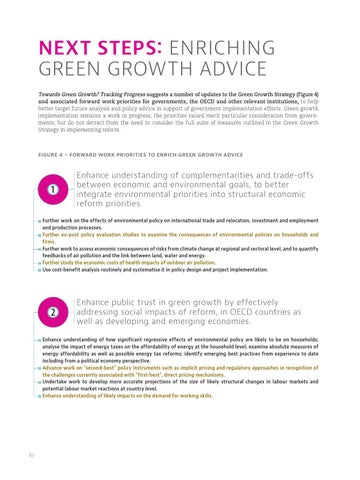
Next steps: enriching green growth advice Towards Green Growth? Tracking Progress suggests a number of updates to the Green Growth Strategy (Figure 4) and associated forward work priorities for governments, the OECD and other relevant institutions, to help better target future analysis and policy advice in support of government implementation efforts. Green growth implementation remains a work in progress; the priorities raised merit particular consideration from governments, but do not detract from the need to consider the full suite of measures outlined in the Green Growth Strategy in implementing reform.
Figure 4 – Forward work priorities to enrich green growth advice
1
Enhance understanding of complementarities and trade-offs between economic and environmental goals, to better integrate environmental priorities into structural economic reform priorities.
Further work on the effects of environmental policy on international trade and relocation, investment and employment and production processes. Further ex-post policy evaluation studies to examine the consequences of environmental policies on households and firms. Further work to assess economic consequences of risks from climate change at regional and sectoral level, and to quantify feedbacks of air pollution and the link between land, water and energy. Further study the economic costs of health impacts of outdoor air pollution. Use cost-benefit analysis routinely and systematise it in policy design and project implementation.
2
Enhance public trust in green growth by effectively addressing social impacts of reform, in OECD countries as well as developing and emerging economies.
Enhance understanding of how significant regressive effects of environmental policy are likely to be on households; analyse the impact of energy taxes on the affordability of energy at the household level; examine absolute measures of energy affordability as well as possible energy tax reforms; identify emerging best practices from experience to date including from a political economy perspective. Advance work on “second-best” policy instruments such as implicit pricing and regulatory approaches in recognition of the challenges currently associated with “first-best”, direct pricing mechanisms. Undertake work to develop more accurate projections of the size of likely structural changes in labour markets and potential labour market reactions at country level. Enhance understanding of likely impacts on the demand for working skills.
10
•DEF OECD brochure English.indd 10
28-05-15 16:41
3
Ensure that environmental policies are coherent and aligned within and across sectors
Assess sectoral and issue-specific policy to ensure policies are internally coherent. The OECD’s Taxing Energy Use provides a starting point to assess government fiscal policy. Assess issue- and sector-specific policy to ensure policies are aligned across sectors. The OECD’s Aligning Policies for the Transition to a Low Carbon Economy project provides a starting point with respect to climate policy. Consider further work to help governments align policies within and across sectors. One potential example is work to assess policy alignment for biodiversity conservation and sustainable use across sectors such as agriculture, tourism and fisheries. Redouble efforts to eliminate the USD 640 billion support for fossil fuels currently being spent by governments. Reinvigorate efforts to gear innovation systems to both accelerate and direct innovation to green technologies and processes. The primary mechanism to advance this effort at the OECD will be the forthcoming 2015 Green Growth and Sustainable Forum, on “Enabling the Next Industrial Revolution: systems innovation for green growth”. The process to revise the Innovation Strategy is also relevant.
4
Consider the ocean economy and mining in gearing sectoral policies for green growth
Advance work to consider green growth issues related to emerging ocean industries and mining.
5
Use headline indicators to raise awareness, measure progress and identify opportunities and risks
Continue to advance methodological development of the green growth headline indicators and broader green growth indicator set. Continue to improve measuring of natural capital stocks in physical and monetary terms, including measurement of land and natural resources with a view to implementing key aspects of the System of Environmental-Economic Accounting (SEEA). Further develop sectoral indicators.
6
Factor in the particular set of challenges and opportunities that green growth represents for developing and emerging economies
Explicitly identify the inter-linkages between the OECD Green Growth Strategy and the OECD Development Strategy and advance knowledge of the different sequencing and mix of green growth policy instruments needed in developing and emerging economies. Incorporate environmental considerations into the economic and governance policy advice the OECD provides to developing and emerging economies, including through relevant peer review processes, the Global Relations Strategy and OECD regional programmes.
11
•DEF OECD brochure English.indd 11
28-05-15 16:41
12
•DEF OECD brochure English.indd 12
28-05-15 16:41
•DEF OECD brochure English.indd 3
28-05-15 16:41
OECD Green Growth Studies
Towards Green Growth? Tracking Progress Four years of the Green Growth Strategy The 2011 Green Growth Strategy provided initial guidance to governments on how to achieve economic growth and development, while preventing costly environmental damage and inefficient resource use. What progress have countries made in aligning economic and environmental priorities since 2011? Towards Green Growth? Tracking Progress attempts to evaluate this progress and highlight where there is broad scope to heighten the ambition and effectiveness of green growth policy. It draws lessons from green growth mainstreaming across the OECD’s work programme, notably in terms of how governments can maximise institutional settings to seize economic opportunities surrounding the transition to a green economy, and considers ways to enrich the Green Growth Strategy based on work undertaken since its launch.
Contact: Nathalie.Girouard@oecd.org
Photo: Š iStock.com/mjf795