Annex 4 - Different Operational Approaches to Integrated Flood Risk Management
The cyclical approach to disaster management Hazard prediction and modelling - Systematic approach - Vulnerability management - Building resilient communities
- Feedback - Update scenarios - Evaluation of socioeconomic damage - Vulnerability assessment
Prevention and mitigation
Post-crisis managemen
- Rapid assessment of damage - Restoration of transport and communication infrastructures
Recovery
State of preparation
Alert
Response
- Development scenarios - Training - Emergency planning maps
- Real-time monitoring and forecasting - Early alert systems - Warning the population - Scenario identification
Emergency telecommunications Communication and coordination - Knowledge of the situation - Identification of victims - Resource intervention
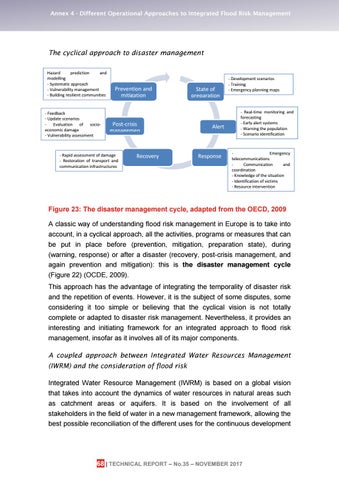
Figure 23: The disaster management cycle, adapted from the OECD, 2009 A classic way of understanding flood risk management in Europe is to take into account, in a cyclical approach, all the activities, programs or measures that can be put in place before (prevention, mitigation, preparation state), during (warning, response) or after a disaster (recovery, post-crisis management, and again prevention and mitigation): this is the disaster management cycle (Figure 22) (OCDE, 2009). This approach has the advantage of integrating the temporality of disaster risk and the repetition of events. However, it is the subject of some disputes, some considering it too simple or believing that the cyclical vision is not totally complete or adapted to disaster risk management. Nevertheless, it provides an interesting and initiating framework for an integrated approach to flood risk management, insofar as it involves all of its major components. A coupled approach between Integrated Water Resources Management (IWRM) and the consideration of flood risk Integrated Water Resource Management (IWRM) is based on a global vision that takes into account the dynamics of water resources in natural areas such as catchment areas or aquifers. It is based on the involvement of all stakeholders in the field of water in a new management framework, allowing the best possible reconciliation of the different uses for the continuous development
68 | TECHNICAL REPORT – No.35 – NOVEMBER 2017