Green Jobs in Practice
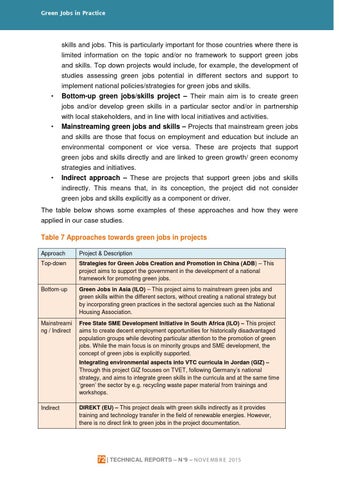
skills and jobs. This is particularly important for those countries where there is limited information on the topic and/or no framework to support green jobs and skills. Top down projects would include, for example, the development of studies assessing green jobs potential in different sectors and support to implement national policies/strategies for green jobs and skills. • Bottom-up green jobs/skills project – Their main aim is to create green jobs and/or develop green skills in a particular sector and/or in partnership with local stakeholders, and in line with local initiatives and activities. • Mainstreaming green jobs and skills – Projects that mainstream green jobs and skills are those that focus on employment and education but include an environmental component or vice versa. These are projects that support green jobs and skills directly and are linked to green growth/ green economy strategies and initiatives. • Indirect approach – These are projects that support green jobs and skills indirectly. This means that, in its conception, the project did not consider green jobs and skills explicitly as a component or driver. The table below shows some examples of these approaches and how they were applied in our case studies. Table 7 Approaches towards green jobs in projects Approach
Project & Description
Top-down
Strategies for Green Jobs Creation and Promotion in China (ADB) – This project aims to support the government in the development of a national framework for promoting green jobs.
Bottom-up
Green Jobs in Asia (ILO) – This project aims to mainstream green jobs and green skills within the different sectors, without creating a national strategy but by incorporating green practices in the sectoral agencies such as the National Housing Association.
Mainstreami ng / Indirect
Free State SME Development Initiative in South Africa (ILO) – This project aims to create decent employment opportunities for historically disadvantaged population groups while devoting particular attention to the promotion of green jobs. While the main focus is on minority groups and SME development, the concept of green jobs is explicitly supported. Integrating environmental aspects into VTC curricula in Jordan (GIZ) – Through this project GIZ focuses on TVET, following Germany’s national strategy, and aims to integrate green skills in the curricula and at the same time ‘green’ the sector by e.g. recycling waste paper material from trainings and workshops.
Indirect
DIREKT (EU) – This project deals with green skills indirectly as it provides training and technology transfer in the field of renewable energies. However, there is no direct link to green jobs in the project documentation.
72 | TECHNICAL REPORTS – N°9 – NOV E MB R E 2015