74
Landscape Architect Quarterly 08/
10/
14/
21/
Publication # 40026106
22/
Features Taking the Plunge The Importance of Taking Risks CSLA Awards CSLA Recognition Awards CSLA Class of Fellows 2026 Issue 74
Creating Cooler Community Spaces
With temperatures on the rise, heat islands are becoming a growing challenge for parks, playgrounds, and other outdoor recreation areas. Thoughtful design choices, such as shade structures and cooling features, can help create more comfortable environments that encourage people to stay, play, and connect. Let's work together to build healthier and more inclusive community spaces. abcrecreation.com Canadian Owned & Operated Since 1992
Masthead
Editor Glyn Bowerman
OALA
OALA
About
About OALA
Past President Steve Barnhart
Ground: Landscape Architect Quarterly is published by Ontario Association of Landscape Architects and provides an open forum for the exchange of ideas and information related to the profession of landscape architecture. Letters to the editor, article proposals, and feedback are encouraged. For submission guidelines, contact Ground at magazine@oala.ca. Ground reserves the right to edit all submissions. The views expressed in the magazine are those of the writers and not necessarily the views of OALA and its Governing Council.
The Ontario Association of Landscape Architects works to promote and advance the profession of landscape architecture and maintain standards of professional practice consistent with the public interest. OALA promotes public understanding of the profession and the advancement of the practice of landscape architecture. In support of the improvement and/or conservation of the natural, cultural, social and built environments, OALA undertakes activities including promotion to governments, professionals and developers of the standards and benefits of landscape architecture.
Councillors Ashley Hosker Lynda Macdonald Matt Perotto
Upcoming Issues of Ground Ground 75 – (2026) D.I.Y.
Intern Councillors Khadija Kushalgadhwala Emiley Switzer-Martell
Ground 76 – (2026) Memory
.74
2026-2027 OALA Governing Council
Photo Editor Jennifer Wan
President Aaron Hirota
OALA Editorial Board Tracy Cook Ryan De Jong Feroz Faruqi Mark Hillmer Helene Iardas Michelle Ma Lauren MacIsaac Ashna Modi Shahrzad Nezafati Julie St-Arnault Natasha Varga Jennifer Wan
Vice President Justin Whalen
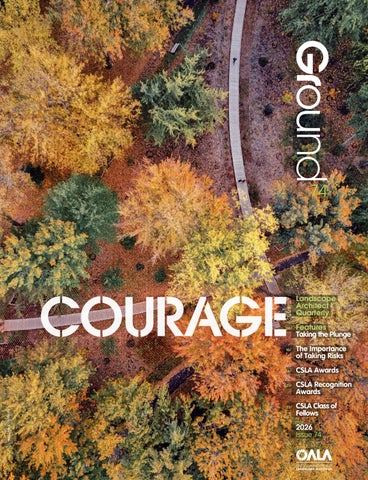
Art Direction/Design Noël Nanton/typotherapy www.typotherapy.com Advertising Inquiries advertising@oala.ca 416.231.4181 Cover Playfield and Grande Poudrière Pond Redevelopment, Parc Jean-Drapeau, Montréal, Quebec. Image courtesy of the CSLA and NIPPAYSAGE. See CSLA Awards, page 14. Ground: Landscape Architect Quarterly is published four times a year by the Ontario Association of Landscape Architects. Ontario Association of Landscape Architects 305-56 The Esplanade, Toronto, ON M5E 1A7 416.231.4181 www.oala.ca info@oala.ca Copyright © 2026 by Ontario Association of Landscape Architects. Contributors retain copyright of their work. All rights reserved. ISSN: 0847-3080 Canada Post Sales Product Agreement No. 40026106 See www.groundmag.ca to download articles and share content on social media.
Secretary Matthew Campbell Treasurer Kate Preston
Lay Councillor Karen Liu Appointed Educator University of Guelph Afshin Ashari Appointed Educator University of Toronto Elise Shelley University of Guelph Student Representative Amber Mays
Deadline for story pitches September 1, 2026 Now seeking submissions at magazine@oala.ca Deadline for advertising space reservations: October 8, 2026 Artwork submissions: October 22, 2026
University of Toronto Student Representative Jeffrey Carter OALA Staff Executive Director Aina Budrevics Registrar Ingrid Little Coordinator Olivia Godas Member Relations & Governance Advisor Angie Anselmo
See www.groundmag.ca for a digital, searchable, archival database, listing all articles, authors, subjects, key words, etc. published in Ground over the years.
TO VIEW ADDITIONAL CONTENT RELATED TO GROUND ARTICLES, VISIT WWW.GROUNDMAG.CA.
.74
Needs You Ground relies on OALA members, people from related professions, and those simply passionate about landscapes. If you would like to contribute in any form, whether it’s writing, photography, or participating as a member of our Editorial Board, don’t hesitate to reach out to us at magazine@oala.ca Ground Magazine represents the work of many passionate volunteers. If that sounds like you, come join the team! You do not need to be an OALA member or landscape architect to contribute to either the Editorial Board or the magazine, and anyone who expresses interest will be seriously considered.
Contents
03/
Up Front Information on the ground Courage:
08/
Taking the Plunge: a case for urban river swimming TEXT BY TYLER ALLEN BRADT, OALA
10/
The Importance of Taking Risks
President’s Message
President’s Message
Editorial Board Message
A few words of en(courage)ment. Courage often shows up in big moments—but it’s encouragement that carries us forward day to day. It’s how we sustain each other, especially in times of change.
Courage is a key trait needed for all landscape architects. We draw on it when we stand up for the needs of our natural environment; we draw on it when we advocate for the people and communities we serve; and we draw on it when we exude professional confidence to advise our colleagues and clients.
In my recent travels to Japan, I found a sticker that read: “Don’t become negative. Do positively.” It feels particularly relevant to our profession right now. Choosing to lead with optimism and support isn’t passive, it’s an active, intentional form of leadership.
TEXT BY LAUREN MAC ISAAC, OALA
14/
CSLA Awards
21/
CSLA Recognition Awards
22/
CSLA Class of Fellows
26/
Research Corner The Impacts of Dogs on Urban Park Soils TEXT BY KATIE STRANG, OALA AND TYLER BRADT, OALA SUPPORT BY JACK LEGG, MICHAEL LYNCH, AND MICHAEL ORMSTONHOLLOWAY, OALA INACTIVE
32/
42/
Notes A miscellany of news and events Artifact Big Fight in Little Chinatown TEXT BY JENNIFER WAN
This past June at the CSLA-APALA Congress, I was struck by how much our community embodies both courage and encouragement. The CSLA Awards of Excellence once again highlighted projects that push boundaries while contributing meaningfully to communities and landscapes. These projects don’t just inspire; they encourage all of us to aim higher.
For our summer issue, we wanted to celebrate Courage in our profession. Given the season, and knowing that this issue celebrates the winners of the 2026 CSLA Awards, we felt that a celebratory theme would be appropriate to recognize those who have achieved top honours. In addition to the awards coverage, we’ve got a number of interesting stories for you to enjoy in this issue.
We also celebrated a new class into the CSLA College of Fellows, including OALA members Shannon Baker, Nelson Edwards, Robert Corry, Wai Ying Di Giorgio, Joseph Fry, Diane Matichuk, Bryce Miranda, Jonathan Sagi, and Le’Ann Whitehouse.
One such story is a submission from an Ground editorial board member who recently made a big change and moved to Melbourne, Australia. Lauren wrote about her experience and the importance of taking personal risks, for broadening your horizons, and for personal growth. While the move has meant Lauren is no longer able to attend our board meetings, she continues to be a valued member supporting us in planning content, organizing roundtables, and participating in our new social media subgroup.
I also want to acknowledge OALA members Glenn O’Connor and Pete North for their contributions as recipients of CSLA Recognition Awards this year. Celebrating individuals reinforces that our profession is built not just on projects, but on people who support, mentor, and elevate others.
I would also like to take this opportunity to welcome the new incoming Editorial Board Chair Natasha VargaPapp. Natasha has been a valuable member of the board for many years and I have no doubt she will bring a new energy to the role.
We’re also looking ahead. Council, staff, and our committees are beginning work on the 2027–2031 Strategic Plan. The progress made over the past five years gives us positive momentum. The next plan is an opportunity to be both thoughtful and bold.
It has been my pleasure to contribute to Ground in a number of ways since 2018, but it is time for me to move on, for now. I will continue to stick around for a little overlap to make Natasha’s transition easier but this will be my final issue as Chair. I hope you’ve enjoyed the issues we’ve put out together and I look forward to becoming a surprised reader like all of you, once again.
I encourage you to join us at the OALA Conference, October 1-3 in Kitchener. It’s always one of the best opportunities to connect. Let’s remember that encouragement is something we can all offer. A conversation, a gesture of support, or a moment of recognition can go a long way. I look forward to seeing many of you in Kitchener. AARON HIROTA OALA PRESIDENT PRESIDENT@OALA.CA
2026 Issue 74
Editorial Board Message
MARK HILLMER CHAIR, EDITORIAL BOARD MAGAZINE@OALA.CA
Up Front
03
.74
01 BEGINNINGS
courage to start Courage doesn’t always feel courageous in the moment. It often acts as a driving force that keeps us moving forward—out of curiosity, necessity, or maybe a bit of both. Changing career paths from architecture to landscape architecture, while also moving from one climate zone to another, is not something I planned for. Yet, somehow, it worked out. These are reflections of my own journey from student days and early career choices, to caring for our profession in a more meaningful way.
Up Front: Information on the Ground
Student internships are a first step out of the comfort zone of academics into a new world of pragmatism. We learn a little more about ourselves and what it means to actually go to work. Curiosity made me apply for an internship in Katowice, Poland. It would be my first time living away from family and there were only a few of us submitting applications through the International Association for the Exchange of Students for Technical Expertise (IAESTE).
02
01/
A plaza in Krakow, Poland.
IMAGE/
Tijana Brkic
02/
Public art, Krakow, Poland.
IMAGE/
Tijana Brkic
Up Front
.74
04
03
During that summer abroad as an architectural intern, it was open spaces that kept sparking my interest. Designing buildings was just not as compelling anymore. While the architects in the office were detailing staircases and facades, I was developing renders of office building entrances and restaurant patios with views of protected forests. Continuing to explore your own interests while everyone else seems more settled and comfortable with theirs is its own form of courage. If internships are practice runs, our first fulltime job is the real beginning. Gone is the atmosphere of studio project work and daily catch ups with friends. Days become more fast-paced and you complete a project only to wake up the next day immediately facing another. It takes courage to make it through some days, especially if you are in a new city away from home. After completing my studies in Belgrade, Serbia, I landed a job in Abu Dhabi, United Arab Emirates. It was a decision driven by necessity and without any acquaintances there to make my transition easier. However, it was a leap of
04
05
faith I am glad I made. Although hired as an urban designer, staying curious led me into the world of landscape architecture. Working for a boutique firm allowed me to learn about plants, irrigation, and grading, all while having fun and hearing about things for the first time. Keeping an open mind leads to interesting new ways of approaching projects, no matter the scale, typology, or context.
06 03/
Mushrif Park, Abu Dhabi.
IMAGE/
Tijana Brkic
04/
Waterfront promenade, Dubai.
IMAGE/
Tijana Brkic
05/
Corniche Beach, Abu Dhabi.
IMAGE/
Tijana Brkic
06/
Knez Mihailova Street, Serbia.
IMAGE/
Tijana Brkic
For years, there were a lot of conversations around what I liked to call my ‘career identity crisis.’ Studying architecture established the foundations of my design education, but I was not designing buildings anymore. Urban design felt right, as it simultaneously looked at city scale, while also paying attention to details. However, designing open spaces was the realm of landscape architecture. That felt so far out of reach at the time—pursuing a career as a landscape architect. Where did I fit in, professionally? And how was I going to navigate that when moving to another country? In Abu Dhabi I was a member of the Society of Engineers. Meanwhile, Toronto had the OALA, OPPI, and OAA. Eventually, the idea of urban design being a ‘lens’ resonated with me a lot. All three disciplines—landscape architects, planners, and architects—can approach a project using the perspectives of urban design. This helped me feel more confident about my eclectic professional background and my path towards licensure in landscape architecture.
Up Front
05
.74
11
07
12
08
My career continues to be a winding path of discovery. No project is the same, and new challenges will always present themselves. It’s been almost a decade since I moved to Toronto to work in mostly urban environments, and it seems to me landscape architects and designers are equally courageous: trees endure, our roles in multi-disciplinary teams evolve, and adaptive solutions are discovered. There is a necessity rooted in respect for our climate, waters, soil, and cultures. It is not only about what happens next; it is equally about understanding the past and making thoughtful decisions in the present. Fittingly, I came across a quote the other day by Emily Dickinson: “How strange that Nature does not knock, and yet does not intrude!” Caring for living systems, as well as ourselves, calls for patience, kindness and (you got it) courage.
09
07/
Mushrif Park, Abu Dhabi.
IMAGE/
Tijana Brkic
08/
Render of restaurant patio in protected birch forest (2012).
IMAGE/
Tijana Brkic
09/
Kalenic Market, Serbia.
IMAGE/
Tijana Brkic
10/
Beachfront park, Dubai.
IMAGE/
Tijana Brkic
11/
Khor Fakkan, United Arab Emirates.
IMAGE/
Tijana Brkic
Render of a trail system for Urban Edge project internship, United Arab Emirates (2015).
12/
IMAGE/
TEXT/ TIJANA BRKIC, OALA, IS AN URBAN DESIGNER AT O2 PLANNING AND DESIGN IN TORONTO. SHE HAS LIVED IN SEVERAL COUNTRIES ACROSS THE GLOBE SINCE CHILDHOOD, AND EXPERIENCED AND DESIGNED PUBLIC SPACES IN VARIOUS CLIMATE ZONES.
10
Tijana Brkic
Up Front
.74
06
13 PUBLIC SPACE
sath in suburbia
The term suburban often carries a negative connotation, but I’d like to reframe it. I am not trying to dismiss valid critiques, but offer another perspective that has evolved from my own lived experiences and shared histories.
I live in a suburban neighbourhood, in a primarily suburban city in southern Ontario: Brampton. Brampton is one of Canada’s youngest and fastest-growing cities, and home to one of the country’s largest SouthAsian, specifically Panjabi, populations. The cultural presence is visible across its
Up Front
07
.74
built landscape: storefronts with vibrant signage, diverse foods, and goods. But what’s even more interesting is how the people take up space in their own neighbourhoods. While you can see a similar pattern in neighbourhoods across the city, let me take you on a journey through my own. My neighbourhood is characterized by single-detached homes, two commercial plazas, two elementary schools, and a multitude of parks. These parks and public spaces vary from walking trails around stormwater retention ponds, to parkettes with playgrounds and a field, to a large central park located in the very centre of the neighbourhood. At this “central park”, there is a playground, a splash pad, a large playing field, and a gazebo with tables. Ironically, this park is also the centre of all activity. On most days, you will find children playing, teens hanging around the swings, parents taking their post-dinner laps around the perimeter, and grandparents under the gazebos discussing every topic under the sun, from food, to home life, to politics (both from their home country and Canadian), and bantering over an intense game of cards. This tradition of getting together in a central park stems from a North Indian tradition of a “Sath.” The Sath is a common central space in villages where the locals would come together and discuss a range of topics, play games, and find solutions to
15
16 13/
Sath in Suburbia interpretation.
IMAGE/
Sakshi Riar
14/
A Brampton strip mall.
IMAGE/
Sakshi Riar
15-16/
A local park in Brampton.
IMAGES/
Sakshi Riar
their problems. The Sath would also be located under a Banyan tree, not only to provide relief from the sun, but also as a wayfinding tool in the village. This tradition creates a sense of community that not only improves mental health, but also allows for some physical activity to be incorporated into daily lives. This also creates a bonding routine between the grandparents and children, strengthening intergenerational familial ties and bonds which can otherwise be lost in the chaotic, busy lifestyle most Canadian families tend to have. While my neighbourhood might look like any other suburban neighbourhood at a glance, upon inspection and reflection, one can see there is a uniqueness to this place. My neighbours, my people, have created a version of suburbia that breathes, that challenges dominant narratives of suburban life. Beneath the gazebo, in the echo of laughter across the field, through the everyday rituals of gathering, conversation, and care, they have embedded diasporic traditions into the suburban fabric. It becomes a Sath without borders, a village carried across continents. In this way, suburbia becomes a less rigid planning typology and more a social landscape, one continually reshaped by memory, migration, and collective presence. It becomes home. TEXT/ SAKSHI RIAR IS A LANDSCAPE ARCHITECTURAL INTERN, LANDSCAPE DESIGNER, RESEARCHER, AND STORYTELLER WHOSE WORK EXPLORES THE RELATIONSHIPS BETWEEN LAND, MEMORY, IDENTITY, AND BELONGING.
14
Taking the Plunge
.74
08
01
a case for urban river swimming 01/
A Grand Swim.
IMAGE/
Katie Strang
02/
Context Plan.
IMAGE/
Katie Strang
03/
Polluntant sources.
IMAGE/
Katie Strang
Hard urban / infrastructural edges characteristic of the river through downtown Galt.
04/
IMAGE/
Katie Strang
05/
Hard urban edge as well as some of the storm water outlets where you can see staining on the concrete.
IMAGE/
Katie Strang
that already lends itself to public access. Galt also lacks a true central public space. It has City Hall square and a handful of small parks, but nothing it can truly point to as its core public gathering space. The Grand River could become Galt’s central square—its grand public commons—and a draw for residents across Cambridge and the wider Kitchener-Waterloo region. Where else in the region can you go for a swim in July and follow up with a quick walk to the pub or coffee shop?
TEXT BY TYLER ALLEN BRADT, OALA
Why can’t we swim in the Grand River in Downtown Galt in Cambridge, Ontario? This may seem like fantasy, but it shouldn’t. Many of the barriers are well within the scope of landscape architecture. Most urban centres in Ontario that sit along rivers have their downtown on one side or the other. Galt is unusual in that it is cleanly bisected by the Grand River. A history of flood-control engineering has given the river an almost entirely urban edge—one
This isn’t just a water quality issue. A public swimming area is also an equity proposition. The City of Toronto maintains many public pools that function as cooling centres in the heat of July and August for people without air conditioning. A swimmable Grand means a free activity for families to enjoy in the downtown core. The Grand could become a centre of public life in Cambridge—open to anyone who wishes to be a part of it. A public realm like this would also become part of the City’s identity. The City of Cambridge logo depicts water flowing beneath a bridge. The City wants the Grand River to be its defining feature, but right now,
Taking the Plunge
09
.74
not untouchable. It is possible to rethink them without denying flood risk. Runoff from upriver farms (especially livestock operations) and golf courses is also a challenge. But the Grand River Conservation Authority already runs programs that help fund best management practices to reduce runoff into the rivers and streams of the watershed. The solutions are already in place; uptake is the problem. Another issue is overflow from the region’s wastewater treatment plants, which can send partially treated effluent directly into nearby rivers during major storm events. Additional treatment capacity, along with constructed or floating wetlands at outfalls, could help reduce these loads at key point sources. Downtown Galt also has many storm outlets that discharge directly into the Grand, carrying runoff from roofs, streets, and parking lots straight to the river. A green streets program, combined with a dedicated storm channel incorporated into new swimming infrastructure, could reduce pollution in stormwater runoff, lower runoff volumes, and redirect surplus flow from streets and parking lots downstream of swimming areas.
02
it isn’t. There have been attempts to bring people back to the Grand River. Mill Race Park and Founders Point both allow people to get down to the water’s edge and there is a pedestrian path along a portion of the riverbank. Recently, a pedestrian bridge was added to cross the river. These interventions, though, are either relatively small, lacking in design vision, or just not providing true access. Anyone visiting Galt would likely tell you the heritage core is what makes downtown special, and that is true. But it is also true of Elora, Fergus, Kingsville, Listowel, Orangeville, Port Hope, and any other number of large towns and small cites across Ontario. The historic charm of the downtown is undoubtedly lovely, but it is not unique. The river as a publicly accessible and vibrant gathering space, by contrast, could set Galt apart from the rest.
There are also seasonal and infrastructural challenges to account for, including the Grand River’s high, fast spring freshet and the location of the Parkhill Dam at the north end of the downtown river corridor. Both create a real safety concern. A barrier at the nearby Parkhill Road Bridge could create a clear exclusion zone to keep swimmers away from dangerous currents. Achieving this goal would require a lot more study. But, even at a glance, the watershed already includes seven swimming beaches maintained by the Conservation Authority along the Grand River and its major tributaries. If we can swim over at Laurel Creek, why not in Galt? Landscape architects are well positioned to help lead this vision. We have the plants, and we know how to use them in phytoremediation. We have best management practices ready for uptake at the private property level. We have the design and engineering tools to address stormwater runoff. What we lack is the institutional will and civic ambition to make this real. At the municipal level, initiating a feasibility study and advocating for pilot projects would be a good start. More broadly, Galt needs to give the Grand River its due and recognize it for what it is: the core public realm of the city. Urban rivers are not untouchable. We do not need to remain stuck in the false choice between doing nothing and renaturalizing everything. We should start treating the Grand River as a singular opportunity to build one of the most distinctive public-realm centrepieces in Ontario.
04
BIO/ TYLER ALLEN BRADT, OALA, IS PRINCIPAL AND FOUNDER OF FIELDWORK DESIGN OFFICE, A LANDSCAPE ARCHITECTURE, RESEARCH, AND PUBLIC ART STUDIO FOCUSED ON JOYFUL, ECOLOGICALLY GROUNDED DESIGN. WITH OVER 15 YEARS OF EXPERIENCE IN LANDSCAPE ARCHITECTURE, URBAN DESIGN, AND HORTICULTURE, TYLER’S WORK EXPLORES HOW BIODIVERSITY, BEAUTY, AND EVERYDAY PUBLIC LIFE CAN MEANINGFULLY SHAPE RESILIENT PLACES.
03
It must be acknowledged that there are indeed challenges to overcome. Flooding is a real risk in Galt. Most of the downtown flooded in the 1970s, which resulted in the channelization and embankments we see there today. That flood may still shape how the river is perceived, but it should not distract from the Grand River’s potential as a public asset. Inherited flood-control landscapes are 05
The Importance of Taking Risks
.74
10
The Importance of Taking Risks
when it would be easier to stay quiet. These moments, often small and internal, are where courage becomes part of daily practice. It also takes courage to occupy space within the profession. To enter a room knowing you may be the youngest voice, or the only woman, or the only minority. To question a superior’s design decision, challenge a contractor on site, or oppose a consultant. To advocate for better outcomes, even when they may not align with a client’s immediate priorities. These are not abstract ideas. They are lived realities for many emerging professionals. 01 TEXT BY LAUREN MAC ISAAC, OALA
Landscape architecture is a profession that requires courage. Projects large and small are built on problem-solving, often facing challenges like climate change, sustainability, environmental justice, and equity, all of which compete with the bottom line or a constrained budget. Every pen stroke, CAD line, plant selection, and RFI response has a tangible impact on the built environment and the communities that inhabit it. We have seen the consequences of failed projects, poorly planned cities, and thoughtless design. It takes both courage and confidence to make decisions that shape the world in such lasting ways. Courage in landscape architecture is not always obvious. It can look like advocating for a design decision that prioritizes long-term ecological health over shortterm cost savings. It can mean pushing back on value engineering that strips a project of its social or environmental integrity. It might be proposing a solution that challenges a client’s expectations, or asking difficult questions early in a process
As we raise a new generation of landscape architects, I often question whether courage can be taught in a classroom. It can be discussed,
05
06
The Hapa Collaborative offices, Vancouver.
01/
IMAGE/
Lauren Mac Isaac
02/
ASPECT Studios, Melbourne, Australia.
IMAGE/
Lauren Mac Isaac
03-04/
Melobourne, Australia.
IMAGES/
Lauren Mac Isaac
LABASH annual Landscape Architect conference.
05/
IMAGE/
Lauren Mac Isaac
Engagement session in Lonsdale, British Columbia.
06/
IMAGE/
Lauren Mac Isaac
03
04
encouraged, and modelled, but it is ultimately learned through experience. At the same time, my generation is navigating difficult economic and political conditions. Coming out of a global pandemic that disrupted our education and early careers, stability has become the priority. Comfort is often encouraged as the responsible choice, even when it comes at the expense of personal growth, development, and sometimes happiness. 02
11
.74
While I appreciate the realities shaping these decisions, and acknowledge that the ability to take risks comes with a level of privilege, I have also come to understand that prioritizing stability above all else can conflict with the qualities that make a strong landscape architect. Boldness, curiosity, and a willingness to think beyond what already exists are difficult to develop in environments that do not challenge us. Exposure to different places, systems, and perspectives makes us better designers. The question then becomes how we seek out that exposure within our own limitations. For many of us, it may not mean moving across the world. It could mean relocating within our own country, working in a different region, or choosing environments that challenge what we already know. When I moved across the country from Hamilton to Vancouver
The Importance of Taking Risks
12
.74
08
07
earlier in my career, the knowledge I brought with me became a foundation, while everything around me pushed me to learn quickly and continuously. That combination of familiarity and discomfort is where meaningful growth happens. I came to many of these realizations in the fall of 2025. I was a newly registered landscape architect, excited by the possibilities in front of me, but realized I had reached the limits of what my current position could offer. When I made the decision to move to Australia, everyone told me how brave I was. In reality, it did not feel that way. As the time approached to leave a stable job, my home country, and the people I knew, I became less and less sure of what I was doing. Would I like Melbourne? Would I find community? Would I be able to find work? Would this decision set me back? What grounded me was not confidence, but clarity. I knew I was no longer growing in the way I wanted to, and that staying would not change that. Six months later, I can say that the growth I have experienced, both personally and professionally, would not have been possible if I had stayed where I was comfortable. The outcome was not guaranteed, and that uncertainty was the point.
For emerging landscape architects, this is where personal and professional development begin to overlap. Taking risks in our personal lives, whether large or small, builds a kind of confidence that is difficult to develop otherwise. It changes how we approach our work. If we become more comfortable navigating uncertainty in our own lives, we are better equipped to handle it in our projects. We are more willing to speak up, to test ideas, and to take responsibility for decisions that do not have clear answers. Importantly, these acts of courage do not need to be dramatic to be meaningful. Moving to a new country is one example, but it is not the only one, nor is it accessible to everyone. Courage can take smaller, more immediate forms. It might mean asking to work on a project that genuinely interests you rather than waiting to be assigned. It could be learning a new software or tool in real time because it will improve the outcome of your work. It might mean choosing not to return to a familiar internship or position because you recognize it is no longer the right fit. In practice, it can also look like volunteering to lead a client presentation for the first time, even if you are unsure how it will go. It might mean defending a planting strategy that prioritizes biodiversity when you know it will be challenged. It could be staying engaged in a difficult coordination process instead of stepping back when conversations
07-08/
Graphics for a public space in Marathon, Ontario.
IMAGES/
Lauren Mac Isaac
09/
Graphics for Lonsdale, British Columbia.
IMAGE/
Lauren Mac Isaac
Engagement session in Lonsdale, British Columbia.
10/
IMAGE/
09
10
Lauren Mac Isaac
The Importance of Taking Risks
13
.74
become uncomfortable. Each of these decisions carries some level of risk, but they also create opportunities to build confidence and resilience.
11
13
12
15
The hesitation to take these risks is often rooted in the fear that something will not work out. That fear is valid, but it can also be limiting. Not every decision will lead to the outcome we expect, but even the missteps provide clarity about what we value and where we want to go. Over time, those experiences build a stronger sense of direction and capability. There is also a broader responsibility embedded in this. As landscape architects, the work we do has lasting consequences. The spaces we shape influence how people live, interact, and experience their environment. In the face of climate change, urbanization, and growing inequities, the need for thoughtful and forward-thinking design has never been greater. Meeting that responsibility requires more than technical skill. It requires a willingness to make difficult decisions, to advocate for better outcomes, and to challenge the status quo when necessary. Choosing courage does not mean rejecting stability entirely. It means recognizing when comfort is no longer serving your growth, and being willing to step beyond it. It means seeking out experiences that expand your perspective, even when they feel uncertain. Over time, these decisions shape not only your career, but the kind of landscape architect you become. 11-13/
Pazarena Park, British Columbia.
IMAGES/
Lauren Mac Isaac
14/
Graphic for a British Columbia parkway.
IMAGE/
Lauren Mac Isaac
15/
Design process for a B.C. Parkway.
IMAGE/
Lauren Mac Isaac
BIO/ LAUREN MAC ISAAC, OALA, IS A LANDSCAPE ARCHITECT AT ASPECT STUDIOS IN MELBOURNE, AUSTRALIA. A GRADUATE OF THE UNIVERSITY OF GUELPH’S BACHELOR OF LANDSCAPE ARCHITECTURE PROGRAM, SHE RECENTLY MOVED ABROAD TO PURSUE HER PASSION FOR EQUITABLE AND SUSTAINABLE DESIGN INTERNATIONALLY.
14
CSLA Awards
14
.74
CSLA AWARDS Canadian Society of Landscape Architects Awards of Excellence 03
The Canadian Society of Landscape Architects Awards of Excellence are given for outstanding accomplishment in landscape architecture. Congratulations to the following OALA members whose projects received awards.
Project Name: Place Banque Nationale - Parc MichelBélanger (Montréal, QC) Consultant: CCxA Architectes paysagistes Contact: Claude Cormier, OALA, AAPQ, FCSLA, Sophie Beaudoin, AAPQ, FCSLA, Yannick Roberge, OALA, FAAPQ, FCSLA, Damien Dupuis, AAPQ, CSLA, Léonard Flot, Landscape Architectural Intern Category: Small-Scale Public Landscapes
04
01
05
Project Description: Place Banque Nationale consolidates distinct landscape archetypes at the new Montréal National Bank headquarters. A park, esplanade, and two terraces allow people to enjoy the generous space, and the paths accommodate users and cyclists. The landscape components at Parc Michel-Bélanger reflect Montréal’s history and embody the idea of "vivre ensemble et joie de vivre."
02
01-07/
Place Banque Nationale - Parc MichelBélanger (Montréal, QC)
IMAGES/
Courtesy of the CSLA and CCxA Architectes paysagistes
06
07
CSLA Awards
15
.74
08
Project Name: Anwebiiwining (Thunder Bay, ON) Consultant: Architecture49 Contact: Bhavana Bonde, OALA, MALA, AALA, BCSLA, APALA, CSLA Category: Small-Scale Public Landscapes
12
Project Description: Anwebiiwining (a place where one rests) demonstrates how collaborative design can decolonize a space through inclusivity, re-centering Indigenous voices and values. The colonial aesthetic of the plaza was addressed by introducing natural materials, and by reversing the plaza’s orientation, emphasizing the forest as a backdrop for a wood stage.
10
13
11
14
09
08-14/
Anwebiiwining (Thunder Bay, ON)
IMAGES/
Courtesy of the CSLA and Architecture49
CSLA Awards
16
.74
CSLA AWARDS
15
16
Project Name: Museum of Anthropology at the University of British Columbia in collaboration with Musqueam First Nation (Vancouver, BC) Consultant: Hapa Collaborative Contact: Joseph Fry, OALA, BCSLA, FCSLA Category: Medium-Scale Public Landscapes
17
20
21
18
Project Description: Cornelia Oberlander's 1977 design for The Museum of Anthropology at the University of British Columbia was inspired by the Haida Gwaii, however the museum resides on traditional Musqueam territory. For this reconstruction, the team worked directly with Musqueam representatives to “correct the narrative,” so the landscape is an authentic representation of their culture.
15-22/
Museum of Anthropology at the University of British Columbia in collaboration with Musqueam First Nation (Vancouver, BC)
IMAGES/ Courtesy of the CSLA and Hapa Collaborative
19
22
CSLA Awards
Project Name: CASA Paradise Courtyard (Toronto, ON) Consultant: PUBLIC WORK Contact: Marc Ryan, OALA, APALA, CSLA Category: Small-Scale Public Landscapes OR Residential Landscapes Designed by a Landscape Architect Project Description: The CASA Courtyard demonstrates how residential landscapes can function as both public and private spaces within a dense city context. Delivered through a design competition and realized within a private condominium development, it functions as both a vital mid-block pedestrian connection and a destination, extending the surrounding streetscape into a welcoming public space.
17
.74
28
24
26
25
29
CASA Paradise Courtyard (Toronto, ON)
23-30/
IMAGES/ Courtesy of the CSLA and PUBLIC WORK
30
27
23
CSLA Awards
18
.74
Project Name: Landscape Carbon Benchmarking Study (City of Toronto) Consultant: DTAH Contact: Colin Berman OALA, CSLA Category: Research
CSLA AWARDS 40
31
32
Project Description: DTAH’s Landscape Carbon Benchmarking Study is one of the first efforts in Canada to quantify embodied carbon and sequestration in urban development landscape design. The Benchmarking Study also received the Jury’s Award of Excellence. It identifies where carbon is concentrated in landscape construction, demonstrates how design can reduce emissions, provides a framework for carbon-conscious design, and establishes benchmarks municipalities can adopt and refine.
31-32/
Landscape Carbon Benchmarking Study (City of Toronto)
IMAGES/
Courtesy of the CSLA and DTAH
CSLA Awards
19
.74
33
Playfield and Grande Poudrière Pond Redevelopment, Parc Jean-Drapeau (Montréal, QC)
33-38/
Project Name: Playfield and Grande Poudrière Pond Redevelopment, Parc Jean-Drapeau (Montréal, QC) Consultant: NIPPAYSAGE Contact: Mathieu Casavant, OALA, AAPQ, APALA, CSLA, Michel Langevin, AAPQ, CSLA Category: Large-Scale Public Landscapes
IMAGES/
34
37
Project Description: The redesign of the Plaine des Jeux (playing field) and the Grande Poudrière ponds reaffirms the iconic character of Montreal’s oldest public park. The design team restored and rehabilitated heritage elements while meeting contemporary requirements, resulting in high-quality landscapes with restored and accessible buildings and structures, and dense and diverse vegetated areas.
35
36
38
Courtesy of the CSLA and NIPPAYSAGE
CSLA Awards
20
.74
CSLA AWARDS
39
41
40
31
42
Project Name: Leslie Lookout Park (Toronto, ON) Consultant: CCxA Architectes paysagistes and gh3* Contact: Claude Cormier, OALA, AAPQ, FCSLA, Marc Hallé, OALA, AALA, FCSLA, Carlos Portillo, Landscape Architectural Intern, Amy René, AAPQ, CSLA Category: Small-Scale Public Landscapes Project Description: Leslie Lookout Park, at the east end of the Ship Channel in Toronto’s Port Lands, combines an industrial past with new, natural elements. It offers a public beach and panoramic viewing platform. The design encourages ecological restoration and social gathering. Indigenous consultations shaped the design, aligning lookout orientations informed by cultural principles.
44
43
45
39-45/
Leslie Lookout Park (Toronto, ON).
IMAGES/
Courtesy of the CSLA and CCxA Architectes paysagistes and gh3*
CSLA Recognition Awards
21
.74
Internationally, as the principal-in-charge and water park sector leader at FORREC, he shaped water park design in 10 countries on 3 continents.
01
CSLA AWARDS Canadian Society of Landscape Architects Recognition Awards of Excellence—OALA Recipients
Teaching Award
Domestically, Glenn operated his own firm. He served on the CSLA Board of Directors, was its and OALA’s president, currently chairs OALA’s Practice Legislation Committee, participates in the OALA Finance, Audit and Risk Management Committee, Governance & Strategy Committee, and chaired the task force to create the Engaging a Landscape Architects Guides (Parts 1 & 2). In addition to these OALA committees, he is a reviewer for PDP, advises interns, and supports Ski Day, Golf Day, and numerous task forces and committees. He is current LACF treasurer and has been an ardent supporter for both OALA and CSLA staff.
02
Pete received a Master in Landscape Architecture from Harvard University’s Graduate School of Design and Bachelor of Landscape Architecture from the University of Toronto. He has been a design critic and lecturer in landscape architecture programs across North America and a visiting professor at the Louisiana State University Robert Reich School of Landscape Architecture and the Harvard Graduate School of Design. Schwabenbauer President’s Award
03
● Peter North, OALA, CSLA Pete North has been a core faculty member at the John H. Daniels Faculty of Architecture, Landscape, and Design at the University of Toronto since 2006 and is a founding partner of North Design Office Inc. Pete’s teaching, research, and design work considers the role of regenerative landscape technologies in contemporary landscape design, specifically in urban environments. His work explores materials, technologies, vegetation communities, and design form which can facilitate resilient ecologies and healthy urban environments. North Design Office is an internationally award-winning landscape architecture, urbanism, and design office established in Toronto.
04
● Glenn O'Connor, OALA, FCSLA Glenn O'Connor pioneered woodland planting techniques in the 1980s. These were refined and utilized on many projects at a large scale over four decades and continue to be.
01/
Peter North and student.
IMAGE/
Courtesy of the CSLA
02/
UofT Metis2024 Repairia.
IMAGE/
Courtesy of the CSLA
Niagara College Welland Woodland, Year 1.
03/
IMAGE/
Courtesy of the CSLA
04/
Meadowlands Ancaster aerial image.
IMAGE/
Courtesy of the CSLA
CSLA Class of Fellows
22
.74
CSLA AWARDS Canadian Society of Landscape Architects 2026 Class of Fellows— OALA Members
05
Award of Excellence, and the 2022 OALA Research & Innovation Award. He was inducted into the CELA Academy of Fellows in 2022.
06 05-06/
Samples of Shannon Baker's work.
IMAGES/
Courtesy of the CSLA
He teaches ecological principles for landscape design, and his research investigates agricultural landscapes and reclamation of damaged lands for ecological and social consequences using principles and methods from landscape ecology. He has presented his research globally and his papers are widely published.
Shannon Baker, OALA, FCSLA Shannon Baker holds a BLA from the University of Guelph (2000) and a Master of Urban Design Studies from the University of Toronto (2013). Her practice has involved award-winning work across Canada and internationally.
07
Her work as Project Director, Parks and Public Realm at Waterfront Toronto includes The Bentway Phase I and Biidaasige Park—part of the Port Lands Flood Protection Project. Robert Corry, OALA, FCSLA Whether through guest lectures, studio reviews, or field tours, she will always welcome the opportunity to share with students. She has also volunteered for the OALA as a reviewer for Intern Members, on the Ground magazine editorial board, and on the Practice Legislation Committee.
Dr. Robert Corry is a professor of landscape architecture at the University of Guelph and holds degrees from the University of Guelph, University of Minnesota, and University of Michigan. He is a recipient of the American Society of Landscape Architects' Presidents
07/
An example of the ecological systems Robert Corry researches.
IMAGE/
Courtesy of the CSLA
08/
Uxbridge, Ontario.
IMAGE/
Courtesy of the CSLA
09/
Goderich Downtown.
IMAGE/
Courtesy of the MMM Group Ltd.
10/
Beaverton, Ontario.
IMAGE/
Courtesy of the CSLA
11/
A samples of Nelson Edwards' work.
IMAGE/
Courtesy of the CSLA
12/
Foot of Lonsdale Plaza, Vancouver.
IMAGE/
Courtesy of the CSLA
Render of Ponderosa Commons, Vancouver.
13/
IMAGE/
Courtesy of the CSLA
CSLA Class of Fellows
23
.74
10
Wai Ying Di Giorgio, OALA, FCSLA
Joseph Fry, OALA, FCSLA
Wai Ying Di Giorgio, BLA University of Toronto 1992, has practiced landscape architecture and urban design for over 30 years for landscape architecture, architecture, and planning firms.
Joseph Fry is the founding principal of Hapa Collaborative with over 32 years of experience. He has been a member of the Vancouver Advisory Urban Design Panel, chair of the Richmond Urban Design Panel, a director of the BCSLA, and adjunct professor and advisory board member for UBC’s School of Architecture and Landscape Architecture.
As a principal at The Planning Partnership since 2013, her work includes the Downtown Goderich Master Plan, the Clarkson GO Major Transit Station Area Plan, the Brampton City-wide Urban Design Guidelines, the Fort Erie Waterfront Master Plan, and the Bay Beach Waterfront Park. She has been a studio guest at the John H. Daniels Faculty of Architecture, Landscape, and Design, and the Ryerson School of Urban and Regional Planning. She currently sits on the Design Review Panel for the City of Brampton.
Nelson Edwards, OALA, FCSLA Nelson Edwards has over 40 years of experience in Ottawa working among different professional disciplines in diverse specialties including: urban design and planning, environmental assessments, and green space systems. He is often called upon to help find solutions to complex problems through a landscape architectural lens.
12
From northern Ontario, he graduated with a BLA from the University of Guelph in 1994, then settled in Vancouver. In 1998, he studied with Japanese American landscape architect Robert Murase. In 2009, he established Hapa Collaborative where he was design lead for many projects such as the awardwinning Sun Hop Park in Vancouver. 08
11
He has volunteered on OALA Council and committees, and contributed to CSLA initiatives such as design juries and congress committees. He is a founding member of Ottawa’s Urban Forum lecture series. He holds a BLA from University of Guelph (1983) and a MUP from McGill (1992). He has won the 2005 OALA David Erb Memorial Award and the 2010 OALA Public Practice Award. 09
13
CSLA Class of Fellows
24
.74
Bryce Miranda, OALA, FCSLA
14
Bryce Miranda is a partner at DIALOG, where he plays a leadership role in the landscape architecture practice and contributes to urban design and public realm work. As a former partner at DTAH, he helped shape some of Toronto’s notable public realm projects. He brings over 25 years of experience. His focus is on civic spaces that are meaningful and resilient, supporting daily life while responding to challenges like climate adaptation, mobility, and intensification.
15
He advances the profession through mentorship and collaboration, has served as Treasurer of the OALA Council, taught at the University of Toronto, and participated in design reviews at universities across Canada.
Diane Matichuk, OALA, FCSLA Diane Matichuk has a 16-year career at the City of Gloucester and, post amalgamation, the City of Ottawa. She revitalized over 100 existing parks and developed over 20 new ones. She has been principal landscape architect for Civitas Group (Civitas Architecture Inc) since 2008, where she broadened their skills in landscape renewal and design. The Parliament Hill Escarpment Stairway and Site Rehabilitation project received the 2018 CSLA National Award of Excellence. Diane has demonstrated her commitment to the profession as an active member of the Ottawa Chapter of OALA, chairing the 2010 OALA Conference. In 2017, she received OALA's Carl Borgstrom Award for Service to the Environment.
16 14-16/
Samples of Diane Matichuk's work.
IMAGES/
Eau Claire Plaza, Calgary.
17/
Eau Claire Plaza.
IMAGE/
Adam Borman
18/
Evergreen Brick Works, Toronto.
IMAGE/
Courtesy of DTAH
17
18
CSLA Class of Fellows
25
.74
Jonathan Sagi, OALA, FCSLA Groundcubed Founding Partner Jonathan Sagi shapes expansive landscapes while building meaningful relationships that unite people, ideas, and specialties. He graduated from the University of Guelph with an Honours Bachelor of Landscape Architecture, launched his career in Pawleys Island, then moved back to Canada in 2007. He has more than 25 years of experience spanning landscape architecture, architecture, urban design, and master planning for parks, zoos, transportation corridors, and civic infrastructure and institutions across Canada and the U.S. Jonathan centres his practice around the people who’ve helped build it. Alongside his sharp business instincts, he nurtures a collaborative culture where every team member feels empowered.
21
22
Le'Ann Whitehouse, OALA, FCSLA Le’Ann Whitehouse has taught Landscape Architecture at the University of Guelph and has lectured at McMaster University and University of Toronto. Since 2000, she has served the OALA as a Councillor, Executive Committee member, and Advisor, and CLARB as Exam Question Creator, Master Grader, and Cut Score Committee Member.
19
In 2004, Le’Ann wrote the first version of OALA’s Study Manuals for Landscape Architecture Registration Examinations which won a CSLA National Award. Her personal awards include the Excellence in Landscape Architecture Honour from the University of Guelph in association with the ASLA, and the OALA’s David Erb Memorial Award (2012) and her projects have similarly garnered awards.
20
23
19/
Klondike Park, Edmonton.
IMAGE/
Courtesy of the CSLA
Hoodoos: geological formations in Alberta.
20/
IMAGE/
Courtesy of the CSLA
21-23/
Samples of Le'Ann Whitehouse's work.
IMAGES/
Courtesy of the CSLA
Research Corner
26
.74
TEXT BY KATIE STRANG, OALA AND TYLER BRADT, OALA SUPPORT BY JACK LEGG, MICHAEL LYNCH, AND MICHAEL ORMSTON-HOLLOWAY, OALA INACTIVE
BIOS/
KATIE STRANG, OALA, IS A PROJECT MANAGER AT FIELDWORK DESIGN OFFICE. WITH A BACKGROUND IN HORTICULTURE, ARBORICULTURE, AND VISUAL ART, SHE IS INTERESTED IN THE WAY ECOLOGICAL PROCESSES, MANAGEMENT PRACTICES, AND PATTERNS OF USE ARE REFLECTED IN THE LONG-TERM PERFORMANCE OF URBAN LANDSCAPES. TYLER ALLEN BRADT, OALA, IS PRINCIPAL AND FOUNDER OF FIELDWORK DESIGN OFFICE, A LANDSCAPE ARCHITECTURE, RESEARCH, AND PUBLIC ART STUDIO FOCUSED ON JOYFUL, ECOLOGICALLY GROUNDED DESIGN. WITH OVER 15 YEARS OF EXPERIENCE IN LANDSCAPE ARCHITECTURE, URBAN DESIGN, AND HORTICULTURE, TYLER’S WORK EXPLORES HOW BIODIVERSITY, BEAUTY, AND EVERYDAY PUBLIC LIFE CAN MEANINGFULLY SHAPE RESILIENT PLACES.
Research Corner
27
.74
04
Because nitrogen moves quickly through several biochemical forms in soil, it is difficult to interpret in a single test. While landscape architects routinely test pH, texture, organic matter and salinity, nitrogen rarely appears in urban park soil assessments. To address this, we paired standard chemical soil testing and microbial sequencing, which offer complementary views of nitrogen cycling. Chemical testing developed with Jack Legg at SGS Ag Labs in Guelph measures the forms of nitrogen present at the moment of sampling, such as ammonium and nitrate. These values represent the outputs of microbial processes and help identify hotspots or imbalances, but they cannot explain why those patterns occur.
02
Urban parks support a complex set of expectations that can be hard on the soil ecosystem. They must accommodate people, pets, programmed activities and citywide ecological goals, all within compact spaces where soils are under constant pressure and lack the time or intact systems needed to recover. Many Canadian cities are experiencing rising dog ownership and growing demand for dog-friendly spaces, placing increased pressure on park soils. Although the effects of dog urine and feces are often considered surface level turf issues, the impacts extend much deeper. Soil health drives tree health, and a balanced soil ecosystem supports resilient green infrastructure that requires less maintenance and replacement over time. Although anyone can recognize dead spots in grass, dog inputs interact with soil chemistry, nutrient cycling, and microbial processes in more complex ways that are still poorly understood in a Canadian context. This makes us question the types of ecologies we are creating in urban parks, and how their soils function. Supported by the Landscape Architecture Canada Foundation, our team conducted a study at Allan Gardens in Toronto to explore these relationships. The work is preliminary, but the findings suggest that concentrated dog use alters soil chemistry and soil microbial composition in ways that matter for long-term park management. Specifically,
03
we focused on nitrogen, a major output from dog urine, and a key component of the proteins that support plant growth and chlorophyll production. Although nitrogen is abundant in the atmosphere, most plants cannot use it until soil microbes convert it into plant-available forms. Once in the soil, nitrogen moves through a rapid series of transformations, many of them microbially driven. As organic matter decomposes, organic nitrogen is first converted into ammonium, a relatively stable form that can attach to soil particles. In warm, well-aerated conditions, microbes then transform ammonium into nitrate through nitrification. Nitrate is readily available to plants, but because it moves easily with soil water, it is also highly vulnerable to leaching or being lost to the atmosphere. Dog urine introduces nitrogen more directly. It enters the soil as urea, a simple compound that is rapidly converted into ammonium, then nitrate, creating short-term spikes that move quickly through this cycle.
Amplicon microbial testing by Michael Lynch at Metagenom Bio in Waterloo provides a different perspective. By identifying which microbial groups are present and in what proportions, it offers insight into how nitrogen is being processed. Shifts in nitrifying bacteria, urea specialists, or overall diversity can signal changes in how the soil system is functioning, even when chemical values appear typical. Together, these methods show both a snapshot of the soil and of the processes shaping it: a combination that is especially valuable in complex, high-use park environments.
01/
Dog.
IMAGE/
Nordwood Themes/Unsplash+
02/
The Allan Gardens greenhouse.
IMAGE/
Katie Strang
03-04/
Views of the Allan Gardens park space.
IMAGES/
Katie Strang
Research Corner
28
.74
A Case Study at Allan Gardens Allan Gardens is one of Toronto’s oldest and most heavily used parks, with mature trees, turf, and gardens. It includes a busy fenced off-leash area, but dog activity also occurs throughout the park, making it an ideal location for studying soil response to dog inputs. 06
We identified four sampling sites in high use zones and a control site within the fenced children’s garden where dogs are not permitted. Soil samples were collected in June and August to capture change over the growing season. SGS Guelph analyzed chemical indicators including nitrate nitrogen, ammonium, total salts, pH, and total Kjeldahl nitrogen using the same methods employed in standard soil testing. Metagenom Bio conducted microbial sequencing to examine broad patterns in bacterial and fungal community composition.
05
Nitrogen Hotspots and Soil Chemistry 05/
Soil sampling locations in Allan Gardens.
IMAGE/
Fieldwork Design Office
06/
Dog Waste and the Nitrogen Cycle.
IMAGE/
Fieldwork Design Office
07/
Ammonium Testing Results.
IMAGE/
Fieldwork Design Office
Ammonium levels were relatively stable across all sites, changing by less than 1 part per million (ppm) between June and August. This suggests that nitrification, the microbial conversion of ammonium to nitrate, was rapid and that dog-related nitrogen inputs were accumulating later in the cycle rather than in ammonium form. Under warm summer conditions, ammonium commonly converts quickly to nitrate. The control sample, however, began with higher ammonium levels in June and declined by August, likely reflecting uptake of nitrogen from soil organic matter or leaf litter over the season. In the dog-impacted samples, ammonium increased slightly over the same period, suggesting continued inputs from the breakdown of dog waste through the growing season.
07
Research Corner
29
.74
08
Nitrate nitrogen concentrations were consistently higher in dog-impacted areas than in the fenced control site and increased more between June and August. In particular, the sample location near the main dog park entrance increased by 610% between sampling intervals. This aligns with other studies which have found high levels of soil nitrogen near dog activity zones.
09
As expected, total salts increased in dogimpacted areas. This reflects the overall concentration of dissolved ions in the soil, like K⁺, Na⁺, Ca²⁺, Mg²⁺, Cl⁻, as well as nitrogen compounds. Although increases were moderate, elevated salts can stress fine roots and limit nutrient uptake, particularly in compacted soils.
10
13 11
We found no significant change in pH, despite reports from other regions that dog urine can cause soil acidification. This is likely due to the slightly alkaline conditions of the Allan Gardens soils, which are characteristic of Southern Ontario. Most soils in the area have strong buffering capacity due to calcium carbonate derived from the limestone bedrock, which helps neutralize pH changes. This effect can be further enhanced in areas with urban fill containing concrete aggregate. As a result, pH alone may not be a reliable indicator of dogrelated soil stress in this context.
12
08/
Nitrate Nitrogen Testing Results.
IMAGE/
Fieldwork Design Office
09/
Electrical Conductivity/Total Salts Testing.
IMAGE/
Fieldwork Design Office
10/
A path through Allan Gardens.
IMAGE/
Katie Strang
11/
pH Testing.
IMAGE/
Fieldwork Design Office
12/
Allan Gardens.
IMAGE/
Katie Strang
13/
Testing the soil in Allan Gardens.
IMAGE/
Katie Strang
Research Corner
30
.74
Soil Biology: Niche Heterogeneity and Emerging Specialists The microbial analysis offered early insight into how soil biology responds to chronic dog activity. Dog impacted soils showed slightly lower bacterial diversity in late summer and subtle shifts in the abundance of groups involved in nitrogen transformations. 16
These differences may reflect growing niche heterogeneity (the variation in ecological roles and species interactions within an ecosystem). Urban park soils already contain many distinct microhabitats shaped by compaction, root density, moisture, and park activities and management. Dog waste creates additional patches of high nitrogen availability. Within these patches, microbial communities may shift toward bacteria that specialize in urea breakdown or rapid nitrification. Future research could identify which microbial functional groups are responding most strongly and whether they influence root health or nutrient availability.
15 14-16/
Allan Gardens.
IMAGES/
Katie Strang
The technique also sequenced all the bacteria in the soil samples, and identified that there is relatively low diversity of bacterial species present in both the dogimpacted and control sites (<1000), which suggests a microbial community more similar to one typically associated with managed agricultural soils than a more complex forest soil system, which might have 2000-4000 bacterial species. Field Observations: Compaction and Ammonia Odors Beyond laboratory results, field observations revealed conditions that help explain some of the soil chemistry. High use areas displayed compacted soil, surface crusting, and degraded or absent turf, which is consistent with previous soil studies done within the park. Compaction limits infiltration and reduces pore space, which affects nitrogen cycling by altering oxygen availability. 14
We also noted the smell of ammonia in several sampling locations. This indicates that ammonia volatilization may be occurring. Volatilization converts ammonium to ammonia gas that is lost to the atmosphere. It is more likely in compacted or alkaline soils that are drying at the surface. The combination of localized nitrogen loading and compacted soil structure can lead to nitrogen loss before plants or microbes can use it and may contribute to turf decline near tree bases or along dog routes. These conditions point to a mismatch between patterns of use and the soil processes needed to support healthy park vegetation long-term. These interactions between physical soil structure and nitrogen dynamics are important. Compaction measurements, infiltration tests, and ammonia volatilization monitoring would provide valuable data in future studies.
Research Corner
31
.74
Implications for Practice Park soils occupy a hybrid ecological condition. They support trees that depend on slow, ecologically regulated nutrient cycling, but are managed more like open systems, with regular disturbance, biomass removal, and uneven inputs. Dog-related nitrogen erratically introduces concentrated nutrients that move rapidly through the soil. At Allan Gardens, we found localized nitrate enrichment, subtle microbial shifts, and conditions that can promote nitrogen loss, even where pH remains stable. Rather than functioning like forests or agricultural soils, park soils operate as fragmented, reactive ecologies. For landscape architects, this has practical implications. With more refinement, targeted nitrogen testing could help identify highuse areas where nutrient imbalances may affect plant performance. Design responses that protect soil structure and organic matter, such as mulched zones, protection from compaction around tree bases, and circulation strategies that limit repeated dog use in sensitive areas, can help moderate these effects. Understanding park soils in these terms allows us to better align design and maintenance with the ecological processes we are actually creating.
17
18
17/
Allan Gardens.
IMAGE/
Katie Strang
18/
Testing the soil in Allan Gardens.
IMAGE/
Katie Strang
19/
Nitrogen Cycling and Reference Ecologies – Is a Park More Like a Field or a Forest?
IMAGE/
Fieldwork Design Office
20/
Allan Gardens.
IMAGE/
Katie Strang
20
19
Notes
32
.74
Notes: A Miscellany of News and Events
02
camping
01/
Canadian National Exhibition.
IMAGE/
Alphy John/Unsplash+
MacGregor Point Provincial Park, Lake Huron.
02/
For fans of the Ontario Provincial Parks system, there are 67 new campsites this summer, spread over three popular destinations: MacGregor Point, Killarney, and Driftwood. This is the first phase of a roughly $60-million, multi-year expansion.
01
exhibition As a recognized CNE Association Member Organization, the OALA is eligible for exclusive CNE ticket discounts: up to 41 per cent off. This offer is for OALA members only, so don’t miss your chance to enjoy all the fun, food, and festivities at a great price. The deadline is August 20, 2026. See the June Association newsletter or contact coordinator@oala.ca if you would like access to the member discounted tickets.
From a Government of Ontario press release: “The new campsites are part of Ontario Parks’ broader $60 million campsite expansion and modernization efforts to add up to 300 new campsites and upgrade 800 campsites with electrical service. This includes the creation of 65 new campsites at Bon Echo and Presqu’ile Provincial Parks that will be available for 2027 summer season.” Campground reservations are already available at: reservations.ontarioparks.ca
IMAGE/ Brett Hodnett, courtesy of Flickr via Creative Commons License: https://creativecommons.org/licenses/ by-sa/2.0/deed.en
Notes
33
.74
03
safety Whether you're camping, conducting site tours, or simply enjoying the outdoors, it's important to protect yourself from tickborne illnesses such as Lyme disease. Some tips include wearing light coloured clothing so ticks are easier to spot; wearing long-sleeved shirts, long pants tucked into socks, and closed-toed shoes; using insect repellent with DEET or icaridin; checking yourself, your children, and pets; removing ticks promply; and staying on marked trails, avoiding tall grass and brush.
new full members Ontario Association of Landscape Architects is proud to recognize and welcome the following new full members to the Association approved at the May and June Examining Board meetings: Declan Anderson *
Shika Jagwani
Emerson Blue *
Eunji Jung
Tijana Brkic *
Huiqing Kuang
Shane Budish
Katherine Liu
Ka Yu Phoebe Chan
Holly MacAlpine *
Corrie Daneliak *
Jordan McAuley
Rachel De Melo *
Henry Mitchell III *
Feroz Faruqi *
Allison Neuhauser
Allison Fleury
Tanya Pande *
Olivia Fraser *
Guillaume Paradis
Brendan Gallant
Yannick Roberge
Caelan Griffiths
Ray Ronaghan
Jonathan Hong
Steven Stelliga
Asterisk (*) denotes Full Members without the use of professional seal.
04
waterfront OALA is proud to be an Official Event Partner for the Waterfront Revitalization and Urban Renewal Conference by Trueventus in Toronto from September 23-24, 2026. 05
conference This year’s OALA Conference, titled JOY: The Power and Purpose of Place, will explore bold ideas and innovative solutions that demonstrate how OALA members are leading the way in designing more vibrant and joyful environments that have the potential to heal social division and strengthen our societal resilience. Join us in Kitchener, October 1-3, 2026, to share stories, spark your imagination, and celebrate the joyful potential of landscape architecture. Highlights include tours, the Oktoberfest Welcome Reception, educational sessions, and the OALA Awards Ceremony.
Get your seat now to explore strategies for designing vibrant, inclusive public spaces and fostering community-led placemaking initiatives. Scott Torrance, OALA, is speaking on Wednesday, September 23 on "Designing multi-functional public spaces along the waterfront that adapt to seasonal and long-term climate shifts.” There is a 10 per cent discount for OALA members, and you can register at: oala.ca/events 03/
IMAGE/ Lennart Tange, courtesy of Flickr via Creative Commons License: https://creativecommons.org/licenses/ by/2.0/deed.en 04/
The 2024 OALA Conference.
IMAGE/
Courtesy of the OALA
Promotional poster for the 2026 OALA Conference.
05/
IMAGE/
For detailed information and to register, visit: oala.ca/events/2026-oalaconference
Female blacklegged tick.
Courtesy of the OALA
Elevating Outdoor Spaces to stand the test of time
The Post Condos/Strybos Barron King LTD.
www.hausersite.com
800-268-7328
sales@hausersite.com
EPIK The Next Level of Play
First Ontario EPIK Coming Summer 2026 Hespeler Optimist Park City of Cambridge Contact Openspace Solutions info@openspacesolutions.com | 519.699-PLAY (7529) Check out our new website www.openspacesolutions.com
A NEW SPIN ON PLAY Experience movement made for everyone! Our multigenerational motion play equipment invites toddlers, children, teens, parents, and grandparents to spin, climb, and adventure together. Designed for inclusion and built to last, our products allow you to create an outdoor space that engages every generation, for generations. Ready to get moving? New World Park Solutions— Ontario’s exclusive distributor of Playworld® products—is here to help. Visit us at: NewWorldParkSolutions.ca New World Park Solutions P: 519.750.3322 info@nwps.ca newworldparksolutions.ca
Playworld Systems, Inc. is a PlayPower, Inc. company. © 2026 PlayPower, Inc. All rights reserved.
WEAVE VISION INTO THE INFRASTRUCTURE. Aggregate-reinforced performance thermoplastic
vibrant community identity
custom creativity
Bridge the gap between utility and artistry. Traffccatterns allows for intricate, custom designed surfaces that are heat-fused to asphalt or concrete. This aggregate-reinforced thermoplastic system provides a seamless, trip-hazard-free transition for pedestrians while meeting the most rigorous accessibility standards. It’s not just a marking; it’s a community statement. Transform Your Community. Start your design consultation at hubss.com
URLINS 8" TYP
BEAM 6" TYP BEAM " TYP
Aluminum Shade + Shelter Solutions lumProducts inum+ SInnovative hadeCustom + SDesigns helt+ePre-Engineered r SolutiofornProject s Location Customizable A Standard 87 TYP 8
B
Customizable StandardDesign Products + Innovative Services Custom Designs + Pre-Engineered for Project Location Complimentary + Specification Helping You Create a Sense of Place Complimentary Design + Specification Helping You Create a Sense of Place SECTION G-GServices
Aluminum Shade + Shelter Solutions SCALE: 1 / 60
Customizable Standard Products + Innovative Custom Designs + Pre-Engineered for Project Location Complimentary Design + Specification Services Helping You Create a Sense of Place G 314 7/8 [7998 mm]
205 [5207 mm]
G
+ +
COLUMN 6"X6"X3/16" TYP
150 [3810 mm]
106
+ YOUR CONCEPT YOUR CONCEPT
A
A
YOUR CONCEPT
4
3
www.sturdesign.com www.sturdesign.com www.sturdesign.com
=
20
H
A
OUR DESIGN & CONSTRUCTION OUR DESIGN & CONSTRUCTION DESIGNED:
D.BUDNITSKY, P.ENG
APPROVED:
MIKE SANKEY
2024-07-24
DATE:
CIFIC ENGINEERING BEYOND THE ANCHOR FASTENERS IS BY OTHERS.
THERWISE SPECIFIED, MATERIAL OF STRUCTURAL COMPONENTS NUM ALLOY 6061-T6.
= =
J
Layout SIZE:
B
SHEET: 1 OF 2
SATISFIED CLIENT SATISFIED CLIENT
TOLERANCE: FRACTIONS ± 1/8'' ANGLES ± 0.5° UNITS:
INCHES
(UNLESS OTHERWISE SPECIFIED)
MATERIAL:
www.sturdesign.com
Aluminum 6061
WEIGHT ESTIMATE: 2086.7 lbmass SCALE:
1 / 60
PROJECT:
(1255) The Greenwich, NAK Oakville
OUR DESIGN & CONSTRUCTION REV:
2
PRODUCT CODE: CP-TB-IRR-SL-RADC-7997x5207-IVA26LWG-CV
PRODUCT:
Custom Tosa Pergola
SATISFIED CLIENT
THE INFORMATION AND DESIGNS CONTAINED IN THIS DRAWING ARE CONFIDENTIAL AND THE PROPRIETARY PROPERTY OF STUR DESIGN INC.. NEITHER THIS DESIGN NOR ANY INFORMATION CONTAINED IN THIS DRAWING MAY BE REPRODUCED OR DISCLOSED TO OTHERS WITHOUT THE EXPRESS WRITTEN CONSENT OF STUR DESIGN INC..
2
1
A Trusted Partner for Landscape Architects throughout North America A Save TrustedYour PartnTime er for -Lainfo@sturdesign.com ndscape Architects throu-gh855 out N207 orth 9669 America
Save Your Time - info@sturdesign.com - 855 207 9669
A Trusted Partner for Landscape Architects throughout North America
Save Your Time - info@sturdesign.com - 855 207 9669
PLAYING A-ROUND
Lloyd S. King Child Care Collaborators: MNCFN – Mississaugas of the Credit First Nation
playon@earthscapeplay.com |
Hagersville, ON
|
1.877.269.2972
earthscapeplay.com
Cowan Recreation Centre at RBJ Schlegel Park
2026 OALA CONFERENCE & AWARDS JOY: The Power and Purpose of Place JOY: The Power and Purpose of Place Ga uk
rke tte
; Ea rth
sc ap
e Pla y
Wa
October 1-3, 2026 | Kitchener, Ontario
REGISTER HERE
et Pa el St re
te rl
o o Pa
rk b
y In
d u st
ry o
us
Tours Thursday, October 1 Reclaiming the Jewel: Designing for Joy at Waterloo Park and Silver Lake Cowan Recreation Complex: The Case for IPD and Community Considerations
Saturday, October 3
www.oala.ca Photo credit: Goneflying Photography & Media; GSP Group
Northdale Parkettes: A Walking Tour Through Two Playful Urban Oases Get Inspired in Our Shop: Where Nature Meets Play Steps to Growth: Improving Connection Through Urban Placemaking
This year’s OALA Conference, titled “JOY: The Power and Purpose of Place", will explore bold ideas and innovative solutions that demonstrate how OALA members are leading the way in designing more vibrant and joyful environments that have the potential to heal social division and strengthen our societal resilience.
Oct 1 Tours Oktoberfest
Oct 2 Education Sessions OALA Awards Night
Oct 3 Tours
Thank you to conference Title Sponsor:
Artifact
42
.74
01 02
04
05
03
TEXT BY JENNIFER WAN
Chinatowns across North America are fighting to survive. That struggle is at the heart of Karen Cho’s 2022 documentary, Big Fight in Little Chinatown. Against the dense grey concrete of New York City, Montreal, Vancouver, and Toronto, pops of colour punctuate the film’s shots. We see the classic signage on Mom ‘n Pop restaurants, red lanterns hanging in brimming storefronts, local grocery fruit stands spilling onto the sidewalk, and the red signage and motifs that so often signify the Chinatown. 01-06/
Stils from Fight in Little Chinatown.
IMAGES/
EyeSteelFilmi
06
Through this film we meet the vibrant legacy businesses and generations of Chinese families who have endured mounting development pressures in these downtown cores. The communities are remnants of the cities’ downtown working-class, persisting amid waves of gentrification, rising rents, and the lasting impacts of racist policies. They hold community history, and culture, preserving the foods, traditions, and social fabric of neighbourhoods that have long served as entry points for new immigrants.
and resistance. Grassroots groups are mobilizing residents, businesses, and allies to challenge weak policies and advocate for protections against erasure. To me, this is what courage in urbanism is about, and it connects us to our neighbourhoods, communities, and hidden histories.
Today, these Chinatowns remain under existential threat yet endure through active community organizing
BIO/ JENNIFER WAN IS A LANDSCAPE ARCHITECTURAL INTERN AND DESIGNER AT ERA ARCHITECTS AND THE PHOTO EDITOR OF GROUND MAGAZINE. SHE IS A BIG FAN OF PRINT MEDIA AND MAKING MAGAZINES!
Big Fight in Little Chinatown can be viewed for free on EyeSteelFilm.
O m
O
ld
w To
n
Fi
l rg be
as
s
n Ko
a
a Pl
er nt
O
ut
s er
pa
ce
O
ut
do
o
i rK
tc
he
n
s Sy
m te
n ee Gr eg a
Un ik
Th
eo
ry
Pr iv ac y
Jo
Pa n
in
M
el F
od
ul
en ce
ar
a Pl
Sy st
nt
er
s
em
Vi
a eg m O
Vi
o ct
ta rS
nl
ey
a Cl
ic ss
C
n io ct le l o
n Be
e ch
20
a Gr
g tin
nc Fe
s
Park Street brings together top tier manufacturers to provide a
single point of contact for durable, design-focused street furniture and
outdoor site amenities. We work with Canadian landscape architects, designers,
architects, and municipalities to help them select products that bring their vision to life. Connect with us | info@parkst.ca | 1.888.788.7408 | www.parkst.ca
e
em st y S
o ct
rS
ta
ey nl
St
e
s el
it e
s™
Ba
ck
le
ss
Be
nc
h
Rainwater naturally flows between the paver joints and into the subbase, reducing runoff.
Permeable Without Compromise Designing to be environmentally friendly doesn’t mean you have to compromise your vision. With a variety of sizes, colours, and finishes available in our permeable paver collection, you can create sustainable stormwater management solutions that seamlessly coordinate with your designs. Incorporate these systems into new developments or retrofit existing spaces.
Connect with a Unilock Representative for Samples, Information & CEU Seminars.
Project: Holy Trinity School, Richmond Hill, ON // Designer: MHBC | Planning Urban Design and Landscape Architecture // Product: Eco-Promenade® & Eco-Line® with Smooth Premier finish in 2 colours.