L AW TA L K 9 0 6 · M ay 2 0 1 7
COVER STORY · 1897
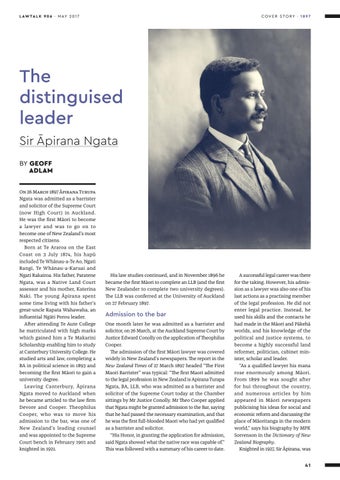
The distinguised leader Sir Āpirana Ngata BY GEOFF ADLAM On 26 March 1897 Āpirana Turupa Ngata was admitted as a barrister and solicitor of the Supreme Court (now High Court) in Auckland. He was the first Māori to become a lawyer and was to go on to become one of New Zealand’s most respected citizens. Born at Te Araroa on the East Coast on 3 July 1874, his hapū included Te Whānau-a-Te Ao, Ngati Rangi, Te Whānau-a-Karuai and Ngati Rakairoa. His father, Paratene Ngata, was a Native Land Court assessor and his mother, Katerina Naki. The young Āpirana spent some time living with his father’s great-uncle Rapata Wahawaha, an influential Ngāti Porou leader. After attending Te Aute College he matriculated with high marks which gained him a Te Makarini Scholarship enabling him to study at Canterbury University College. He studied arts and law, completing a BA in political science in 1893 and becoming the first Māori to gain a university degree. Leaving Canterbury, Āpirana Ngata moved to Auckland when he became articled to the law firm Devore and Cooper. Theophilus Cooper, who was to move his admission to the bar, was one of New Zealand’s leading counsel and was appointed to the Supreme Court bench in February 1901 and knighted in 1921.
His law studies continued, and in November 1896 he became the first Māori to complete an LLB (and the first New Zealander to complete two university degrees). The LLB was conferred at the University of Auckland on 27 February 1897.
Admission to the bar One month later he was admitted as a barrister and solicitor, on 26 March, at the Auckland Supreme Court by Justice Edward Conolly on the application of Theophilus Cooper. The admission of the first Māori lawyer was covered widely in New Zealand’s newspapers. The report in the New Zealand Times of 27 March 1897 headed “The First Maori Barrister” was typical: “The first Maori admitted to the legal profession in New Zealand is Apirana Turapa Ngata, BA, LLB, who was admitted as a barrister and solicitor of the Supreme Court today at the Chamber sittings by Mr Justice Conolly. Mr Theo Cooper applied that Ngata might be granted admission to the Bar, saying that he had passed the necessary examination, and that he was the first full-blooded Maori who had yet qualified as a barrister and solicitor. “His Honor, in granting the application for admission, said Ngata showed what the native race was capable of.” This was followed with a summary of his career to date.
A successful legal career was there for the taking. However, his admission as a lawyer was also one of his last actions as a practising member of the legal profession. He did not enter legal practice. Instead, he used his skills and the contacts he had made in the Māori and Pākehā worlds, and his knowledge of the political and justice systems, to become a highly successful land reformer, politician, cabinet minister, scholar and leader. “As a qualified lawyer his mana rose enormously among Māori. From 1899 he was sought after for hui throughout the country, and numerous articles by him appeared in Māori newspapers publicising his ideas for social and economic reform and discussing the place of Māoritanga in the modern world,” says his biography by MPK Sorrenson in the Dictionary of New Zealand Biography. Knighted in 1927, Sir Āpirana, was 41