STAFF PHOTO BY RENEE YANG, DESIGNED BY RACHEL BUIGAS-LOPEZ AND LAURA SHKOURATOFF
2
WASHINGTON SQUARE NEWS | MONDAY, MARCH 6, 2017 | NYUNEWS.COM
NYU Law Spearheads Dialogue on Inequality and Race By ARUSHI SAHAY Contributing Writer
NYU Law opened the Center on Race, Inequality and the Law on Feb. 27 to provide NYU community members a space to engage in discussions, lectures and panels and apply to scholarships related to race, inequality and leadership. As well as providing a physical space in NYU Law’s Wolf Hall, the center hosts programs including an annual lecture series named after late NYU professor and civil rights attorney Derrick Bell. Despite being an NYU Law initiative, the center will offer programming for both undergraduate and graduate students as well as faculty. The center eventually plans to expand by offering scholarships and fellowships while also focus on student leadership. Professor of Clinical Law Tony Thompson has been named the director for the new center, and he said that the support from
the NYU community has been overwhelming thus far. “In the 21 years I’ve been at this law school, we’ve seen the greatest outpouring of wanting to be involved,” Thompson said. “To give an example, from the launch event we had over 1,200 RSVPs. I have gotten literally hundreds of emails a day, and I have gotten dozens of phone calls from alums and students saying they want to find ways to get involved.” Thompson said that during his time as a law professor, he has noticed that the influence of race on secondary education has often been an afterthought. Thompson believes this center could have a national impact and affect the current dialogue around legal education. He feels it is important for students to take action in this political time. “I think that participation in the activities, volunteering [and] dialogue amongst themselves means there’s a range of things that students can do to
both to help the center itself, but most importantly to be well-versed in what the issues are and the challenges ahead,” Thompson said. “One of the most dangerous things we’re seeing is a new kind of insensitivity around issues of gender, race, ethnicity and equality and I think continuing in student forums and having dialogues [and] educating yourself is very very important at this point of time in our history.” CAS Dean Gabrielle Starr, who is a member of the university’s Equity, Diversity and Inclusion task force, said that Thompson’s work on equality is critical and that the center highlights the importance of justice at NYU. “Professor Thompson is a leading figure in work on equality,” Starr said. “His commitment to incarcerated individuals and their families has proven to help change the lives of many.” Starr also said that the center is indicative of the university’s position in local and national
Does the Bias Hotline Work? By OLIVIA ROOS Contributing Writer
Both students and coordinators believe that the Bias Response Line — created in fall 2016 by the Office of Equal Opportunity — still requires improvements to become an efficient and reliable service. According to its website, the Bias Response Line was created to provide a private and confidential tool through which members of the NYU community can report instances of discrimination, bias or harassment. Reports to the Bias Response Line are gathered and addressed by administrators in the Office of Equal Opportunity and then referred to the appropriate entity within the university. Community members can access the Bias Response Line by completing an online form on the BRL website, calling the office or by sending an email. However, if students chooses to call, they will be met with a message recording service and they can either leave a description of their complaint or make an appointment
to speak with someone in person. The Office of Equal Opportunity responds to requests within 24 hours of the next business day. Tera Nakata and Jamie MacFarlane are the case managers for the Office of Equal Opportunity. In a joint statement, they said that the Bias Response Line was created in response to complaints from the NYU community about the lack of options for reporting concerns on equity, diversity and inclusion issues. “After an investigation is completed, our office will make a determination as to whether or not the reported incidents constitute a violation of those policies,” Nakata and MacFarlane said. “If an individual is found to be in violation of a policy, the case is referred to other offices, as appropriate, for the administering of sanctions.” MacFarlane said that the current structure of referrals is in place because there is no onesize-fits-all answer for the reports that come to Bias Response Line. MacFarlane also said that Bias Response Line operates separately
STAFF PHOTO BY ANNA LETSON
The Bias Response Line is a phone service established in fall 2016 through which community members can confidentially report incidents of bias, discrimination or harassment.
from the Wellness Exchange and the Student Health Center but sometimes involves these entities in order to resolve specific issues. CAS junior Amanda Davis said that because NYU can be difficult to navigate at times, services like the Bias Response Line encourage students to file complaints when necessary. However, she thinks that the service has not been promoted as much as it should be. “I don’t see much promotional stuff about it,” Davis said. “And I would appreciate being able to talk to someone immediately after I make the call instead of having to wait 24 hours. I think they are doing a great job so far they just need time to really outfit a good procedure for the line.” Davis thinks that filing a complaint can be daunting and that the confusing process often keeps students from attempting to file it in the first place. But, she said that Bias Response Line is successful in easing the process, because it assures students that an expert is listening. MacFarlane said that Bias Response Line has received both favorable feedback, and suggestions on how to improve the process. MacFarlane also said the overall goal is for people to know that there is a single, effective point of contact to report instances of bias. “The [Bias Response Line] is in its pilot phase,” MacFarlane said. “We are addressing concerns on a case-by-case basis to determine what is the appropriate response or resolution, tracking our efforts, receiving feedback from our stakeholders and considering all the information gathered so we can do the best possible job on behalf of the NYU community.” Email Olivia Roos at news@nyunews.com.
STAFF PHOTO BY RENEE YANG
NYU School of Law opened the Center on Race, Inequality and the Law. This space allows students and faculty to openly discuss issues about race, inequality and leadership. leadership for justice. NYU Law junior Kayla Vinson said that the center is an important step forward for NYU’s law school, and the conversations the center will hold are timely ones. She thinks the importance of race and inequality is embedded in the American legal system and these biases must be remedied. “The law school curriculum
rarely elevates these issues to a level that reflects how pervasive they are in the law,” Vinson said. “That is why I think the center is so important. It will center race and inequality in its conversations and in its work. We can’t address the inequalities unless we face them head on.” Email Arushi Sahay at news@nyunews.com.
CRIME LOG
Feb. 25 to Feb. 28
By COCO WANG Deputy News Editor The NYU Department of Public Safety received four reports of larceny, one report of controlled substance and one report of motor vehicle theft between Feb. 25 and Feb. 28.
Larceny
On Feb. 26 at 2:30 a.m. Public Safety received a report from a student who said that their laptop was missing from a study lounge at Bobst Library. Police notification was declined. On Feb. 26 at 10 p.m. a student reported a bicycle missing from a bike rack on Broadway and Waverly Place. The incident is under investigation. On Feb. 27 at 11:02 a.m. a stu-
dent's cell phone was reported to be missing from the Basic Science building. Police notification was declined. On Feb. 28 at 5:35 p.m. a student’s backpack was reported to be missing from Weinstein Hall. A police report was filed.
Controlled Substance
On Feb. 26 at 11:30 p.m. Public Safety recovered a small amount of marijuana from a dorm room in Third North Residence Hall.
Motor Vehicle Theft
On Feb. 25 at 7:10 a.m. an employee’s car was reported as missing from near Meyer Hall. A police report was filed. Email Coco Wang at cwang@nyunews.com.
NYUNEWS.COM NYUNEWS.COM NYU NEWS.COM NYUNEWS.COM NYUNEW S.COM NYUNEWS.COM NYUNEWS.CO M NYUNEWS.COM NYUNEWS.COM NY NYUNEWS.COM NYUNEWS.COM NYU NEWS.COM NYUNEWS.COM NYUNEW S.COM NYUNEWS.COM NYUNEWS.CO M NYUNEWS.COM NYUNEWS.COM NY NYUNEWS.COMNYUNEWS.COM NYUNEWS.COM NYU NEWS.COM NYUNEWS.COM NYUNEW S.COM NYUNEWS.COM NYUNEWS.CO M NYUNEWS.COM NYUNEWS.COM NY
NYUNEWS.COM | MONDAY, MARCH 6, 2017 | WASHINGTON SQUARE NEWS
3
CAS Scholarship Aids Future Public Servants
By MONA CHEN Contributing Writer
NYU is offering students a public service by establishing the Marc and Ruti Bell Public Service Scholarship, which offers financial compensation to second- and third- year undergraduate students with financial need who plan to advance the public good post-graduation. According to the university, a maximum of 20 scholarship recipients will be selected annually. The number of students selected depends on how many qualify by the standards of the committee reviewing the applications. The committee, which will be comprised of representatives from all NYU undergraduate schools, will decide the specific amount awarded to each recipient – recipients can renew the award of up to $8,000 each year until graduation. CAS Assistant Dean for Students Joel Ward said the goal of the program is to offer additional financial assistance to students interested in pursuing a career in public service. It especially aims to help reduce the number of loans and overall debt for students in this career field. “So many NYU students are dedicated to applying the
knowledge and experiences they are gaining both inside and outside of the classroom to help solve the challenges society still faces,” Ward said. “We are all incredibly excited to be able to offer this additional financial assistance to our NYU undergraduates who have a passion and commitment to serving and advancing the public good.” GLS junior Juney Ha is contemplating pursuing a career in public service and said that she would definitely consider applying for the scholarship. Ha believes that it is vital to encourage dedicated public students who prioritize societal issues. “It’s encouraging to see such a large, private institution like NYU use their funds to promote a career in public service,” Ha said. “Public servants are dedicated to improving the standards of society and fixing the issues that are presented to us in a national context. Public service is a privilege and should be acknowledged as such.” Ha said that although any scholarship is a good use of money, she is enthused that this scholarship is both need-based and encourages a sometimes overlooked career path. Steinhardt junior Zaria Wat-
kins said she was very excited when she first heard about this scholarship — Watkins thinks students in large communities can often feel weighed down by a lack of money in their prospective industries, and this scholarship does a good job of resolving those concerns and empowering those students interested in taking a path less traveled. “The benefits of participating in service are innumerable and immeasurable,” Watkins said. “It is important to remember that we do not exist in a vacuum, and through service we have the power to improve ourselves, our school community and New York.” With the establishment of the Marc and Ruti Bell Public Service Scholarship, NYU students will have one more source of financial support for their service-centered endeavors and aspirations. LS freshman Amy Qi said that she is eager to apply for the scholarship next year. She also believes that student debt and financial burdens impede students’ flexibility in exploring careers and forces many to seek jobs in fields such as finance that are generally considered more lucrative. “I think careers in public ser-
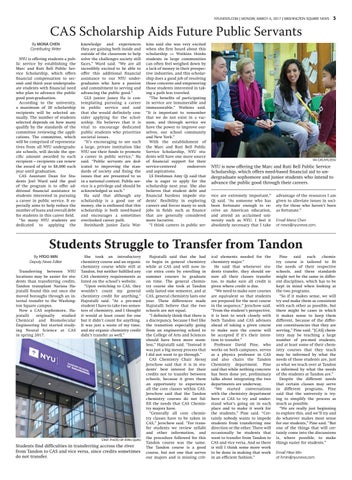
VIA CAS.NYU.EDU
NYU is now offering the Marc and Ruti Bell Public Service Scholarship, which offers need-based financial aid to undergraduate sophomore and junior students who intend to advance the public good through their careers. vice are extremely important,” Qi said. “As someone who has been fortunate enough to receive an American education, and attend an acclaimed university such as NYU, I feel it absolutely necessary that I take
advantage of the resources I am given to alleviate issues in society for those who haven’t been as fortunate.” Email Mona Chen at news@nyunews.com.
Students Struggle to Transfer from Tandon
By HTOO MIN Deputy News Editor
Transferring between NYU locations may be easier for students than transferring credits. Tandon transplant Narissa Hajratalli found this out once she moved boroughs through an internal transfer to the Washington Square campus. Now a CAS sophomore, Hajratalli originally studied Chemical and Biomolecular Engineering but started studying Neural Science at CAS in spring 2017.
She took an introductory chemistry course and an organic chemistry course while still at Tandon, but neither fulfilled any CAS chemistry requirements as listed on the school’s website. “Upon switching to CAS, they wouldn’t count my general chemistry credit for anything,” Hajratalli said. “As a pre-med student I have to take two semesters of chemistry, and I thought it would at least count for one but it didn’t count for anything. It was just a waste of my time, and my organic chemistry credit didn’t transfer as well.”
STAFF PHOTO BY RYAN QUAN
Students find difficulties in transferring accross the river from Tandon to CAS and vice versa, since credits sometimes do not transfer.
Hajratalli said that she had to begin in general chemistry while at CAS and will now incur extra costs by enrolling in summer courses to graduate on time. The general chemistry course she took at Tandon only lasted one semester, and at CAS, general chemistry lasts one year. These differences made Hajratalli believe that the two schools are not equal. “I definitely think that there is a discrepancy, because I feel like the transition especially going from an engineering school to the College of Arts and Sciences should have been more seamless,” Hajratalli said. “Instead it was just a big messy process that I did not want to go through.” CAS Chemistry Chair Alexej Jerschow said that it is in students’ best interest for their credits not to transfer between schools, because it gives them an opportunity to experience all the core classes within CAS. Jerschow said that the Tandon chemistry courses do not fulfill the needs that CAS Chemistry majors have. “Generally all core chemistry classes have to be taken in CAS,” Jerschow said. “For transfer students we review syllabi and other information, and the procedure followed for this Tandon course was the same. The Tandon course is a good course, but not one that serves our majors and is missing crit-
ical elements needed for the chemistry major.” He said that whenever students transfer, they should ensure all their classes transfer too, to make sure all credit is given where credit is due. “We need to make sure courses are equivalent so that students are prepared for the next course in the sequence,” Jerschow said. “From the student’s perspective, it is best to work closely with both Tandon and CAS advisors ahead of taking a given course to make sure the course will be accepted if it’s their intention to transfer.” Professor David Pine, who works on both campuses, serves as a physics professor in CAS and also chairs the Tandon Chemistry department. Pine said that while nothing concrete has been done yet, preliminary talks about integrating the two departments are underway. “We started conversations with the chemistry department here at CAS to try and understand what’s going on in each place and to make it work for the students,” Pine said. “Certainly nobody wants to impede students from transferring one direction or the other. There will occasionally be students that want to transfer from Tandon to CAS and vice versa. And so there is still I think some more work to be done in making that work in an efficient fashion.”
Pine said each chemistry course is tailored to fit the needs of their respective schools, and these standards might not be the same in different disciplines, which has to be kept in mind when looking at the two programs. “So if it makes sense, we will try and make them as consistent with each other as possible, but there might be cases in which it makes sense to keep them different, because of the different constituencies that they are serving,” Pine said. “[CAS] chemistry may be teaching a large number of pre-med students, and at least some of their chemistry courses that they teach may be informed by what the needs of those students are, just as what we teach over at Tandon is informed by what the needs of the students at Tandon are.” Despite the different needs that certain classes may serve in different programs, Pine said that the university is trying to simplify the process as much as possible. “We are really just beginning to explore this, and we’ll try and do whatever makes most sense for our students,” Pine said. “But one of the things that will certainly come into the discussions is, where possible, to make things easier for students.” Email Htoo Min at hmin@nyunews.com.
4
WASHINGTON SQUARE NEWS | MONDAY, MARCH 6, 2017 | NYUNEWS.COM
ARTS
EDITED BY HAILEY NUTHALS ARTS@NYUNEWS.COM
Getting ‘Complicated’ with NYU’s The Misters
By HAILEY NUTHALS Arts Editor
If ever there were an apt name for a debut EP, The Misters’ “Complicated People” hits the nail on the head. After three years and as many lineups, the group of NYU students and New York musicians is releasing its first body of work this Thursday, March 9. The band was born in Steinhardt junior, frontman and lyricist Michael Nitting’s dorm room in Third North Residence Hall during his freshman year with friends — and now Steinhardt juniors — Greg Jakubik, Noah Hadland and Sebastian Zel. These days, Nitting is the last remaining member of the original lineup, and is joined by Steinhardt freshman Todd Martin, Steinhardt junior Jim White and Chris Rivera. The lads were quickly able to book shows throughout New York’s boroughs, playing everywhere from TKTK sessions with Washington Square News to Halloween costume parties at the Bushwick Public House — their charisma and energy were unstoppable. Despite the fact that the band is now on its
third separate lineup of members, Nitting said that The Misters have kept their essential sound coherent throughout external changes. “It’s been sort of interesting to see how the sound has shaped through three different lineups — from the original one to the second one to what we are currently,” Nitting said. “Predominantly, it’s the same music that we’re playing. They’re playing the same notes, just in their own peculiar styles.” The Misters’ EP is a compilation of songs that Nitting has written over the past five years. “Trip,” their first official single, was written during Nitting’s senior year of high school, but their latest single “GSP” was penned last spring. Although there might seem to be little connection between such chronologically disparate songs, Nitting said that the EP was essentially an exploration of its title within the context of his own life. “It’s sort of my realization that I myself am a complicated person, which sort of took me a little while to recognize,” Nitting said. “But also, each song is pretty heavily associ-
ated with one or two complicated people that I’ve interacted with in my life.” Part of the complexity is merely existing as a musician within New York and NYU specifically. In such a huge city known for its thriving music scene, Nitting noted that it’s easy to become intimidated by the prospect of becoming just a guitarist on a stage in front of an audience of other nobodies. “I can get very overwhelmed by the accomplishments of the people that I’m friends with, or just see people that are making it or just about to break the cusp,” Nitting said. “It’s frustrating, because we’re always wondering what’s the equation to get big or get signed and get your music out to as many people as possible and I have to constantly remind myself that there isn’t an equation. And that can be really hard. Everyone has a specific experience, so I’m just trying to figure out what ours is.” Read the full interview with Nitting online at www.nyunews.com. Email Hailey Nuthals at arts@nyunews.com.
PHOTO BY HAILEY NUTHALS
Michael Nitting, frontman and lyricist of The Misters, performed with the band’s original lineup at a 2016 concert during the Knitting Factory.
‘Raw’ Gnaws Through Expectations of Female Sexuality
By SYDNEY RAPPIS Staff Writer The story of a girl’s coming of age through sexual and intellectual exploration paired with the strange desire for raw meat could have easily fallen into the campy, B-list horror genre like the many cannibal films that preceded it. But French filmmaker Julia Ducournau’s “Raw” chooses a different route. While the consumption of human flesh is a ma-
jor aspect of the film, Ducournau honors the gory endeavor with style and pacing that induces stress rather than pure horror. The film begins with a middle-aged couple dropping off their innocent — and ill-prepared — daughter Justine (Garance Marillier) on her first day of veterinary school. In what would have been a banal and commonplace segment in any other film, this scene indicates
none of the unapologetic gore that soon follows. It does, however, establish the narrative tone, through which every scene in the movie — including awkward first meetings between roommates and traumatic university hazing rituals — is beautiful to look at, designed to heighten the viewer’s awareness of human bodies and the fleshy sinew that binds them together. With a small cast, “Raw” relies
COURTESY OF CINETIC MEDIA
Garance Marillier plays Justine in “Raw,” the visceral winner of the 2016 Cannes Film Festival’s FIPRESCI Critics Prize.
ARTS CLASSIFIEDS
heavily on its actors to handle the absurd plot. Marillier’s stunning performance is steeped in subtlety, something difficult to achieve given the sensational subject matter. Justine is juxtaposed with her older sister (Ella Rumpf ), who studies at the same school, and embodies the role with equal finesse. From the moment Justine steps onto campus, any social expectations she had are thrown out the window. Her parents are no help to her, her sister treats her worse than the upperclassmen do and she has no one with whom to discuss her newfound desire for raw meat after being forced to eat a rabbit kidney in a hazing ritual. The film’s absurdity is not found in a woman discovering she has an appetite for flesh, but in the disorienting environment she is forced to navigate before she can begin to understand what is happening to her. She nervously chews on her hair, eventually running to the bathroom to vomit. Like a disturbing circus act, she gags up handful after handful of hair. On the surface, this film is about
cannibalism and unrestrained female desire. But scenes where girls are so anxious that they chew on their hair despite physical repercussions is anything but absurd — in fact, it’s painfully real. Using a hyperbolic social taboo, Ducournau addresses issues surrounding female sexuality and communication. If women were encouraged — or at the very least, allowed — to express questions or concerns surrounding desire and sexuality, perhaps they wouldn’t be resorting to eating hair and pinky fingers. Instead, Justine’s unnatural desire is suppressed, causing disastrous results for the characters. While many concealed desires aren’t as taboo as eating flesh, one wonders if men are only allowed to express nontraditional preferences when they are billionaires and named Mr. Grey. It seems like men get a pleasure room, while women are murderers. “Raw” will open in theaters on Friday, March 10. Email Sydney Rappis at film@nyunews.com.
Are you an artist looking for someone to collaborate with? A musician seeking a gig accompanist, a director seeking actors, an actor seeking a headshot photographer, or anything you might want a fellow student’s help with? You can list yourself in WSN’s weekly Arts Classified section and get your name out to the NYU community.
Send your name, NYU email address, and a brief description of what you’re looking for to the Arts Editor at arts@nyunews.com.
NYUNEWS.COM | MONDAY, MARCH 6, 2017 | WASHINGTON SQUARE NEWS
ARTS
EDITED BY HAILEY NUTHALS ARTS@NYUNEWS.COM
Responses to the Election at Kimmel By ANASTASIYA SHELEST Contributing Writer
Since the election of President Donald Trump last November, the art world has been in turmoil about how to react. But mixed-medium artist Andrea Arroyo didn’t wallow in despair. She quickly turned to her community for support and called upon professional and amateur artists to share their feelings about the election results through artistic expression. That turned into her “Unnatural Election: Artists Respond to the 2016 U.S. Presidential Election” collection, which is now on display in the eighth floor of Kimmel. This project currently includes more than 250 works by 200 different artists from around the world. “When I started, I thought, if I get 20 or 30 pieces I may actually do an exhibition of original work,” Arroyo said. But she quickly surpassed her goal as works poured in, and Arroyo had to reevaluate her original plans for the project. Arroyo initially intended only to accept submissions between the
PHOTO BY ANASTASIYA SHELEST
Andrea Arroyo, the curator of the “Unnatural Election” exhibit.
presidential election and inauguration day, but overwhelming interest in the project encouraged her to keep accepting them through May 16. Arroyo decided to create a website to archive the images and provide viewers with additional information. “The more work I started to get, the more I realized that I need to do what is manageable for me, because I’m doing it by myself,” Arroyo said. “[That way] I can keep it as an ongoing project.” Accessibility is what makes the online forum so important. The physical works, which will be displayed at Kimmel through May, are only a small portion of this growing project. The website includes not only photographs and illustrations of submissions but also performance art, music and poetry. Arroyo describes “Unnatural Election” as an ever-expanding tapestry of expression surrounding the election. This perfectly describes the arrangement of the works at Kimmel, which are printed on uniform rectangular sheets and arranged in columns of four along the walls. Since a good number of works in this project come from a place of raw, untempered emotion, the positioning of more level-headed pieces next to more emotional ones makes the exhibit easier to digest. The most affecting pieces are what Arroyo calls trauma work. The response to the election was immediate and the devastation translated tangibly into those submissions. “The first week, most of the work was [trauma work],” Arroyo said. “A lot of
images with swastikas, references to fascism and Nazis and so on.” Arroyo confronts the trauma work head-on, and ultimately only has two criteria for the works. The first criterion is whether the art is true to the artist. She wants to be sure that the art is made in the voice of the artist, not just a representation of a broader population. The second criterion is whether the art itself is quality content. “Is it good art?” Arroyo asked. “Meaning, does it communicate something? Does it move something?” Although the exhibit encourages free expression, Arroyo also made sure to include some restrictions. “I did reject many works that were just offensive, that only made fun of the physical attributes of the President and his wife,” Arroyo said. “The piece can use the physical attributes of a person, but only if it’s making a point that is deeper.” Some of the trauma work Arroyo came across forced her to reevaluate the idea of art. “Sometimes when I got an image that was very strong, I got upset because it was frankly quite upsetting,” Arroyo said. “But then I realized that it was doing its job. Art is supposed to touch you and move you in different ways.” “Unnatural Election” is on view on at the Kimmel Galleries on the eighth floor of the Kimmel Center through May 2017 and online. Email Anastasia Shelest at entertainment@nyunews.com.
‘Queen’ Shows Youth Response to Illness By ANNALUZ CABRERA Staff Writer
Stigmatization of illnesses, particularly vicious, chronic ones like cancer can lead to silence and neglect from the family and friends of those afflicted. But treating chronic illnesses as a taboo subject can lead to isolation for the affected. The NYU Steinhardt Program in Educational Theater’s production of “Two Weeks with the Queen” opened on Feb. 24 at the Provincetown Playhouse and discussed the ramifications of this stigmatization. In this coming-of-age story, the protagonist Colin Mudford learns that cancer doesn’t just affect the person with the diagnosis. “Two Weeks with the Queen” is a heartwarming and comedic play. It reminds audiences that those who are ill are the ones who need the most love, care and attention. In the play, which began in Australia, Colin, played by master’s student Megan Crosby, learns that his brother Luke (freshman Eric Gelb) has cancer and a short expected lifespan. Hoping to spare Colin the grief of watching his brother die — and to avoid his innocent but inappropriate comments — his parents ship him off to live with an aunt and uncle in England. In England, Colin shocks his relatives with his frequent use of the word “cancer.” Meanwhile, his cousin Alistair (also played by Gelb) gawks at Colin’s confidence and will-
ingness to break the rules. While the pair discuss the subject of helicopter parents, Alistair learns to overcome his fears and stand up for himself. Together, they get into a mess of trouble while trying to get in contact with the queen’s doctor — who Colin is convinced is his brother Luke’s last chance of survival. Although the play was initially slow in pacing, Crosby’s vigor transported the audience through Colin’s exciting two-week stay in England. A truly charismatic performer, Crosby won the audience’s heart while acting like an overly energetic kid who admittedly could be a brat. Crosby’s genuine anger and laughter made her character’s plight intensely emotional. Master’s candidates Maggie Bussard and Brendan Chambers played Colin’s parents and relatives, among other roles. Cheryl Brumley and Shannon Stoddard, both also master’s candidates, filled out numerous roles as well, but they most significantly portrayed a gay couple coping with one partner’s diagnoses of AIDS and cancer. The actors’ energy was captivating, and their quick transitions from Australian to British accents were impressive. Most importantly, they evoked empathy while keeping the play light in spite of its dark subject matter. Gelb was an audience favorite. His quirky gestures, convincingly frustrated facial expressions and plucky
sidekick personality drew bursts of laughter from the audience. With such a dialogue-rich, humorous and emotional performance, a static set might have worked better, and set changes in such an intimate space were somewhat distracting. Nevertheless, it was the actors’ energy — and not so much the props — that truly drove the performance. The play was successful and the surprise finale dance number left a memorable impression. Email Annaluz Cabrera at theater@nyunews.com.
COURTESY OF NYU STEINHARDT
“Two Weeks with the Queen,” ran from Feb. 24 to March 5. The play was about the effects cancer can have on people outside the patient themselves.
5
PHOTO BY CASSIE CUI
Tisch sophomore Adrian Martens also known as Dasychira, sat down with WSN to discuss music, travel and identity.
No Sacrifices with Dasychira By CONNOR GATESMAN Contributing Writer
Electronic musician, insect aficionado and current sophomore at Tisch’s Clive Davis Institute of Recorded Music, Adrian Martens — better known by his stage name Dasychira — sat down with WSN to discuss his new EP, “Immolated.” A native of Johannesburg, South Africa, Martens explained how world travel and his identity have shaped his music. Washington Square News: How long have you been making music? Dasychira: I’ve been making music since I was about 15, but I only got more serious about it after I moved to New York about two years ago and started working under the name Dasychira. WSN: What makes this project meaningful to you? D: With this project, especially with the record that I put out, I wanted to explore my identity through the lens of an insect as a metaphor for the journey I’ve been through. I pulled inspiration from growing up in Johannesburg, moving here, and moving around [to] so many different places of the world, and how that affects my identity, and my music too. Arguably, my music is my identity. At least that’s what I strive for. WSN: What does the word “immolated” mean to you? D: I came across the word a little while ago while reading a poem. I looked it up and the word meant “to sacrifice by burning.” Although in the context of this EP, I wanted “Immolated” to be more of an offering of myself than a sacrifice, sharing this part of my identity that I could communicate sonically. I wanted it to be as upfront as possible, so that I was vulnerable to my musical process, sacrificing all comfort, all complacency. WSN: Did you use samples on this EP, or is it all your recordings? D: It’s definitely a bit of both. I love using found sound recordings, but I think there’s such a cool, processed vibe to samples from existing songs. One of my favorite samples to work with for this record was the sound of a seal barking, one of those Northern California elephant seals. You can hear that sample in the beginning of the song “Vipera,” which I made with my friend Embaci. That sample was just so much fun to use, because I had no idea how it would work in the context of the track. But once I started warping it, it ended up being a really powerful rhythmic device. WSN: How would you describe this EP’s aesthetic? D: I wanted it to sound alive but also dead inside, being pulled apart and reborn again. I was trying to follow the cycle of an insect. Throughout the track listing, I wanted it to sound like an insect that is on the verge of dying, being dissected, dying, and its reincarnation. In terms of texture, I wanted the EP to sound like it was breathing and full of feeling and emotion. That was the most important thing to me, to convey my interpretation of an insect’s emotional experience. Email Connor Gatesman at music@nyunews.com.
6
WASHINGTON SQUARE NEWS | MONDAY, MARCH 6, 2017 | NYUNEWS.COM
FEATURES
EDITED BY TAYLOR NICOLE ROGERS FEATURES@NYUNEWS.COM
Are Tequila Benefits Fact or Fiction? By DREW LEDERMAN Contributing Writer
Editor’s Note: WSN does not condone underage drinking. Please drink responsibly and legally. When trying to lead a healthy lifestyle, most nutritionists and doctors recommend reducing or eliminating alcohol from your diet. But recent scientific evidence has shown that agave, the plant from which tequila is made, may aid in weight loss, as well as lowering cholesterol, blood pressure and blood sugar This drink also fights off the common cold, makes bones stronger and breaks down fats. Moderate alcohol consumption, typically around one drink per day, can marginally increase good cholesterol and extend life expectancy. Since the 1030s, tequila has been consumed to help cure the common cold, with an elixir that is a combination of tequila blanco — the purest version of the spirit — agave nectar and lime juice. The recent buzz about tequila has cited agavins, the natural sugars from the agave plant used in tequila, as the reason for these health benefits. According to Mercedes G. López, a researcher at the Centro de Investigación y de Estudios Avanzados, Biotechnology and Biochemistry Irapuato, agavins cannot be digested nor absorbed. This allows them to act as a dietary fiber,without elevating blood glucose, which is important for those suffering from diabetes. Agavins also increase the body’s concentration of GLP-1, the peptide that makes you feel fuller for longer, as the digestion process is slowed. This curbs the appetite and
can therefore help weight loss. However the sugary mixes we add to tequila make it bad for our bodies. And similarly to any other alcohol: too much of this good liquid can prove disastrous to your liver. Another important thing to note is that tequila doesn’t give you a hangover. Naysayers and spring break survivors are rolling their eyes, but scientists and mixologists alike assert its validity. Due to their lack of absorption by the body, the agavins in the drink leave you free of headaches and other side effects caused by artificial sweeteners. Tequila naturally has no sugar or carbs. As long as the bottle says 100 percent agave and hasn’t had anything else added to it, purified tequila is a completely gluten-free spirit that cuts down on bloating. We all wish that the vices of life were truly benefitting our health, yet, sadly, they aren’t. Although its effects do not live up to the current hype, tequila is still a better drink option due its absence of sugar and carbs and lack of hangovers and bloating. Email Drew Lederman at dining@nyunews.com
VIA FLICKR.COM
Tequila can extend life expectancy, induce weight loss and even cure the common cold.
NYU Republicans Not Monolithic By ALYSSA KELLY Contributing Writer
Considering the nation’s divisive political climate, it’s no surprise that NYU’s own ideological quarrels highlight disputes between much of the student body and campus conservatives. As a minority among the student body, Republican students' views are often overshadowed by NYU’s left-leaning culture and are not well-known outside of the NYU College Republicans meetings. With the White House on their side, NYU Trump supporters have a powerful ally despite being outnumbered on campus. Although she isn’t completely on board with all of Trump’s policy ideas, LS freshman Audrey Cunningham voted for Trump due to a lack of options. “I respect that he is doing the things he promised on the campaign trail, because that’s not something we see a lot from politicians,” Cunningham said. “Do I agree with all of those things? Not necessarily.” Although NYU's Trump supporters might not support all of his actions, they voted to Make America Great Again for him for various reasons. Cunningham and LS freshman Bennett Kaufman cite taxes and jobs, while Tisch senior Jack Joseph supports Trump for ideological reasons. Within Trump's first 40 days, his actions have already caused concern among liberal and conservative students alike. Kaufman has some reservations about Trump’s first power moves in office. “I think there’s been some things that he’s done well,” Kaufman said. “I mean he’s been trying to
follow up on his campaign promises, but there have been some things that haven’t gone well, like the travel ban, and he’s said some dumb things, which isn’t exactly what I wanted to see.” NYU’s generally antagonistic attitude toward the current administration has prompted some Republican students to feel defensive of their political beliefs. Joseph believes that many of NYU’s liberal students will eventually shift their political allegiances. “The way I see it, these students, they’re going through a phase, they’re going to grow out of it in a few years,” Joseph said. “And this whole fighting fascists or what they perceive to be fascism, it’s fashion to them. It’s LARPing. They want to fight the
“
This whole fighting fascists or what [liberal students] perceive to be fascism, it’s fashion to them. JACK JOSEPH
”
mythical dragon or the Nazis that don’t exist.” On the other hand, Cunningham believes these challenges to her political ideology have led her to take an academic approach to political discussions. “I feel like I need to be more socially aware and politically
NYU’s Cloudy Water Sparkles By KATE HOLLAND Contributing Writer
GRAPHIC BY EMILY FONG
NYC tap water is world-renowned for its quality and freshness, ranking among the most pristine drinking water in the world. However, some students who are new to the big city are skeptical of tap water, because it can come out of the faucets looking cloudy. But is what we see really what we’re getting? Like many students, CAS freshman Vinnie Zhang has made a habit of filtering her tap water through a Brita filter. “I feel like without filtering it, the water wouldn’t be clean enough to drink,” Zhang said. “Sometimes it comes out of the tap looking cloudy.” Reports of cloudy tap water are common in many NYU buildings; however, the murkiness is not indicative of the water’s quality. The cloudiness is a result of tiny air bubbles suspended in the water caused by the dramatic shift in pressure from the pipes to the cup. In fact, New York City is one of only five major cities in the United States
that does not require filtration as a form of treatment, according to the 2015 New York City Drinking Water Supply and Quality Report. New York City has one of the most extensive municipal water systems in the world, providing one billion gallons of drinking water every day to millions of New York City residents, including Tisch freshman Mickey Galvin. “I think the water from the tap in Manhattan tastes better than any water I’ve ever had in my life,” Galvin said. “I think it tastes just as good as bottled water.” Climate change has also had a significant impact on water quality in the past decade. Fluctuating precipitation patterns, fauna health and rising temperatures all affect the quality and availability of water. However, these concerns are not what drive LS freshman Carmen Colosi to filter her water. “I filter my water just because I always have,” Colosi said. “I’m used to dealing with drought conditions, so I’m just thankful I can
GRAPHIC BY EASTON SELF
Being a Republican at NYU can be difficult among a sea of liberals. aware to be able to back up my views,” Cunningham said. “Everyone should.” As inclusive as NYU is, she believes this election seems to have marginalized Republicans on campus. “We are a school that should embrace diversity, but I feel like when that comes to political views, that’s not the case at all,” Cunningham said. Joseph, Cunningham, and Kaufman all identified different issues as their highest political concerns. Their varying priorities testify to the range of conservative views on campus. As the Trump administration embarks on what will surely be a bold tenure, the on campus minority of students that support him find themselves in a prominent position despite their small numbers. Only time will tell what lasting impression this administration and their supporters will have on NYU’s campus. Email Alyssa Kelly at features@nyunews.com.
take long showers.” Among the many benefits of living in Manhattan, the clean tap water is one of them. The NYU Community should be aware of the amount of work behind our clean water and work with NYU to conserve as much of it as possible. The world is currently experiencing a global water crisis. Water is quickly becoming the world’s hottest commodity as populations rise and our consumption increases exponentially, depleting bodies of water without allowing time for natural replacement to occur. NYU’s student body is among the most actively liberal in the nation, leading the way in numerous social movements. Among its other passions, NYU should not forgot to preserve its most precious and coveted resource: tap water. Read the full version at nyunews.com. Email Kate Holland at features@nyunews.com.
NYUNEWS.COM | MONDAY, MARCH 6, 2017 | WASHINGTON SQUARE NEWS
FEATURES
EDITED BY TAYLOR NICOLE ROGERS FEATURES@NYUNEWS.COM
By ANASTASIYA SHELEST Contributing Writer While the athleisure trend has won over the fashion world, we’ve only just begun to see that aesthetic reflected in the beauty industry. Athleisure, for those not yet seduced by its stylish fitness wear, is a look designed to seamlessly transition from the gym to the outside world. Applied to cosmetics, this trend encourages the use of makeup while exercising. And while we all know that this is a breakout waiting to happen, many popular brands are hopping on the bandwagon to offer healthy — or at least minimally damaging — alternatives to traditional makeup. Here are a few options for anyone seeking to try the look.
Too Faced Better Than Sex Waterproof Mascara, $17
Runny mascara is the worst, and this waterproof version of Too
7
Athleisure Beauty Product Guide
Faced’s best-selling Better Than Sex Mascara delivers results. It provides a dramatic increase in lash length and volume, without smearing or running even during the toughest workouts.
NUDESTIX Intense Matte Lip + Cheek Pencil
The NUDESTIX brand is known for its “barely-there” makeup aesthetic. The Intense Matte Lip and Cheek Pencil is perfect for the athleisure lifestyle, because it does double duty — you can apply it as a lipstick or blush — and avoids the overdone makeup look by subtly enhancing your features. It’s currently available in 12 colors to compliment every skin tone.
Perricone MD No Makeup Makeup Bundle, $110
Practically every product from the Perricone MD brand screams athleisure. All its products are created as skincare first and makeup second. This bundle, which in-
cludes the No Foundation Foundation, the No Bronzer Bronzer, the No Lipstick Lipstick and the No Mascara Mascara, functions as a complete makeup regimen. All the products include SPF protection as well as avitamin C booster, and they’re made without parabens, sulfates or phthalates. The bundle will keep skin looking healthy throughout a workout and the rest of the day.
Drunk Elephant Skin Fit Kit, $25
The Skin Fit Kit from Drunk Elephant takes athleisure in a simpler skincare direction. The kit includes its Umbra Sheer Physical Defense sunscreen in SPF 30, B Hydra Intensive Hydrating Gel and Lippe volumizing lip balm. This kit is perfect for anyone in the market for a luxurious product without the fear of smudged pigment during a session on the elliptical.
MILK MAKEUP Headliner Makeup Set, $25
The
MILK
Gallatin Fashion Artists Strut Their Design Stuff
STAFF PHOTO BY POLINA BUCHAK
Gallatin hosted its seventh annual Gallatin Fashion Show this past Thursday, By THOMAS CHOU Contributing Writer This past Thursday, the Gallatin School of Individualized Study celebrated its seventh annual Gallatin Fashion Show, one of the school’s signature events. Following the school's interdisciplinary nature, the theme of this year's show was “emPOWERed,” and asked designers to create mini-collections inspired by power and strength. The show featured 10 designers, and a faculty member displaying her class’ designs – all of whom are current Gallatin students or recent alums. Every designer introduced their unique capsule collection to the audience before the looks came down the runway. With collections inspired by a variety of elements – from superheros to endangered animal species – the runway show captured each students's unique artistic direction. Standout collections included one by Gallatin alum Rachel Wang, titled “Dreamscape," a story based on the concept of a “girl’s futile escape from danger,” showing the evolution of the dream with each look. Wang utilized an eye-catching, embroidered eyeball motif, placing it on beanie hats and throughout the garments, adding an interesting design element to her oversized work shirts. Wang’s craftsmanship further shone
in the detailing of her pieces. With a unique take on a bomber jacket, the construction of the piece added shape and form to the look, while the flared, faux-fur sleeves added a sophisticated drama to an otherwise simplistic collection. Gallatin freshman Sophia Merlino debuted her first mini-collection titled “House of Power.” A collection of lingerie and loungewear, Merlino was inspired by “the strength and beauty in every woman." Her pieces, almost entirely made of silk, consisted of a primarily neutral color scheme. Merlino utilized flowy fabrics and loose silhouettes that created movement down the runway, culminating in pieces like a stunning pair of what appeared to be silk-chiffon, army green/gray pants with slits from the ankle all the way up to the hip. Merlino’s collection balanced sensuality with power. Selly Djap, also a freshman, debuted her collection “Polarity.” Inspired by experiences growing up in Indonesia and living by the ocean, Djap’s collection featured “the diverse, salient qualities of the underwater world.” Her work was an incredible demonstration of detailed beading and a meshing of different textiles. The collection was dreamy but did not consist of only flowy, ethereal-style pieces. One standout was a red dress featuring a structured bust with an overlaid lace on the bottom hem. The quality of her craftsmanship demonstrated her ability to follow her vision through to completion while upholding a high standard of quality. Djap’s collection was tightly edited and sleek, and it was an exciting preview of all she has to offer as a young designer. Other designers who exhibited their collections included Ryan Andrewsen, Delaney Beem, Shayna Feuer, Victor Leonard, Victoria Robichaud, Carson Stern, Em Watson and faculty member Louise Harpman. View the full gallery of their work and the Gallatin Fashion Show online at nyunews.com. Email Thomas Chou at bstyle@nyunews.com.
MAKEUP
brand
STAFF PHOTO BY TAYLER MACMILLAN
Athleisure is the trend of wearing clothing and beauty products adaptable for the gym and the outside world. Beauty companies further embrace this trend with travel-sized products. is one of the hottest brands around because of its modern aesthetic, simple color scheme and light-wear formula. This kit features four mini-sized popular products that are perfect for a gym makeup bag: the mini Ubama Mascara in Inked, the Lip Color in Dip Out, the Micellar Water Makeup Remover
Wipes and its star product, the Cooling Water. With a freshfaced approach to traditional makeup, the Headliner Makeup Set offers new essentials for transitioning from a workout to your workday. Email Anastasiya Shelest at bstyle@nyunews.com.
How to Eat Eggs Throughout Your Day By YASMIN GULEC Dining Editor
Containing zero carbs and no sugar while providing the cheapest source of high quality protein, eggs are a nutritional powerhouse and a great addition to any meal. Here are some ways you can incorporate them into your diet.
Eggs on the Go
For an easy grab-and-go, try making eggs in a jar. Cut four bacon slices into small chunks and cook for seven minutes until brown and crispy. Add half a pound of thinly sliced button mushrooms and two minced green onions and cook for another three minutes. Add one teaspoon of almond flour, half a cup of chicken or vegetable stock and two teaspoons of lemon juice. Bring to a boil and cook until a constant texture. Rub some cooking fat on the bottom and inside edges of four mason jars. Pour the bacon and mushroom mixture in each jar and break two eggs on top of each one. Season with sea salt and freshly ground black pepper to taste. Place the four jars into a big pot and add water until the water level reaches the middle of the jars. Bring to a medium-high heat until the eggs are cooked the way you like them. Remove the glass jars from the pot, and sprinkle some chives on top.
Eggs in the Dining Hall
Get fried eggs from the grill, and then get a biscuit from the bakery section and cut it in half. Place the fried egg, some bacon and potatoes into the biscuit. Drizzle some maple syrup or sriracha sauce on top for a zesty breakfast sandwich.
Eggs for Lunch
To make a delicious egg-in-a-hole sandwich, cut out a circle in the middle of a slice of bread. In a large skillet, heat oil over medium heat and cook the bread slice until lightly toasted. Flip and crack an egg into the hole of the bread slice. Season with salt and pepper and cook for three minutes. Toast another slice of bread for the base, and put some feta cheese, spinach and bacon inside the sandwich.
Eggs for Dessert
Pavlova is a meringue-based dessert that is light and delicious. Preheat the oven to 300 degrees Fahrenheit. Mark a 9-inch circle on a baking paper sheet and place on an oven tray. Crack four egg whites in a bowl, and whisk until stiff peaks form. Gradually add 250 grams of caster sugar and beat continuously until the mixture is smooth and stands up in peaks. Beat in one teaspoon of vanilla extract, one teaspoon of white vinegar and two teaspoons of cornflour. Spoon the mixture onto the circle you made on the baking paper. Bake in the oven for 60 75 minutes — until lightly golden, hard on the edges and soft in the middle. Turn off the heat, and leave it in the oven the oven until cold. Decorate the meringue with freshly whipped cream, chopped fresh fruit and mint leaves as you wish. Email Yasmin Gulec at ygulec@nyunews.com
Eggs for Breakfast
For a healthy and delicious start to the day, hard-boil an egg. Drizzle olive oil on both sides of a bread slice and toast it. The olive oil will give the bread a caramelized texture and a smokey taste. Mash the hardboiled egg with a slice of feta cheese and half an avocado — like you are making mashed potatoes. Sprinkle on some salt, pepper and cumin. Add a teaspoon of pesto sauce to your mashed mixture. Afterwards, put the mixture on the toast and drizzle olive oil on top.
STAFF PHOTO BY JULIA SALIBA
There are many creative ways to cook an egg besides the typical scrambled eggs with toast.
By JEMIMA MCEVOY News Editor
“
I guess one difference I’ve seen between Mumbai and New York is that people are nicer here, much to the contrary of what I was expecting. PURAV SHAH
” By PARIS MARTINEAU Abroad Editor As members of a global university, NYU students often spend their time beyond the confines of the Washington Square campus. With sites in over 14 locations around the world — ranging from Abu Dhabi to Berlin — it’s no surprise that over 3000 undergraduates choose to study away from their home campus each year. But this transition from one country to another can be overwhelming for many. There are countless cultural differences to adjust to, possible language barriers to overcome and — on top of all that — classes to attend. WSN talked with some NYU students who are currently studying abroad about their personal experiences with culture shock. Here are their thoughts.
On my first day of high school in Chicago IL., the girl sitting next to me in English class announced with a booming voice and American accent that she liked my pants. I was momentarily alarmed. “She can see my pants?” I thought. I looked down at my denim-cloaked legs and felt my heart rate decrease exponentially, but I was still confused. It was only later that day I realized the reason for this misunderstanding. Having moved from the U.K. only weeks beforehand, I was used to pants being called trousers and underwear being called pants. I was lucky that my transition issues were limited to small miscommunications, but other international students face a larger gap between cultures. LS freshman Nikki Glucksman moved from Thailand to New York when she started attending NYU, and she said that although the transition of moving to another country was lessened by her experience at an international high school in Bangkok, she sometimes finds the differences between Bangkok and New York challenging. Glucksman said the language barrier was not an issue, because she learned both English and Mandarin, but she still found it tough to relate with people on certain topics. “Growing up in Bangkok, a bunch of my friends were from all around the world — some friends were from England and Sweden, and of course some friends from America,” Glucksman said. “But coming here, I realized that a lot of my friends are American, or if they are Asian they were born and raised in America. So I think it’s just different, and so it’s harder for me in
Email Paris Martineau at pmartineau@nyunews.com.
I thought Sydney would be very similar, however, the people and way of life [are] different. They are very slow paced, chill — almost too chill since the buses never seem to be in a rush! I expected it to be very beach-y, but it has proven to be like New York in many ways: in terms of how the people carry themselves, how they dress and how they embrace diversity. So overall, the transition’s been easy, and going through it with other peers makes it even easier. I’ve also kept in touch with a lot of my friends, as many of them have gone away this semester. JAMES TRANOS, CAS sophomore, NYU Sydney
a way to talk about certain things because they wouldn’t necessarily understand it.” Glucksman said that differences between the countries make it difficult for her to discuss food and even party culture. She said New Yorkers talk about Wendy’s and Taco Bell, while people at home usually ate homemade food and authentic dishes, so at fist she could not actively participate in conversations on this subject. Tandon freshman Purav Shah also said that one of the biggest differences between New York and his home in Mumbai is the food. But aside from less flavorful dishes, Shah said that there weren’t as many differences between the two cultures as he had anticipated. However, Shah said he was pleasantly surprised that New Yorkers were kinder than he expected. “I was told that people over here don’t have time to talk to anyone, because in New York everyone always had to get somewhere,” Shah said. “I guess one difference I’ve seen between Mumbai and New York is that people are nicer here, much to the contrary of what I was expecting. Obviously that does not include the few people who have been kind of racist toward me, but in general, people are much nicer.” Whether you miss the spices from back home, the sense of humor of the people around you or simply feel as though New York City doesn’t have your back, it’s important to remember that culture shock is temporary. Although you may feel as though people can see your underpants, they could just be giving you a genuine compliment. Email Jemima McEvoy at jmcevoy@nyunews.com.
The French have a very different sense of time from New Yorkers. We hoard our time and only give it to people and activities that we think are absolutely worthy. In addition, we want every little thing on command. But here, businesses and even bars close earlier than I’m used to as a New Yorker, and honestly that “time change” was harder to adapt to than the literal time change from crossing the Atlantic. In dating culture, guys are very persistent I think, like guys on Tinder will chew you out if you don’t reply within an hour or so and ask why you hate them. Also, several guys I’ve talked to have put an emphasis on being “spontaneous” for dates with when/where we’ll meet up, but in New York, everyone’s time is so precious that you have to decide a week in advance exactly where and when you’re meeting. HANNAH STARKE, Steinhardt sophomore, NYU Paris
Coming to Paris from Abu Dhabi was more of a lifestyle change than culture shock. I had to get used to cooking for myself, managing budgets and commuting, which are not part of everyday life on closed campuses like Saadiyat. I love feeling like an adult and living somewhere that feels closer to a ‘metropolis’– the best thing is how much it’s possible to travel from Paris. This city can definitely be isolating when compared to a close community like the one in Abu Dhabi, but it’s much easier to make friends when everyone is part of a new experience in studying away. CHARLOTTE GUNDRY, NYU Abu Dhabi junior, NYU Paris
When we first venture into an unfamiliar culture, it is only natural to feel lost. But as global scholars, it is one of the most valuable and humbling experiences to experience the unknown. We only grow when we are so dependent on our knowledge of a foreign language, when we are encouraged to break the barriers between personal and professional relationships or even when we are without values we hold to heart like freedom. MOMACHI PABRAI, Gallatin sophomore, NYU Tel Aviv
By FAITH GATES Deputy Features Editor I remember seeing the event for free swag during Welcome Week — of course, as a broke college student, I went. The room was full of high-energy Welcome Week leaders handing all first-year students free bright white and purple NYU T-shirts. The only problem? They said Class of 2020. Being a transfer student is hard — you get grouped together with freshmen, but you socially don’t fit in. The academics are different no matter what type of school you transferred from, and you constantly feel left out of the loop. Transfer students scored higher than freshman student on an index of depression before and during the semester, according to a University of Michigan student thesis. Transfers also scored lower in social connectedness, which was the case for Tisch junior and transfer Kyle Schmidt. “[Transferring] has a way of making you feel alone and hopeless,” Schmidt said. “Like most people, moving to New York can suffocate you into a world of loneliness.” Making friends can be tough for transfer students, especially because many people cement their friend groups during fresh-
man year. While freshmen matriculate and experience college together, transfers are relatively alone. CAS sophomore Lourania Oliver transferred from the Navy Academy, where her favorite part was the support she received from her classmates. “When something was wrong, or when someone was falling behind, we all used to group together and help,” Oliver said. “But here, I had no sense of community, and that is what I miss the most about the academy.” NYU's lack of a campus makes it especially hard for transfer students to make friends and find commonalities with other students. Nursing senior and transfer Megan Salvato said she only made friends in her major and at work. “I just didn’t have anything in common with the others,” Salvato said. “Plus I came in as a 22-year-old, so I was just at a different place in life than the freshmen or even the transfers they tried to group me with. I didn’t make a ton of friends here, just a few close friends who I have a lot in common with.” The hardest part of transferring is finding a place to live in this crazy city. Transfers
are very rarely given housing in dorms, and they are often forced to find places to live on their own, with little to no help from the university — NYU makes housing available but not guaranteed for transfer students. While the Commuter and Off-Campus Student Programs attempt to help commuters, they do not find housing for them, so the university is not liable for where commuter students end up staying. The number of university transfers accross the nation has been increasing every year. According to the UM study, transfers reported lower levels of perceived availability of social resources, had fewer chances to live on-campus and to receive financial aid and had acquired financial burdens than their freshman counterparts. Although my 2018 graduation date approaches sooner than I can even believe, my “NYU Class of 2020” shirt will always be my reminder of the struggle of transferring. Email Faith Gates at fgates@nyunews.com.
STAFF PHOTO BY RENEE YANG
10
WASHINGTON SQUARE NEWS | MONDAY, MARCH 6, 2017 | NYUNEWS.COM
OPINION
EDITED BY THOMAS PRICE OPINION@NYUNEWS.COM
UNIVERSITY LIFE
Everyone Should Learn a Foreign Language in College
By TOMMY COLLISON Staff Writer
In WSN’s pages and elsewhere, students will often take NYU to task over the myriad requirements students in the College of Arts and Science must fulfill before they graduate: two science requirements, up to four semesters of a foreign language, Writing the Essay, a math class and then some. All that’s missing is the partridge in a pear tree. Students with high school credits can skip some or all of these requirements, and those of us lucky enough to have learned a foreign language to an intermediate level can test out of the language requirement. But given
the unique environment of a student’s four years at university and the huge benefits of being multilingual, students ought to take as many foreign language classes as their four-year plan allows. The benefits of learning a foreign language are varied. Beyond the immediate utility of being able to visit a new country and interact with its people in their mother tongue, there is significant cultural exchange. Reading a novel you’re already familiar with in a new language — for me, it was “Harry Potter y el Prisionero de Azkaban” — is an efficient, enjoyable way to pick up idioms and syntax that you don’t get in the classroom. By knowing
EVERYONE SHOULD LEARN A FOREIGN LANGUAGE IN COLLEGE
what happens, you’re left to enjoy how the story is told. This is different for each language and is a rewarding experience. Your time as an undergraduate is perfect for learning a language — far better than your post-graduate years. Learning a language requires short bursts of sustained exposure, and so taking a language three or four times
a week brings about a familiarity that breeds success. Taking a language class is also a great way to make friends, whether it’s a shared sense of Stockholm Syndrome or the fact that no two people can do a class roleplay as a journalist and an Egyptian singer of international renown and not end up best friends. NYU’s many study abroad opportunities — from Buenos Aires to Tel Aviv to Shanghai — allow students to take the next step and immerse themselves in an environment where everything from ordering coffee to going on a Tinder date is carried out in the local language. I can point to the fact that learn-
ing a second language can prevent Alzheimer’s, that it improves your memory or that bilingual candidates are more attractive than their monolingual counterparts. But ultimately, I’ve made my best friends in university language classes. I met my partner at a summer Arabic intensive program where we were contractually banned from speaking English. Cultural exchange is its own form of protest against xenophobia and nationalism, and there’s no better way to connect people than by learning how others see the world around them. Email Tommy Collison at opinion@nyunews.com.
NYU SHOULD WEED OUT HARSHER MARIJUANA PENALTIES
CARTOONS BY AIDEN BAE
UNIVERSITY LIFE
NYU Should Weed Out Harsher Marijuana Penalties
By EMMA RUDD Deputy Opinion Editor
In a study conducted by the University of Michigan, 38 percent of college students used marijuana in 2015 — the highest recorded rate since the 1980s. A different report by The Substance Abuse and Mental Health Services Administration found that on an average day, 1.2 million college students between the ages of 18 and 22 consumed alcohol and 703,759 students used marijuana. Yet despite growing rates of usage and its recent legalization in certain states, marijuana use remains an intolerable offense with severe disciplinary consequences on college campuses.
In light of the decriminalization of marijuana in New York, NYU should lessen its policies against marijuana use to match those against alcohol use on campus and set an example for other colleges who maintain harsher penalties. An estimate of 1,825 college students between the ages of 18 and 22 are found to have died from alcohol-related accidents each year, but colleges still typically maintain more relaxed rules about underage drinking than marijuana use. Columbia University rules that those 21 years and older who wish to drink alcohol may do so responsibly and lawfully with penalties such as rehabilitation, suspension or expulsion
as disciplinary actions. In terms of drug use, the university has a no-tolerance policy with disciplinary measures up to and including expulsion and rehabilitation. Despite seemingly similar disciplinary measures, it is clear in the language and wording of the policies that alcohol use is more acceptable than drug use and will be punished less severely. NYU has a similarly ambig-
uous policy on alcohol and drug abuse. While it threaten similar disciplinary actions, controlled substance findings are reported on the university crime log, while alcohol is not. In almost every case, the substance is a small amount of marijuana, the crime is reported to Public Safety and the case is referred to the Community Standards office for disciplinary measures. In most cases of alcohol use on university property, the Residential Adviser writes up the incident, and the student is referred to a one-time alcohol education program. This case-by-case procedure facilitates the different approaches in disciplining drug-related offenses.
Colleges across the United States hold similarly intolerant policies against marijuana use as it becomes increasingly popular among students. Despite marijuana’s lower rates of accidents compared to alcohol, students are subjected to punishments as severe as academic probation, loss of financial aid and expulsion for possession and use. Given increasing rates of legalization and research on marijuana’s effects and increased usage, universities should reconsider the severity and ambiguity of its marijuana policies before enacting harsh punishments. Email Emma Rudd at opinion@nyunews.com.
NYUNEWS.COM | MONDAY, MARCH 6, 2017 | WASHINGTON SQUARE NEWS
OPINION
EDITED BY THOMAS PRICE OPINION@NYUNEWS.COM
CULTURE
STAFF EDITORIAL
No More LGBT Character Tragedies By MELANIE PINEDA Staff Writer For the past few days, director Bill Condon of the highly anticipated live-action “Beauty and the Beast” remake has been in the news for revealing that the film would make history with Disney’s first ever LGBT character. Already, the revelation has caused controversy — with many applauding and many shaming Disney for the move — one theater in Alabama is even refusing to screen the film. The character in question is the infamous LeFou — a name which roughly translates to “the fool” — whose subplot follows him questioning his feelings towards his abusive best friend, the heterosexual and misogynistic Gaston. Not only does making a traditionally villainous and comedic character gay suggest that LGBT characters should not get happy endings, but it also portrays sexuality as a joke rather than a significant component in a character’s development. The media as a whole should be held accountable for enforcing stereotypical representation and should instead produce more fleshed out, accurate LGBT portrayals. Around nine million Americans
identify as part of the LGBT community, and like most minorities, they rarely get to see themselves on the big screen, especially in children’s films. To send this message to LGBT youth — where the character that represents them has their feelings rebuked — is careless and will ultimately do more harm than good. About 40 percent of homeless youth identify themselves as LGBT, putting them at greater risk of being victimized and developing mental health issues. Already feeling rejected by their own families, these adolescents should not see themselves in the media as characters who are also rejected or follow storylines that portray their sexuality in a negative manner. But Disney is not the only promoter of this problematic depiction of the LGBT community. TV shows such as “Modern Family,” “Glee” and even “Friends” have been doing so for years. In 2015, about 17.5 percent of major films released con-
tained LGBT characters. More often than not, however, these roles are purposely used to evoke humor or push a negative stereotype of the LGBT community. Only eight of the 22 film studios to include LGBT characters passed the Vito Russo test, which calculates these characters’ portrayals in a way that mirrors the Bechdel test, a rating system based on whether or not women in a film discuss something other than a man. None of these studios obtained a good grade, and Disney failed altogether. Negative depictions of LGBT characters only further cement the community as being different from the norm rather than playing an active and important part in society. Being the media powerhouse that it is, Disney should not rely on subtle implications to make supposed history within the LGBT community. It is better to have no representation at all than one that does not help further a positive LGBT agenda and indirectly weakens it instead. With the new political movements impacting LGBT rights, the media must give the community the positive representation it has long yearned for and deserves. Email Melanie Pineda at opinion@nyunews.com.
UNIVERSITY LIFE
Having Opinions First Step To Change By THOMAS PRICE Opinions Editor
NYU is a university of constant, dynamic change. There is a consistent and unyielding march towards progress, and this is not a bad thing. However, with such progress, there is always a current of ideas and proposals that may not be in everyone’s best interests. Even worse is the near universal apathy and obliviousness of much of the student body. Not caring enough to have an opinion on many of these matters is no way to go through college. Staying informed and being opinionated about issues that directly affect the university is a worthwhile investment of time. Whenever students have united over an issue which they deeply believe in, the effects are quick and impacting. There is no limit to the absolute power that the thousands of NYU students have when they unite in passion and belief. Unfortunately, this does not happen as often as it
SUBMITTING TO
11
should. Most of the time, decisions about the future of the university go by without even a murmur in favor or against. This indifference is far more concerning than anything else. This is not to suggest that NYU students should be protesting with picket signs against any and all decisions the administration makes, but instead that they should simply have opinions about them.It is about understanding and improving their immediate surroundings. Staying informed and up to date on the institution that is providing their education and acting as the focal point of four years of their lives is vastly important. There is genuinely too happening on this campus to
remain apathetic. No one should stand idly by when issues that affect students directly like sanctuary campus status teeters on the fence. Being uninformed and un-opinionated will allow important issues to be passed over without the demonstrations that have created so much change already. Opinions are the essence of what make us human. They show us the core features of who people are and what they believe. They are what makes us more fundamentally dynamic than a living, breathing saltine cracker. Instead of being a physical representation of the color beige, we should stand up, speak our minds and simply care. When a school’s students do not care about what happens at that school, it is worrisome. Improvement only happens when people care deeply about something, and that starts by merely having an opinion about it.
Board Representation Needed for Students
On March 1, at the town hall featuring NYU President Andrew Hamilton, NYU Student Labor Action Movement hijacked the discussion on affordability to raise its concerns regarding NYU’s board of trustees. For months, SLAM has been arguing in favor of student representation on the 69 person board. Currently, there is little transparency regarding the board’s decision-making process. Although Hamilton continues to push back on the idea, student representation is vital to ensure the board’s decisions reflect the interests of students and not those of large corporations and wealthy donors. Because the board of trustees is responsible for “creating policy, setting mission and purpose, strategic planning, reviewing programs and relating campus to community and community to campus,” it is necessary that these policies, missions and programs take into account the voices of the students they will directly impact. For example, trustee John Paulson has recently become the object of student protest because of his position as an economic adviser to President Donald Trump. These protests highlight the dissonance between students’ ideal vision of the board and its reality. Student involvement in the decision-making process would help repair this schism. Student representation on the board would offer much needed transparency between the decision-makers and those affected by their outcomes. Unlike the trustees, students are not beholden to outside financial interests. For example, many students are frustrated that the board of trustees has not listened to NYU Divest’s request to stop investing in fossil fuels. Of course, students are not qualified to make any of the major financial decisions that the board makes. However, having a student on the board would give the trustees an idea of how average students would react to their decisions. Should the board listen to the representative, it would lead to more decisions that take into consideration not only the interests of the board, but also the interests of the rest of the NYU community. Considering the significant rift between students’ ideas and interests and those of the board of trustees, adding student representation would help highlight day-to-day issues of university life and help seal this rift. For the continuing improvement of NYU, it is time to include a student voice on the Board of Trustees.
Email the WSN Editorial Board at opinion@nyunews.com. EDITORIAL BOARD: Thomas Price (Chair), Emma Rudd (Co-chair), Andrew Heying (Co-chair) STAFF PHOTO BY POLINA BUCHAK
Email Thomas Price at opinion@nyunews.com.
Send mail to: 75 Third Ave. #SB07, New York, N.Y. 10003 or email: opinion@nyunews.com WSN welcomes letters to the editor, opinion pieces and articles relevant to the NYU community, or in response to articles. Letters should be less than 450 words. All submissions must be typed or emailed and must include the author’s name, address and phone number. Members of the NYU community must include a year and school or job title.
WSN does not print unsigned letters or editorials. WSN reserves the right to reject any submission and edit accepted submissions in any and all ways. With the exception of the staff editorial, opinions expressed on the editorial pages are not necessarily those of WSN, and our publication of opinions is not an endorsement of them.
12
WASHINGTON SQUARE NEWS | MONDAY, MARCH 6, 2017 | NYUNEWS.COM
SPORTS
EDITED BY RACHEL RUECKER SPORTS@NYUNEWS.COM
Rivalries Run Deep for NYU Athletics
VIA GONYUATHLETICS.COM
The NYU men’s soccer team played in its 2015 season final against Brandeis University. The current team captain, Bryan Walsh, claims Brandeis is the team’s main rival. By LORENZO GAZZOLA Contributing Writer Rivalries and sports are interdependent: one cannot exist without the other. For NYU Athletics, this is no different. Whether it was historic football matches against the University of Missouri or intense basketball games at Madison Square Garden against UCLA, NYU Athletics has always had a rival. As a former national championship holder in the NCAA’s Division I program, NYU’s dominance created bitter rivalries between the Violets and some of America’s top college programs. But this quickly changed when the Violets began de-emphasizing their athletic program in 1953. As NYU eventually removed all varsity sports — besides fenc-
ing — from Division I in 1981, the Violets gained new rivals as the competition changed to Division III. Columbia University has historically rivaled NYU in both academics and prestige, so the schools have always shared bitter feelings for each other. Columbia and NYU have long competed for the privilege of representing Manhattan. However, Columbia competes in Division I, while NYU competes in Division III. Therefore, the two schools rarely face each other in athletic competitions, so students don’t always feel like each other’s rivals on a sports level. However, this sentiment does not apply to members of NYU’s men’s club water polo team. Team member and CAS freshman Edward Sheu declared Co-
lumbia as his team’s top rival. Sheu said that the two teams often compete against one another in tournaments and other competitions. “The rivalry with Columbia stems from two conflicting senses of local pride as New York City based schools, and our drive to beat them and prove our ability is the stem of [that],” Sheu said. NYU varsity rivalries differ from team to team. CAS junior and women’s volleyball captain Rayne Ellis made this clear when she discussed her team’s top rival. “Rivalry is interesting because your team could choose a rival and hate them for years — without the other team even knowing that you’re rivals,” Ellis said. “Baruch considers us ri-
vals, we consider them an easy win. It goes like that.” Ellis did, however, mention a few teams as particular rivals. “I’d say the closest thing to having a mutual rivalry is with Stevens Tech in Hoboken,” Ellis said. “Sometimes we beat them, sometimes we lose to them. It really just depends on the year. Also everyone in the UAA hates Emory University because of their personas on the court.” SPS sophomore Max Parks of the Violets’ men’s basketball team says the team experiences much of the same sense of competition against UAA schools. “I would consider the team’s current biggest rival to be any team in the UAA, but especially teams like Emory University, Rochester and Washington [University],” Parks said. “The UAA is one of the hardest leagues in [Division III], so any and every game between us is a rivalry.” Parks said that this UAA rivalry is significant with the team’s recent success in its bids for the UAA title, making the stakes high for the Violets when playing top teams in the division. “The enrollment number is higher than other schools that we play,” Parks said, citing the university’s city locationas. “The pride for all of the schools is unmatched compared to nonUAA teams. Most years, more than one UAA team makes it to the NCAA national tournament as well, so it is always
great competition.” Even NYU men’s soccer team captain and senior Bryan Walsh, whose team has gone through some mediocre periods in recent seasons — going 9-8-2 this past season and 6-12 the one before — is no stranger to the spirit and motivation that comes with a rivalry. Walsh called Brandeis University his team’s top rival. “It’s usually our last game, definitely a bitter cold game in November, especially if it’s up north at their place,” Walsh said. “Since it’s the last game, there’s usually something to play for concerning UAA positioning. They’ve been a solid team that retains their players well in the past four years.” The Violets, who finished their season with a 9-8-2 record, defeated Brandeis 1-0 on the last day of the past season, a victory especially important to seniors like Walsh. “The last win of my college career was our first win against Brandeis in about a decade, so that was pretty sweet,” Walsh said. While much of the student body under-appreciates NYU’s Athletic programs, for the student athletes, college competition is certainly no joke. Disclaimer: Rayne Ellis has written for the WSN sports desk before. Email Lorenzo Gazzola at sports@nyunews.com.
The Sorry State of New York Basketball
By SAYER DEVLIN Deputy News Editor
Being a basketball fan in New York is tough right now. The Knicks are 25-37 and are unlikely to make the playoffs. Since the new millennium, the Knicks have made the playoffs five times. Four of those playoff appearances ended in first round exits, the other one ended in a second round loss. The high point of Knicks fandom for the past 15 or so seasons has been a second round playoff loss to the Indiana Pacers in 2012 — and maybe the Knicks’ failures on the court wouldn’t hurt so much if they had an even half competent front office. Management has cycled through 11 head coaches since 2000, and owner James Dolan has hired three people to lead the front office since 2011. The latest of these new hires, President Phil Jackson, had no prior management experience — exemplifying how the Knicks favor style over substance. After Jackson made some sound bas-
ketball decisions two off-seasons ago, drafting Jerian Grant and rising Latvian unicorn Kristaps Porzingis and signing Robin Lopez, he traded for the inefficient Derrick Rose and then signed the oft-injured Joakim Noah to a four-year, $72 million contract. Rose even compared the Knicks to the Golden State Warriors before the start of the season. The Knicks are unlikely to see greener pastures in the near future. Noah will have three years left on his contract at the end of the season, and Carmelo Anthony will be paid nearly $55 million over the next two seasons — he has a player option he is likely to exercise on the second year. And because Anthony’s defense is essentially nonexistent, he requires a very specific skill-set surrounding him — namely efficient shooting, rebounding and defense — for his team to succeed The Knicks are also paying Lance Thomas for the next three seasons. They have little young talent outside of Porzingis and the Spaniard
Willy Hernangomez after trading away a bevy of draft picks over the last several years. The most excruciating part of being a Knicks fan is the organization’s inability to think long-term. By refusing to rebuild while also branding New York’s Madison Square Garden as “The Mecca of Basketball,” despite the fact that the Knicks haven’t been relevant since Patrick Ewing’s heyday, the Knicks have brought their misery upon themselves. And then there’s the Brooklyn Nets. The Nets are 10-51 and hold the worst record in basketball. Even though the Nets are the worst team in the league, they still won’t be able to capitalize on their putridity. The trouble started in 2013 when the Nets acquired aging stars Paul Pierce and Kevin Garnett and two role players for the rights to four first-round draft picks and bench warmers. At the time, the Nets’ principal owner Mikhail Prkhorov lotted the team's additions, “Today, the basketball gods smiled on the Nets," Prkhourov
said. "With the arrival of Kevin Garnett and Paul Pierce, we have achieved a great balance on our roster between veteran stars and young talents. This team will be dazzling to watch and tough to compete against.” The Nets’ best season came in 2013, when they lost in the second round to the Miami Heat. The Nets had mortgaged their future in exchange for aging stars that couldn’t get them out of the second round. NYU’s basketball program hasn’t fared much better. The Violets men’s basketball team sloughed through a dismal 7-18 season going 2-12 against UAA opponents. The Violets women’s basketball team posted a mediocre 1413 record but went just 3-11 against UAA opponents. The nearest solace for New York basketball fans lies 140 miles north of New York in Storr, CT, where the University of Connecticut’s women’s basketball team has won 106 straight games and counting. During the streak, the team’s average margin of victory has
been 38.4 points. They are head and shoulders — and then some — above their competition. With little hope for success in the future, New York basketball fans will likely just have to suffer through a few more years of really bad basketball. Email Sayer Devlin at sdevlin@nyunews.com
VIA FLICKR.COM
Basketball in New York, in both professional and college teams, continues to see a decrease in quality playing.
NYUNEWS.COM | MONDAY, MARCH 6, 2017 | WASHINGTON SQUARE NEWS
SPORTS
EDITED BY RACHEL RUECKER SPORTS@NYUNEWS.COM
WEEKLY SPORTS UPDATE Feb. 27 to Mar. 5
By NIKA WOODFILL Deputy Sports Editor
Baseball (2-0) The baseball team had a successful start to the season, defeating John Jay College 7-4 on Wednesday and beating Rutgers University-Newark 1311 on Saturday. The Violets’ victory on Wednesday was hard fought, with John Jay securing the lead for much of the game. However, thanks to runs by sophomores Jack Elias and Bobby Moskow, the team was able to rebound and claim the win. The team entered its game on Saturday with confidence and gained a five-run advantage within the first four innings. Despite this early surge, Rutgers bounced back, tying up the game early in the fifth inning. This deadlock was broken in the eighth inning with the Violets scoring three runs, attaining their second win of the season. The team faced off against SUNY Canton today, where they dominated 20-1. They play next down in the sunshine state on Sunday against University of Wisconsin-Stout.
Women’s Basketball (14-3)
The Violets ended their season this week with a crushing 64-63 defeat by Springfield College in the ECAC quarterfinals on Friday. NYU maintained an early lead for the first half, but Springfield gained new momentum in the second half, attaining the lead for the rest of the game. The team’s strong performance was bolstered by NYU senior Amy Harioka, who scored 22 points.
Track and Field
The Track and Field teams competed at the ECAC Indoor Championships this weekend, with the women’s team placing 19th and men’s team finishing in 14th. The Violets were carried by notable performances on both teams. For the women, freshman Evelyn Nkanga earned second in the triple jump with a distance of 11.52m. For the men, sophomore William Lee placed third in the high jump with a height of 1.98m. The Track and Field teams will
13
Transferring Into the Team
begin their outdoor season on March 17, at the Emory Invitational in Atlanta, Ga.
Men’s Volleyball (10-6)
Men’s volleyball had a painful week, falling to rival Stevens Tech (25-15, 25-14, 22-25, 23-25, 15-8) on Wednesday and losing in consecutive games against Eastern Mennonite University (19-25, 2523, 25-16, 25-23) and Marymount University (21-25, 25-22, 23-25, 25-18, 16-14) on Saturday at the Marymount Tri-Meet on Saturday. After defeating Stevens Tech two weeks ago, the Violets entered Wednesday’s game hopeful for a second win. However, the team fell behind early in the game, losing its first two matches and their early momentum. Saturday’s matches were similar, with the Violets securing the first match win. Despite this early lead, things went downhill in both matches, and the Violets were unable to recover. The Violets took on Arcadia University yesterday, defeating them in straight sets 27-25, 25-17 and 25-17. They play again Saturday at the UVC Crossover at Vassar College.
Tennis W: (2-1) M: (1-1)
Both tennis teams fell to Swarthmore College this weekend, with the women’s team losing 7-2 and the men’s team losing 8-1. The women’s team effort was led by freshman Rupa Ganesh, who secured two wins for the Violets. The men’s only victory this weekend came from senior Umberto Setter. who earned a (64, 2-6, 6-4) win. The Violets will travel to Massachusetts next Friday, where the women’s team will compete against St. Lawrence College and the men’s team will face Brandeis University.
Softball (1-1)
The women’s softball team started its season yesterday, splitting its opening decisions against Fairleigh Dickinson University-Florham on Sunday, winning the first 20-4, before dropping the following game 9-11. Email Nika Woodfill at nwoodfill@nyunews.com.
VIA GONYUATHLETICS.COM
Amy Harioka was the top-scoring player for the NYU women’s basketball team during its final game of the season and close loss to Springfield on Friday.
VIA GONYUATHLETICS.COM
CAS transfer junior Marquel Love scoring against Stockton, Oct. 20, 2016. By MADDIE HOWARD Staff Writer Being an athlete at NYU is no easy task, especially during freshman year. One must both adjust to the climate of collegiate sports and navigate the city-school landscape. After some time, athletes develop bonds with their teammates that make the stress of juggling so many new experiences much more bearable. However, there is a population of NYU athletes who must bear the burden of being new twice: transfer–athletes. CAS junior and women’s soccer
player Marquel Love transferred to NYU last semester from Humboldt State University, a Division II school in California. NYU’s academic reputation played a large role in her switch, though that didn’t make the transition process much easier. “Emotionally as well as socially it was very difficult at first for me,” Love said. “Obviously when coming in everyone in my class had formed relationships that were already two years strong. The freshmen had each other, and I was the only transfer kid. Coming in as a transfer, I felt left out at first and judged for my skills and everything else I did on the field.” However, the change did not stop Love from excelling during her season, as she earned both the honor of UAA Second-Team All Conference and a regular starting position. “Playing time was not really a concern for me,” Love said. “I knew that I was new and that the returning forwards were all previously on the team, so it would be hard to earn a starting spot. The playing style here is a lot better than what I was used to, and transferring here and playing with the formation that we do actually makes me a lot more confident when I play and it gives me a better opportunity to express myself.” CAS freshman Grant Otto, of the baseball team, transferred mid-year from Oberlin College in Ohio.
“I decided on NYU because of its unique combination of prestigious academics, competitive athletics and especially the liveliness of New York City,” Otto said. “The NYU baseball team is very focused on putting together a successful season, probably more so than at Oberlin. Specifically, the freshman class on the team at NYU is a focused group of guys with strong baseball backgrounds. Overall, this team has a better baseball background with more committed players than I experienced at Oberlin.” While Otto is new, he has high hopes for the upcoming season and his future position on the team. “The freshman class is loaded with talent, some of which is at shortstop, which is where I play,” Otto said. “This might even benefit me in the long run, as it will push me to work harder for playing time than I would if the position was just handed to me, like it was at Oberlin.” While being a transfer-athlete can be intimidating, students are willing to go through the process to be part of the NYU athletic community. The chance to be a student at an academically invigorating school like NYU, while competing for the competitive Division III sports program, is worth the challenge. Email Maddie Howard at sports@nyunews.com.
Softball Season’s Early Hopes By NIKA WOODFILL Deputy Sports Editor
As the NYU softball team opens its season, it looks to build off last year’s impressive season, in which the Violets finished with a 26-15 record and clinched the ECAC Division III Metro Championship. The team defeated Fairleigh Dickinson University-Florham 7-5 last year, to secure the Championship title for the first time in the program’s two-year history. The players are hopeful that they can achieve similar results this year and further develop their talent this season, sophomore outfielder Ashley Mains said. “Overall I think our goals for the season are to improve, win and make it to the NCAA championships,” Mains said. The team underwent drastic administrative changes this year, hiring four new assistant coaches, including Chris Foye, the former Felician University softball team head coach. The team dynamic has fluctuated greatly over the past two years — last year’s winning squad was comprised of 13 freshmen, and this year’s team has seven new recruits in addition to the fresh coaching staff. According to senior third base-
woman Molly Webber, the team is addressing these changes and working on team bonding. “We are looking to strengthen our team dynamic,” Webber said. “Having a handful of new recruits demands our attention to detail. We must initiate creating a strong bond as a team from the start in order to be able to rely on one another all year long.” Despite these challenges, Webber said the team is working hard to improve. “Our hard work will pay off in the end,” Webber said. “We have dedicated countless hours on and off the field in preparation for opening day.”
Mains mirrored Webber’s confidence in the team’s ability to perform. “Our strengths are winning and getting results,” Mains said. “We have a lot of athleticism and talent on our roster.” The Violets faced against Fairleigh Dickinson University-Florham for a pair of games to open their season yesterday where they won 20-4 in the first game before losing 11-9. They will travel to Florida next to play a doubleheader on Monday against Hamilton College and Stockton University. Email Nika Woodfill at nwoodfill@nyunews.com.
VIA GONYUATHLETICS.COM
Claire Stefanelli scored a grand slam during the opening game of the NYU softball team’s 2017 season on Sunday.
WSN’S BEAUTY/STYLE BLOG
COME TO OUR SUNDAY PITCH MEETINGS 75 3RD AVE, #SB07 | 3:30 P.M.
Dirt
By ABAGAIL M. DONOGHUE Crying is a privilege You are a soft animal Sound erupts from A place we have never been Unfamiliar rhythm of hurt I can’t keep hold of the beat Language is a gift Your mouth has forgotten How to move verbs and nouns We held tight to them but They don’t serve you Every inch of you is covered By hands and heat Patting the pain away No room for me To pat so I sit Down in the dirt Just sit in the dirt Covered in dirt I cover myself Indian style hunched I hunch But the hurt is not a shape And this is not good enough So we just sit in the dirt Waiting for it to be Enough Waiting to know what is Enough
UNDER THE ARCH WSN’S CREATIVE WRITING BLOG
COME TO OUR SUNDAY PITCH MEETINGS 75 3RD AVE, #SB07 | 3:30 P.M.
Washington Square News @nyunews @nyunews
Email tips@nyunews.com to report stories
WASHINGTON SQUARE NEWS
ADVERTISING
DIAMOND NAGA SIU
Sales Manager
Editor-in-Chief
Managing Editors SIERRA JACKSON KAITLYN WANG deputy LEXI FAUNCE Creative Directors RACHEL BUIGAS-LOPEZ LAURA SHKOURATOFF Interactive Director EMILY FONG Copy Chiefs EMILY FAGEL KATHERINE PLATZ Multimedia EUAN PRENTIS, RYAN QUAN deputy VERONICA LIOW multimedia abroad ANNA LETSON video VIOLA MAI cartoonist AIDEN BAE Social Media Editors CASSIDY MILLER SOPHIE LEWIS
SENIOR STAFF
Business Manager
ALEX HANSON
RHEA NAYAK
Circulation Manager
DEVIN PADILLA
Creative Director, W Media Group
GRACE ROGERS
University Sales Manager
ALISON RAO
Graphic Designer
VIKAS NAIR
Sales Representitive
ALLISON LAMBDIN
Sales Associates
ELISE BURKETT, MAKENA MUELLER, BRIAN CHRISTENSEN ZAPLECKI
Circulation Assistant
APOORVA NORI
ADVISING
news JEMIMA MCEVOY, NATASHA ROY arts HAILEY NUTHALS features TAYLOR ROGERS
Director of Operations
DEPUTY STAFF
RACHEL HOLLIDAY SMITH
news SAYER DEVLIN, MIRANDA
LEVINGSTON, HTOO MIN, COCO WANG
sports NIKA WOODFILL film ETHAN SAPIENZA books and theater ALLI PIERSON entertainment NATALIE WHALEN music GILCHRIST GREEN features FAITH GATES dining YASMIN GULEC beauty and style SOPHIE SHAW abroad PARIS MARTINEAU, ALI WEBB photo RENEE YANG video JULIA SALIBA
OPINION PAGE
editor THOMAS PRICE deputy ANDREW HEYING, EMMA RUDD
BLOGS
violet vision MICHAELA HOFFMAN the highlighter JORDAN REYNOLDS under the arch BOURREE HUANG
NANCI HEALY
Editorial Adviser Editors-at-Large
ALEX BAZELEY, GABRIELLA BOWER, ANNE CRUZ, GRACE HALIO, JESSICA MARTINEZ, SHAWN PAIK
Senior Editor
POLINA BUCHAK, RACHEL RUECKER
About WSN: Washington Square News (ISSN 15499389) is the student newspaper of New York University. WSN is published in print on Mondays and throughout the week online during NYU’s academic year, except for university holidays, vacations and exam periods. Corrections: WSN is committed to accurate reporting. When we make errors, we do our best to correct them as quickly as possible. If you believe we have erred, contact the managing editors at managing@nyunews.com
STAFF PHOTO BY RENEE YANG