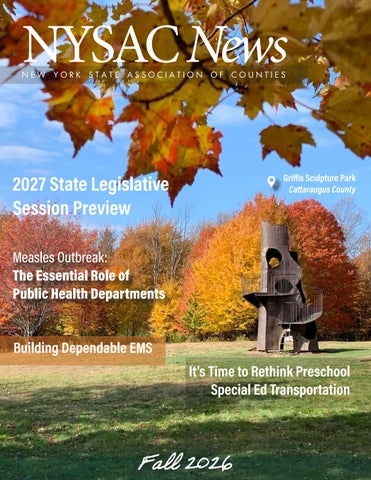
NYSAC News
NEW
YORK
STATE
ASSOCIATION
OF
COUNTIES
2027 State Legislative Session Preview
Griffis Sculpture Park Cattaraugus County
Measles Outbreak: The Essential Role of Public Health Departments Building Dependable EMS It's Time to Rethink Preschool Special Ed Transportation
Fall 2026
FOR NEW YORK COUNTIES
Put AI to work for your county programs Start with what you need. Add more anytime. No big platform to buy. Pick only the apps your programs need.
AI Answers
AI Notes
Ask AI about your systems, spreadsheets and reports. Build dashboards and get insights in minutes, not days.
Record a session or meeting. AI fills in your note template, so notes take minutes, not hours. Just review and sign.
Free 30-day pilot
Free trial
AI Builder
Cases
Describe what you need. AI builds a prototype for you to approve, then it’s built with no-code tools at low cost.
Manage your county programs from start to finish. Start with forms, files and checklists, and add other apps as you need them.
Free prototype
From $250/month · no setup fee
Counties using iCentral
“iCentral transformed our workflow, cutting down on time-consuming paperwork and allowing us to focus on what truly matters: supporting children and families.”
✓ Cortland
✓ Delaware
✓ Madison
✓ Onondaga
✓ Tompkins
✓ Wayne
And more across New York
Deb Thomas Former Director, Tompkins County Now an iCentral partner
Book an iCentral demo www.icentral.biz/ny-counties 888-777-7151 hello@icentral.biz
Scan to book a demo →
Clean Energy Solutions from NYPA Energy Savings. Reliability. Carbon Reduction.
NYPA is a leader in clean energy solutions and power programs in New York State. We help local governments across the State to develop affordable, actionable energy solutions.
Our experts bring proven audit, planning, procurement, and implementation solutions— together with knowledge of New York State policy, grants, and incentives. Talk with us about NYPA’s streamlined bid and procurement process—saving customers time and money. Let our project managers and engineers serve as an extension of your team—working with you to develop a roadmap to reach your clean energy goals.
To learn more, provide your information at nypa.gov/services123 EnergySolutions@nypa.gov
ENERGY EFFICIENCY | LED LIGHTING | EV INFRASTRUCTURE SOLAR | ELECTRIFICATION | ECONOMIC DEVELOPMENT PROGRAMS nypa.gov/services
NYSAC News | www.nysac.org
3
ENGINEERING FOR TOMORROW SURVEYING • CIVIL ENGINEERING • STRUCTURAL ENGINEERING GEOTECHNICAL ENGINEERING • ENVIRONMENTAL SERVICES CONSTRUCTION INSPECTION • MATERIALS TESTING
NEW YORK CITY • WHITE PLAINS • NEWBURGH ALBANY • ROCHESTER • MOUNTAINVILLE 800-829-6531 | tectonicengineering.com
A Short-Term, Highly Liquid Local Government Investment Pool for the Public Sector in New York Available in two separate investment funds: NY MuniTrust® Excelsior Fund Counties Only
Endorsed by:
NY MuniTrust® Empire Fund Other Public Entities
Investors should consider the investment objectives, risks, charges, and expenses of the Funds carefully prior to investing. Investment in the Funds is not insured or guaranteed by the Federal Deposit Insurance Corporation (FDIC) or any other government agency, and although the Funds seek to preserve the value of the investment at a fixed share price, it is possible to lose money by investing in the Funds. The Pool is an intermunicipal agreement (IMA) created through a municipal cooperation agreement (Municipal Cooperation Agreement) made pursuant to New York General Municipal Law, Articles 3-A and 5-G (collectively, the Act), dated as of February 1, 2022 by and among Orange County (Lead Participant) and each district and municipal corporation, as defined in the Act, that enters into the Municipal Cooperation Agreement hereof (collectively, together with the County of Orange, the Participants). BNY and NY MuniTrust® are unaffiliated companies. BNY Mellon Securities Corporation (BNYSC), a registered broker-dealer, is a distributor for NY MuniTrust. BNY Mellon Investment Servicing (US) Inc. is the transfer agent, The Bank of New York Mellon is custodian and BNY Investments Dreyfus, a division of Mellon Investments Corporation (MIC), a registered investment adviser, is the investment advisor. All are subsidiaries of The Bank of New York Mellon Corporation. BNY is the corporate brand of The Bank of New York Mellon Corporation and may be used to reference the corporation as a whole or its various subsidiaries generally. Risks include market risk, interest rate risk, credit risk, and liquidity risk. Please refer to the Information Statement for more information. FOR NEW YORK MUNICIPAL INVESTORS ONLY-NOT FOR USE WITH RETAIL INVESTORS. NOT FDIC-INSURED. NOT BANK GUARANTEED. MAY LOSE VALUE. ©2026 BNY Mellon Securities Corporation, distributor, 240 Greenwich Street, 9th Floor, New York, NY 10286. MIC-1025621-2026-10-22
A POWERFUL PARTNERSHIP BNY and BNY Investments Dreyfus support NY MuniTrust by providing custody, fund accounting, record keeping, client servicing, distribution, and investment management for the investment pool.
CONTACT Michelle Lens lens.m@bny.com 212.922.6616 Nathan Salapong nathan.salapong@bny.com 412.236.9802 NYMUNITRUST.COM
President's Page Building a Stronger New York NYSAC OFFICERS Kevin D. Watkins, MD, MPH Cattaraugus County President
Hon. Margaret M. Kennedy Otsego County President Elect
Hon. Steven M. Neuhaus Orange County First Vice President
Hon. Paul M. Wendel, Jr. Chautauqua County Second Vice President
Philip R. Church Oswego County Immediate Past President
BOARD MEMBERS Hon. Luis A. Alvarez, Sullivan County Hon. Shawna Black, Tompkins County Mr. Christopher DeBolt, Ontario County Ms. Ruth A. Doyle, St. Lawrence County Hon. Jeffrey Elder, Niagara County Hon. J. Ryan McMahon II, Onondaga County Ms. Alithia L. Rodriguez-Rolon, New York City Office of the Mayor Hon. Edward Romaine, Suffolk County Hon. Susan J. Serino, Dutchess County
PARLIAMENTARIANS Hon. A. Douglas Berwanger, Wyoming County Hon. Daniel P. McCoy, Albany County
I
t is an immense honor to write the introduction to this edition of the NYSAC News Magazine.
partnerships with state and federal leaders so we can protect taxpayers and sustain essential services.
My years in medicine and public health have taught me that the forces shaping people’s lives are connected. Health is tied to housing, transportation, public safety, education, jobs, the environment, and trust in government. Counties touch every one of these. We are close enough to know our residents’ needs and large enough to bring towns, villages, cities, schools, hospitals, businesses, and community groups to the same table.
That work is already underway. We have launched the Presidential Task Force on Veterans Services and Support, chaired by the Honorable Jeffrey Elder. New York is home to the nation’s fifth-largest veteran population, and the Task Force will focus on recognition, outreach, employment, and advocacy.
You will see that truth throughout this magazine. These articles explore how our county departments make a difference in the lives of millions of New Yorkers every single day. That work is not getting easier. Costs are rising, our workforce is changing, infrastructure is aging, and state and federal decisions are making it harder to fund essential services. But hard times create opportunities to lead, and counties know how to lead. We bring people together, share services, try new ideas, and change course when something isn’t working. We are resilient and flexible, and we are here to serve. During my term, I will focus on three commitments: advocating for counties of every size and region, uniting our voices around practical solutions, and strengthening our
I also want to thank the county employees who make all of this possible: the people who answer calls at every hour, repair our roads, protect public health, run our elections, and care for those in need. Their work often happens out of sight, but every community depends on it. A bridge does not ask who voted for it. A 911 call does not check party registration. Let us lead with facts, compassion, and respect, and ask one clear question of every decision: Will this strengthen our communities and improve the lives of the people we serve? New York’s future will be built county by county, community by community. I am proud to build it with you.
Kevin D. Watkins, MD, MPH President, NYSAC Public Health Director, Cattaraugus County NYSAC News | www.nysac.org
5
At Nationwide®, participant priorities are our priorities. From enrollment through retirement, our people, tools and education support participants so they can confidently make smart decisions.
To find out more, contact:
Brend an Morrison, Prog ram Direct or
( 617) 686-8990
Morrib 16@nat ionw id e.com
w w w .NRSFORU.com
Nationwide, through its affiliated retirement plan service and product providers, has endorsement relationships with the National Association of Counties and the International Association of Fire Fighters-Financial Corporation. More information about the endorsement relationships may be found online at www.nrsforu.com. Nationwide and its agents, representatives and employees are prohibited by law from offering investment, legal or tax advice and do not do so. Please consult with your tax or legal advisor before making any decisions about plan matters. Retirement Specialists are registered representatives of Nationwide Investment Services Corporation, member FINRA, Columbus, Ohio. Nationwide and the Nationwide N and Eagle are service marks of Nationwide Mutual Insurance Company. © 2021 Nationwide
NRM-19374AO (2/21)
Director's Note So, What Does a County Do? NYSAC STAFF (partial listing)
Stephen J. Acquario, Esq. Executive Director
Karen Catalfamo Office/Financial Manager
James Connolly Fiscal Policy Analyst
Patrick Cummings, Esq. Counsel
Peter Gallagher
Legislative Policy Analyst
Patricia Gettings Assistant to the Director
Mark LaVigne Deputy Director
Dave Lucas
Director of Finance & Intergovernmental Affairs
Juanita Munguia
Business Development Manager
Tom Oldfather
Communications Manager
Kate Pierce-Nimz Multimedia Specialist
Alexandra Regan Legislative Director
Jeanette Stanziano
Director of Education & Training
Chancey Young
Member Information Manager
Fostering Excellence in County Government
I
t’s a fair question, and one I’m asked often: What, exactly, does a county do? I’ve learned that the honest answer is rarely short. If you want proof, just page through this issue of the NYSAC News. In these pages, one author makes the case that the State should take over the social services programs counties administer on its behalf. Another examines why emergency medical services are struggling in communities across New York, and what it will take to make sure an ambulance still comes when someone calls. Our public health leaders write about confronting the return of measles, a disease many New Yorkers believed belonged in the history books. Keep reading and the list keeps growing. Counties help older adults age with dignity in their own homes and connect veterans with the benefits they earned. We run recycling programs and protect our waterfronts. We deliver mental health care in rural communities where the nearest provider may be an hour away. We work to keep lead out of children’s homes and bloodstreams, invite visitors to discover our main streets and mountains, and fight the invasive species threatening our lakes and forests. We are preparing for data center proposals that bring both promise and pressure on our land, water, and power. We defend human rights. And we are working through the risks and opportunities of artificial intelligence in real time.
written in Albany or Washington becomes a caseworker, a clinic, a road crew, or a 911 dispatcher. Much of what we do is invisible when it works and painfully visible when it doesn’t. Residents rarely think about their county until the moment they need it, and in that moment, they need it to work. The breadth of that work is also why NYSAC exists. No county leader can be an expert in everything on that list, and none should have to figure it out alone. The Association serves as a way station, a library, a resource, a facilitator, and a repository of best practices. When one county finds a better way to recruit EMS volunteers or respond to an outbreak, we make sure every other county hears about it. When a new challenge arrives, whether it’s a data center application or an AI policy, we help counties meet it with shared knowledge instead of starting from scratch. We have done this work for 100 years. We intend to do it for another 100, serving the county leaders who serve New Yorkers today, and their children and grandchildren tomorrow. So the next time someone asks what a county does, perhaps the best answer is simply this: We leave our communities better than we found them. And then hand them a copy of this magazine.
That is one magazine. One edition. And it barely scratches the surface. This is why explaining counties is so hard. We are not one thing. We are the place where state and federal policy meets real people, where a mandate
Stephen J. Acquario, Esq. NYSAC Executive Director
NYSAC News | www.nysac.org
7
NYSAC News NEW
YORK
STATE
ASSOCIATION
OF
COUNTIES
NYSAC News NEW
YORK
STATE
ASSOCIATION
OF
COUNTIES
NYSAC’s mission is to foster excellence in county government and unite the voice of New York’s county leaders. President
Kevin D. Watkins, MD, MPH Publisher
Stephen J. Acquario Managing Editor
Mark F. LaVigne
Advertise with NYSAC Contact NYSAC Business Development Manager Juanita Munguia at 518-465-1473 or jmunguia@nysac.org Published three times a year by the New York State Association of Counties (NYSAC), NYSAC News is the official publication of NYSAC, a non-profit municipal association serving the 57 counties of New York State and the City of New York with its five boroughs for over 100 years. NYSAC’s mission is to foster excellence in county government and unite the voice of New York’s county leaders.
NYSAC NEWS MAGAZINE 515 Broadway, Suite 402, Albany, New York 12207 Phone • (518) 465-1473 Fax • (518) 465-0506
Editor
Tom Oldfather Designer
Kate Pierce-Nimz Advertising Staff
Juanita Munguia
8
NYSAC News | Fall 2026
©2026 New York State Association of Counties
Table of Contents Volume 48, Issue 3 ◆ Fall 2026
10
A Changing Legislature, Familiar Priorities
39
Building Dependable EMS Through County Coordination
12
It's Time to Rethink Preschool Special Ed Transportation
40
Live Lead Safe in LivCo
14
Beyond the Headlines The Essential Role of Local Health Departments in a Measles Outbreak
42
How Essex County’s Rural School Nurse Partnership Strengthens Community Public Health
17
It Takes More than a Village
46
Franklin County Leverages Empire State Development Grant to Bolster Tourism
18
Your Area Agency on Aging
48
Beneath the Surface
20
Counties Convene Veterans Task Force
50
23
Why Doesn’t New York State run Social Services?
Best Practices for Communities Considering Data Centers
54
24
How Westchester County and Nespresso Are Recovering More Aluminum
When Financial Reporting Falls Behind, Local Government Leaders Lose Visibility
56
Mastering AI Prompts for Local Government
27
Holding the Line
58
Why Artificial Intelligence Is Becoming a Governance and Financial Risk
28
Preserving Access to the Bay
60
Youth Tobacco Use Is at Historic Lows
30
Rural Health Transformation Begins With Local Partnership
62
32
A Youth Listening Model for County Caucuses
We Didn’t Rebrand the County. We Rebranded the Invitation.
65
Strengthening Communities Through Human Rights Education
36
Answering the Call
66
Counties win When New York Funds Diversion Courts NYSAC News | www.nysac.org
9
A Changing Legislature, Familiar Priorities 2027 State Legislative Session Preview By Alexandra Regan, NYSAC Legislative Director
W
hen lawmakers return to Albany in January, affordability, health care, housing, and energy costs are expected to remain at the forefront of the debate. Those issues shaped prolonged budget negotiations between the Governor and Legislature earlier this year, and changes in federal funding will add urgency to discussions surrounding the SFY 2028 State Budget. For NYSAC, the coming session will be an opportunity to protect county taxpayers from additional costs while advancing reforms and investments that counties have long sought. State finances will shape those debates. Although tax receipts ran ahead of projections through the first half of the current fiscal year, the State Comptroller projects $31.7 billion in cumulative budget gaps over the following three fiscal years. Federal funding reductions and new administrative requirements will add pressure, raising concerns about whether the State will look to local governments to help close those gaps. Preventing that outcome will be NYSAC’s top priority. Since October 1, the federal share of Supplemental Nutrition Assistance Program (SNAP) administrative costs has fallen
from 50 to 25 percent, shifting an estimated $168 million in annual costs to counties and New York City. Beginning as early as fall 2027, federal penalties could also leave New York responsible for an estimated $1.1 billion annually in SNAP benefits. NYSAC will advocate for full state assumption of these new costs, investments in eligibility technology and administrative capacity, and continued protection of the local Medicaid spending cap as federal health care changes take effect. Counties will also work to protect the revenue they rely on to meet those obligations. The local sales tax is counties’ largest source of locally controlled revenue and their primary tool for carrying out state and federal mandates without raising property taxes. NYSAC will oppose any state-imposed change to sales tax sharing that diverts revenue away from county budgets and will ask the State to make existing county sales tax rates permanent, so they no longer depend on extender legislation every two years. Governor Hochul has also announced plans to pursue legislation repealing the sales tax exemption for large data centers, a measure NYSAC and our members have urged her to include in the SFY 2028 Executive Budget.
NYSAC projections of the SNAP administrative cost shift broken out by county as of June 2026.
10
NYSAC News | Fall 2026
County officials can also expect renewed advocacy around longstanding state mandates. NYSAC will seek full reimbursement of the State’s intended 59.5 percent share of preschool special education transportation expenses, along with incentives for school districts to partner with counties on transportation. Reform of the competency restoration process under Criminal Procedure Law § 730 will remain a priority, as well. Two bills that passed both houses in 2026—S.1004-B (Brouk)/A.5567-B (Simon) and A.11024 (Simon)/S.10309 (Brouk)—provide a framework for addressing costly, unpredictable commitments and improving the restoration process.
The coming session will be an opportunity to protect county taxpayers from additional costs while advancing reforms and investments that counties have long sought. Alongside these fiscal debates, state leaders are expected to continue pursuing childcare expansion, housing development, and infrastructure investment. NYSAC will press for sufficient Child Care Assistance Program funding and for changes that make the County Infrastructure Grants Program more accessible, including reducing the county match from 50 to 25 percent and increasing maximum grants to $2 million. Emergency medical services will be another major focus. With county EMS plans due in December 2026, lawmakers will have a clearer picture of coverage gaps, workforce shortages, and local system needs. NYSAC will seek a dedicated implementation fund, flexible operating and capital assistance, and improved reimbursement to help counties carry out the solutions identified in their plans. The objective is to ensure that the State’s new planning requirement is followed by meaningful implementation support.
Save the Date!
March 8th-10th NYSAC Legislative Conference Crowne Plaza Albany County, NY
The Legislature will also look considerably different in January, with more than 30 lawmakers retiring or pursuing other opportunities and several incumbents defeated in June primaries. NYSAC will work to familiarize incoming legislators and their staff with county priorities and the impact of state policy decisions on local budgets and services. We encourage county officials to connect with their new representatives before the legislative session begins to share the issues and priorities facing their communities. The Governor’s State of the State and Executive Budget proposals will provide a clearer picture of the debates ahead. NYSAC will be looking for opportunities to advance longstanding county priorities while ensuring that the State’s response to mounting fiscal pressures does not create additional burdens for local taxpayers.
NYSAC News | www.nysac.org
11
It's Time to Rethink Preschool Special Ed Transportation By James Connolly, NYSAC Fiscal Policy Analyst
E
ach school year, New York counties transport thousands of preschoolers to special education programs. New York is the only state in the nation that assigns financial responsibility for preschool special education, including transportation, to county governments rather than school districts. NYSAC recently released a white paper, Preschool Special Education Transportation: Aligning Transportation with the Systems That Serve Children Best, examining the growing costs of this state mandate and recommending reforms. At first glance, it may seem odd that counties are responsible for transporting preschoolers to special education programs. After all, school districts identify children in need of services and work with Committees on Preschool Special Education (CPSEs) to determine appropriate placements and services. School districts also have established transportation systems, including bus fleets and trained drivers. Yet counties, which have only an observer role in CPSE meetings and no authority to challenge placement decisions, are responsible for arranging and paying for transportation. Under state law, counties initially cover the full cost of transporting preschoolers to center-based special education programs. The state reimburses counties for 59.5 percent of eligible expenses, but reimbursement caps often leave counties receiving less than that amount. These caps are based on a formula that does not adequately reflect actual transportation costs, leaving counties to absorb the difference.
A Growing Financial Burden Preschool special education transportation is a significant and growing expense for counties. A survey by the New York State Association of County Health Officials (NYSACHO) found that average county spending on preschool transportation increased from $1.2 million in 2020 to $3.08 million in 2025. Several factors are driving these costs, including driver shortages, rising fuel prices, increased enrollment (up 19 percent between 2022 and 2024), and growing reliance on private transportation companies. Counties are not education providers, and county health departments are not transportation agencies. Yet the rising cost of this mandate diverts resources from other county responsibilities, including public and environmental health programs.
The High Cost of Private Transportation Counties typically transport preschoolers through contracts with private transportation companies, partnerships with school districts, or a combination of both. Private transportation contracts are the more common and more expensive approach. In many regions, consolidation among transportation companies has reduced competition and weakened counties' ability to negotiate favorable rates. Some counties receive bids from only one or two companies, leaving them with little choice but to accept the proposed price to ensure children can access their services. School districts offer a more cost-effective alternative. They already operate bus routes, maintain fleets, and have established safety and driver qualification procedures. Many also have vehicles available during midday hours that could accommodate preschool transportation. According to a NYSACHO survey of county health departments, partnerships with school districts can reduce transportation costs to as little as one-third to one-fifth of the cost of private contracts. These savings could become even more significant as competition among private transportation providers continues to decline.
12
NYSAC News | Fall 2026
A Path Toward Reform At NYSAC's 2026 Fall Seminar in Onondaga County, the Board of Directors adopted a resolution urging the Governor and State Legislature to transfer administrative responsibility for preschool special education transportation to local school districts. Shifting this responsibility would better align transportation with the school systems that already determine children's services and operate the infrastructure needed to transport them. It could also reduce costs while ensuring children continue to receive the transportation they need. In addition to recommending this shift, NYSAC's white paper outlines six reforms that could ease the financial burden on counties: 1.
Provide targeted transportation aid to help offset the cost of transporting preschoolers to special education programs.
2.
Raise or eliminate reimbursement caps so state funding better reflects actual transportation expenses.
3.
Encourage county–school district partnerships through formal agreements and financial incentives.
4.
Improve enrollment and waitlist data by requiring the State Education Department to develop a real-time tracking system.
5.
Support cross-county collaboration through state incentives that help counties coordinate transportation services.
6.
Establish a commission on preschool special education reform to examine long-term improvements to the system.
Together, these recommendations offer a path toward a more efficient and financially sustainable transportation system that better serves children, families, and county taxpayers.
OCTOBER 2026
DR. KEVIN D. WATKINS
515 Broadway, Suite 402
NYSAC President
Albany, NY 12207
HON. J. RYAN MCMAHON, II NYSCEA President
STEPHEN J. ACQUARIO
www.nysac.org
• NYSHIP is available to virtually all public employers across New York State • Over 800 counties, cities, towns, villages, school districts and special districts participate in NYSHIP • More than 1.2 million public employees, retirees and their families have health insurance through NYSHIP
Rethinking Preschool Special Education Transportation Rising Costs, Limited Control, and the Case for Reform
Did You Know?
A unique health insurance plan developed for New York’s public employees Scan to read full NYSAC report or visit www.nysac. org/issues/childrenwith-special-needs/
For additional information regarding The Empire Plan, public employers may visit our website at www.cs.ny.gov or email the Public Employer Liaison Unit (PELU) for the New York State Health Insurance Program at PELU@cs.ny.gov.
518-465-1473
Executive Director
Employee Benefits Division of the New York State NYSAC | www.nysac.org Department of CivilNews Service
13
Beyond the Headlines The Essential Role of Local Health Departments in a Measles Outbreak By Heidi Bond, Public Health Director, Otsego County; Immediate Past President, NYSACHO Scott King, Public Health Director, Seneca County; Workforce and Funding Chair, NYSACHO Tyler Shaw, Public Health Director, Allegany County; Vice-President, NYSACHO
W
hen measles cases appear in the headlines, public attention often focuses on case counts, exposure notices, and vaccination rates. Far less visible is the intensive work taking place behind the scenes in local health departments (LHDs), where public health professionals are conducting investigations, building community trust, coordinating partners, and working tirelessly to contain the spread of disease. Recent conversations with leaders at the New York State Association of County Health Officials (NYSACHO) Heidi Bond, Public Health Director for Otsego County, Tyler Shaw of Allegany County, and Scott King of Seneca County reveal the complexity of responding to a measles outbreak and underscore why communicable disease control remains one of the most fundamental responsibilities of local public health.
Building Trust in Hard-to-Reach Communities One of the greatest challenges counties described was reaching communities where traditional communication methods are ineffective or unwelcome. In several affected communities, there is a reluctance to engage with government agencies. As a result, public health staff have relied heavily on face-to-face outreach, often going door-to-door to conduct investigations, share information, and answer questions. Yet even with that effort, health departments frequently learn about individuals only after they become ill enough to seek medical care. For Bond and her team, trust-building became one of the most important tools in the outbreak response. Recognizing that there may be residents who are hesitant to engage with public health officials, she developed and personally delivered a letter explaining why the health department wanted to speak with community members. The message was simple: The department was seeking information to help stop the spread of disease, not to force vaccination, impact businesses, or disrupt daily life. The response was encouraging. Community members reported 14
NYSAC News | Fall 2026
appreciating the respectful approach, and local business owners conveyed positive feedback, helping open doors for future conversations. "We're building trust along the way," Bond explained, noting that relationship-building became just as important as traditional disease control activities.
Taking Vaccination Services to the Community Several counties found success by adapting vaccination services to meet residents where they are. In Seneca County, a home-based vaccination initiative had been launched approximately a year before the outbreak to improve access and strengthen relationships with key communities. When measles began spreading, county leaders expanded the program, bringing vaccines directly to homes, porches, driveways, and community gathering places.
The results have been significant. County officials reported a five-fold increase in measles, mumps, and rubella (MMR) vaccinations compared to the previous year, with more than 310 MMR vaccinations administered in Allegany and Seneca alone during the current response.
A Clear Message for County Leaders
The effort worked because it was built on trust rather than convenience alone. Public health staff discovered that some community members still remembered nurses and providers who had cared for their families' decades earlier. Those longstanding relationships became valuable bridges during the outbreak response.
The relationships, emergency plans, exercises, communication systems, and partnerships that proved invaluable during the outbreak were not created overnight. They were built through years of planning and investment.
Partnerships Make the Difference Every interviewee pointed to partnerships as a critical component of the response. County emergency management offices are helping distribute information to first responders within hours of receiving guidance. Local physicians and healthcare providers are serving as trusted sources of information for patients and families. Regional cooperation among neighboring counties also provided invaluable support, particularly when working with communities that span county borders or have longestablished cultural traditions. In Allegany County, one particularly effective partnership emerged between the local health department and hospital system. Recognizing the need to rapidly notify residents who may have been exposed to measles, the health department drafted a public health message that was distributed directly through the hospital's electronic medical record system. The hospital sent notifications to patients who may have been exposed during a specific timeframe, allowing public health officials to reach community members quickly through a trusted healthcare source. Because the messaging originated from the local health department but was delivered through the hospital's existing patient communication system, the partnership combined public health expertise with the hospital's ability to reach large numbers of residents efficiently. The collaboration was strengthened by an established relationship between the organizations. Allegany County Public Health Director Tyler Shaw serves on the hospital board, creating additional opportunities for coordination and problem-solving during the response. The experience illustrates how strong relationships built before an emergency can significantly improve communication during an outbreak. "This wasn't something we had to build during the crisis," Shaw explained. "We already had those relationships in place." The interviewees consistently emphasized that successful outbreak response depends on partnerships established long before an emergency occurs. Whether with hospitals, emergency management agencies, trusted healthcare providers, neighboring counties, or community leaders, those relationships become critical assets when a community faces a public health threat.
When asked about the most important lesson learned from the outbreak, all three interviewees returned to a common theme: preparedness matters.
Local health leaders expressed concern that public health funding is often viewed through the lens of immediate need rather than long-term preparedness. Yet outbreak response demonstrates that maintaining staffing, emergency preparedness programs, and public health infrastructure before a crisis occurs is what allows communities to respond effectively when one does. Workforce challenges were also a recurring concern, particularly the ongoing difficulty of recruiting and retaining public health nurses. Counties reported that staffing shortages continue to strain response efforts and limit capacity during emergencies. Shaw emphasized that sustained investment in public health emergency preparedness is critical, noting that funding for many preparedness activities has remained largely flat for years despite increasing demands on local health departments. These federally funded resources support the staff, planning efforts, emergency exercises, community partnerships, and response capabilities that allow counties to act quickly and effectively when outbreaks occur. Local elected leaders’ advocacy with state and federal policymakers on the importance of these resources in the communities they represent is vital. The broader message was clear: Investing in public health before an outbreak is far less costly than attempting to build response capacity during one.
Looking Ahead The experiences shared by Bond, Shaw, and King illustrate that communicable disease control extends far beyond clinical care or vaccination campaigns. It involves relationship-building, community trust, surveillance, education, coordination, emergency preparedness, and countless hours of work that often remain invisible to the public. Their message to county leaders is straightforward: Support the systems, staff, and partnerships that keep communities healthy before the next outbreak arrives. The effectiveness of tomorrow's response depends on the investments made today.
NYSAC News | www.nysac.org
15
16
NYSAC News | Fall 2026
It Takes More Than a Village By Matt Barron, Director of Policy & Communications, New York Public Welfare Association
F
or parents struggling to make ends meet, cope with emotional trauma, or manage their own disabilities, caring for a child with complex medical and behavioral health needs can be overwhelming. School attendance, quality of life, and opportunities for the future can suffer as families struggle to find the support they need. Local departments of social services (LDSS) are often called upon when families reach a breaking point. Sometimes, a parent refuses to bring a child home from the hospital because they no longer know how to provide the care the child needs. In other cases, domestic violence or other crises leave families unable to cope.
Counties also need more flexible funding and stronger collaboration between state agencies, particularly the Office of Children and Family Services and the Office of Mental Health. Expanding programs such as Systems of Care and Youth Assertive Community Treatment could help connect children to appropriate services sooner, reduce lengthy emergency room stays, and prevent the need for costly, longterm residential placements. Better coordination of funding across agencies would also help ensure that children do not fall through the cracks simply because their needs cross administrative boundaries.
Though relatively rare, these cases present enormous challenges for LDSS and the private agencies that support them. Children endure repeated disruptions while county staff navigate a fragmented system with inadequate tools, information, and placement options.
Another important piece of the solution is strengthening the private agencies that provide foster care, residential treatment, and other essential services. Many of these organizations struggle with the rising cost and limited availability of liability insurance, threatening their ability to serve children and families.
Some children have spent days or even months sleeping in county offices because appropriate services and placements could not be found. In desperate efforts to secure care, counties have sometimes been forced to place children with out-of-state providers at costs exceeding $500,000 per child annually. These extraordinary expenses strain county budgets while children and families continue to struggle.
Recent legislative progress, including the development of an insurance risk pool and expanded authority for agencies to provide clinical services to children and their family members, offers opportunities to strengthen these providers. Sustained support in the next state budget and legislative session will be necessary to build on that progress, preserve access to services, and help more children remain safely with their families.
These challenges are not new. For decades, counties across New York and the nation have struggled to secure appropriate care for children with complex needs. But there is reason for optimism, as county leaders and their partners advance practical solutions to longstanding gaps in the system.
Counties are doing their part by modernizing technology, improving coordination, and supporting children whose needs extend across multiple systems. But local efforts can only go so far when funding, services, and agency responsibilities remain fragmented.
During the 2025–26 legislative session, both houses of the State Legislature unanimously passed legislation (A.7603/S.7978) to improve coordination of residential and community-based services. The bill would establish a confidential portal to help agencies coordinate care and require diagnostic evaluations within 72 hours, followed by placement or services within five business days.
By implementing A.7603/S.7978, expanding cross-agency funding and coordination, and making voluntary foster care agencies more sustainable, New York can create a system that delivers for children with complex needs. Counties are ready to be partners in building a system that delivers for all New Yorkers.
While this legislation represents meaningful progress, improving coordination alone will not solve the problem.
Counties stand ready to work with the State and their partners to ensure that children with complex needs, and the families who care for them, can access the support they deserve. NYSAC News | www.nysac.org
17
Your Area Agency on Aging A Partner in Preparedness By Kathryn Carroll, Disability and Program Coordinator, Association on Aging in NY
D
oes your county plan for disasters and emergencies? Does that plan fully include your area agency on aging (AAA)? If not, AAAs can make the case for being valuable partners — as three did at the 2026 Disaster Preparedness Commission conference, hosted by the Division of Homeland Security and Emergency Services (DHSES). The three AAAs presented as a panel at the September event in Tarrytown, each sharing examples of how AAAs bring the resources, expertise, and relationships needed for preparedness and response. The panel began with an overview of the aging services network. The Older Americans Act of 1965 created a federal– state–local structure in which oversight and federal funds flow to state units on aging and then to area agencies on aging — the organizations that provide aging services at the local level. In New York, the State Office for Aging serves as the state unit and oversees 59 AAAs. AAAs deliver a core set of services, including: •
Nutrition and health (e.g., congregate and home-delivered meals)
•
Social services and supports (e.g., caregiver respite, older adult center programming, transportation)
•
Information, assistance, and counseling
•
In-home supports (e.g., personal care, personal emergency response services, case management)
Through this work, AAAs build informed, trust-based relationships with older adults and caregivers, many of whom live with disabilities or chronic conditions. These residents need thoughtful consideration when counties plan for human needs during emergencies and disasters. During the panel discussion, Chemung Director Beth Stranges noted that the public hearings AAAs must hold are an opportunity to gather community input and educate residents about emergency preparedness. The Chemung County Department of Aging and Long Term Care — the county’s AAA — did exactly that on October 1, holding a hearing that included a special presentation on preparedness for older adults. AAAs are also strong partners for hosting other preparedness events, such as the Citizen Preparedness Corps presentations DHSES offers with the National Guard. Many AAA services
18
NYSAC News | Fall 2026
are themselves preparedness measures: where possible, some AAAs provide frozen or shelf-stable backup meals in case severe weather or another event disrupts home-delivered meal routes. AAAs also provide Personal Emergency Response Services (PERS), and through a partnership between the New York State Office for the Aging and the Association on Aging in New York, they offer SCC MedQR devices that give first responders access to a person’s critical medical information. Commissioner Randy Hoak of the Erie County Department for the Aging highlighted AAAs’ unique expertise and capacity. Their relationships with, and knowledge of, the older population have proved valuable for communicating with residents before major snowstorms bear down on western New York. Notably, New York’s AAAs delivered roughly 160,000 congregate and 12 million home-delivered meals to older adults in 2025. That experience preparing and serving food at scale makes them key partners in the response and recovery phases of a disaster or emergency. Jefferson County Office for the Aging Director Bethany Munn shared examples from a series of localized disasters in her county. After a water main break, the Office for the Aging helped deliver water to older adults and paid close attention to what would be accessible to those living in buildings without working elevators. After a major storm caused widespread, multi-day power outages, the office deepened its relationship
with Fire and Emergency Services by establishing procedures to communicate clients’ needs to emergency management. AAAs have ways to reach their clients at scale; Jefferson County uses another of the aging innovations noted above, Blooming Health, for this purpose. During an unsafe water advisory in 2025, the Office for the Aging used Blooming Health to reach older adults who needed water delivered — demonstrating its invaluable role during emergencies.
The Takeaway
Partnering With Your AAA Three First Steps 1.
Get them in the room early. Include your area agency on aging in emergency planning meetings and annual plan reviews — not just during response. As Chemung Director Beth Stranges noted, AAAs’ required public hearings are a ready-made venue for preparedness education. 2. Tap their client relationships. AAAs reach older adults at scale through meal routes, Personal Emergency Response Services, and contact systems like Blooming Health. That reach is worth more to you before an event than after.
Flooding, snowstorms, unsafe water, and power outages are just a few of the threats to our counties’ residents. Each will test our ability to plan and coordinate resources — especially for those with the greatest need. As you go about your work, we urge you to consider how a strong AAA partnership can strengthen it.
3. Formalize how you’ll share information. Jefferson County deepened its partnership by establishing procedures to communicate clients’ needs to emergency management. Build that channel now, not mid-crisis.
Kathryn Carroll is the Disability Program Coordinator at the Association on Aging in New York.
FROM CONCEPT TO COMMUNITY Service Offerings: Architecture Engineering Surveying Environmental Landscape Architecture Geology Grant Services...and more! 518.786.7400
HQ: Latham
www.ctmale.com
C.T. Male Associates Engineering, Surveying, Architecture, Landscape Architecture & Geology, D.P.C. NYSAC News | www.nysac.org
19
Counties Convene Veterans Task Force
N
YSAC is excited to announce the creation of the Presidential Task Force on Veterans Services and Support! Created by NYSAC President Dr. Kevin D. Watkins, this task force will bring together county leaders and veterans service professionals from across the state to identify opportunities to strengthen services for New York’s veterans and their families. The Presidential Task Force will focus on the following initial priorities: 1. Connecting veterans across New York State with available services, resources, and their local communities. 2. Expanding NYSAC’s Operation Green Light initiative and identifying additional opportunities to recognize veterans during the month of November and throughout the year.
3. Expanding employment resources and opportunities for veterans at the county level. 4. Identifying and advocating for state and federal policies that strengthen county veterans' services and improve outcomes for veterans and their families. We aim to foster more collaborative and creative approaches to veterans' services to better facilitate how counties interact with their veterans. We hope this diverse group will provide a forum for sharing best practices, identifying common challenges, and developing recommendations that can benefit counties and veterans across New York State. To learn more about the county roles in supporting veterans and the work of our Task Force, visit www.nysac.org/veterans
Looking for solutions to your County’s toughest DSS challenges? CareFindr®: Software for Tracking Foster Care Children and Vendor Information ResourceFindr: Software for Tracking Chronic Care Five Year Look Back FraudFindr®: Software for Financial Fraud Detection & Investigation
Find out how Bonadio is leading a new era of DSS efficiency. Contact Us Today to Schedule a Demo.
20
Tim Ball Leader, Bonadio Advisory & Consulting
Tim Doyle Government Partner
Courtney Handy Principal— CareFinder®
Josh Bills Principal—FraudFindr® & ResourceFindr
tball@bonadio.com
tdoyle@bonadio.com
chandy@bonadio.com
jbills@bonadio.com
NYSAC News | Fall 2026
Finding Value in Surplus For 30 years Absolute Auction & Realty has been providing New York municipalities professional auction services, finding value in surplus, with outstanding results. In rem tax foreclosures, surplus real estate, vehicles and equipment? Today, as always, results matter.
Professional Solution. Maximizing Results. Industry Leaders.
AARauctions.com
Absolute Auctions & Realty, Inc. 45 South Ave, Pleasant Valley, NY 845-635-3169 | info@aarauctions.com NYSAC News | www.nysac.org
21
UPCOMING WEBINAR HELP POWER YOUR CRITICAL SITES
Resilience, Reliability, and the Reality of Battery Storage Control Costs and Uptime: Behind-the-Meter Battery Energy Storage Systems (BESS) are engineered to manage costs and maintain uninterrupted power for critical operations. Designed for Safety and Reliability: Systems built to protect critical-load facilities with built-in safety mechanisms and new fire prevention technology.
REGISTER NOW SCAN THE QR CODE
Large Incentives and Rebates: Options may include little or no up-front capital outlay, offering attractive paybacks with long-term economic benefits. Battery technology is advancing quickly, making Battery Energy Storage Systems safer and more affordable than ever before. Join this Educational Webinar to learn more about the enhanced technology and how it can benefit your community today.
DECEMBER 11 12:00 - 1:00 PM ET
CBS 10-26.indd 1 22 FP Ad NYSAC NYSACMag News | Fall 2026
10/16/26 1:28 PM
Why Doesn’t New York State run Social Services? By Daniel P. McCoy, Albany County Executive
O
ver my 15-year tenure as county executive, I have worked hard to be a responsible fiscal steward for the people of Albany County. During that time, we have progressed from borrowing to make payroll to maintaining a sustainable budget model that provides robust essential services while keeping taxes flat and predictable for taxpayers. Unfunded mandates passed down from the State to local governments are nothing new. However, 2027 could be a watershed year for counties in New York State. Due to State changes to the Tier 6 pension system, federal changes to the Supplemental Nutrition Assistance Program (SNAP), and skyrocketing fuel prices driving inflation, the threat to county taxpayers has never been greater. Under the One Big Beautiful Bill Act passed by the federal government, counties will be responsible for 75 percent of SNAP administrative costs beginning in October of this year, shifting an estimated $3 million in annual expenses to Albany County alone. What's worse, New York State has declined to share in that financial burden. As if that new expense weren't enough, counties could also be responsible for paying penalties to the federal government if the State's SNAP payment error rate is too high. There is currently no way to determine Albany County's individual error rate, making it difficult to address a problem without being able to identify it. How much could the penalty cost? Starting in October 2027, it could cost Albany County taxpayers $10 million annually if the State's error rate remains above the new federal threshold. To put that into perspective, a 1 percent property tax increase in Albany County generates $1 million. It is our understanding that New York State has not yet decided whether local social services districts will bear the full brunt of this change. Like counties, the State is advocating at the federal level to reverse these misguided changes. Since all counties are being held to the same standard, the best solution seems clear: New York State should assume full responsibility for the administration and operation of social services programs currently managed by county social services departments. The current county-based system creates unnecessary inequality, inefficiency, and confusion for residents who depend on essential assistance programs. In fact, New York is one of a small handful of states that require county governments to administer federal and state social services programs. Many other states, including
New York is one of a small handful of states that require county governments to administer federal and state social services programs. Pennsylvania, Michigan, and Vermont, handle these administrative functions at the state level. From a practical perspective, a person's access to services such as SNAP, Medicaid, Temporary Assistance, child welfare support, and emergency housing should not depend on which county they happen to live in. Yet under the present structure, counties differ widely in staffing levels, processing times, office procedures, technology systems, available resources, and, importantly, SNAP error rates. This leads to inconsistent treatment of vulnerable New Yorkers and uneven outcomes across the state. As evidenced by these changes to SNAP, counties also bear significant financial and administrative burdens that strain local property taxpayers. Social services are fundamentally a statewide responsibility. Poverty, disability, and public assistance are matters of statewide concern. A centralized, state-run system could streamline operations, modernize technology, standardize eligibility determinations, reduce duplication, and improve accountability. New York State and the federal government already set program rules and regulations. Maintaining county-level administration only adds layers of bureaucracy that slow down services, increase costs, and breed inefficiency. Other states have demonstrated that centralized administration can improve consistency and efficiency while reducing local fiscal pressure. New York should follow that example and build a truly unified social services system that treats all residents fairly, regardless of geography. The people who rely on these programs deserve a system that is equitable, responsive, and accountable. It is time for New York State to take full responsibility for administering social services statewide. NYSAC News | www.nysac.org
23
How Westchester County and Nespresso Are Recovering More Aluminum By Ken Jenkins, Westchester County Executive
I
mproving recycling doesn’t always require sweeping changes. Sometimes, it starts by making it easier to recycle the small items that often go unnoticed. This fall, Westchester County partnered with Nespresso and the Glass Packaging Institute to expand curbside recycling for more than 900,000 residents served by the County’s Refuse Disposal District. Residents can now recycle used Nespresso capsules and other small aluminum items, such as bottle caps, directly in their curbside recycling bins, making recycling more convenient while helping recover valuable materials that might otherwise be lost. The initiative builds on Westchester County’s continued investment in modernizing its recycling system. At the Department of Environmental Facilities’ Material Recovery Facility in Yonkers, new recovery technology helps capture small aluminum items that can be difficult to separate during traditional sorting. Instead of ending up in the waste stream, those materials can be recovered and returned to productive use. For Westchester County, the project represents a practical example of how public-private partnerships can improve everyday services while advancing long-term sustainability goals. By working with Nespresso and the Glass Packaging Institute, the County is making recycling more accessible for residents while capturing valuable resources and keeping additional waste out of landfills.
County Executive Ken Jenkins praising the new Nespresso partnership at a press conference held on Sept. 16, 2026.
County recycling programs process thousands of tons of material each year, but recovering smaller recyclables has long been a challenge. We viewed that challenge as an opportunity to improve both infrastructure and the resident experience. Rather than asking residents to adopt a new recycling program or travel to a separate collection site, the County focused on integrating the solution into a system residents already use every week. As Westchester County Department of Environmental Facilities Commissioner Vincent Kopicki explained, the partnership builds on the County’s longstanding commitment to improving recycling. By recovering aluminum that might previously have been missed, the initiative strengthens the County’s recycling system while making participation simpler and more convenient for households. “It’s an investment that benefits both our environment and our recycling system,” Kopicki said. The initiative also demonstrates the importance of collaboration. Westchester County contributed local infrastructure and operational expertise, while private-sector partners supported technology and recycling solutions that benefit both residents and the broader recycling system.
24
NYSAC News | Fall 2026
For Westchester County Director of Energy Conservation and Sustainability Peter McCartt, the initiative is also a reminder that environmental progress often comes through small, everyday actions rather than sweeping changes. By giving residents the tools and opportunities to participate, the County can turn individual recycling efforts into a much larger collective impact. As McCartt noted, those efforts help “significantly increase solid waste diversion and build a cleaner, more sustainable community for everyone.” For counties looking to strengthen their own recycling programs, Westchester’s experience shows how successful sustainability initiatives should make participation easier, not more complicated. Westchester County’s partnership demonstrates how practical solutions and collaboration can deliver meaningful results for residents and communities alike.
Westchester County Executive Ken Jenkins standing with County officials and partners from Nespresso USA, the Glass Packaging Institute and the Aluminum Association.
Your employees deserve a top-rated health plan. #1 in Member Satisfaction among Commercial Health Plans in New York
plans.cdphp.com
For JD Power 2026 award information, visit jdpower.com/awards
NYSAC News | www.nysac.org
25
Thank you, Onondaga County! NYSAC extends our heartfelt thanks to Onondaga County Executive Ryan McMahon and the entire Onondaga County team for their outstanding hospitality and all the hard work that made the 2026 Fall Seminar such a success! From months of planning and preparation to an unforgettable Host County Event at Syracuse University's Miron Victory Court, Onondaga County went above and beyond to welcome county leaders from across New York. The evening's special appearance by the Syracuse University Marching Band and cheerleaders brought an extra dose of Orange spirit and made for one of the most memorable moments of the conference. Events like Fall Seminar are made possible by the dedication and generosity of our host counties. Thank you, Onondaga County, for making this year's Fall Seminar one to remember!
Upcoming Education & Training Events NYSAC provides training and education to county leaders on issues vital to public policy and county services For more information on training and education offered by NYSAC, please visit our website at:
NYSAC.org/education-events 26
NYSAC News | Fall 2026
Holding the Line Rockland’s Proposed 2027 Budget Includes Zero Property Tax Increase By Ed Day, Rockland County Executive
F
or county leaders across New York, protecting property taxpayers while maintaining essential services is becoming increasingly difficult. Rising healthcare and pension costs, coupled with new financial burdens passed down to local governments, are putting county budgets under mounting pressure. In Rockland County, my proposed 2027 budget meets those challenges with a clear commitment: zero increase in County property taxes. That proposal builds on five years without a county property tax increase, including a 4 percent reduction. It reflects a principle that has guided my administration since taking office in 2014—fiscal discipline. At that time, Rockland faced a staggering $138 million deficit and stood on the brink of fiscal collapse. Through disciplined budgeting, difficult decisions, and long-term planning, we rebuilt our finances. Today, Rockland holds the highest possible bond ratings from both Moody’s and Fitch. But even strong county finances cannot insulate taxpayers indefinitely from the fiscal threats heading our way. Beginning October 1, 2026, the federal share of Supplemental Nutrition Assistance Program administrative costs dropped from 50 to 25 percent. Under New York’s current funding structure, counties must cover the full non-federal share, increasing our responsibility from 50 to 75 percent of those costs. A second concern is the new SNAP benefit cost-sharing requirement tied to statewide payment error rates. Recent State data put Rockland’s error rate at 5.6 percent, below the 6 percent threshold that triggers benefit cost sharing.
New York’s statewide rate, however, exceeds 10 percent, placing it in the highest cost-sharing tier. Whether Albany will pass those benefit costs down to counties remains unresolved. Requiring Rockland taxpayers to shoulder costs driven by a statewide error rate—despite our stronger local performance—would undermine both accountability and responsible administration. Without State action to absorb these burdens, Rockland projects a potential impact of approximately $6.8 million in 2027 and $20.6 million in 2028. Our proposed budget accounts for the anticipated 2027 costs while holding county property taxes flat. Nevertheless, these obligations severely constrain our operating flexibility and threaten our ability to sustain that approach in future years. We are continuing to improve efficiency within county government. Our Law Department is automating workflows, Purchasing is modernizing procurement, and Information Technology Services is strengthening cybersecurity and network reliability. These investments help staff work more effectively, protect public resources, and support dependable services. Rockland’s experience demonstrates that counties can rebuild their finances, invest in essential services, and deliver tax relief. Sustaining those gains requires a State partner committed to protecting local taxpayers. My proposed 2027 budget holds the line on County property taxes. What happens in 2028 is yet to be determined. Albany must do its part by absorbing these new SNAP costs, rather than allowing them to erode the progress counties have worked so hard to achieve. NYSAC News | www.nysac.org
27
Preserving Access to the Bay Suffolk County’s Working Waterfront Preservation Program By Ed Romaine, Suffolk County Executive
S
uffolk County’s long-sought-after coastline is in higher demand than ever before leaving those whose livelihoods depend on access to the sea in jeopardy. Responding to industry concerns, Suffolk County has taken decisive action to protect the maritime industry’s access to the working waterfront. Commercial fishermen and aquaculture leaseholders alike need working dock space and associated infrastructure to make a living. In 2021, the ocean economy accounted for nearly 40,000 jobs and $1.4 billion in GDP for Suffolk County. In 1998, Suffolk County codified the Right to Fish in the county code, but the right to fish does nothing to secure a place to fish. A 2025 survey of 164 waterfront property owners revealed that more than half had been approached about selling their properties in the previous year. That same year, a major dock in Montauk was sold to the founders of the private equity firm Black Diamond Capital Management for $34.35 million. Without intervention, working waterfronts could give way to luxury condominiums and hotels. The loss of working docks can trigger a downward spiral: Fewer docks mean fewer fishermen, which means fewer fish caught. Declining catches can threaten New York's share of fishing quotas for certain species, creating long-term consequences for the industry and potentially costing the downstate economy billions.
28
A 17-member committee with industry and municipal representation now meets to evaluate applications and make recommendations to the legislature. The program allows property owners to access the equity in their land while retaining ownership and continuing to use it for maritime purposes. The program also protects the substantial investment Suffolk County has made in aquaculture leasing. Leaseholders who raise clams and oysters depend on working waterfront access to maintain their operations. Aquaculture is a major part of the county’s nitrogen reduction plans, with each oyster or clam capable of filtering up to 50 gallons of water a day. By preserving working waterfronts, we are also protecting the investments of those who have committed their time and resources to building the county’s aquaculture industry. Our capital program allocates $9.5 million to protect working waterfront from 2026 to 2028, and the county is currently accepting applications from interested property owners. The goal is to preserve as much of the 2,400 acres of coastal land currently used by maritime industries as possible. While the maritime industry is often associated with the East End, 59 percent of the county's maritime industry acreage is located "up island" in the five western towns, making waterfront preservation a countywide issue.
This danger threatens more than the economy; it threatens the very cultural fabric of a region so intertwined to the sea.
Through our Department of Economic Development and Planning, we are actively reaching out to property owners.
Recognizing these challenges, the County Legislature established the Working Waterfront Program in 2025 modeled on our first-in-the-nation Farmland Protection Program. Through conservation easements and the purchase of development rights, we are now protecting access to the bays that feed our residents and employ thousands.
We do not have to imagine the decline of a maritime industry looks like. The lobster die-off obliterated the fleet based in Northport—a loss that can never be recovered. Today, Suffolk County is home to New York State’s three largest fishing fleets, based in Montauk, Greenport, and Shinnecock. By acting now, we can help ensure these fleets remain part of our economy and our communities for generations to come.
NYSAC News | Fall 2026
Registered Municipal Advisors Serving New York State Municipalities Since 1967 Bond & Note Issues Refunding Bond Issues Lease Financings EFC Short and Long Term Financings Energy Performance Contract Financing Credit Rating Assistance Accounting & Bookkeeping Services Cash Flow Borrowings Continuing Secondary Market Disclosure
Corporate Headquarters
250 South Clinton Street, Suite 502, Syracuse, NY 13202 Phone (315) 752-0051 Christine Crowley, CIPMA, Chief Executive Officer /Municipal Advisor Benjamin Maslona, CIPMA, President/Municipal Advisor Andrew Schreyack, CIPMA, Executive Vice President/Municipal Advisor
Capital Region
Andrew Watkins, CIPMA, Executive Vice President/Municipal Advisor 63 Putnam Street, Suite 202 Saratoga Springs, New York 12866 (518) 541-3861
Hudson Valley Region
Beth Ferguson Vice President, Municipal Advisor 827 Route 82, Suite 10231 Hopewell Junction, New York 12533 (845) 447-2214
Western Region
Kelly Lathan, Financial Analyst 5 North Avenue LeRoy, New York 14482 (585) 502-5010
www.fiscaladvisors.com Founding firm member of the National Association of Municipal Advisors
NYSAC News | www.nysac.org
9/9/2026
29
Rural Health Transformation Begins With Local Partnership By Mary O'Leary, Director of Community Services (DCS), Cattaraugus County
F
or Cattaraugus County, rural health transformation begins with a few practical questions: Can residents reach the care they need and receive the right response during a behavioral health crisis? Are hospitals, primary care practices, behavioral health providers, emergency medical services and community organizations communicating effectively? And can people connect with help without having to repeat their story at every step? Those questions are at the center of a new planning effort supported through New York's Rural Community Health Integration initiative. In September, the Centers for Medicare & Medicaid Services announced more than $76 million for the initiative. The funding is part of New York's larger $212 million federal Rural Health Transformation Program allocation for fiscal year 2026. Southern Tier Health Care System, Inc. (STHCS) is the lead applicant and received a $500,000 Rural Community Health Integration planning grant for Cattaraugus County. The county's Health Department and Department of Community Services contributed local population health and behavioral health information, helping ensure that the application reflected needs identified within the community. The planning process began well before the funding was awarded. In June, Cattaraugus County Public Health Director Kevin D. Watkins, MD, MPH, convened community partners to discuss the opportunity and begin identifying priorities and potential partnerships, followed by a county assessment that gathered perspectives used to shape the application.
The immediate goal is to develop a Regional Health Integration Plan for Cattaraugus County. The planning process will bring together hospitals, primary care and behavioral health providers, EMS, county agencies, transportation and home care providers, and community organizations. It will focus on transitions of care, behavioral health integration, primary care access, transportation, workforce needs, and communication among providers. To prepare for a quick start, STHCS surveyed regional partners about their expertise, capacity and interest across the grant's five required deliverables. Those responses helped identify potential roles and begin organizing teams before the award was announced, an important step given that all planning work must be completed by June 30, 2027.
The County Role From my vantage point at DCS, I see the system from several directions. Our department provides services directly, works with community providers, and helps plan for behavioral health needs across the county. We see what happens when a referral works, but we also see where communication breaks down, where transportation becomes a barrier, and where someone can lose contact with care. That broader view has to remain grounded in the experience of the person seeking help. Behavioral health care has moved away from simply asking what is wrong and toward asking what happened, what support would help, and what recovery means to that individual. Residents know their own lives best, and our job is to provide the support they need to live well in their communities.
30
NYSAC News | Fall 2026
A planning grant provides a structured way to bring the right people together, establish priorities, and develop an approach that can be sustained.
The planning grant gives the county an opportunity to bring those perspectives together: what residents and families experience and what providers see across the system. For Community Services, that means connecting this work with existing programs, identifying gaps, and keeping behavioral health needs central to the larger rural health discussion.
Planning for Rural Communities Planning and implementation take time in a rural community, and progress must be measured in ways that reflect our population, geography, and available resources. A model designed for a densely populated area may not translate directly to a county where residents travel farther for care and providers serve communities spread across a wide area. Local involvement is therefore essential from the beginning. The people who live and work here understand the challenges firsthand, while providers know the pressures affecting their workforce and operations. County departments see how behavioral health, public health, emergency response, and social services intersect, and residents and families know what it feels like to move through the system. The Regional Health Integration Plan will give Cattaraugus County and its partners a shared framework for strengthening those connections. Although a planning grant cannot solve every access or workforce problem, it provides a structured way to bring the right people together, establish priorities and develop an approach that can be sustained. In Cattaraugus County, we want people to spend less time figuring out where to go and more time receiving the care they need. This planning process gives local partners a chance to work out how we can make that happen.
NYSAC News | www.nysac.org
31
A Youth Listening Model for County Caucuses By Albany County Legislative Black Caucus
O
n Sept. 24, 2026, the Albany County Legislative Black Caucus invited young people ages 14 to 21 to the Albany Public Library for its Youth Roundtable. Hosted by Chairwoman Dr. Carolyn McLaughlin and the Caucus under the theme Youth Voices Community Action, the event gave young people the floor to identify the concerns shaping their daily lives. The value of that testimony now depends on how county leaders organize, review, and respond to what they heard. The Roundtable used a simple structure to turn a broad conversation into usable public input. At check-in, participants selected the subjects they wanted to discuss through color-coded wristbands: mental health and wellness; safety, violence, and justice; or jobs, money, and future opportunities. Legislators were assigned to listen across those areas, while schools, youth organizations, higher education, county departments, and community partners joined the discussion. Young people could
32
NYSAC News | Fall 2026
choose where they wanted to contribute, and the Caucus could document recurring concerns without narrowing the conversation in advance. Youth described a need for culturally responsive mental health services, visible Black role models, supportive adults, and safe spaces outside home and school. They raised concerns about K2 (synthetic marijuana) and other drugs, gun violence, homelessness, poverty, trauma, and the transition out of foster care. They also connected wellness and safety to family stress, housing stability, neighborhood conditions, and trust in public systems. Jobs and future opportunities were equally important. Participants called for paid internships that provide real instruction and professional development. They questioned whether young people of color know about Albany County internships and whether outreach reaches schools and trusted community spaces. They
5 STEPS THAT COUNTY CAUCUSES CAN ADAPT 1
Set a focused agenda. Choose a small number of broad subjects in advance, then allow young people to select the issues on which they want to speak.
2
Structure the room for listening. Give youth the microphone first. Assign legislators and staff to specific topics
also described barriers to construction and HVAC careers, uncertainty about employment after college, and the need for clearer pathways from education to a first job. One concern connected every topic: Programs may exist without reaching the young people they were created to serve. Even adults working in government and community settings did not recognize every resource discussed. Youth described the difference between being told to search for help and receiving reliable information where they already learn and gather. The central gap was the absence of a visible path into existing programs. The Caucus began organizing the feedback within days. On Sept. 28, Jaden Gabb met with Brandon D. Russell, Esq., Deputy Majority Counsel and the Roundtable notetaker, for a debrief that separated youth testimony from preliminary staff brainstorming.
and make documentation an official event responsibility.
3
Debrief promptly. Meet within days while the testimony is fresh, identify repeated concerns, and preserve the distinction between what participants said and what staff later proposed.
4
Test each concern against county authority. Determine what the county controls, which services already exist, where access breaks down, and whether an issue belongs with a department, committee, community partner, or another level of government.
5
Close the loop. Return to participants with a plain language update explaining which issues advanced, which were referred, and which require more research. This step turns a listening session into an accountable public process.
Research questions were framed around resource navigation, internship outreach, foster care transitions, culturally responsive mental health services, and apprenticeship barriers. No proposal or partnership was approved. The findings are being prepared for review by Chairwoman McLaughlin and the full Caucus. County youth bureaus, departments, and community organizations may already provide direct services. A legislative caucus has a different role. It can connect lived experience to oversight questions, committee work, budget discussions, and possible legislation. The Albany County experience suggests five steps that other county caucuses can adapt. Albany County remains at the review stage, and transparency about that status is part of the model. The Caucus must still decide which concerns fall within county authority, and which require longer-term policy or budget work. A roundtable becomes meaningful when young people can see how their testimony moved through government and what happened next. County caucuses are well positioned to build that bridge NYSAC News | www.nysac.org
33
A N E W P U B L I C F I N A N C E S TA N DA R D
Every public dollar. Safe. Available. Working. Every single day. Pace-setting counties are not defined by the size of their budgets. They stand apart in how effectively every public dollar is put to work for the communities they serve.
cashVest® Liquidity Intelligence Platform Powered by the industry's first Liquidity Intelligence Data Core and paired with a dedicated Relationship Manager, cashVest works as an extension of a county's finance team.
$4.3T
56.5M
$5B+
public dollars analyzed
transactions evaluated
new revenue and savings identified for communities
Turning public dollars into enduring community impact.
Ready to rise to a higher public finance standard? three+one® is a proud partner of
34
NYSAC News | Fall 2026
S TA R T T H E C O N V E R S AT I O N
threeplusone.us
Control Your Energy Costs Put the power of MEGA to work for you
Access to competitive, stable energy supply rates
Fully compliant with NYS public procurement requirements
No RFP needed– save time and piggyback off MEGA’s bid
MEGA is a nonprofit local development corporation that helps New York’s public entities manage electricity and natural gas supply costs through aggregated purchasing and a transparent, publicly bid procurement process.
Get free pricing with no commitment today We serve more than 250 municipalities and non-profits throughout upstate New York MEGA works with county governments, towns, villages, and school districts
www.megaenergy.org info@megaenergy.org 551-232-8361
NYSAC News | www.nysac.org
35
Answering the Call How Madison County Created a Modern EMS Program to Address Challenges and Stabilize Service By Samantha Field, Madison County Public Information Officer
A
s communities across New York State struggle with staffing shortages and financial pressures affecting emergency medical services, Madison County has taken a different approach by building a county-supported EMS system designed to stabilize emergency care for rural residents. What began as a small countywide paramedic support initiative in 2022 has grown into a municipal ambulance service operating across multiple communities, reflecting broader efforts by local governments to address the growing challenges facing rural EMS systems.
Madison County developed a scalable system capable of supplementing or stabilizing existing agencies while preserving local partnerships whenever possible.
Madison County EMS launched in February 2022 with a countywide medic car, or “fly car,” program. The initiative provided advanced life support paramedics who could respond quickly to emergencies and assist existing ambulance agencies throughout the county.
Emergency Management, integrating ambulance operations with emergency communications, fire coordination, and county emergency management functions.
However, as ambulance agencies experienced increasing staffing shortages and operational challenges, the county’s role expanded.
The county says the primary objective is not simply ambulance transportation, but maintaining reliable emergency medical coverage for communities that might otherwise lose service.
On April 1, 2023, Madison County EMS began ambulance operations in the Town of Sullivan after replacing private ambulance coverage in the area. Later that year, on Nov. 11, Madison County EMS expanded into the Town of Hamilton region after the Southern Madison County Ambulance Corps announced it would cease operations following decades of service.
“When people call 911 for help, they expect that help will be available to them,” said Rex Vosburg, Town of DeRuyter Supervisor and Chairman of Madison County’s Criminal Justice, Public Safety and Emergency Communications Committee.
The county added a third station in the Town of DeRuyter in March 2025, improving emergency response coverage in some of the southernmost rural portions of the county. Today, Madison County EMS operates eight ambulances along with several fly cars staffed by EMTs and paramedics. The municipal EMS agency functions within the county’s Office of 36
NYSAC News | Fall 2026
Like many rural areas nationwide, Madison County has faced mounting challenges in recruiting and retaining EMS personnel. Volunteer participation has steadily declined in recent years, while educational requirements and clinical standards for EMS providers have continued to increase. To address those concerns, the county has invested in workforce development and EMS education programs through partnerships with regional organizations, including Midstate EMS and Mohawk Valley Health System EMS Education. The county supports EMT and paramedic training programs, continuing medical education, CPR instruction, and professional development initiatives aimed at building a larger local workforce of emergency responders.
Emergency Management Director Dan Degear said the county recognized that the EMS crisis extended beyond finances alone. “The crisis facing EMS is also a people problem, so we committed to focus on training the next generation of EMS providers,” Degear said. “We created a dedicated EMS educator position designed to focus on training and maintaining clinical standards.” Since 2023, the EMS education concentration has placed nearly 165 new EMTs into the county’s EMS system, with many now advancing to the AEMT or paramedic levels. Financial sustainability remains one of the largest obstacles facing ambulance agencies. Medicare and Medicaid reimbursement rates often fail to cover the actual costs of maintaining 24-hour emergency medical coverage, particularly in low-volume rural communities where agencies must remain fully staffed and equipped despite relatively few emergency calls. At the same time, ambulance providers continue to face rising equipment costs, insurance expenses, workforce shortages, and increasingly complex regulatory requirements. Rather than pursuing a full countywide takeover of local ambulance services, Madison County developed a scalable system capable of supplementing or stabilizing existing agencies when necessary while preserving local partnerships
whenever possible. The county’s model allows communities to maintain local involvement and identity while gaining access to county financial and operational support. The county’s approach reflects a broader recognition that sustaining rural EMS systems requires more than ambulances alone. “Building a strong relationship with other EMS agencies and working collaboratively has improved the system as a whole,” said Madison County EMS Director Jenna Illingworth. “Long-term stability depends on coordination, predictable funding, and workforce development.” As rural communities across the country continue searching for sustainable EMS solutions, Madison County’s system may serve as a model for others confronting similar challenges. Madison County believes the program demonstrates how county government can combine emergency management, professional staffing, regional coordination, and scalable deployment into a modern EMS framework capable of adapting to changing community needs. “For residents,” said Vosburg, “the goal remains simple: ensuring that when someone calls 911 during a medical emergency, help arrives.”
Bond: Your Trusted Legal Partner in Municipal Legal Services Bond serves over 150 municipal entities in New York State in areas such as: • Environmental and Energy • Labor and Employment Litigation • Municipal Law • Public Finance • Tax Assessment, Condemnation and Property Valuation • Zoning and Planning
ALBANY BUFFALO ELMIRA LONG ISLAND NEW YORK CITY ROCHESTER SARATOGA SPRINGS SYRACUSE UTICA WESTCHESTER One Lincoln Center, Syracuse, NY 13202 • 315.218.8000 • BSK.COM
NYSAC News | www.nysac.org
37
You know us for our top-notch accounting work with municipalities and school districts.
That’s just the tip of the iceberg. There’s so much more... • Specialized Accounting • Single Audits • Budget Consulting
38
NYSAC News | Fall 2026
• Forensic Engagements • Cybersecurity • Employee Benefits
Nicholas DeSantis Partner Harrison, NY 914.421.5637 ndesantis@pkfod.com
Scott Oling Partner Harrison, NY 914.421.5616 soling@pkfod.com
Jeffrey S. Davoli Partner Hauppauge, NY 631.299.3444 jdavoli@pkfod.com
Joseph Centofanti Partner Wethersfield, CT 860.257.1870 jcentofanti@pkfod.com
David Gannon Partner Cranford, NJ 908.967.6855 dgannon@pkfod.com
Building Dependable EMS Through County Coordination By Everett Erichsen, Commissioner of Emergency Services, Ulster County
W
hen someone calls 911 for a medical emergency, the expectation is simple: An appropriately staffed ambulance will arrive in time to help. Across New York, meeting that expectation has become increasingly difficult as communities face workforce shortages, declining volunteer participation, rising costs, and gaps in emergency medical services coverage. Those challenges were the focus of a NYSAC panel discussion bringing together perspectives from state government, EMS operations, and county leadership. I developed the topic and discussion points and served as moderator, with the goal of helping county leaders consider how to build dependable, sustainable EMS systems. Joining me were Assemblymember Dr. Anna Kelles, Greenport Rescue Squad Executive Director Aidan O’Connor Jr., and Ulster County Assistant EMS Coordinator Michael Benenati. We began with the financial pressures facing EMS agencies. Aidan explained that as organizations move from volunteer operations to paid staffing, their budgets increase substantially. Revenue, however, remains tied largely to the volume of patients transported. That leaves a significant gap between what agencies are paid for individual calls and the actual costs of maintaining reliable emergency coverage, especially in rural communities with limited call volume. Understanding that gap requires looking at the cost of readiness. An ambulance must be staffed, equipped, and available before an emergency occurs. Those costs continue even when no calls come in. Rural agencies also face long travel distances and hospital turnaround times that can keep a crew occupied for hours. A community may have relatively few calls, but its residents still need an ambulance ready when they need help. These financial and operational pressures often become visible well before an agency closes its doors. Michael discussed how counties can use dispatch data to identify missed calls, prolonged response times, and frequent reliance on neighboring services. Combined with information about staffing, leadership, and finances, those warning signs give county leaders an opportunity to address problems before coverage deteriorates further. The comprehensive county EMS reporting process can bring that information together and provide a foundation for action. Doing so requires cooperation among municipalities, dispatch centers, and EMS agencies. It also requires recognizing that some agencies need help gathering and organizing their information. Aidan noted that limited administrative capacity can make participation difficult, even when an organization wants to contribute.
Beyond identifying local gaps, these reports can help counties make a stronger case for state support. Assemblymember Kelles encouraged county leaders to present shared needs alongside practical solutions and clear costs. Distinguishing ongoing operating expenses from multiyear capital investments can make those requests more useful in Albany. Through NYSAC, counties have an opportunity to bring common priorities forward with a coordinated message. That same coordination is important at home. In Ulster County, participating municipalities contract with the county, which then contracts with existing EMS agencies to provide coverage. Municipalities support the arrangement through general funds or ambulance tax districts. Our countywide operating certificate allows resources to move across municipal boundaries, helping existing providers serve a broader area and making better use of available ambulances. The approach must still reflect local conditions. Geography, travel time, provider capacity, and service areas that cross county lines all effect how coverage should be organized. Sharing resources can improve efficiency, but an ambulance must still be close enough to reach the patient. Likewise, mutual aid remains valuable, although routine dependence on neighboring agencies can place an unfair burden on the communities funding those services. Funding and coordination also need to be coupled with accountability. Michael described Ulster County’s contracts, financial documentation requirements, and progressively higher response benchmarks. During the discussion, I emphasized that these expectations should help agencies succeed. Initial funding gives providers an opportunity to build capacity, while additional payments tied to improvement support stronger performance and responsible use of taxpayer dollars. Audience questions brought the discussion back to the people who depend on this system. Ambulance availability affects patients and families, but also hospitals, nursing homes, and neighboring communities. County leaders therefore need to consider both the full cost of EMS and how reliably it serves residents. The work ahead is to turn the comprehensive county reports into practical improvements. By bringing partners together, setting clear expectations, and developing sustainable funding arrangements, counties can strengthen coverage before the next crisis occurs. Ultimately, success will be measured by whether people receive timely, appropriate care when they call for help. NYSAC News | www.nysac.org
39
Live Lead Safe in LivCo Breaking Down Barriers to Childhood Lead Prevention By Rachel Merrick, Public Health Specialist, Livingston County Department of Health
L
ead-based paint has been banned in the United States for nearly five decades, yet children continue to be exposed daily. In Livingston County, where more than 64 percent of homes were built before 1978, childhood lead exposure remains a very real—and preventable—public health concern. Prevention efforts are increasingly important as awareness grows around the severe health risks associated with even low levels of lead exposure and the lifelong impacts on a child’s development. In a digital environment where public health agencies often compete with misinformation, the Livingston County Department of Health’s Childhood Lead Poisoning Prevention Program (LCDOH CLPPP) is overcoming barriers through partnerships and innovative outreach initiatives.
Cutting Through Information Overload To make lead prevention information easier to understand and access, LCDOH CLPPP overhauled its educational materials, replacing lengthy, text-heavy flyers with visual, single-topic resources designed for quick comprehension across reading levels.
The program integrated QR codes linking directly to local online resources covering lead exposure sources, symptoms, prevention measures and lead-related recalls. It also created a unified logo and launched the official slogan, “Live Lead Safe in LivCo,” both of which are used across social media, print, and promotional materials. To make it easier for families to access services, the program developed a streamlined referral form for health care providers, daycare centers, home-visiting programs, and community agencies. Since its launch in February 2025, the process has generated 64 referrals for individuals seeking lead testing, home assessments and educational resources.
Removing Financial Barriers to Lead Safety To prevent lead exposure during home renovations, LCDOH CLPPP is working to increase public awareness of where leadbased paint may be found in a property and how to safely remove hazards. Through funding from the Centers for Disease Control and Prevention (CDC), the program acquired an X-ray fluorescence device to identify lead-based paint during home assessments. Eliminating the need for third-party contractors enables faster risk assessments for children with elevated blood lead levels and proactive inspections before home renovations. To eliminate financial barriers for property owners facing mandated remediation, LCDOH CLPPP also hosts free Environmental Protection Agency Lead Renovation, Repair and Painting certification courses, training that typically costs hundreds of dollars per person. Since January 2025, six courses have certified 55 participants, including 35 construction trade workers, seven landlords, four homeowners and nine public health employees.
Expanding Access to Lead Testing To increase lead testing rates, LCDOH CLPPP offers on-site testing throughout the community and partners with clinics that lack point-of-care testing capabilities to provide direct patient referrals. 40
NYSAC News | Fall 2026
Through this partnership, one clinic increased testing rates by 7.97 percent for 1-year-olds and 17.08 percent for 2-year-olds. The program also provides lead testing supplies and incentives to health care providers to improve access to testing and increase patient awareness of available services. Since January 2025, LCDOH CLPPP has provided capillary blood lead testing for 65 children and four nursing mothers.
Building Community Engagement Through Partnerships Collaboration is key to preventing service duplication and extending the reach of resources in rural counties. To make lead safety tangible, LCDOH CLPPP uses interactive visual tools, creative social media engagement, and accessible incentives.
Livingston County Department of Health lobby. Individuals who interact with the dollhouse and complete a survey are entered into a drawing for a lead cleaning kit and bag of promotional items. Through a partnership with The Lead Coalition, the program also secured stainless steel cookware, which was distributed to community members at no cost in conjunction with a Foodlink event.
Making Lead Prevention a CommunityWide Effort The success of childhood lead prevention depends on more than identifying a hazard. It requires meeting families, providers, landlords and community partners where they are.
Program staff attend annual Head Start enrollment events to provide on-site lead testing and guidance on reducing lead hazards in the home. To encourage continued prevention efforts, the program also recognizes community agencies and health care providers through Certificates of Excellence and social media spotlights.
By simplifying communication, removing financial and logistical barriers, strengthening partnerships and bringing services directly into the community, LCDOH CLPPP is turning lead prevention from an awareness campaign into an accessible, community-wide effort.
One of the program’s most engaging educational tools is an interactive dollhouse that displays common household lead-related risks. The dollhouse has been featured at several community resource fairs and is prominently displayed in the
In Livingston County, “Live Lead Safe in LivCo” is more than a slogan. It is a commitment to making lead prevention practical, collaborative, and achievable for every family.
NYSAC News | www.nysac.org
41
How Essex County’s Rural School Nurse Partnership Strengthens Community Public Health By Linda Beers, MPH, Essex County Public Health Director
S
chool nurses play an important role in keeping students healthy and safe throughout New York State. Essex County school nurses serve approximately 3,500 students across 10 public school districts and five private schools and nearly 1,900 square miles. Nurses manage everything from everyday health concerns and injuries to mental health needs and public health emergencies. In many schools, one nurse may be the only medical professional available in the building. Because of the county's rural geography, access to ongoing training and professional support can be challenging. The Essex County Health Department (ECHD) works closely with school nurses throughout the year to help them stay informed, prepared, and connected to local public health resources.
Annual School Nurses In-Service Each year in late August, ECHD hosts its annual School Nurses In-Service in Elizabethtown, N.Y. Held just before the start of the school year, the event brings together school nurses, county public health staff, and representatives from regional health organizations. The training focuses on current public health issues and practical information nurses can use throughout the school year. Topics are selected based on emerging trends, local needs, and feedback from school nursing staff.
Recent Training Topics Digital Safety and Exploitation: In partnership with federal and specialized forensic teams, nurses learned how to recognize warning signs of online child grooming, human trafficking, and other digital safety concerns. Programs such as Know2Protect help provide resources and guidance for identifying these risks. Vaping and Nicotine Trends: Nurses received updates on youth tobacco and nicotine use, prevention strategies, and screening tools such as Spot the Vape. Training is supported by local Tobacco Treatment Specialists and the Tobacco Use Reduction Network. Immunization Compliance: ECHD provides guidance on New York State school immunization requirements, medical exemptions, vaccine schedules, and reporting systems such as NYSIIS. This helps nurses navigate compliance requirements and address questions from families and school administrators. Clinical Preparedness: Training has included topics such as poison prevention, tick-borne diseases, Coxsackie virus, epilepsy first aid, and HPV cancer prevention. Mental Wellness: Nurses receive information on local youth mental health data and are connected with resources through Essex County Mental Health and local prevention organizations.
42
NYSAC News | Fall 2026
Monthly Support Through Stetho-Scoop Annual training provides an important foundation, but ongoing communication is equally important. To support school nurses throughout the year, ECHD hosts monthly virtual Stetho-Scoop meetings with school nursing staff from all 15 schools. These 30- to 45-minute Zoom meetings provide an opportunity for nurses to receive timely updates, ask questions, and share experiences with colleagues across the county. When new health concerns arise, such as seasonal respiratory illness, communicable
disease outbreaks, or changes to immunization guidance, ECHD can provide information directly to nurses without requiring them to leave their schools for additional training. The virtual meetings also allow nurses to share resources and discuss challenges that are unique to working in rural schools. This regular connection helps ensure that nurses have access to county public health support when they need it. For nurses who cannot attend our virtual meetings, recordings and notes are shared as well as an opportunity to sign up to receive our department monthly newsletter straight to their inbox.
NYSAC News | www.nysac.org
43
NYSAC thanks the Exhibitors and Sponsors of our 2026 Fall Seminar SPECIAL EVENT SPONSORS
C&S Companies
Absolute Auctions & Realty, Inc.
CDPHP
AJ3 Solutions, LLC
Eagleview
Barton & Loguidice
ECC Technologies, Inc.
Beam
FirstNet Built with AT&T
Capital One Bank
Fiscal Advisors & Marketing, Inc.
CLA
Metropolitan Commercial Bank
Deckard Technologies
Motorola Solutions, Inc.
Dormitory Authority of the State of New York (DASNY)
NYSTEC
Harris Beach Murtha Iron Mountain Government Solutions LaBella Associates NGU Sports Lighting NORESCO NYMIR Oracle Palo Alto Networks PERMA PKF O'Connor Davies Pracademic Partners ProAct, Inc. Roemer Wallens Gold & Mineaux LLP Spectrum Waymo
GOLD SPONSORS Arrow Bank Bank of America 44
NYSAC News | Fall 2025 2026
Wendel Companies
SILVER SPONSORS
Crowne Plaza Albany - The Desmond Hotel
Amplifon Hearing Health Care
Eagleview
Bamboo Health
Empire Procure Connect Enterprise Fleet
Brightcore Energy
Equitable
Cantata Health Solutions
HUNT Engineers, Architects & Surveyors
Constellation
JustFOIA
KeyBank McFarland Johnson, Inc.
Keenan & Associates LaBella Associates Metropolitan Commercial Bank
N.K. Bhandari, Architecture & Engineering, P.C.
Municipal Electric and Gas Alliance
Northeast Government Consulting
Municipal Services Bureau
Plummer, Wigger & Hohman
National Alliance on Mental Illness of New York State
SMRT Architects & Engineers SWBR
National Association of Counties (NACo) National Association of Counties (NACo) PPP Nationwide Retirement Solutions
Trellis Marketing, Inc.
New York State and Local Retirement System
Troy and Banks Inc
NGU Sports Lighting
Unique Comp Inc Venesky & Company Veregy
NIBNY (formerly NYSPSP) NY MuniTrust NYMIR NYS Department of Public Service NYSEG/RG&E
EXHIBITORS Aetna Alera Group Amazon Business Auctions International Audio-Video Corporation Authentic Communication Matters Beacon Bid Beam Black Creek Integrated Systems Corp. C.T. Male Associates C2AE An AtkinsRéalis Company CAI Capital Region BOCES Centrica Business Solutions ClearGov Colliers Engineering & Design
NYSTEC OpenGov Palo Alto Networks PERMA Polimorphic Public Consulting Group Quantify Roemer Wallens Gold & Mineaux LLP Saratoga Flag Company Schneider Electric The Bonadio Group three+one TipCo U.S. BENCOR/MidAmerica USDA Rural Development UTC Associates Visit Syracuse WBCP, Inc.
NYSAC News | www.nysac.org
45
Franklin County Leverages Empire State Development Grant to Bolster Tourism By Phil Hans, Director, Franklin County Office of Economic Development & Tourism
I
n late 2024, Franklin County’s Office of Economic Development & Tourism successfully applied for Empire State Development’s Market New York matching funds grant to rebrand the county’s tourism destination, develop a new website, and produce travel guides and rack cards to promote the region. The grant allowed the county to conduct a competitive RFP process, resulting in a partnership with Boire Benner Group, a Plattsburghbased creative agency. Working collaboratively with our tourism staff and stakeholders throughout the county, the team developed a new destination brand, created content, launched a new website, and produced print materials to help tell Franklin County’s story. Through this collaborative process, Franklin County embraced Always Franklin, a brand that captures what makes our destination special: A place to begin a love for the outdoors, a family-friendly destination to unplug and make memories in the Adirondacks, and a great place to visit that may even inspire people to make it home. Establishing the brand was just the beginning. Comprehensive brand guidelines were developed to ensure consistent use of the Always Franklin identity, an important step in building recognition and awareness.
46
NYSAC News | Fall 2026
Following months of thoughtful content development, the new website launched in June 2026. Since launch, the site has attracted approximately 250,000 unique users exploring what makes Franklin County an ideal destination. From visiting the Thomas Dambo Trolls exhibit at The Wild Center in Tupper Lake to traversing the Adirondack Rail Trail or skiing at Titus Mountain Family Ski Center, the website gives potential visitors new reasons to choose Franklin County for their next getaway. We also recognize that growing a destination brand takes more than a website and marketing campaign. It requires participation from the businesses and organizations that make our communities special. Through the county’s tourism-related grant programs, local businesses can access funding to support promotional campaigns and enhance their offerings, creating new and improved experiences for residents and visitors alike. Grant recipients are required to incorporate the Always Franklin brand into their marketing, use the brand guidelines, tag Always Franklin on social media, and link to the destination website. This approach helps extend our reach, strengthen our brand, and connect visitors with experiences throughout the county. We are proud of the partnerships we have built with Empire State Development and Boire Benner Group, and grateful for the opportunity to leverage state funding to strengthen our tourism economy.
In just a few short months, we have established a new destination identity, expanded our digital presence, and created new opportunities to promote our attractions while helping local lodging properties fill their rooms. The economic benefits of tourism extend well beyond the visitor experience. According to the 2025 Economic Impact of Visitors to New York study conducted by Tourism Economics, visitor spending in Franklin County saves each county household approximately $1,700 annually through the tax revenue generated by tourism. With our new brand in place and a strategic paid media campaign planned for 2027, we are building upon this foundation to attract more visitors, support local businesses, and strengthen our communities. This is a great example of what can happen when state investment, strategic partnerships, and local collaboration come together. By leveraging grant funds effectively, Franklin County has created a stronger foundation for tourism promotion and longterm economic growth.
NYSAC News | www.nysac.org
47
Beneath the Surface Warren County's Fight Against Invasive Species By Don Lehman, Warren County Director of Public Affairs
N
ick Rowell and Jake Dunkley emerged from the depths of Brant Lake in northern Warren County on a late August morning, holding an assortment of small plants and tossing out names such as bladderwort and pondweed. The two had spent hours diving through the lake's western end, collecting samples and photographing underwater plant life as curious boaters and anglers passed nearby. For Rowell and Dunkley, employees of the Warren County Soil & Water Conservation District (WCSWCD), it was another day spent exploring the county's lakes in search of invasive species and documenting the native plants that call these waters home. Their work takes them to some of Warren County's largest lakes, including Lake George and Schroon Lake, as well as smaller bodies of water such as Lake Luzerne and Trout Lake. Over a multiyear period, most lakes in the county receive surveying visits funded through a variety of grants, including support this year from the Lake Champlain Basin Program. "We do this to help the lake associations and the (NYS) DEC," said WCSWCD District Manager Jim Lieberum. "It's good that we have more eyes on the water so we can make better decisions." In a county where tourism is the largest economic driver, protecting water quality is about more than preserving the environment. Healthy lakes are central to the region's economy and quality of life, making the early detection and management of invasive species especially important. The Warren County Board of Supervisors annually supports the Soil & Water Conservation District's environmental protection programs, which range from stormwater runoff management and water sampling to severe weather hazard mitigation. But some of the district's most unusual work takes place well below the water's surface.
48
NYSAC News | Fall 2026
Rowell and Dunkley are on the front lines of efforts to contain aquatic invasive species, searching for plants that can crowd out native vegetation and disrupt lake ecosystems. They document their findings through photographs, physical samples and GPS coordinates, building a record that helps guide future management decisions. On that late August morning, Lieberum kept watch from a small boat as the two certified divers made their second visit to Brant Lake of the summer. Rowell is in his 12th year of diving for WCSWCD and has developed an encyclopedic knowledge of the plants growing in the county's lakes and ponds. He can readily identify species by their scientific names, including many that most people would never recognize. Some lakes support dozens of native plant species, with Trout Lake topping this year's surveys at 37. The divers also assess whether efforts to control invasive species are working. Brant Lake, for example, was treated with ProcellaCOR, an aquatic herbicide used to target invasive Eurasian watermilfoil. According to Rowell, the results are visible beneath the surface.
"To see dead milfoil next to a live native species is impressive," Rowell said. After countless hours underwater, Rowell has collected plenty of stories that have little to do with invasive plants. He has encountered snapping turtles the size of car tires, large northern pike lurking in weed beds and an assortment of lost belongings, including wallets, cellphones and vape pens. "We do see our fair share of snappers. I can tell you that Trout Lake and Schroon Lake have some of the biggest smallmouth bass I have ever seen," Rowell said. "Sometimes we see freshwater jellyfish. It doesn't get much weirder than jellyfish." Last summer, he even reunited a grateful Glens Falls woman with a wallet and cellphone she had lost near a Schroon Lake boat launch days earlier. While the work offers its share of surprises, it is also physically demanding. The Brant Lake survey required more than a mile of swimming with scuba tanks strapped to the divers' backs, all while carrying clipboards and a sizable underwater camera. Fortunately, the effort brought encouraging news. The latest survey found no new invasive plant species in Brant Lake,
Healthy lakes are central to the region's economy and quality of life, making early detection and management of invasive species especially important.
and the divers documented more than a dozen native species continuing to thrive. For Rowell, Dunkley and their colleagues, those findings are a reminder of why the work matters. Each survey adds to their understanding of the county's waterways, helping local officials and lake associations identify threats, evaluate treatments and protect the natural resources that make Warren County a destination for residents and visitors alike.
NYSAC News | www.nysac.org
49
Best Practices for Communities Considering Data Centers By Vice Chair Mike Turner, Loudoun County, VA Board of Supervisors
Editor's Note: Loudoun County, Virginia, has been at the forefront of the rapid growth of data centers, giving local officials firsthand experience navigating the opportunities and challenges these facilities present. At NYSAC's 2026 Fall Seminar in Onondaga County, Loudoun County Board of Supervisors Vice Chair Mike Turner shared lessons learned from his county's experience during a featured plenary session on large-scale data centers. The following recommendations, which can be found along with additional resources at www.loudoun.gov/ashburn, distill the key takeaways from his presentation, offering practical guidance for county leaders evaluating data center development in their own communities.
Critical Issues for Any Community Considering Data Centers •
Make sure your Land Use Plan addresses data center performance standards such as the ones listed below and make sure your Zoning Ordinance aligns with the Land Use Plan. Make sure both are current.
•
Never allow data centers to build “by right” without governing body specific approval.
•
Never sign a Non-Disclosure Agreement.
NOISE 1.
2.
Conduct a pre- and post-construction noise study (dBA and dBC). dBA is audible noise; dBC measures specific frequencies and can measure tonal/narrow band low-frequency humming. Pass a noise ordinance/zoning ordinance that limits noise to a maximum of 50 dBA (audible sound) perceived noise at the sending property line and reduces any dBC Tonal/Narrow band noise to background noise levels. (Option: Limit postconstruction to a percent of pre-construction noise).
POWER 3.
50
Require utilities to specify, in writing, the maximum power requested by the data center, how the utility plans to deliver power (routing, overhead, substations, etc.)(500 Kv = 2.1 Gw; NYSAC News | Fall 2026
230 Kv = 750 Mw), and require Board approval to exceed the maximum. 4.
Build data centers near existing power lines but no closer than 2x the ROW.
5.
Require substations to be onsite or adjacent and included in the application. Never allow “by right” utility substation development or allow them as an “accessory use” to a data center.
6.
For energy storage, use long duration storage systems (10 hours of storage minimum), not lithium-ion batteries which are not long duration systems.
WATER 7.
Require the data center and water utility to specify in writing how much water the data center will use annually.
8.
Determine whether the data center will use air cooling, open loop water cooling or closed loop water cooling.
9.
Determine whether the data center will use potable water or reclaimed water.
10. Determine how the data center will purify its wastewater and whether the local water treatment facility can adequately process the wastewater.
EMISSIONS 11. Require Tier IV backup generators or Tier II generators with Selective Catalytic Conversion (SCR) attached. If using natural gas turbines, require SCR using ammonia as the catalyst. SETBACK 12. If near residential now or in the future, require a 500’ setback; 1,000’ is ideal. APPEARANCE 13. Require natural screening, berms, fenestration (windows) on principal facades. 14. Limit building height, Floor Area Ratio (FAR) to ensure compatibility with surrounding structures. 15. Encourage microgrid design within the data center campus for future use (Microgrid: large power consumer, baseload power source, backup power source, long-duration storage, grid connection).
Data Center Pros: •
Very high tax revenue (depending upon your tax structure).
•
Strong support for community initiatives.
•
Very low impact on infrastructure (no kids in schools; no cars on roads).
•
Good construction jobs when building.
Data Center Cons: •
Visually unappealing (60-100’ high; concrete walls). This can be somewhat mitigated by setback, berms, greenery, fenestration (faux windows).
•
Noise, both dBA (normal hearing range) and dBC (tonal, narrow band noise; low frequency hum).
•
High power consumption and growing (rule of thumb: 150 Mw per every 1 mill. Sq. ft.).
•
Water consumption.
•
Light pollution.
•
Power transmission lines.
•
Power substations.
Providing timely advice and solutions to local governments across the state on: • • • • • • • •
Labor Relations Employment Law GML 207-a, 207-c Municipal Finance Employee Training Contract Negotiations Anti-Harassment Policy Housing Redevelopment
For information, please contact John R. Mineaux 518.464.1300 www.rwgmlaw.com 13 Columbia Circle Albany, New York 12203
NYSAC News | www.nysac.org
51
Public Employer Risk Management Association, Inc.
Solutions for a safer tomorrow. PERMA provides over 800 public entities in New York with reliable Workers’ Compensation coverage and comprehensive workplace solutions. Currently, our membership includes 13 County and County Groups. • Our available coverage options include large deductible plans, TPA services and full first dollar. • We offer comprehensive Risk Management services that include industry experts, risk analytics, facilities site inspections, training programs, as well as self-directed learning resources. • Personalized service with our in-house claims management team.
New! PERMA Points Loyalty Program Turn engagement into rewards. Earn points by participating in designated activities throughout the year and redeem safety equipment or services to build your risk management program.
Return on Investment
$6.5M
amount of equity redistributed to members
$7.5M
allocated dividends for the next 3 years
PERMA Points Loyalty Program
$1M
in Safety Grants
Learn more about PERMA membership: Inquire: perma.org/quote Email: sales@perma.org Call: 518-220-1111
52
NYSAC News | Fall 2026
Advertiser Index A Better Road Forward....................................................16 Absolute Auctions & Realty, Inc......................................21 Auctions International, Inc................................................6 Bond, Schoeneck & King.................................................37 CDPHP..............................................................................25 Centrica Business Solutions.............................................22 Crowne Plaza Albany - The Desmond Hotel.................55 C.T. Male Associates ........................................................19 eScribe Software Ltd.........................................................63 Fiscal Advisors & Marketing, Inc....................................29 iCentral................................................................................2 Iron Mountain Government Solutions...........................29 MEGA................................................................................35 MVP Health Care.............................................................68 N.K. BHANDARI, Architecture & Engineering, P.C.....49 NACo Public Promise Procurement...............................43 Nationwide Retirement Solutions.....................................6 New York Power Authority................................................3 New York State Health Insurance Program (NYSHIP).. 13 NY MuniTrust ....................................................................4 NYCLASS..........................................................................57 NYMIR..............................................................................64 PERMA..............................................................................52 PFM Financial Services LLC............................................26
INVESTED IN COMMUNITIES THAT POWER US It’s one thing to do business in the U.S. It’s another to be invested in its future. A future that can be thoughtful, prosperous, and smoke-free. That’s why we don’t sell traditional cigarettes in the U.S. Instead, we’re innovating with purpose to offer legal-age adults who smoke a better path forward. We’re invested in advancing science. Delivering innovative, science-backed, FDA-authorized smoke-free products. We’re invested in responsibility. Committed to ensuring our products are for adults 21 and over with responsible marketing practices that help prevent youth access and appeal. We’re invested in economic growth and high-skilled jobs. Creating thousands of direct and indirect jobs across the country. With $800+ million in announced projects in American manufacturing.* We’re invested in community. Since 2022, via community and national partnerships, we’ve granted over $25 million to organizations supporting military veterans and families, disaster relief, and economic empowerment.
PKF O'Connor Davies, LLP.............................................38
Together, as we build our smoke-free future, we’ll continue to invest in the industry, people, and opportunity of America.
Roemer Wallens Gold & Mineaux, LLP..........................51
Because we’re proud to be invested in America.
PMI....................................................................................53
Systems East......................................................................31 Tectonic Engineering Consultants, Geologists & Land Surveyors, D.P.C.................................................................4 The Bonadio Group..........................................................20 three+one..........................................................................34 TipCo Automated Systems...............................................67
Learn more at USPMI.com *See PMI press releases of July 16, 2024 (Aurora, CO) and August 27, 2024 (Owensboro, KY) for full details and forwardlooking and cautionary statements. “PMI” refers to the Philip Morris International family of companies globally. “PMI U.S.,” “we,” “our,” and “us” refer to one or more of PMI’s U.S. businesses.
NYSAC News | www.nysac.org
53
When Financial Reporting Falls Behind, Local Government Leaders Lose Visibility By Timothy Doyle, Partner, The Bonadio Group
A
nnual financial reporting is a familiar responsibility for local governments. While meeting filing requirements remains important, the reporting process can also provide valuable insight into the overall health of an organization's financial operations. When annual reports are delayed, the filing itself is often only one part of the story. Reporting backlogs can reveal broader challenges, including staffing shortages, competing priorities, outdated processes, or limited capacity within the finance function. Addressing those issues early can help organizations maintain accurate financial records and provide leaders with the information they need to make informed decisions.
Growing Pressure on Local Government Finance Teams Finance teams across the public sector continue to face increasing demands. Retirements, recruitment challenges, evolving reporting requirements, and growing expectations for transparency have made it more difficult for many governments to maintain the staffing levels and expertise needed to support day-to-day financial operations. Many local governments rely on a small number of individuals to manage accounting, payroll, budgeting, grant reporting, cash management, audit preparation, and year-end reporting. When a key team member leaves or workloads increase, routine activities such as reconciliations, financial reviews, and closing procedures can quickly fall behind.
Reliable financial information provides a stronger foundation for both daily operations and long-term strategic decision-making.
54
NYSAC News | Fall 2026
Over time, those delays can create a growing backlog that becomes increasingly difficult to address while meeting ongoing operational demands.
The Real Risk: Reduced Visibility for Decision-Makers Strong financial reporting supports more than compliance. It provides elected officials, administrators, finance leaders, and governing boards with the visibility needed to make sound decisions throughout the year. Budget development, capital planning, grant administration, debt management, and long-term financial forecasting all rely on accurate and timely financial information. When records are incomplete or reporting is delayed, leaders may have a less clear understanding of available resources, spending trends, project costs, restricted funds, or future obligations. Limited visibility can make it more challenging to evaluate priorities, allocate resources, respond to emerging issues, and plan for future investments. Current financial information supports better decision-making and helps build confidence among residents, lenders, grantors, and other stakeholders.
Rebuilding Capacity and Confidence As finance departments face growing demands, many local governments are exploring new ways to strengthen financial operations while managing staffing constraints. Solutions may include process improvements, technology enhancements, staff development, or additional financial expertise. For some organizations, outsourcing accounting and finance support can provide the flexibility needed to address immediate challenges while improving long-term financial operations. Support may range from reconciliations and financial statement preparation to budgeting, forecasting, grant management, audit readiness, and ongoing finance department support. Governments that successfully address reporting challenges often gain benefits that extend beyond meeting a filing deadline.
Improved processes, stronger documentation, more consistent reporting routines, and enhanced financial visibility can help support more informed decision-making throughout the year.
Questions Leaders Should Be Asking A periodic review of financial operations can help identify challenges before they become larger issues. Questions worth considering include: •
Are all bank accounts reconciled and reviewed regularly?
•
Are financial reports timely, accurate, and useful for decisionmaking?
•
Are grants, capital projects, and debt obligations being tracked effectively?
•
Have audit adjustments and recommendations been fully addressed?
•
Does the current finance structure provide sufficient capacity to meet reporting, budgeting, and compliance responsibilities?
•
Do leadership teams have the financial information they need to make confident decisions?
The answers can help determine whether a government would benefit from process improvements, additional resources, targeted support, or a more comprehensive outsource accounting and finance solution.
Looking Beyond the Next Filing Deadline Annual reporting deadlines will always be an important milestone. The strength of a government's financial operations throughout the year, however, has a far greater impact on its ability to plan, adapt, and serve its community effectively. Organizations that invest in strong financial processes are often better positioned to manage risk, navigate uncertainty, capitalize on opportunities, and maintain public trust. Reliable financial information provides a stronger foundation for both daily operations and long-term strategic decision-making. If you have any questions or are interested in learning more, we are here to help. Please do not hesitate to reach out to discuss your specific situation. This material has been prepared for general, informational purposes only and is not intended to provide, and should not be relied on for tax, legal or accounting advice. Should you require any such advice, please contact us directly. The information contained herein does not create, and your review or use of the information does not constitute, an accountant-client relationship.
HOTEL | DINING MEETINGS | EVENTS | WEDDINGS 800-448-3500 518-869-8100 desmondhotelsalbany.com
NYSAC News | www.nysac.org
55
Mastering AI Prompts for Local Government By Rita Reynolds, Director, Public Sector, CAI
I
remember the very first prompt that I gave to ChatGPT, it went something like this; “Give me three icebreakers for an IT committee meeting.” In a matter of seconds, I had three relevant icebreakers for my meeting. What used to take me (at least) 10 minutes took less than 10 seconds. Now, the questions I ask are more elaborate and specific. I’ll ask the generative artificial intelligence (genAI) tool of choice, “From the perspective of a facilitator to a group of technology professionals in local government, give me three icebreakers that pertain to current government technology challenges and include an image that I can use in a PowerPoint.” The response is even more relevant and gives me a nice image to use, as well. When considering the use of AI in government, genAI offers huge opportunities to improve process efficiency, both internally as well as with public-facing solutions and responses. Strong prompts can improve public records responses, provide clearer communications, offer alternatives to budget constraints, and ultimately build constituent trust.
Different Types of Prompts for AI in Local Government A prompt is a detailed question with specific instructions that you either type or ask the genAI tool to respond to. There are three types of prompts: instructional, analytical, and technical. INSTRUCTIONAL: The most common type of prompt, where you specify exactly what you are looking for. Examples include “Summarize this document or meeting minutes for me,” or “Write a speech for an upcoming event.” ANALYTICAL: You can ask a genAI tool to review uploaded spreadsheets or reference a data set of prior-year budgets and then analyze projections for future years, etc. The action will depend on what type of analysis you include in the prompt. TECHNICAL: Developers are using genAI to produce code faster, review code, and find errors in the underlying code that runs the application. Beyond coding, even spreadsheet formulas and calculations can be created from a solid technical prompt.
56
NYSAC News | Fall 2026
AI Prompt Best Practices Of all the AI prompt tips out there, it is most important to focus on role, context, tone, and audience. As you craft your prompt, it is always helpful to ask the tool to present the result from the perspective of a specific role. This could be a budget analyst, human resource director, public affairs officer, or an elected official. In terms of context, set the stage for how the results will be used. For example, stating whether it is for a report, a press release, an employee communication, or minutes to be shared on a public website will produce better results. One of the AI prompt best practices is paying attention to the tone. The easiest way to do this is by thinking about what adjectives to use. Asking genAI to be insightful, persuasive, or engaging are all great adjectives to employ. In regards to the audience, I've found significant differences in results when I establish who I want to reach. This is especially important when using AI in government. Describing that you want the output to resonate with the Board of Supervisors during the annual budget workshop, or to constituents conveying news on property assessments or emergency situations, will produce much more appropriate and acceptable communications.
What to Avoid Like any tool, genAI can be used for good or bad. It is important to first follow your organization’s acceptable use and AI guidelines. Specific areas to avoid include: •
Requests that could lead to Illegal activities.
•
Proprietary, confidential, or personally identifiable information.
•
Content that promotes violence.
•
Anything outside your organization’s acceptable use policy.
When reviewing AI prompt best practices, remember that genAI can also produce incorrect or skewed information. Prompts asking for facts, statistics, or legal guidance should always be verified. Be mindful of prompts that can introduce bias. For example, RFP requirements that favor specific vendors, or job descriptions that inadvertently exclude candidates. Special attention should be paid to mitigating AI bias as part of responsible AI use.
Sample Prompts
WEAK PROMPT: “Write a press release about a county website.”
One of the best AI prompt tips is to learn by refining your prompts as you go. You can also improve your prompts by learning from others using AI in local government.
ADEQUATE PROMPT: “Write a professional press release announcing that Name of County launched a new government website. Mention that the website is easier to navigate, mobile-friendly, and gives residents better access to online services.”
Here are a few examples from local government colleagues: 1.
Answer the questions on the uploaded cyber insurance application, assuming the respondent follows national security standards, and do so with wording that does not lead the reader to believe that the answers were generated by AI.
2.
Redline this uploaded contract to indicate which terms conflict with county contracting policy, which is also uploaded here as well.
3.
Find the differences in the 30 collective bargaining agreements uploaded
Finally, here are AI best practices for how to turn a weak prompt into a stronger prompt
STRONGER PROMPT: “Write a one-page press release for Name of County announcing the launch of its new county government website. The audience includes residents, local media, and county stakeholders. Use a professional but approachable tone appropriate for local government communications. Include quotes from the County Commissioners. Highlight improved accessibility, mobilefriendly design, easier access to online services, ADA compliance, and enhanced cybersecurity protections. Mention examples such as property records, meeting agendas, permit applications, and emergency alerts. Include a headline, media contact information, and a call to action to visit the new site.” The stronger prompt is more detailed and is going to produce a more polished and professional response.
NYSAC News | www.nysac.org
57
Why Artificial Intelligence Is Becoming a Governance and Financial Risk By Elisabeth DuBois, Ph.D., Cyber Risk Specialist, NYMIR
I
magine this scenario: A county employee uses artificial intelligence to help draft a grant application. Another uses it to summarize a lengthy board report. A department head uses it to prepare a presentation for the county legislature, while someone else uses it to research policy language for a public-facing document. Would county leadership know any of this was happening? More importantly, would anyone know what information was entered into the AI tools, whether the information generated was accurate, or whether the county had inadvertently exposed sensitive data? These are no longer hypothetical questions. Artificial intelligence is already being used in county government across the country, often without formal policies, training, or oversight. Employees are discovering AI tools on their own and using them to work faster, write better, and manage growing workloads. That's not necessarily a bad thing. But for counties, AI isn't just a technology issue. It's becoming a governance issue, a cybersecurity issue, and increasingly, a financial risk issue.
Counties Have More at Stake Unlike many organizations, counties manage some of the most sensitive information in government, including social services records, public health information, personnel files, and financial records. They also oversee essential functions involving 911 and emergency management, elections, probation and public safety, and infrastructure and utilities. As AI becomes more common in the workplace, county leaders need to understand that employees may unintentionally enter sensitive information into tools they know very little about. The risk isn't necessarily that an employee is trying to do something wrong. It's that they're trying to do something helpful without understanding the consequences.
AI is becoming a governance issue, a cybersecurity issue, and increasingly, a financial risk issue for counties.
The Financial Risks Are Real When county leaders think about AI, they often focus on efficiency and cost savings. And there are opportunities. AI can help employees draft reports, organize information, summarize documents, and reduce administrative workloads. But the financial risks deserve equal attention. A privacy breach involving resident information, a fraudulent payment request generated through an AI-powered scam, or incorrect information included in an official county document could have serious consequences. Counties could also face legal challenges resulting from inaccurate AI-generated content, regulatory investigations following a data exposure, and reputational damage that erodes public trust. 58
NYSAC News | Fall 2026
One employee entering sensitive information into the wrong AI platform could create a costly incident that far outweighs any productivity gains. County leaders should be asking not only how much AI can save them, but also what it could cost if it isn't governed properly.
Cybercriminals are Moving Faster Than Government County employees are not the only people using AI. Cybercriminals are embracing it, too. AI allows attackers to create highly convincing phishing emails, fake invoices, fraudulent payment requests, and realistic impersonations of public officials. The obvious spelling errors and awkward language that once made scams easier to recognize are disappearing. A county finance office may receive an email that appears to come from a trusted vendor. A department head may receive a message that looks like it came from a supervisor, while a resident may receive a fraudulent communication that appears to come directly from the county. As AI improves, these attacks will become harder to detect and potentially more expensive to recover from.
Many counties are asking whether they need an AI policy. The better question may be whether they can afford not to have one. AI governance does not have to be complicated. At its core, it simply means creating clear rules and expectations before problems occur. County leaders should establish which AI tools are approved for use, what information can never be entered into AI systems, and who is responsible for oversight. They should also determine how employees will verify AI-generated information, what training staff need before using these tools, and how AI use should be documented and monitored.
Looking Ahead to 2027
Governance Matters More Than Technology
The counties that succeed will not necessarily be those with the biggest technology budgets. They will be the counties that establish reasonable guardrails, educate employees, protect sensitive information, and understand the financial and governance risks associated with new technology.
Many counties are asking whether they need an AI policy. The better question may be whether they can afford not to have one.
The time for counties to start that conversation isn't in 2027. It's now. NYSAC News | www.nysac.org
59
SPONSORED CONTENT
Youth Tobacco Use Is at Historic Lows New York Adults Who Smoke Still Need Better Choices. By Dr. Matthew Holman, Vice President and Chief Science and Regulatory Strategy Officer, PMI U.S.
T
here is a piece of good public health news that deserves more attention: Youth tobacco use in the United States has fallen to historically low levels. That progress did not happen by accident. It reflects years of prevention work, stronger age restrictions, public education, and a broad consensus that tobacco and nicotine products should not be used by anyone under the legal age. That progress is worth saying plainly, especially at a time when public discussion often leaves people with the impression that youth tobacco use is only moving in the wrong direction. The data tell a more encouraging story. But encouraging does not mean solved. Any youth use is unacceptable, and prevention must remain central to how nicotine products are marketed, sold, monitored, and regulated. For New York, the public health challenge is to protect that hard-won progress while confronting a different, persistent problem: cigarettes. According to the CDC, cigarette smoking remains the leading cause of preventable death in the United States. Millions of adults continue to smoke despite decades of warnings, restrictions, taxes, and cessation campaigns. Complete cessation is always the best choice for health.
60
NYSAC News | Fall 2026
But for adults who would otherwise continue smoking, access to accurate information about scientifically substantiated smokefree nicotine alternatives matters. That is why FDA's recent action on ZYN nicotine pouches is significant. After scientific review, the agency issued modified risk orders for 20 ZYN nicotine pouch products, allowing them to be marketed with a specific FDA-authorized claim: "using ZYN instead of cigarettes puts adults at lower risk of mouth cancer, heart disease, lung cancer, stroke, emphysema, and chronic bronchitis." FDA did not say these products are safe. It did not say people who do not use nicotine should start. It authorized a claim to help adults who smoke better understand relative risk. That distinction is important. Nicotine products are addictive and not risk-free. They are not substitutes for quitting tobacco and nicotine altogether, and they are not intended as nicotine replacement therapies (e.g., patches, gums, etc.). But science-based policy should recognize meaningful differences in risk between cigarettes and smoke-free nicotine products for adults who switch completely.
New York State Association of Counties The latest youth tobacco data show these goals are not mutually exclusive. According to FDA's analysis of the 2025 National Youth Tobacco Survey, current use of tobacco products, combustible tobacco products, and e-cigarettes declined between 2022 and 2025. FDA also reported that youth use of nicotine pouches remained low and stable, with 1.7 percent of students reporting current nicotine pouch use in 2025, compared with 1.8 percent in 2024. Those numbers should give New York policymakers confidence, not complacency. They show that historically low youth tobacco use can coexist with a marketplace that includes FDA-authorized smoke-free alternatives for adults. Keeping youth use low requires continued discipline from regulators, retailers, manufacturers, parents, educators, and public health leaders. PMI U.S. has been clear that smoke-free nicotine products are for current nicotine consumers who are 21 and older—not youth, not non-users, and not people who are trying to quit nicotine altogether. The company's responsible marketing practices reflect that commitment. Advertising features only individuals aged 35 or older. Branded websites require independent online age verification for visitors 21 and older. PMI U.S. limits its social media presence to platforms that allow age-restricted controls. It does not pay social media influencers to endorse its products and does not engage in product placement in movies or television programs. Those practices are part of a broader 10-point approach to underage prevention that includes responsible marketing, retail support programs, real-world monitoring, and a call for collective action. The approach includes age-gated website access, monitoring of underage-use data, responsible marketing standards, retail technology advancement, responsible social media policies, FDA regulation, continued innovation for age restriction, support for enforcement against illicit products, responsible retail practices, and support for compliance checks such as mystery shopping by FDA.
County Government Institute Upholding the pillars of good government: Leadership, Integrity, Accountability Visit NYSAC.org/CGI to learn more about coursework and training For more information about CGI, contact Chancey Young, NYSAC Member Information Manager via email at cyoung@nysac.org or call 518-465-1473.
No single company, regulator, or public health organization can do this alone. The right framework for New York is practical and evidencebased: Keep nicotine products away from anyone under 21, enforce minimum age of purchase laws, address illicit products, maintain clear product standards, and require responsible marketing. The United States has made extraordinary progress reducing youth tobacco use, and New York should continue building on that progress. That is worth saying plainly, and it is worth protecting. The next step is to bring the same seriousness to the adults who still smoke. A mature tobacco policy should be able to do both: Prevent young people from starting and help adults who continue to smoke move to better alternatives. Those goals belong together. NYSAC News | www.nysac.org
61
We Didn’t Rebrand the County. We Rebranded the Invitation. By Ryan Geraghty, Marketing & Communications Director, Destination Marketing Corporation / Upstate Vacations
H
ow do you market a place you know people would love to visit when many of the people you want to reach don’t yet know its name?
That was the question behind one of the biggest shifts we made in our tourism marketing for Schoharie County. For years, the county’s consumer-facing tourism brand was Visit Schoharie County. It was accurate. It told visitors exactly who we were and where we represented. But accuracy and inspiration are not always the same thing. Schoharie County has extraordinary tourism assets: sweeping landscapes, outdoor recreation, historic sites, farms and agritourism, family attractions, locally made food and beverages, arts and culture, and small communities that still feel distinctly themselves. Our challenge was not creating something worth visiting. It was getting an unfamiliar traveler to stop long enough to discover it.
Start With the Traveler
That led us to Upstate Vacations, our new tourism brand created to position Schoharie County within something travelers already understand and actively seek: An Upstate New York getaway. The change was not intended to hide the county’s identity. In fact, the opposite was true. It was about creating a stronger doorway into it.
They may search for a fall weekend in Upstate New York, a family getaway, hiking near the Capital Region, a farm experience, a scenic drive or somewhere within a few hours of home. This distinction became central to our strategy.
Local government and destination organizations understandably think geographically. We operate within counties, municipalities, and service areas. But travelers do not necessarily plan that way.
Rather than requiring visitors to know “Schoharie County” before they could discover what was here, let alone spell it, Upstate Vacations allows us to begin with the experience they are looking for — and then introduce them to Schoharie County and its communities. This spring, that transition became tangible with a new brand, a reimagined Upstate Vacations Inspiration Guide and the October 15 launch of our new website UpstateVacations. com, replacing VisitSchoharieCounty.com. Together, the print and digital platforms are designed less like directories and more like invitations to explore.
Building for How People Will Search Next A new name and a new website were only part of the work. We also had to consider how dramatically online discovery is changing. 62
NYSAC News | Fall 2026
For decades, destination websites have been built primarily around traditional search engines. Today, travelers are also asking AI tools where they should spend a weekend, discovering businesses through maps, relying on social media for trip ideas, and expecting accurate information immediately. Our new website was designed with that next phase of internet search in mind: clear information, strong destination content and better connections between our site and the digital sources travelers already rely upon. One important change is our increased use of Google Business Profiles to power business information. Rather than asking a small tourism organization to maintain hundreds of hours, phone numbers, photos, and other details in a separate database, the model puts more control with the business owner. When businesses maintain the Google presence they already use, that information can become more useful throughout the broader visitor ecosystem. It is a relatively simple shift, but an important one: the most accurate information should come as close to its source as possible.
Public Sector Meeting Managment Buyer’s Guide Save time, reduce stress, and run better meetings. Get My Guide
A Rebrand Is a Strategy, Not a Logo Perhaps the most important lesson from this process is that destination branding cannot begin with colors, fonts, or taglines. It begins with a question: What obstacle is keeping people from choosing us? For Schoharie County, one of those obstacles was awareness. We did not need to reinvent the place. We needed to reconsider the invitation. Upstate Vacations gives us a stronger way to reach travelers who may never have searched for Schoharie County by name — and then show them exactly why they should remember it after they arrive. For counties considering similar work, that may be the most replicable lesson of all: Preserve what makes a place distinctive, but do not be afraid to change the doorway people use to discover it. NYSAC News | www.nysac.org
63
NYMIR is a licensed, regulated insurer owned by its policyholders — over 1,000 municipalities across New York State. Since 1993, we have built a strong, fiscally responsible program, providing property and casualty insurance to counties, cities, towns and villages, both big and small. Customer service, knowledge of municipal operations, risk management and aggressive claims defense are the cornerstones of NYMIR — not shareholder returns or corporate earnings targets. One of NYMIR’s strengths is reliability. We will not waver from our dedication to supporting our members with the best coverages, claims handling and risk management services possible. Our members rely on us for three simple reasons: our conscientious experts are always there for them; we have maintained stability in a volatile insurance market; and we have consistently provided high quality insurance and responsive services that meet the unique needs of New York State’s local governments. Check out our website to see why we’re the leading insurance program for local governments in New York.
CUSTOMER SERVICE - KNOWLEDGE OF MUNICIPAL OPERATIONS - RISK MANAGEMENT
64
NYSAC News | Fall 2026
Strengthening Communities Through Human Rights Education How Orange County Leads the Way By Inaudy I. Gil, Executive Director, Orange County Human Rights Commission
A
s the state of our social climate continues to dim, we must remember that human rights matter as much as ever. Bias incidents are rising, reports of hate and discrimination persist, and inequity continues to plague our most vulnerable communities. In moments when our constituents depend on us for representation, support, and even encouragement, it is vital that Human Rights Commissions shine a light on the major social issues our communities face. By doing so, we create awareness and strengthen support for those who need it most. Equally important is the role of local leaders in supporting the mission of Human Rights Commissions and helping protect dignity and civil rights for everyone. Human rights should not be seen as abstract—they are the lived experiences in our neighborhoods, workplaces, and schools. Humanizing these experiences creates a clearer path to healing and meaningful change. In Orange County, the Human Rights Commission serves as a trusted, communityrooted resource committed to this work. The Orange County Human Rights Commission takes great pride in leading an innovative education program that raises awareness about topics that are often overlooked, considered too uncomfortable, or depend on the needs of the community. Aiming to strengthen community cohesion while promoting equity and inclusion, the Commission hosts conferences, seminars, webinars, workshops, and art exhibits that encourage the participation of local youth. It collaborates with local organizations to expand its reach, deepen trust, and advance the mission of dignity for all. Over the past five years, the Commission has held more than 250 events, engaging over 12,000 residents. These events address a wide range of human experiences and human rights issues, creating open spaces for dialogue across differences. All events are offered at no cost to participants.
Acting as a bridge between government, community organizations, and residents, the Commission provides culturally responsive and solution‑focused information and education. A key example of this work is the Annual Human Rights Conference, which convenes diverse stakeholders and focuses on timely topics such as civility, inclusion, and leadership. Designed to be interactive and practical, the conference provides real‑world solutions for professionals responding to real‑life human rights challenges. It has been a tremendous success each year and is expected to continue growing. Human rights work benefits everyone. It strengthens workplaces, promotes healthier communities, and builds trust in our systems. Supporting human rights for all creates space for true equity, economic vitality, and overall community wellbeing. While we recognize the ongoing challenges in delivering services and information on these important topics—such as misinformation, resistance to change, and limited resources— these obstacles only underscore the need for continued innovation and collaboration. By working together with those committed to building stronger, more resilient, and thriving communities, we can continue moving forward despite our differences. There are many ways to get involved in advancing human rights in your community. Residents can participate in locally offered programs and events, educate themselves and others on the challenges faced by different communities, speak up against injustice when it occurs, and even partner with their local Commission to explore how they can contribute. No matter the task, human rights work is a shared responsibility—and everyone has a role to play.
NYSAC News | www.nysac.org
65
Counties win When New York Funds Diversion Courts By James Norton MCJ, Government & Community Affairs Manager, NAMI New York State
F
or decades, New Yorkers dealing with mental health and substance use issues have been funneled into county jails. One estimate suggests that 44 percent or more of individuals in county custody have a mental illness, even before accounting for substance use disorders. Because many counties also operate mental hygiene programs and community health services, this may seem like an issue of public health and public safety alone. But it is also a significant financial issue for county governments. Following the 2009 expansion of drug courts, counties across the state used the opportunity to establish and fund their own diversion courts. Today, New York has 30 mental health courts, 35 veterans courts, and 12 human trafficking courts. By reducing incarceration, these courts can generate substantial savings and demonstrate the potential return on state investment in county diversion programs.
While diversion courts offer opportunities for county savings, much of the financial benefit flows to the state. A 20-year review of drug courts, drawing on 18 rigorous cost-benefit analyses, found average savings ranging from $4,000 to $12,000 per participant, with a return of $3.36 for every dollar invested. These savings are particularly meaningful given that the average annual cost of incarceration in New York is approximately $115,000 per person. Yet counties continue to bear much of the cost of operating diversion courts and providing associated mental health services.
Mental illness is not a crime, but untreated symptoms and limited access to care can lead people into the criminal justice system. Diversion courts seek to improve public safety, court operations, and the well-being of justice-involved individuals with behavioral health needs by connecting them with court-supervised, community-based treatment. They provide an alternative to the revolving door of jail and prison for people whose involvement in the legal system stems from underlying mental health and substance use issues. These alternatives are often less costly than incarceration.
The proposed Treatment Court Expansion Act would establish state funding to help counties without diversion courts create them, while providing stable, ongoing support for existing courts. The legislation would also expand eligibility for individuals with co-occurring conditions, ease restrictions based on criminal charges and pleas, and increase access to treatment services. Together, these changes would allow diversion courts to serve more people and address a broader range of behavioral health needs.
Much of the cost of addressing behavioral health needs falls on county governments. In 2026, the Conference of Local Mental Hygiene Directors and the National Alliance on Mental Illness of New York State wrote letters supporting legislation to address the growing financial burden of Article 730 competency restoration cases. Under the current system, counties can be charged approximately $1,300 per day for competency restoration services provided by the Office of Mental Health.
Meanwhile, counties face mounting fiscal pressures, including the potential impact of federal Medicaid funding reductions. Shifting the cost of diversion courts to the state would provide counties with financial relief, allowing them to reinvest those resources in Medicaid programs and expand access to behavioral health services for residents.
In 2018, the New York State Sheriffs' Association called for increased state funding for medication-assisted treatment programs in jails.
66
A 2019 Vera Institute of Justice study found that a typical New York county spent $225 to incarcerate a single person for one night. Meanwhile, Medicaid, whose county share is often the largest item in a county budget, accounts for one in every four dollars spent on mental health care, according to NAMI.
NYSAC News | Fall 2026
A unified, fully funded diversion court system could provide more effective alternatives to incarceration for people with mental illness, veterans, and survivors of human trafficking. As counties work to protect and strengthen their behavioral health systems, sustained state investment in diversion courts would help expand access to treatment while easing the financial burden on local governments.
NYSAC News | www.nysac.org
67
PRSRT STD U.S. POSTAGE PAID ALBANY, NY PERMIT # 695
515 Broadway, Suite 402 Albany, NY 12207
Trusted by Teams, Chosen by Leaders MVP provides access to high-quality care and easy-to-use tools— making your health care experience better than ever. • Dedicated account managers provide support and keep your plan running efficiently • Coast-to-coast coverage with over one million providers nationwide1 • Flexible plan options, including HMOs, EPOs, and Medicare group plans, plus supplemental spending account options
See what MVP can do for you. Visit mvphealthcare.com/NYSAC.
• Health benefits that emphasize well-being, women’s health, virtual care access, and more 1
Nationwide coverage with Cigna Healthcare® is included on select plans.
Health benefit plans are issued or administered by MVP Health Plan, Inc.; MVP Health Insurance Company; MVP Select Care, Inc.; and MVP Health Services Corp., operating subsidiaries of MVP Health Care, Inc. Not all plans available in all states and counties.