F E AT U R E | P L AY I N G TO W I N
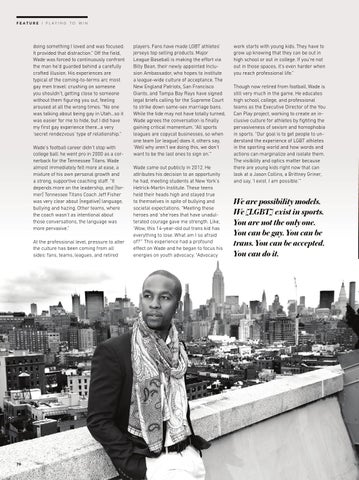
doing something I loved and was focused. It provided that distraction.” Off the field, Wade was forced to continuously confront the man he’d guarded behind a carefully crafted illusion. His experiences are typical of the coming-to-terms arc most gay men travel: crushing on someone you shouldn’t, getting close to someone without them figuring you out, feeling aroused at all the wrong times. “No one was talking about being gay in Utah...so it was easier for me to hide, but I did have my first gay experience there...a very ‘secret rendezvous’ type of relationship.” Wade’s football career didn’t stop with college ball; he went pro in 2000 as a cornerback for the Tennessee Titans. Wade almost immediately felt more at ease, a mixture of his own personal growth and a strong, supportive coaching staff. “It depends more on the leadership, and [former] Tennessee Titans Coach Jeff Fisher was very clear about [negative] language, bullying and hazing. Other teams, where the coach wasn’t as intentional about those conversations, the language was more pervasive.” At the professional level, pressure to alter the culture has been coming from all sides: fans, teams, leagues, and retired
70
players. Fans have made LGBT athletes’ jerseys top selling products. Major League Baseball is making the effort via Billy Bean, their newly appointed Inclusion Ambassador, who hopes to institute a league-wide culture of acceptance. The New England Patriots, San Francisco Giants, and Tampa Bay Rays have signed legal briefs calling for the Supreme Court to strike down same-sex marriage bans. While the tide may not have totally turned, Wade agrees the conversation is finally gaining critical momentum. “All sports leagues are copycat businesses, so when one team [or league] does it, others say, ‘Well why aren’t we doing this, we don’t want to be the last ones to sign on.’” Wade came out publicly in 2012. He attributes his decision to an opportunity he had, meeting students at New York’s Hetrick-Martin Institute. These teens held their heads high and stayed true to themselves in spite of bullying and societal expectations. “Meeting these heroes and ‘she’roes that have unadulterated courage gave me strength. Like, ‘Wow, this 14-year-old out trans kid has everything to lose. What am I so afraid of?’” This experience had a profound effect on Wade and he began to focus his energies on youth advocacy. “Advocacy
work starts with young kids. They have to grow up knowing that they can be out in high school or out in college. If you’re not out in those spaces, it’s even harder when you reach professional life.” Though now retired from football, Wade is still very much in the game. He educates high school, college, and professional teams as the Executive Director of the You Can Play project, working to create an inclusive culture for athletes by fighting the pervasiveness of sexism and homophobia in sports. “Our goal is to get people to understand the experience of LGBT athletes in the sporting world and how words and actions can marginalize and isolate them. The visibility and optics matter because there are young kids right now that can look at a Jason Collins, a Brittney Griner, and say, ‘I exist. I am possible.’”
We are possibility models. We [LGBT] exist in sports. You are not the only one. You can be gay. You can be trans. You can be accepted. You can do it.