BLUEPRINT
THE SLIDE 1 9 T H C E N T U R Y A M E R I C A’ S M O S T N O T O R I O U S G AY B A R
THE BOWERY BOYS TAKE US ALONG AS THEY DIG BENEATH THE PAVEMENT TO FIND OUT SOME SURPRISING FACTS ABOUT ONE OF THE CITY’S MOST RAUCOUS PARTIES. Gay and lesbian life in 19th century America meant reading between the lines, latching on to known code words to locate a community buried deep under the mainstream. But you may not have had to look very far in the early 1890s to locate The Slide (157 Bleecker St.), once one of New York’s most notorious and flamboyant bars. We know of its existence primarily due to the pearl-clutching reaction of moral-minded New Yorkers. While you can’t trust police blotters and morality crusaders to give an accurate depiction of what The Slide was truly like, an attempt to peel back the hyperbole provides a sight that would rival the bawdiest gay bars of Hell’s Kitchen. The Slide was a basement dive, packed every night with men who fancied “male degenerates” and the occasional female looking for something outrageous. Music, drinking, and laughter prevailed until the early morning; female prostitutes mingled with the boys to create what must have been a dizzying stew of genders, the air filled with cheap booze, wild sex (“orgies beyond description”), and tunes banged out on an old piano. Newspapers described it as a “fairy resort.” Men openly wore drag to the delight of patrons, of which there were many, according to one scandalized report, “one to three hundred people, most of
54
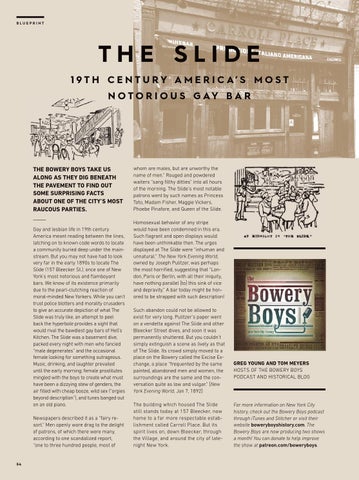
whom are males, but are unworthy the name of men.” Rouged and powdered waiters “sang filthy ditties” into all hours of the morning. The Slide’s most notable patrons went by such names as Princess Toto, Madam Fisher, Maggie Vickers, Phoebe Pinafore, and Queen of the Slide. Homosexual behavior of any stripe would have been condemned in this era. Such flagrant and open displays would have been unthinkable then. The urges displayed at The Slide were “inhuman and unnatural.” The New York Evening World, owned by Joseph Pulitzer, was perhaps the most horrified, suggesting that “London, Paris or Berlin, with all their iniquity, have nothing parallel [to] this sink of vice and depravity.” A bar today might be honored to be strapped with such description! Such abandon could not be allowed to exist for very long. Pulitzer’s paper went on a vendetta against The Slide and other Bleecker Street dives, and soon it was permanently shuttered. But you couldn’t simply extinguish a scene as lively as that of The Slide. Its crowd simply moved to a place on the Bowery called the Excise Exchange, a place “frequented by the same painted, abandoned men and women, the surroundings are the same and the conversation quite as low and vulgar.” [New York Evening World, Jan 7, 1892] The building which housed The Slide still stands today at 157 Bleecker, now home to a far more respectable establishment called Carroll Place. But its spirit lives on, down Bleecker, through the Village, and around the city of latenight New York.
GREG YOUNG AND TOM MEYERS HOSTS OF THE BOWERY BOYS PODCAST AND HISTORICAL BLOG
For more information on New York City history, check out the Bowery Boys podcast through iTunes and Stitcher or visit their website boweryboyshistory.com. The Bowery Boys are now producing two shows a month! You can donate to help improve the show at patreon.com/boweryboys.