OPINION
TO
AS WE NEAR A SUPREME COURT DECISION THAT WILL HOPEFULLY RENDER MARRIAGE EQUALITY THE LAW OF THE LAND, BOTH SUPPORTERS AND OPPONENTS ARE ASKING THE SAME QUESTION: “HOW WAS THE GAY RIGHTS MOVEMENT IN THE UNITED STATES ABLE TO MOVE FASTER AND FARTHER THAN ANY PRECEDING CIVIL RIGHTS MOVEMENT?” MY ANSWER DRAWS ON A LONGSTANDING DEBATE IN CONSTITUTIONAL LAW ABOUT THE NATURE OF DISEMPOWERED GROUPS.
In 1938, the United States Supreme Court stated that groups were more likely to be disadvantaged if they were “discrete and insular” minorities. Scholars have interpreted “discrete” to mean visibly different and “insular” to mean geographically isolated. The paradigm case: segregated Blacks. In 1985, constitutional law professor Bruce Ackerman argued that the Court had gotten it exactly wrong, maintaining that “anonymous and diffuse” minorities were even more vulnerable, invoking gays as a core example. Because gays were generally able to pass, he contended, our search and mobilization costs were higher (hence the wish of gay rights activists that all gay people would wake up blue one day). And because gays were dispersed throughout society, we were politically isolated—we could not, for instance, vote out a representative from a majority-minority district. When I first read Ackerman’s analysis as a law student in the mid-1990s, I thought he was dead right. But I soon had to modify my view. Somewhere around the turn of this millennium, a critical mass of gay individuals had come out of the closet. When that happened, we reached a tipping point where the gay rights movement rocketed forward. And we did so not in spite of, but because of, our anonymity and diffuseness. Because we are anonymous, gatekeeping mechanisms have never worked against us as they have worked against racial minorities or women. Gays have always populated all of society’s most powerful sectors, including the media, the military, the entertainment industry, politics, and corporations. When it became relatively safe to come out, gay people did so at the highest levels of influence—from Anderson Cooper to Tim Cook. And because we are diffuse, we were already in close contact with the folks we needed to persuade. Every extended family in America has a gay family member, meaning that many gays (though sadly not all) found an army of allies on the other side of the closet door—from the Cheneys to the Portmans. Ackerman’s thesis, then, is both right and wrong, depending on whether the “anonymous and diffuse” group has achieved a critical mass. So to complete the dream of gay equality, we need to create that mass on a global scale.
26
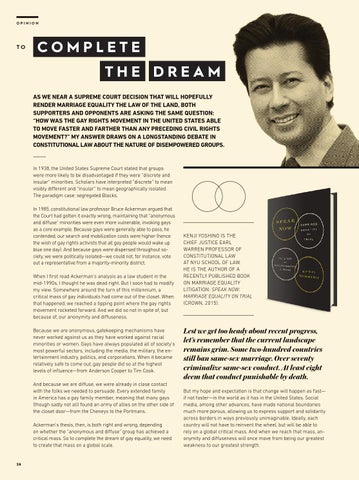
KENJI YOSHINO IS THE CHIEF JUSTICE EARL WARREN PROFESSOR OF CONSTITUTIONAL LAW AT NYU SCHOOL OF LAW. HE IS THE AUTHOR OF A RECENTLY PUBLISHED BOOK ON MARRIAGE EQUALITY LITIGATION: SPEAK NOW: MARRIAGE EQUALITY ON TRIAL (CROWN, 2015).
Lest we get too heady about recent progress, let’s remember that the current landscape remains grim. Some two-hundred countries still ban same-sex marriage. Over seventy criminalize same-sex conduct. At least eight deem that conduct punishable by death. But my hope and expectation is that change will happen as fast— if not faster—in the world as it has in the United States. Social media, among other advances, have made national boundaries much more porous, allowing us to express support and solidarity across borders in ways previously unimaginable. Ideally, each country will not have to reinvent the wheel, but will be able to rely on a global critical mass. And when we reach that mass, anonymity and diffuseness will once move from being our greatest weakness to our greatest strength.