K
The portrait
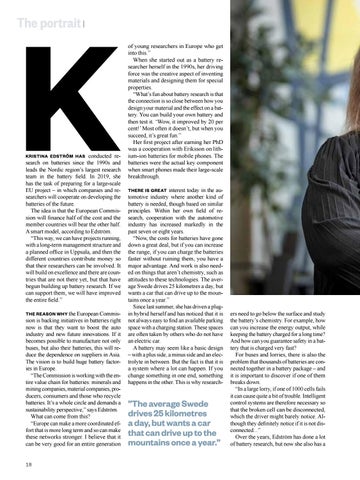
KRISTINA EDSTRÖM HAS conducted re
search on batteries since the 1990s and leads the Nordic region’s largest research team in the battery field. In 2019, she has the task of preparing for a large-scale EU project – in which companies and re searchers will cooperate on developing the batteries of the future. The idea is that the European Commis sion will finance half of the cost and the member countries will bear the other half. A smart model, according to Edström. “This way, we can have projects running, with a long-term management structure and a planned office in Uppsala, and then the different countries contribute money so that their researchers can be involved. It will build on excellence and there are coun tries that are not there yet, but that have begun building up battery research. If we can support them, we will have improved the entire field.”
THE REASON WHY the European Commis sion is backing initiatives in batteries right now is that they want to boost the auto industry and new future innovations. If it becomes possible to manufacture not only buses, but also their batteries, this will re duce the dependence on suppliers in Asia. The vision is to build huge battery factor ies in Europe. “The Commission is working with the en tire value chain for batteries: minerals and mining companies, material companies, pro ducers, consumers and those who recycle batteries. It’s a whole circle and demands a sustainability perspective,” says Edström. What can come from this? “Europe can make a more coordinated ef fort that is more long term and so can make these networks stronger. I believe that it can be very good for an entire generation
18
of young researchers in Europe who get into this.” When she started out as a battery re searcher herself in the 1990s, her driving force was the creative aspect of inventing materials and designing them for special properties. “What’s fun about battery research is that the connection is so close between how you design your material and the effect on a bat tery. You can build your own battery and then test it. ‘Wow, it improved by 20 per cent!’ Most often it doesn’t, but when you succeed, it’s great fun.” Her first project after earning her PhD was a cooperation with Eriksson on lith ium-ion batteries for mobile phones. The batteries were the actual key component when smart phones made their large-scale breakthrough. THERE IS GREAT interest today in the au tomotive industry where another kind of battery is needed, though based on similar principles. Within her own field of research, cooperation with the automotive industry has increased markedly in the past seven or eight years. “Now, the costs for batteries have gone down a great deal, but if you can increase the range, if you can charge the batteries faster without ruining them, you have a major advantage. And work is also need ed on things that aren’t chemistry, such as attitudes to these technologies. The aver age Swede drives 25 kilometres a day, but wants a car that can drive up to the moun tains once a year.” Since last summer, she has driven a plugin hybrid herself and has noticed that it is not always easy to find an available parking space with a charging station. These spaces are often taken by others who do not have an electric car. A battery may seem like a basic design – with a plus side, a minus side and an elec trolyte in between. But the fact is that it is a system where a lot can happen. If you change something in one end, something happens in the other. This is why research
”The average Swede drives 25 kilometres a day, but wants a car that can drive up to the mountains once a year.”
ers need to go below the surface and study the battery’s chemistry. For example, how can you increase the energy output, while keeping the battery charged for a long time? And how can you guarantee safety in a bat tery that is charged very fast? For buses and lorries, there is also the problem that thousands of batteries are con nected together in a battery package – and it is important to discover if one of them breaks down. “In a large lorry, if one of 1000 cells fails it can cause quite a bit of trouble. Intelligent control systems are therefore necessary so that the broken cell can be disconnected, which the driver might barely notice. Al though they definitely notice if it is not dis connected...” Over the years, Edström has done a lot of battery research, but now she also has a