ENVIRONMENTAL CONSCIENCE
Law ’73 Chair, Master of Science (Environmental Management) Programme Management Committee and Associate Professor, Faculty of Law
Assoc Prof Lye Lin-Heng (Law ’73) holds Master’s degrees in law from the University of London and Harvard University. She is also Deputy Director of the Law Faculty’s Asia-Pacific Centre for Environmental Law (APCEL), Deputy Chair of the IUCN Academy of Environmental Law and former Chair of the Academy’s Teaching and Capacity-Building Committee. Assoc Prof Lye has served as Chair of the MEM Programme since its inception, and has been instrumental in turning what started out as a good idea into a reality. Today, she teaches the compulsory MEM module on Environmental Law and oversees the progress of the programme.
You were there at the genesis of the MEM programme. What was the motivation behind a multi-disciplinary approach? I’m an environmental lawyer but I tell my students, “It’s not enough (to just know the law).” You need the institutions, the right policies; sound land-use planning; and you have to build the environmental infrastructure. For example, you can have a good water law but if you do not have sewage and trade effluent treatment plants, your rivers will still be polluted. The laws have to be enforced, and here, you need a clean government. Everything is inter-related. We were motivated because the environment must be a major concern – every university must have a good programme on the environment. How does MEM compare with what other universities are doing? Before we started this programme, we scouted for good partners, and found the Yale School of Forestry and Environmental Studies (FES), the oldest environment school in the US. They were happy to join us. Today, Prof Marian Chertow, an expert on industrial ecology at Yale, co-teaches the Business and the Environment module. I go to Yale each year to teach a course on Comparative Environmental Law 12
ALUMNUS
to their students. Some of my colleagues have also taught there. It all worked very well. We have also partnered with the Nicholas School of the Environment and Earth Sciences at Duke University. [As for differences], FES is a comprehensive school in Yale but not us. We have professors from different faculties teaching our MEM classes. It is quite amazing that our different departments work so well together. We’re real pioneers here. Not many universities can pull this off. Why is such a system good? I can say collaboration between faculties is very positive. We (teaching staff) learn from each other as well. A number of us make it a point to attend the fortnightly MEM seminars. We get speakers from different disciplines and it’s open to the public. These seminars expand and enrich our perspectives. Even in my own classes in the Law school, I invite colleagues from other faculties to share their views – so Prof Peter Ng shares his perspectives as a scientist on the workings of the Convention on Biodiversity, for example. In turn, I teach a class to his students on Environmental Law. Now we’re collaborating with professors from the NUS Business School. It’s very positive: they’ve started a Chair there, the Mochtar Riady Professorship in Sustainability.
What do you hope to see in the next 10 years for MEM? I would like the programme to be strengthened. It would be good to have a one-and-a-half year (three semesters) or two-year (four semesters) full-time programme. The programme is very packed now. However we are concerned about the increased costs for students from developing countries. Ideally, we would also like to implement a student exchange programme with Duke and Yale but this is only possible if we have at least a threesemester programme. What improvements can Singapore make by way of its environmental laws? Two things I hope to see: one, recycling laws. Basically, we need a law to compel people to separate their wastes. Taiwan, South Korea and Japan have excellent laws on recycling. Here, we have private garbage chutes in our apartments, so even if we had a law, it cannot be enforced. This has to stop. HDB now builds apartments with a waste disposal chute outside, but there is no separate chute for recyclables. This is fine if we are socially responsible, but in Singapore, regrettably, people only change if there is a law to compel them. Two, we should have an Environment Impact Assessment law (EIA). The EIA is basically a “look before you leap” law, to see how a proposed project impacts the environment. The public should have an opportunity to comment. The decision lies with the government. The EIA enables them to make an informed decision. If the project has to proceed, sound mitigating measures can be undertaken. Environmental sustainability requires political will and a clean government. The whole picture is an integrated one.
Environmental sustainability requires political will and a clean government. The whole picture is an integrated one.
PROFESSOR LEO TAN BSc (Zoology) ’69 and PhD, Marine Biology ’74 Professor, Department of Biological Sciences and Director, Special Projects, Faculty of Science
Prof Tan is renown for many achievements in the spheres of the environment and nature, among them being the Chairman who transformed NParks during his tenure from 1998 to 2007. His vision of turning Singapore from Garden City into City In A Garden has come to pass with the creation of Gardens By The Bay. A passionate marine biologist and conservationist, he championed the conservation of the ecosystems at Labrador Park – now the protected Labrador Nature Reserve. Among his many other contributions is the reforestation of Pulau Semakau. Within NUS, he is a fearless fundraiser, most notably for the upcoming Lee Kong Chian Natural History Museum.
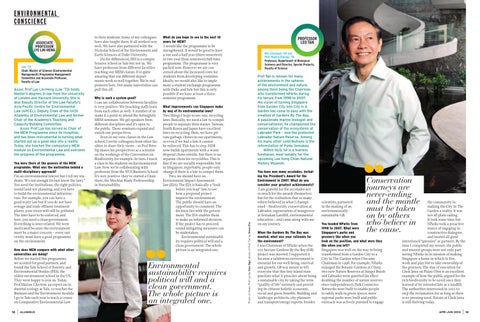
Photo of Assoc Prof Lye by Stan Ngo; photo of Prof Tan by Steve Zhu
ASSOCIATE PROFESSOR LYE LIN-HENG
You have won many accolades, including the President’s Award for the Environment in 2007. What do you consider your greatest achievements? I am grateful for the accolades not so much for the awards themselves but for the realisation that so many others believed in what I championed – biodiversity conservation at Labrador, regeneration of mangroves at Semakau Landfill, environmental education – and came along with me on my journey. When the Gardens By The Bay was mooted, what was your rationale for the environment? I was Chairman of NParks when the 101-hectare Gardens By the Bay (GB) project was mooted. I supported it because a salubrious environment is essential for our well-being, survival and growth. GB was meant to tell everyone that this tiny island state practises what it preaches about being a sustainable city by taking the term “quality of life” seriously and providing its citizens holistic economic, social and green benefits. Building and landscape architects, city planners and transport/energy experts, besides
scientists, partnered in the making of an environmentallysustainable GB.
Conservation journeys are never-ending and the mantle must be taken on by others who believe in the cause.
You headed NParks from 1998 to 2007. What were Singapore’s parks and greenery like when you took on the position, and what were they like when you left? Singapore was well on the way to being transformed from a Garden City to a City In The Garden when I became Chairman in 1998. For example, NParks enlarged the Botanic Gardens at Cluny, two new Nature Reserves at Sungei Buloh and Labrador were gazetted (in effect doubling the number of nature reserves since independence), Park Connector Networks were built to enable people to safely walk in green spaces, more regional parks were built and public outreach was actively pursued to engage
the community in making the City In The Garden a reality. It was not all plain sailing. It took some time but NParks took a proactive stance of engaging in constructive dialogues and treated all good intentioned “greenies” as partners. By the time I completed my tenure, the public and interest groups were not only partnering NParks in its mission of making Singapore a home in which to live, work and play but to take ownership of the greenery. The stay of execution for Chek Jawa on Pulau Ubin is an excellent example of how the public argued for the rich biodiversity to be saved once they learned of its intended fate as a landfill. The authorities intervened in 2001 to stop the reclamation for as long as there is no pressing need. Nature at Chek Jawa is still thriving today. APR–JUN 2013
13