2010 soundcheck •
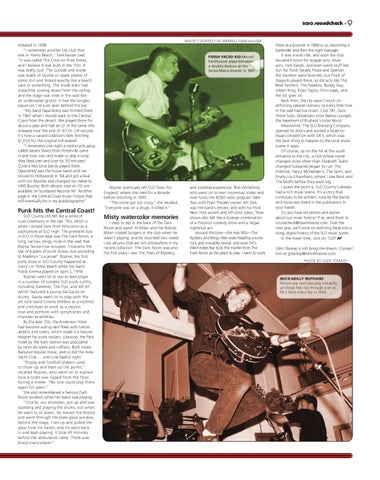
released in 1998. “I remember another old club that was in Pismo Beach,” Fankhauser said. “It was called The Cove on Price Street, and I believe it was built in the ‘50s. It was really cool. The outside and inside was made of Gunite or ripple plaster of some sort and looked exactly like a beach cave or something. The inside even had stalactites coming down from the ceiling, and the stage was inset in the wall like an underwater grotto. It had the longest aquarium I’ve ever seen behind the bar. “My band Fapardokly was formed there in 1967 when I moved back to the Central Coast from the desert. We played there for about a year and had an LP of the same title released near the end of ‘67 on UIP records. It’s now a valued collectors item fetching $1,000 for the original still sealed! “I remember one night a motorcycle gang called Satans Slaves from Porterville came in and took over and made us play a song they liked over and over for 30 minutes! Quite a few local bands played there. Fapardokly was the house band until we moved to Hollywood in ‘68 and got a deal with Uni Records and changed our name to HMS Bounty. Both albums now on CD are available on Sundazed Records NY. Another page in the Central Coast music history that will eventually be in my autobiography!”
Punk hits the Central Coast! SLO County still felt like a series of rural cowtowns in the late ‘70s, which is when I moved here from Wisconsin as a sophomore at SLO High. The premiere club in SLO in those days was The Dark Room, a long, narrow, dingy, hole-in-the-wall that Buena Tavola now occupies. It became the site of dozens of punk shows, but according to Madelyn “Lucymad” Ropner, the first punk show in SLO County happened at Harry’s in Pismo Beach when her band Public Enema played on April 2, 1978. Ropner went on to star as lead singer in a number of notable SLO punk outfits, including Slammer, The Flyz, and AK-47, which featured a young Sal Garza on drums. Garza went on to play with the art rock band Downy Mildew as a violinist and continues to work as a session man and perform with symphonies and chamber ensembles. By the late-‘70s, the Anderson Hotel had become a drug den filled with heroin addicts and losers, which made it a natural magnet for punk rockers. Likewise, the Park Hotel by the train station was populated by ne’er-do-wells and ruffians. Both hotels featured regular music, and so did the Avila Yacht Club … until one fateful night. “Rugby and football players used to show up and beat up the punks,” recalled Ropner, who went on to explain how a toilet was ripped from the floor during a melee. “No one could play there again for years.” She also remembered a famous Dark Room incident when her band was playing. “Charlie, our drummer, got up and was standing and playing the drums, but when he went to sit down, he missed the throne and went through the plate glass window behind the stage. I ran up and pulled the glass from his hands, and he went back in and kept playing. It took 45 minutes before the ambulance came. There was blood everywhere!”
PHOTO COURTESY OF MERRELL FANKHAUSER
FRESH FACED KID Merrell Fankhauser plays between a double feature at the Santa Maria theater in 1961
Ropner eventually left SLO Town for England, where she lived for a decade before returning in 1995. “The scene got too crazy,” she recalled. “Everyone was on a drugs. It killed it.”
Misty watercolor memories I used to slip in the back of the Dark Room and watch Al Milan and the Robots. Milan cooked burgers in the club when he wasn’t playing, and he recorded two sweet rock albums that are still somewhere in my record collection. The Dark Room was also the first place I saw The Trees of Mystery,
and indelible experience. Bob Whiteford, who went on to own Insomniac Video and now hosts the KCBX radio program Take Two with Plam Theater owner Jim Dee, was the band’s emcee, and with his thick New York accent and off-color jokes, Trees shows also felt like a strange combination of a Poconos comedy show and a Vegas nightclub act. Around this time—the mid-‘80s—The Ripsters and Bingo Nite were heading a roots rock and rockabilly revival, and soon DK’s West Indies Bar took the mantel from The Dark Room as the place to play. I went to work
9
there as a bouncer in 1988 or so, becoming a bartender and then the night manager. It was a wild ride, and soon the club became known for reggae acts, blues acts, rock bands, and even weird stuff like Sun Ra. Rock Steady Posse and Spencer the Gardner were favorites, but Flock of Seagulls played there, as did acts like The Beat Farmers, The Paladins, Buddy Guy, Albert King, Koko Taylor, Chris Isaak, and the list goes on. Back then, the city wasn’t much on enforcing cabaret licenses, so every little hole in the wall had live music: Club 781, Osos Street Subs, Sebastians (now Native Lounge), the basement of Brubeck’s (now Novo). Meanwhile, The SLO Brewing Company opened its doors and started a head-tohead competition with DK’s, which was the best thing to happen to the local music scene in ages. Of course, up on the hill at the south entrance to the city, a club whose name changed more often than Elizabeth Taylor changed husbands began its run: The Hobnob, Yancy McFadden’s, The Spirit, and finally Loco Ranchero, where I saw Beck and The Muffs before they went big. I guess the point is, SLO County’s always had a rich music scene. It’s a story that continues to be written, now by the bands and musicians listed in the publication in your hands. Do you have old photos and stories about our music history? If so, send them to soundcheck@newtimesslo.com. Over the next year, we’ll work on archiving these into a living, digital history of the SLO music scene. In the mean time, rock on, SLO! S✔ Glen Starkey is still living the dream. Contact him at gstarkey@newtimesslo.com. PHOTO BY GLEN STARKEY
ROCKABILLY RUFFIANS Notoriously hard partying rockabilly act Bingo Nite rips through a set at DK’s West Indies Bar in 1990.