A
U
S
T
R
A
L
I
A
N
Overall Effectiveness
N
I
V
Average Score
E
R
S
I
T
I
Activity
6.6
Your lectures
6.0
Lectures report
6.0
Final report
6.0
Your tutorials
6.0
Design report
5.9
Observing lectures
5.9
Working with guide
E
S
’
R
E
V
I
E
W
Effectiveness
Highly Effective
for undertaking Pinnacle. When this participant’s responses were tracked through the survey data, it emerged that despite their primarily financial motivation, they still rated Pinnacle highly, found it effective and would recommend it to a colleague. It is clear from the results that the majority of participants undertook the programme because they wanted to learn about teaching and improve their teaching skills.
U
Moderately Effective
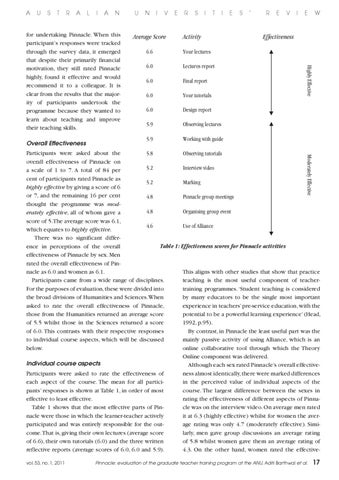
Participants were asked about the 5.8 Observing tutorials overall effectiveness of Pinnacle on 5.2 Interview video a scale of 1 to 7. A total of 84 per cent of participants rated Pinnacle as 5.2 Marking highly effective by giving a score of 6 or 7, and the remaining 16 per cent 4.8 Pinnacle group meetings thought the programme was mod4.8 Organising group event erately effective, all of whom gave a score of 5.The average score was 6.1, 4.6 Use of Alliance which equates to highly effective. There was no significant differTable 1: Effectiveness scores for Pinnacle activities ence in perceptions of the overall effectiveness of Pinnacle by sex. Men rated the overall effectiveness of Pinnacle as 6.0 and women as 6.1. This aligns with other studies that show that practice Participants came from a wide range of disciplines. teaching is the most useful component of teacherFor the purposes of evaluation, these were divided into training programmes. ‘Student teaching is considered the broad divisions of Humanities and Sciences. When by many educators to be the single most important asked to rate the overall effectiveness of Pinnacle, experience in teachers’ pre-service education, with the those from the Humanities returned an average score potential to be a powerful learning experience’ (Head, of 5.5 whilst those in the Sciences returned a score 1992, p.95). of 6.0. This contrasts with their respective responses By contrast, in Pinnacle the least useful part was the to individual course aspects, which will be discussed mainly passive activity of using Alliance, which is an below. online collaborative tool through which the Theory Online component was delivered. Individual course aspects Although each sex rated Pinnacle’s overall effectiveParticipants were asked to rate the effectiveness of ness almost identically, there were marked differences each aspect of the course. The mean for all particiin the perceived value of individual aspects of the pants’ responses is shown at Table 1, in order of most course. The largest difference between the sexes in effective to least effective. rating the effectiveness of different aspects of PinnaTable 1 shows that the most effective parts of Pincle was on the interview video. On average men rated nacle were those in which the learner-teacher actively it at 6.3 (highly effective) whilst for women the averparticipated and was entirely responsible for the outage rating was only 4.7 (moderately effective). Simicome. That is, giving their own lectures (average score larly, men gave group discussions an average rating of 6.6), their own tutorials (6.0) and the three written of 5.8 whilst women gave them an average rating of reflective reports (average scores of 6.0, 6.0 and 5.9). 4.3. On the other hand, women rated the effectivevol. 53, no. 1, 2011
Pinnacle: evaluation of the graduate teacher training program at the ANU, Aditi Barthwal et al.
17