



















Go to the App Store or Google Play and search “NPMHU” to install and use at no charge











Go to the App Store or Google Play and search “NPMHU” to install and use at no charge





FOR YOUR IPHONE OR ANDROID SMARTPHONE





We are pleased to provide this communication tool to all Mail Handlers. You can access the latest news, updates, events, and information of organizational importance. THE APP’S FEATURES INCLUDE:





+ Current NPMHU news with periodic push notifications of importance









+ Legislative and Political NPMHU Action Center


+ Quadrennial Convention Information
+ NPMHU Women’s Committee



+ Current Wage Charts


Paul V. Hogrogian National President
Kevin P. Tabarus Secretary-Treasurer
June Harris Vice President Central Region
John A. Gibson
Vice President Eastern Region
David E. Wilkin
Vice President Northeastern Region
Lawrence B. Sapp
Vice President Southern Region
Don J. Sneesby
Vice President Western Region
The Mail Handler, ISSN:1098-5689, is published quarterly by the National Postal Mail Handlers Union, 815 16th St, N.W. Suite 5100, Washington, DC 20006. Periodicals postage paid at Washington, D.C. and additional mailing offices.
POSTMASTER: Send address changes to The Mail Handler, 815 16th St, N.W. Suite 5100, Washington, DC 20006. Copyright 2024: National Postal Mail Handlers Union. All rights reserved. Reproduction without permission is prohibited. The Mail Handler is published for the members of our union. For additional copies please send $2.00 to: National Postal Mail Handlers Union—National Headquarters, 815 16th St, N.W. Suite 5100, Washington, DC 20006, (202) 833-9095.


Paul V. Hogrogian, National President
Dear Members:
Earlier this year the Postal Service announced what it called “Mail Processing Facility Reviews” (MPFRs) for approximately sixty sites. The Postal Service had determined that there was a need to consolidate certain mail processing operations from these facilities into other processing centers. The plan was to move ALL Outgoing/Originating mail (letters/ flats and parcels) from the targeted installation to a centralized Mail Processing Facility (MPF). The targeted facilities included:
• Provo
• Minneapolis
• Trenton
• Wilmington
• South Jersey
• Lehigh Valley
• Bethlehem
• Scranton
• Columbia, MO
• Springfield, MO
• Tacoma
• Yakima
• Wenatchee
• Missoula
• Knoxville
• El Paso
• Fayetteville
• Dakota Central
• Bismarck
• Grand Forks
• Bemidji
• Cheyenne
• North Platte
• Grand Junction
• Buffalo
• Charleston, WV
• Johnston
• Eastern Maine
• Fort Myers
• Champaign
• Peoria
• Lubbock
• Midland
• Abilene
• Brockton
• Burlington
• Casper
• Charleston
• White River Junction
• Fresno
• Reno
• Gulfport
• Quad Cities
• Waterloo
• Iron Mountain
• Sioux Falls
• Manchester

While some of these consolidations made sense, others did not. The original concept was to centralize mail processing among facilities in a metropolitan area within a 50-mile radius. The Postal Service’s plans, in some instances, have extended much further than that, often exceeding one hundred miles, sometimes exceeding two hundred miles. This would mean that a letter mailed across town would travel to a centralized facility (often 100–200 miles away), be processed there and then returned to the original facility for local processing. We have and will continue to argue to the Postal Service that they must reevaluate the situation, reconsider these plans and implement a more reasonable and rational plan.
Many representatives in Congress have also voiced their opposition to the Mail Processing Facility reviews. At least four separate bills have been introduced in Congress to stop the consolidations until service performance improves. A bi-partisan group of twenty-six Senators signed a letter to pause all changes to the delivery network until the Postal Regulatory Commission reviews the proposed changes. Ron Stroman, a member of the Board of Governors and former Deputy Postmaster General, called on the Service to slow down network changes until service scores improves and “has gotten close to our service targets for 2024.”
The Postal Service has now announced a change in their plans. The Postal Service’s plans propose improvements in mail processing and transportation. The Postal Service now proposes to continue mail cancellation operations in thirty-six of the proposed sixty MPFR sites. The “local” mail processed there will therefore remain in the local area, thereby avoiding the unnecessary round trips of several hundreds of miles. The Postal Service claims that the proposed changes will maintain the existing 1–5-day service standards for first class mail.
The NPMHU has not yet been supplied with a complete list of the thirty-six facilities where local mail will remain local. However, the Postal Service has already announced that its plans to send ALL Outgoing mail from Reno, Nevada to Sacramento, California have now changed. The Reno Postal facility will now continue certain local originating mail processing operations. Outgoing single piece mail will continue to be processed at its current location in Reno.
The Postal Service anticipated staffing impacts due to the proposed move of originating operations to Sacramento. However, with the decision to keep these operations at the Reno facility, there are no anticipated employee impacts. We are hopeful of comparable results in the other thirty-five MPFR sites where the local mail will be processed locally.
The Postal Service also announced that “local” mail in Charleston, WV and Bismarck, ND will also remain “local.”
It is worth repeating that these plans are extremely fluid and subject to change. The National Office will provide updates on this project as we receive more information.
The NPMHU will ensure that the Postal Service complies with all the provisions of our National Agreement especially those contained in Article 12 and keeping all dislocation and inconvenience to Mail Handlers to an absolute minimum when implementing these plans.
3. Jersey City, NJ
4. St Louis, MO
5. Sacramento, CA
6. Philadelphia, PA
7. Westchester, NY
8. San Jose, CA
9. Trenton, NJ
10. Palatine, IL
11. Grand Rapids, MI
The target Launch Date is September 23, 2024, and the anticipated ramp down period (if no Phase 8) is October 21 to November 27, 2024.
This program provides Mail Handlers with another opportunity to perform an essential Public Health Service to the American people.
The proposed changes should not impact Election Mail for the upcoming elections. The Postal Service has outlined its preparedness for the secure and successful delivery of Election Mail during the 2024 general election. The USPS will draw from its successes during the 2020 and 2022 elections. In the 2020 general election, the Postal Service delivered 99.89% of ballots from voters to election officials within seven days. The 2022 midterm elections saw a similar level of efficiency with 99.93% delivered within seven days.
USPS officials announced that it will once again implement proven extraordinary measures in the weeks immediately before and after the election (October 21 to November 15, 2024) to enhance the timely delivery of mail-in ballots entered close to Election Day or the state’s designated ballot return deadline. These efforts may include extra pick-ups, extra deliveries, extended hours and special sort plans on processing equipment to expedite and enhance ballot delivery.
The Postal Service has already committed to pause the movement of mail and packages identified in the Mail Processing Facility Reviews until early 2025.
The Postal Service has once again established Election Task Forces at the National, Local and Branch levels. Mail Handlers will serve on the Local and Branch Task Forces while NPMHU Political and Legislative Director Katie Maddocks will represent the NPMHU on the National Election Committee.
The NPMHU was recently inducted into the Department of Labor’s “Century of Service Honor Roll of American Labor Organizations.” The Honor Roll showcases unions who have reached 100 years. The ceremony, which was hosted by Acting Secretary of Labor Julie Su, was held at the Frances Perkins


Building in Washington, DC on September 17, 2024. I had the privilege of representing the NPMHU at the ceremony. It is certainly a great honor reflecting our great organization and its great membership.
I remain confident that through the work of our Contract Administration Department and our legal representatives, and through the hard work of our Regional, Local, and Branch representatives, we can successfully meet all challenges that lie before us.
Fraternally,
The Postal Service has received the go ahead to move forward with Phase 7 for the processing/shipping of COVID test kits. The proposed COVID test kits fulfillment sites are:
1. Cleveland, OH
2. Industry, CA
Paul V. Hogrogian National President
Kevin P. Tabarus, National Secretary-Treasurer
The NPMHU National Convention was a success. Hundreds of Delegates and their guests attended the convention at Caesar’s Palace in Las Vegas. Delegates were “ALL IN” to set the course for this Union for the next four (4) years.
This was my first NPMHU National Convention as National-Secretary Treasurer, which I shall forever refer to as my own personal “hell week.” What brought this convention together was definitely not just me, but the entire amazing team of people we have at the NPMHU. I keep getting more and more impressed each day with the professionalism and dedication of our team. Everyone chipped in and went well above and beyond to ensure the convention ran smoothly. This included some of the key members of the Contract Administration Department; Teresa Harmon, Tom Ruther, Eugene Horton, Andy Badilishamwalimu, Eileen Mills, Patrick Donovan, Nick Lehto, Max Rehbein, and Von Morse. Also, from our National Office; Executive Assistant to the National Officers — Ponise Shields, Legislative and Political Director — Katie Maddocks, and MHBP Executive Director — Nina Gallauresi. Several MHBP Aetna/CVS Health Representatives took time out of their busy schedules to attend the convention and answer any questions the Delegates had about the MHBP and PSHB.
I was also very proud of the work of the entire National Executive Board — Lawrence Sapp, Dave Wilkin, John Gibson, June Harris, and Don Sneesby. Special thanks to our National President Paul Hogrogian for running the convention and ensuring that everything, every detail was handled with professionalism.
I and all of you should also be extremely grateful for the National Team that did not travel to the convention. Keva, Luciana, James, Giselle, Helen, Claire and Sue stayed in the NPMHU offices ensuring that this Union continued to operate while we were away.
The members of the Convention Committees participated and contributed. They all engaged in productive and professional debates for the betterment of this labor union.
Our legal team was amazing; Scott Burns our Convention Parliamentarian, Paralegals Declan and Annie, Senior Counsel

Bruce Lerner. Special mention to our General Counsel Matthew Clash-Drexler, who left in the middle of the convention taking a “red-eye” flight to the east coast to move his son to college and was back on another “red-eye” flight to be back at the convention the following day.
The glue that held everything together were several core people on the NPMHU Team that I am extremely grateful for their hard work and dedication to this Union. Noah Giebel, Keanna Whitlock, Rachelle Clark, Neil Ryan, and Patrick Donovan.
Several members of the LiUNA General Executive Board left the Democratic National Convention in Chicago on Tuesday morning, just to come to show solidarity and fly back to the DNC on Tuesday afternoon. GEB members Bob Abbott, Ernie Ordonez and Danny Bianco made the trip. General Secretary-Treasurer Michael Sabitoni gave a rousing address to the delegation showing LiUNA’s solidarity with the NPMHU.
Reports were given from the National Officers, National President Paul Hogrogian and myself. Paul updated the delegation on the state of the Union. More detailed reports can be found in this issue on pages 38–50.
All the months and years of preparation for this convention finally paid off.
I might have described a lot of names to you, but these are our people. These are your people. The Union on the workroom floor and at the National Office are much more than one person.
Finally, I ask that all of you vote on this election day. Vote like your job depends on it. Since it does this time! If you want to keep your job in 2025, vote for Kamala Harris and Tim Walz. Everyone should be registered to vote. Also, VOTE BY MAIL!
Fraternally,
Kevin P. Tabarus National Secretary-Treasurer








The phrase has come to have several meanings of uses. From a basic historical context, it is used to suggest that something has or will come to an end and usually in an unsatisfactory or unusual manner. In another vernacular the “Game Over” phrase is used to describe an event that has caused harm, injury or even death.
I was reminded of this as we concluded our 2024 National Convention which was themed “Betting On The Future, We’re All In.” The Convention body set the agenda for this Union for the next four years. While the convention may be over, we know that new work has just begun and old work and work in progress continues.
From a Union official’s perspective, we are all in as we should be. We took an oath of office swearing that we would “honestly and faithfully perform our duties for and on behalf of the membership of this Union.” And Shop Stewards, although not sworn to an oath to uphold the officer’s standards, should nevertheless aspire to live by it. My lengthy experience (all forty years) has shown me that those representatives that do live by this standard are the most successful and more importantly, the most respected.
As for my Union Brothers and Sisters, we ask that you not just “talk about” being a Union member, but “be about” being a Union member. Being a member has its obligations. Of course we applaud, appreciate and love that you are a member of this great organization, but we need you just as you need us. We are all in this together for the betterment of us all. Many times we

may hear non-members (SCABs), talking about how they are never in trouble or how they are always at work. They don’t realize that the Union is much more than defending against discipline. And even for those persons that are always at work and not getting into trouble, the Union is working hard making sure they have somewhere to work. The Union is ensuring that they have a decent working wage, reasonable and affordable healthcare, retirement and many other benefits for their families, and a voice on the job for them.
The Union has 1,700 officers and representatives nationwide for over 50,000 Mail Handlers or one rep for every 29 Mail Handlers. We, the reps, can’t be everywhere at once or see everything around us. We need YOU, the members, to help protect your jobs and the Union will as well, along with protecting your rights. Getting involved and being involved will only make us stronger. Brothers and Sisters, make no mistake about it, we’re not just all in but we’re all in it to win it!
This Union always has and always will meet any and all challenges head-on and will never back down. Our record shows this.
So whether it be Congressional legislation that threatens us, management decisions that threatens us, or any other Union that dares to threaten us, none of them will ever be able to tell this Union “Game Over.”
Lawrence Sapp Vice-President, Southern Region


DAVE WILKIN, NORTHEAST REGION VICE PRESIDENT

After 43 years as a Mail Handler, and Officer of this Union, it’s time to retire. This Union has gone through lots of changes in my 43 years, and I would say for the better.
We have great leadership and changes have been made that make our jobs in the plants much easier. There is always more work to be done to improve working conditions, but things never work as fast as we would want and what the members need.
That being said, you members that are still working towards retirement, don’t sit in the background. Get involved, attend your membership meetings, and get actively involved with the Union. Complaining doesn’t get things done.


Ask to be considered for a Steward position, work your way up as you learn how to handle issues. When we work together, change happens.
I was asked to run for the AVP position in Rochester, at the P&DC in 1987. Six years later I ran for a Local 309 position and the rest lasted until now when I’m retiring in 2024, as the Northeast Regional Vice President.
I believe I made a difference in the working lives of Mail Handlers, because I decided to get involved. I hope all of you will decide to make a difference, in solidarity.
Dave Wilkin
Northeast Region Vice President (Retired)


The MHBP Standard Option is setting a higher standard for postal and federal employee health plans — at a lower cost.
The plan’s low copayments keep your costs down and out-of-pocket expenses predictable. With network providers, the plan pays 100 percent for annual exams, lab tests, maternity care and more. For services like diagnostic tests or surgery, this plan has you covered.
STANDARD OPTION BENEFITS INCLUDE:
• Up to $350 in wellness rewards
• No out-of-pocket costs for maternity care
• No cost for telehealth through Teladoc Health
• No cost MinuteClinic® at a CVS Pharmacy®*
• 40 alternative care visits per year for chiropractic care and acupuncture
• No cost for Lab Savings Program
These rates do not apply to all enrollees. If you are in a special enrollment category, please refer to the FEHB Program website or contact the agency or Tribal Employer that maintains your health benefits enrollment. 2024 STANDARD
Call 1-800-410-7778 (TTY: 711) 24 hours a day, 7 days a week (except major holidays).
Or visit MHBP.com to schedule a one-on-one phone consultation, start a live chat, register to attend a webinar or learn more about MHBP plans.
Teladoc Health is not available to all members. Teladoc and Teladoc physicians are independent contractors and are not agents of Aetna. Visit Teladoc.com/Aetna for a complete description of the limitations of Teladoc services. Teladoc, Teladoc Health and the Teladoc Health logo are registered trademarks of Teladoc Health, Inc. *
and its a






The National Postal Mail Handlers 2024 National Convention was held in Las Vegas, Nevada from August 19 through August 23, 2024. The theme of this year’s Convention was “BETTING ON THE FUTURE, WE’RE ALL IN”. This theme reflects the value and vision that every Mail Handler member brings to our collective economic, political, and workplace struggles.
Delegates from thirty-five Locals gathered in the Augustus Ballroom of Caesars Palace for each day of Convention business. The quadrennial Convention is the supreme governing body of the NPMHU and helps set its course for the years to come. In accordance with the NPMHU’s belief in democracy and fair representation, approximately 350 delegates convened at the Convention to amend the NPMHU constitutions, examine important issues facing the Union, and pass resolutions to guide policy for the next four years.


Preparations for most NPMHU National Conventions take place over the course of a little more than a year. Over this past year, NPMHU staff at the National Office have been working hard to finalize the planning and details needed for a successful convention. The Locals were also busy conducting delegate elections. Starting in May 2024, Convention Committees began meeting in Washington, DC to review the issues facing this Convention: national officer elections, delegate credentials, convention rules, resolutions, and proposed constitutional amendments. The Committees which were selected for this National Convention and their respective chairs are listed below:
• Committee to Elect the Election Committee, Greg Newsome (Local 306)

• Credentials Committee, Yvette Johnson (Local 300)
• Rules Committee, John Gibson (Local 308 and Eastern Regional VP/NEB)
• Constitution Committee, David Wilkin (Northeast Regional VP/NEB)
• Legislative and Political Committee, June Harris (Local 306 and Central Regional VP/NEB)
• Resolutions Committee, Lawrence Sapp (Southern Regional VP/NEB)
The Constitution Committee discussed fifty-two proposed amendments, recommending many for adoption and leaving others to be brought up by delegates on the Convention floor. The Resolutions Committee received a total of twenty-six proposed resolutions. The Resolutions Committee discussed fourteen proposed resolutions and referred twelve to the Legislative and Political Committee. All the recommended amendments and resolutions approved by these committees, as well as copies of those properly submitted but not recommended, were included in the Convention reports.







Amongst the first to arrive in Las Vegas were staff members of the NPMHU National Office and the National Executive Board. Upon arrival in Las Vegas, staff members worked round-the-clock to prepare for a productive Convention: unloading pallets of boxes, processing and distributing convention materials, and doing all they could to ensure that the Convention ran smoothly.
On Wednesday, August 14th and Thursday August 15th, the National Executive Board met for their quarterly meeting and to finalize convention plans.
Following the National Executive Board meetings, members of the different convention committees began to arrive. Building on the meetings that took place in Washington, DC, these committees met again in Las Vegas to finalize their work.

































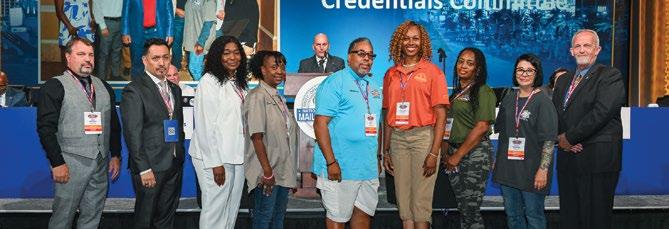
The Credentials Committee met first, on Friday, August 16th. Since its initial meetings in June, where the Committee reviewed and certified the list of delegates, the Committee processed multiple delegate changes, including withdrawals and substitutions. At its meetings in Las Vegas, the Credentials Committee approved its report and finalized the list of certified delegates to be seated at the Convention.
The Constitution Committee also met in Las Vegas to prepare for the discussion on the Convention floor. It reviewed the Committee’s recommended amendments to the National and Uniform Local Union Constitution and prepared to explain their proposals and to provide the rationale for those proposals that were not recommended.
On August 17th, the Rules Committee met to approve the procedures and policies to guide the convention and ensure that all delegates are heard freely and fairly.
That same day, the Resolutions and Legislative and Political Committees also met to finalize their recommendations for proposals to advance the NPMHU’s legislative and political agenda. With election season upon us, these resolutions


are especially important and will form the foundation of our advocacy to the members of Congress and the public at-large.
By Sunday, August 18th, delegates from all over the country began to arrive. Registration ran smoothly. This convention was the second to have gone fully digital with delegates accessing the Convention schedule and committee reports online.


The 2024 NPMHU Quadrennial Convention convened in the Augustus Ballroom. The Local Union Presidents, followed by members of the National Executive Board, were introduced as they entered the conventional hall, and they received rousing applause from the assembled delegates. National President Paul Hogrogian called the convention to order, followed by Brother Jesse Givens of Local 311 who delivered the invocation to officially kick off the convention. The Clark High School Naval Junior ROTC Unit performed the presentation of colors, followed by a beautiful rendition of the national anthem from Retired Sergeant First Class Timothy Wells of the United States Army Field Band.

After a gracious welcome from Local 303 President Juan Torres, delegates and guests heard from inspiring speakers: National President Emeritus John Hegarty reflected fondly on his time in the union; Las Vegas Mayor Carolyn Goodman gave a warm welcome to Las Vegas; and National Association of Letter Carriers President Brian Renfroe called for unity amongst postal unions as the postal service modernizes and promised to have the NPMHU’s back in their upcoming round of bargaining.
Delegates were also greeted by video presentations from numerous elected officials: Nevada Senator Jackie Rosen, Michigan Senator Gary Peters, and Democratic Minority Leader of the House Hakeem Jeffries, each of whom expressed their firm belief in the Postal Service and gratitude for the Mail Handler craft.
Chairperson Yvette Johnson presented the initial report of the Credentials Committee.
Next, Chairperson Greg Newsome, Committee to Elect the Election Committee presented a video detailing the election process and went over each of the twenty-six rules.
Nominations for the Election Committee ran smoothly, the following five nominees consented to their nominations:

• Charles Johnson, Jr. (Local 304)
• Manuel Lazu (Local 306)
• Vel Lewis (Local 311)
• Debbie Retter (Local 316)
• Lolita Wallace (Local 307)
Finally, the Rules Committee delivered its report through chairperson John Gibson. All thirty-two rules were approved unanimously.
Throughout the afternoon, delegates cast their votes for the Judges of Election for the National Election of Officers.
The delegates enjoyed a dinner reception to honor Dave Wilkin, Northeast Regional Vice President and Lawerence Sapp, Southern Regional Vice President, both of whom are retiring members of the National Executive Board.

On Tuesday morning, the delegates once again convened in the Augustus Ballroom. After opening remarks from National Secretary-Treasurer Kevin Tabarus, Brother Wayne Campbell of Local 318 opened the day’s session with a moving invocation. Veterans and active-duty Mail Handlers were honored in a stirring salute to our troops. Then, the National Office staff team took the stage and received resounding applause. The Union is deeply grateful for all their hard work.

Credentials Committee Chairperson Yvette Johnson gave a supplemental report.
Chairperson Greg Newsome of the Committee to Elect the Election Committee announced the results for the election of judges for the election of national officers:
• Charles Johnson, Jr. (Local 304)
• Manuel Lazu (Local 306)
• Debbie Retter (Local 316)
President Paul Hogrogian welcomed the newly elected judges to the convention stage so that they could present to the delegates the rules for the primary officer elections that were scheduled for Wednesday morning.


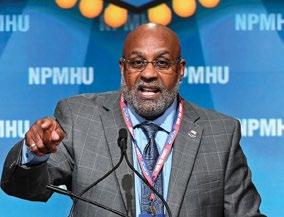





Manuel Lazu then opened the floor for nominations of National Officers. National President Paul Hogrogian was re-elected by acclamation. National Secretary-Treasurer Kevin Tabarus was elected by acclamation. Dan St. Marie was elected to the position of Vice President for the Northeast Region by acclamation. All received thunderous applause from the delegates.
Also nominated for the following positions were:
VICE PRESIDENT, CENTRAL REGION:
• Chris Bentley
• June Harris
VICE PRESIDENT, EASTERN REGION:
• Felandria Jackson
• John Gibson
VICE PRESIDENT, SOUTHERN REGION:
• John (J.R.) Macon
• Nick Mosezar
• Roxie Olds Pride
VICE PRESIDENT, WESTERN REGION:
• Van Cunningham
• Don Sneesby
Following the nominations, delegates then welcomed the leaders of two proud labor unions.
First, Michael Sabitoni, General Secretary-Treasurer of LiUNA, gave a rousing and inspiring speech declaring first and foremost that any attack on the NPMHU is an attack on LiUNA and that the NPMHU will always have LiUNA’s full



































resources and support. General Secretary-Treasurer Sabitoni then emphasized the high stakes of the upcoming presidential election. He implored delegates to vote for union rights in November and to mobilize others to do the same. LiUNA General President Brent Booker closed the LiUNA presentation with a video message expressing his gratitude and solidarity.
Next, Donald Maston, National President of the National Rural Letter Carriers Association, gave his remarks. He acknowledged the difficult work that Mail Handlers do every day as the backbone of the postal community, lauded the NPMHU’s steadfast commitment to its principles, and reflected on the proud history of Postal Service workers fighting alongside each other for their collective rights. His message was straightforward: Together, the two unions can stand stronger for what’s just and fair.


Pam Barrett, Executive Director of Federal Accounts for AETNA, and Nina Gallauresi, the Executive Director of the Mail Handler Benefit Plan, then highlighted the full range of benefits that are available through the MHBP, the work the plan is doing to keep premiums competitive, and that, because of the hard work of Mail Handlers across the country, membership in MHBP is growing. Their words instilled confidence in the continual growth of the Mail Handler Benefit Plan.
Tuesday’s session concluded with a presentation by Brother Dave Wilkin, the Chairperson of the Constitution Committee. Chairperson Wilkin began the delegates’ consideration of the proposed constitutional amendments recommended by the Committee with the remainder of the proposed amendments to be considered the following day. Thank you to Vice President Wilkin for his tireless work on behalf of our Union.
As announced Tuesday, there were three candidates nominated for the position of Vice President, Southern Region. As a result, delegates spent Wednesday morning voting in a primary election for that position. J.R. Macon and Nick Mosezar received the highest votes and will appear on the mail ballot in the election this coming fall.
The Convention reconvened in the early afternoon with Sister June Harris of Local 306 opening the session with a poignant invocation during which delegates kept Brothers and Sisters who have lost loved ones in their thoughts.

The National Officers then presented their reports to the assembled delegates. National President Paul Hogrogian spoke first, beginning with the message that the state of the Union is strong. Looking back over the past few years, National President Hogrogian described the heroic and courageous work Mail Handlers performed during the COVID-19 pandemic and our Union’s pivotal role in the 2020 general and 2022 mid-term elections. National President Hogrogian also described the successes the Union achieved in negotiating the 2022 National Agreement and in working with the Postal Service to insource Mail Handler jobs that had previously been subcontracted.
National President Hogrogian then turned to the challenges ahead and in particular the NPMHU’s response to the Postal Service’s Delivering for America 10-year plan. National President Hogrogian spoke decisively about the need of Mail Handlers from the National to Local to Branch levels to fight to ensure that every position that is properly within the Mail Handler craft be assigned to our Union.






National President Hogrogian concluded his remarks by reiterating the truth that the NPMHU derives its strength from its members and that, by drawing on our collective expertise, the Union can prevail through any challenge.
Next, National Secretary-Treasurer Kevin Tabarus delivered the Report of the National Secretary-Treasurer. He began by highlighting that the decisions made during the 2020 National Convention have helped provide the Union with financial security so that the Union has the resources to fight the challenges ahead.

That said, the NPMHU will not rest on its laurels. National Secretary-Treasurer Tabarus discussed the growth of the Mail Handler craft: in six years, our craft has grown by more than 20%. He made a rousing call for immediate widespread efforts to continue not only to grow the size of the craft but also the membership of the Union.
Following the reports of the National Officers, delegates next heard from more guest speakers: Oregon Congressional Representative Lori Chavez DeRemer discussed the various legislation to protect Postal Service workers for which she has advocated; AFL-CIO President Liz Shuler declared her staunch belief in the NPMHU and emphasized the importance of this upcoming election; and Mark Gardner, National Secretary-Treasurer Emeritus, shared a heartfelt thank you to





the delegates for their hard work and their support during his tenure as National Secretary-Treasurer.

Finally, Brother Jeff Larsen took the stage to conclude the delegates’ review of the Constitution Committee’s recommendations. All of the proposed amendments were adopted by the delegates. Delegates were then given the opportunity to make the case for the amendments that had not been recommended for adoption by the Committee. While no additional amendments were adopted, delegates carefully considered each other’s ideas and engaged in respectful and spirited debate.
In the evening, the delegates enjoyed off-site events at Virgil’s BBQ and Brooklyn Bowl.
Delegates reconvened for the fourth day of the NPMHU National Convention with Brother Rick King of Local 318, opening the session with an inspiring invocation.
The Resolutions Committee, chaired by Lawrence Sapp, took the floor to go over the submissions the Committee had recommended for adoption and to provide the rationale for those they did not. These resolutions are the product of a collective effort of members across the country, and the NPMHU is excited to act upon them in the years ahead.








Following the delegates’ consideration of those resolutions, Chairperson Sapp, on stage for the last time, took a moment to leave the assembled delegates with an important and powerful reminder: the NPMHU is a strong Union because of the strength of its members, and the membership should be proud of the Union’s powerful reputation. Thank you again to Vice President Sapp for his dedicated service to the NPMHU.
Susie Martinez, the Executive Secretary-Treasurer of the Nevada State AFLCIO, delivered remarks lauding Postal Service workers for prevailing over difficult circumstances.
National President Paul Hogrogian then introduced the Women’s Committee: a committee chaired by Vice President June Harris, which was established to empower the Union to advocate for equity and justice in the workplace. The Women’s Committee provides a crucial perspective to the Union. As Vice President Harris made clear, the Union can only be successful when all its members are seen and heard. The Women’s Committee was also responsible for the raffle of NPMHU gift baskets that were made possible due to the generosity of the Committee’s members and many Local Unions.

Legislative and Political Director Katie Maddocks delivered an update on the political work of the Union. The Union is grateful for the work of President Joe Biden, Vice President Kamala Harris, and other allies in the Senate and the House. She laid out the facts plainly: one of the tickets in the upcoming presidential election is pro-labor, while the other is not. On November 5, 2024, NPMHU members will have the opportunity to vote for their rights on the ballot. Until then, they should check that they are registered to vote, sign up to vote by mail, and mobilize others to do the same.
Chairperson June Harris delivered the report of the Legislative and Political Committee. Like the Resolutions Committee, this Committee carefully considered the proposals submitted by members from across the Country to help advance and move forward the Union’s agenda before Congress and the public at large. The resolution to endorse Vice President Kamala Harris and Governor Tim Walz was successfully passed! The NPMHU is excited to stand by the candidates who have stood by them.
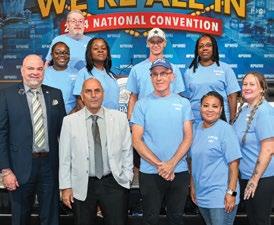
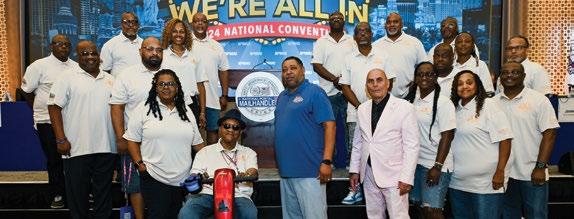
After wrapping up business, delegates gathered for their group and regional photos, showing their spirit with custom Local attire.






On Friday, Sister Yvette Johnson of Local 300 opened the final day of the Convention with a stirring invocation.
The main order of business on the final day of the convention was selecting the location for the 2028 National Convention. Delegates presented compelling cases for a wide variety of locations. The choices were narrowed down to Detroit, Michigan, and Minneapolis, Minnesota. By popular vote, the Convention will take place in Detroit!
In his closing remarks National President Hogrogian stated how proud he was to be the leader of this great organization and that we are the best.
The Convention concluded with delegates dancing the night away at the Convention Gala.


June Harris, Central Region Vice President, Local 306 President, Women’s Commi ee Chairperson
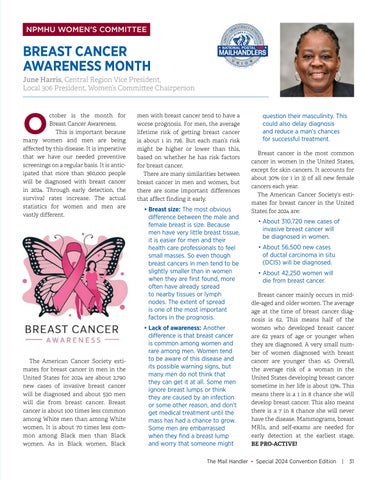
October is the month for Breast Cancer Awareness. This is important because many women and men are being affected by this disease. It is imperative that we have our needed preventive screenings on a regular basis. It is anticipated that more than 360,000 people will be diagnosed with breast cancer in 2024. Through early detection, the survival rates increase. The actual statistics for women and men are vastly different.
men with breast cancer tend to have a worse prognosis. For men, the average lifetime risk of getting breast cancer is about 1 in 726. But each man’s risk might be higher or lower than this, based on whether he has risk factors for breast cancer.
There are many similarities between breast cancer in men and women, but there are some important differences that affect finding it early.


The American Cancer Society estimates for breast cancer in men in the United States for 2024 are about 2,790 new cases of invasive breast cancer will be diagnosed and about 530 men will die from breast cancer. Breast cancer is about 100 times less common among White men than among White women. It is about 70 times less common among Black men than Black women. As in Black women, Black
• Breast size: The most obvious difference between the male and female breast is size. Because men have very little breast tissue, it is easier for men and their health care professionals to feel small masses. So even though breast cancers in men tend to be slightly smaller than in women when they are first found, more often have already spread to nearby tissues or lymph nodes. The extent of spread is one of the most important factors in the prognosis.
• Lack of awareness: Another difference is that breast cancer is common among women and rare among men. Women tend to be aware of this disease and its possible warning signs, but many men do not think that they can get it at all. Some men ignore breast lumps or think they are caused by an infection or some other reason, and don’t get medical treatment until the mass has had a chance to grow. Some men are embarrassed when they find a breast lump and worry that someone might

question their masculinity. This could also delay diagnosis and reduce a man’s chances for successful treatment.
Breast cancer is the most common cancer in women in the United States, except for skin cancers. It accounts for about 30% (or 1 in 3) of all new female cancers each year.
The American Cancer Society’s estimates for breast cancer in the United States for 2024 are:
• About 310,720 new cases of invasive breast cancer will be diagnosed in women.
• About 56,500 new cases of ductal carcinoma in situ (DCIS) will be diagnosed.
• About 42,250 women will die from breast cancer.
Breast cancer mainly occurs in middle-aged and older women. The average age at the time of breast cancer diagnosis is 62. This means half of the women who developed breast cancer are 62 years of age or younger when they are diagnosed. A very small number of women diagnosed with breast cancer are younger than 45. Overall, the average risk of a woman in the United States developing breast cancer sometime in her life is about 13%. This means there is a 1 in 8 chance she will develop breast cancer. This also means there is a 7 in 8 chance she will never have the disease. Mammograms, breast MRIs, and self-exams are needed for early detection at the earliest stage. BE PRO-ACTIVE!


To be fully considered prior to the onset of negotiations, proposals must be submitted by January 31, 2025. Although formal bargaining is not scheduled to begin until June, the Union’s Field Negotiating Committee will be meeting for a full week in February 2025 to review all submitted proposals and outline the changes in the National Agreement that should be proposed by the NPMHU.
To be sure, planning for collective bargaining is a continuous process at the National Office, as the National Officers and representatives working in the Contract Administration Department routinely identify and collect proposals for improving the language currently found in the 2022 National Agreement. But an equally important aspect of preparing for bargaining is the collection and review of proposals generated by mail handlers across the country.

WITH PREPARATIONS UNDERWAY FOR NEGOTIATIONS OVER THE TERMS OF THE 2025 NATIONAL AGREEMENT BETWEEN THE NPMHU AND THE POSTAL SERVICE, THE NATIONAL OFFICE IS
ISSUING ITS OFFICIAL CALL FOR BARGAINING PROPOSALS FROM ALL MEMBERS AND LOCAL UNIONS.


Thus, National President Paul Hogrogian has issued this official call for bargaining proposals from the membership, the Local Unions, and other subordinate bodies of the NPMHU. If you have any proposals that you would like to have considered for the upcoming round of bargaining, now is the time to submit them to the National Office. Every proposal submitted will be fully analyzed by the NPMHU’s Field Negotiating Committee and the National Negotiations Team while the Union develops its opening bargaining proposals. All proposals should set forth the Article, Section, Paragraph, and/or Page of the National Agreement that you are suggesting should be changed; the specific language you would like to see added to, or deleted from, the current National Agreement; and your specific reasons for suggesting the change. If you have supporting evidence or documentation that you believe would support the change that you propose, please submit those materials to the National Office along with your proposals. The National Office is asking that all proposals be submitted as soon as possible, but no later than January 31, 2025. The National Office also has issued a form that can be used to submit proposals.

Once again, proposals from any member (or group of members) and any Local Unions or other subordinate body should be submitted to the National Office by January 31, 2025, by faxing to 202-833-0008 or by using the following address:
National Postal Mail Handlers Union ATTN: 2025 Negotiations
815 16th Street, NW, Suite 5100
Washington, DC 20006


Proposed change to the 2022 National Agreement
Local Union:
Article: Section: Paragraph: Page #: Proposed change or addition to language
Change to read as follows:
Reason for change:
Mail or fax to: NPMHU
2025 Contract Negotiations 815 16th Street NW, Suite 5100 Washington, DC 20006 FAX: 202-833-0008

Name: Local: Signature: Date:

Please supply documentation if available, which supports the need for the proposed change (s) such as; grievances or arbitration decisions or other supporting documentation. Deadline for Submission is January 31, 2025


JOHN GIBSON, EASTERN REGION VICE PRESIDENT, LOCAL 308 PRESIDENT
After wrapping the important business of our quadrennial National Convention, there will be very little time to catch our collective breath. Yes, debate, discussion, and ultimately changes to our National and Local Constitutions are no small matters to be sure. Add to that the important resolutions introduced and considered by the highest authority of this Union, the Convention’s Delegation, seeking to define the loftier goals of this great Union is also an immense and important task. Great thanks to all those behind the scenes who facilitated what was a productive and well executed event. Not to mention the role our National Officers, President Hogrogian and National Secretary Treasurer Tabarus who, in his first effort in this role, made it all come together. A full and detailed report of the activities and the business of the 2024 National Convention is available online at npmhu.org. While there are still National elections to be conducted, which will finalize the business of the 2024 Convention, it is back to the always serious business of defending the contractual rights we have earned over decades of struggle for the scores of dedicated Union representatives across all thirty-six Local Unions.
For example, convention or no convention, the United States Postal

Service continues to drive forward with their marginally conceived plan of sorts to reconfigure the entire Postal Network from processing all the way through the final mile. They have made no secret of the potential pain bargaining unit employees, including mail handlers, may experience as both mail and employees are moved as a result of Postmaster General Dejoy’s 10-year plan. As some have stated, Postal headquarters isn’t quite sure what they plan to do but they’re in a hell of a hurry to do it. Nothing novel in this approach, but that doesn’t make it any less disruptive for thousands of employees. Minimizing any adverse effect on the members of the NPMHU will obviously be of the highest priority as operations management will undoubtedly misapply most of the provisions of Article 12 during this historic upheaval. Sisters and Brothers, I am confident that with Local and National representatives working collaboratively, we will meet this challenge and emerge more unified and stronger than ever.
Of course, our work demands reach well beyond the impact of the colossal changes to the Postal Service proposed by the PMG. As recently announced by President Hogrogian, we are already preparing for next year’s contract negotiations. Our



current collective bargaining agreement expires September 20, 2025, with negotiations beginning in June of next year. As announced on September 9th, President Hogrogian has issued a call to all members to submit proposals which read in part,
“If you have any proposals that you would like to have considered for the upcoming round of bargaining, now is the time to submit them to the National Office. Every proposal submitted will be fully analyzed by the NPMHU’s Field Negotiating Committee and the National Negotiations Team…To be fully considered prior to the onset of negotiations, proposals must be submitted by January 31, 2025. Although formal bargaining is not scheduled to begin until June, the Union’s Field Negotiating Committee will be meeting for a full week in February 2025 to review all submitted proposals and outline the changes in the National Agreement that should be proposed by the NPMHU.” Submission forms for any contract proposal are available at npmhu.org.
As you can see Brothers and Sisters, along with the day-to-day trials and tribulations of defending the rights of mail handlers, there is a constant effort to protect and improve our collective standing in the postal workplace. This battle never ends, and we must always forge ahead.





LEVEL DONATION AWARD
Member
Sponsor
Activist
Leader
Ambassador
Super Ambassador
$26 ($1 per pay period)
$52 ($2 per pay period)
$100
$250
$500
$1o00


PAC Pin
PAC Mug
PAC Polo Shirt
PAC Tumblers
PAC Toiletry Bag
All Incentive Gifts





There is a quick way for Mail Handlers to contribute to the NPMHU PAC. Simply call in to the PostalEASE system, or visit the PostalEASE option on the web at www.liteblue.usps.gov Follow the instructions printed on pages 36 and 37 of this magazine. Your PAC contribution will be made directly from your bi-weekly postal payroll. You also have the option of sending in a personal check or authorizing a credit card contribution. Your contributions will also be entered in to the incentive award program that entitles you to an award based on your contribution level. There are six distinct PAC membership levels and awards. Awards are distributed based on membership level and will be mailed after the end of the year; awards will vary year to year.
Contributions to the Mail Handlers PAC are not deductible as charitable contributions for purposes of federal income taxes. In addition, federal law requires that the Mail Handlers PAC report to the Federal Election Commission the name, mailing address, occupation, and name of employer for each individual whose contributions in any calendar year total in excess of $200. Please also note that the Mail Handlers PAC has political purposes, and that all members have the right to refuse to contribute, and the right to revoke their authorization for any continuing contributions, without any reprisal.
You can contribute directly to the Mail Handlers PAC by filling out the following information and mailing it to:
Mail Handler PAC
P.O. Box 65171
Washington DC 20035
Please enclose your check or money order, or provide authorization to charge your credit card.
(Cut here and return to NPMHU PAC)
This is to certify that I, _________________________________________________________, have voluntarily contributed the amount listed below, to the NPMHU PAC. I understand that this voluntary contribution is not a condition of membership in the union; I have the right to refuse to contribute without any reprisal; if specific contribution amounts are mentioned they are merely suggestions and I am free to contribute more or less; the Union will not favor or disadvantage me because of the amount of my contribution or my decision not to contribute; NPMHU PAC will use the money it receives to make Political expenditures and contributions in connection with federal elections; and only U.S. Citizens and lawful permanent U.S. residents are eligible to contribute.
Employer (if other than USPS)
Contribution Amount: (Please check one):
$26 (Member) $52 (Sponsor) $100 (Activist) $250 (Leader) $500 (Ambassador)
$1000 (Super Ambassador) Other
Please enclose your check or money order, or authorization to charge your credit card.
Contributions to the NPMHU PAC are not deductible as charitable contributions for federal income purposes.
1. Dial 1-877-4PS-EASE—(877-477-3273) and follow the prompt for the Employee Services Main Menu.
2. When prompted, press #1 for PostalEASE
3. When prompted, enter your eight-digit USPS employee identification number.
4. When prompted again, enter your USPS PIN number. (This is the same as the PIN number you use for telephone bidding and/or other payroll allotments.)
5. When prompted, choose option #2 (to select payroll allotments)
6. Then choose option #1 (to select allotments)
7. When prompted, press #2 to continue
8. When prompted, press #3 to add the allotment
9. When prompted for the routing number, enter 054001220
10. When prompted for the account number, enter the following: 11260001 __ __ __—__ __—__ __ __ __ (the last nine digits of your account number is your social security number—this information will allow us to identify you as the PAC contributor).
11. Press #1 if correct
12. When prompted, press #1 for “checking”
13. When prompted, input the bi-weekly dollar amount of your PAC allotment.
14. Press #1 if correct
15. When prompted, press #1 to process
16. You will be provided a confirmation number as well as the start date for the salary allotment.
17. For your records:
· Record the confirmation number
· Record the start date of the salary allotment
18. Press #1 to repeat, or press #9 to end call
PostalEASE on the WEB:
To initiate your bi-weekly PAC contribution on the web, simply go to www.liteblue.usps.gov
1. Enter your eight-digit USPS Employee ID Number and your USPS PIN
2. Follow the link to PostalEASE— you will again be asked to enter your Employee ID Number and USPS PIN
3. Follow the link for PAYROLL – Allotments/NTB
4. Continue to the ALLOTMENTS section
5. Your ROUTING TRANSIT NUMBER is: 054001220
6. Your ACCOUNT # will be: 11260001 __ __ __—__ __ —__ __ __ __ (the last nine digits of your account number is your social security number—this information will allow us to identify you as the PAC contributor).
7. For ACCOUNT TYPE— please select “CHECKING”
8. When prompted, please input the AMOUNT that you would like to contribute to the PAC each pay period.
9. To process your PAC allotment, you will need to select the VALIDATE button, and to finalize the transaction, please select SUBMIT. Be sure to print out a copy of the confirmation page for your records.


PAUL V. HOGROGIAN National President





KEVIN P. TABARUS National Secretary-Treasurer

The National Constitution of the National Postal Mail Handlers Union—in Article XII, Section 9—requires the National President, acting on behalf of the entire National Executive Board, to present a report to the delegates describing all of the activities and accomplishments of the National Union since the last Convention. To comply with that constitutional requirement, this written report was distributed to all delegates attending the 2024 National Convention. The entire National Executive Board sincerely hopes that all delegates and other Mail Handlers will take the time necessary to review the entire report, for the NEB strongly believes that an informed membership is crucial to the continued success of the NPMHU.


TPREPARED FOR THE DELEGATES TO THE NPMHU 2024 CONVENTION LAS VEGAS, NV | AUGUST 19–23, 2024
wo years ago, at the NPMHU 2022 National Convention, the National Officers reported to the delegates of the National Postal Mail Handlers Union that their Union was in excellent shape. We also boldly predicted that the future of our Union would remain bright because of the hard work and dedication of all of our union representatives — at the National, Regional, Local, and Branch levels.
We are pleased to report that our prediction from 2022 has proven accurate. In 2024, as the NPMHU meets in Las Vegas, Nevada for its 2024 National Convention, the state of the National Postal Mail Handlers Union remains excellent. All Mail Handlers have every reason to be extremely proud about the activities and accomplishments of their Union over the past two years.
The NPMHU continues to be a strong and vibrant Union, focused as always

on the bargaining, grievance handling, lobbying, communicating, and training that is the lifeblood of our National Union. As detailed throughout this Report, the NPMHU remains extremely active and extremely determined to achieve great results. We continue to marshal our resources to make them as effective and productive as ever. We remain fully supported by our friends, including the Laborers’ International Union of North America (LIUNA), our international parent body, and the AFL-CIO. And we remain respected and sometimes even feared by our adversaries. We therefore remain prepared to meet the needs of the more than 50,000 Mail Handlers who depend on this great Union.

Before addressing the various issues that have confronted the NPMHU and its membership during the past two years, this report must begin with a full recognition of the heroism of the more than 50,000 postal employees who call themselves Mail Handlers.
In the remainder of this report, the NPMHU will look in two directions — back into the past two years, and ahead into the future.

When we last met in Convention in 2022, we were just coming out of the COVID pandemic, and both the American economy and the Postal Service were just beginning to recover from the ravages of that pandemic. One of the true bright spots of the pandemic though was the effort of the Postal Service generally and the Mail Handlers specifically to continue to ensure the delivery of the mail. The





work of our members was truly historic and helped keep the Postal Service and therefore the American economy going.
In addition, the Mail Handlers played a pivotal role in the federal government’s efforts to minimize the spread of the COVID-19 virus. One such program was the government’s “Free at-home COVID-19 Test” program, which provided each household in America up to 4 individual test kits, free of charge. To facilitate this program, we negotiated a series of MOUs with the Postal Service making it easier to staff the fulfillment centers. This program delivered over 1.8 billion free COVID-19 test to the American people through COVIDTest.gov. While the free at home Test Kit Program was suspended on March 8, 2024, the Postal Service has been given the go ahead to move forward with Phase 7 of the program which will launch on September 23rd. We can be proud of our work in this critical area.


three days and 99.82% within five days. And this year, through the 2024 primaries and upcoming general elections, this fine work has and undoubtedly will continue.
Thank you, Mail Handlers, for a job well done. We all should be extremely proud of the work we did together to preserve the democratic process for the American people.
As always for the NPMHU, the key to effective representation of Mail Handlers is at the bargaining table, especially during rounds of National negotiations with the U.S. Postal Service.

Another area where Mail Handlers really stepped up was in our collective efforts to ensure the proper functioning of our election system. As we have previously reported to you, during the 2020 election year, the Postal Service processed 135 million ballots, 610 million pieces of election mail, and 4 billion pieces of political mail. 97.9% of ballots were delivered within 3 days, and 99.7% of ballots were delivered within 5 days. Vote by mail committees were established at the National and installation levels, and Mail Handlers played a major role on these committees, identifying problems in the processing of ballots to ensure that they were processed in a safe, secure, and timely manner. That work continued during the 2022 midterm elections where the Postal Service processed more than 54 million ballots, nearly 99% of which were delivered within
When we met in Denver, we were in the thick of negotiations. As is typical of our process with the Postal Service, we had spent the summer of 2022 exchanging and discussing our respective proposals but it was not until September when the speed and intensity of negotiations really picked up pace. While we are never able to achieve all of our objectives in negotiations, the 2022 National Agreement contains important improvements affecting the entirety of our union — from our most senior members who continued to receive regular wage increases along with continuation of protection from layoffs to those at the entry level steps of the career pay schedule who received additional wage increases to our MHA members who not only received significant wage increases but importantly achieved a guaranteed path to career status.
including 1.3% which was retroactive to November 19, 2022, 1.3% effective in November 2023, and 1.3% effective in November 2024 and six cost-of-living adjustments added to base pay in March and September of 2023, 2024, and 2025.
The National Agreement also includes an increase to the night shift differential rate each year of the agreement and provides for an additional 1% increase to the lowest steps of the pay schedule.
One of the critical gains of the 2022 National Agreement for our career Mail Handlers was the elimination of the lowest step on the pay schedule and the shortening of the waiting period from 52 to 48 weeks. These changes shortened the career progression by a total of 116 weeks or more than 2 years.

To begin, the National Agreement not only continued but expanded the traditional pattern of annual general wage increases and semi-annual cost-of-living adjustments for all current Mail Handlers. Specifically, the Agreement provides for three general wage increases for career Mail Handlers,
For MHAs, the 2022 National Agreement again continued the pattern of regular wage increases. In addition, during negotiations, we stressed to the Postal Service that it was facing a massive problem in retaining MHAs (along with PSEs, CCAs, and RCAs). This is not only a problem for the Postal Service but also for us. Unlike casuals who were not members of our bargaining unit or the union, MHAs not only are members, but they are also the future of our craft and of this Union. As a result, integrating MHAs into the Mail Handler workforce and creating an environment where MHAs will want to build a career with the Postal Service was a key focus during the 2022 negotiations.
To that end, we were successful in negotiating an additional fifty cent per hour wage increase in the first year of the agreement to the MHA rate. We also negotiated an additional fifty cent wage increase when an individual MHA reaches six months of relative standing.
While the National Agreement continued the pre-existing rules for conversion of MHAs to career — a


process that has been highly successful, resulting in tens of thousands of MHAs being converted to career status, we were also able to take steps to protect against the possibility of any long-term MHAs by setting an automatic conversion into career employment after an MHA reaches twenty-four months of relative standing.
This automatic conversion is into a new career status as a full-time flexible mail handler. While FTFs will have flexible reporting times, it is a career position with full health care, retirement, and other benefits. A converted MHA will stay in the FTF position only until they are converted into a full-time regular position through normal processes based on relative standing, until they successfully bid into a career position, until they get placed into a residual vacancy, or until they otherwise convert into regular employment. Since June of 2023, more than 1,700 MHAs have been converted into an FTF position.

supervisor vacancies and sets forth a requirement to continue to meet to discuss the status of these changes.
To that end, we have been in discussions with the Postal Service about two initiatives. First, the Postal Service has created an EAS-17 level position called Relief Supervisors. These supervisors provide coverage for front-line supervisors who are on leave or scheduled days off.
The second initiative is the Supervisor Apprentice Program pilot which is a 26-week program to prepare EAS-16 level apprentices to be qualified for future supervisor assignments. As apprentices, these employees will no longer be in our bargaining unit.

The 2022 National Agreement also contains important work rule improvements. All career employees are guaranteed consecutive days off and protection from layoff. MHAs and PTFs are guaranteed one nonscheduled day each week except during peak season and MHAs are advanced 40 hours of annual leave upon reappointment to a second 360-term.
The 2022 National Agreement also contains a new Memorandum of Understanding regarding 204(b) temporary supervisors. One of our perennial efforts in negotiations is to discourage our bargaining unit members from taking these temporary supervisor positions. Having Mail Handlers supervising Mail Handlers even on a temporary basis is destructive to our craft. This MOU acknowledges that the Postal Service was in the process of developing alternative approaches to filling temporary
With the implementation of these initiatives, we have received reports from you out in the field, that, in many locations, these programs are doing exactly what was intended: greatly reducing if not eliminating the use of 204-Bs — thus achieving a long-term goal of our Union.
Between rounds of formal bargaining with the Postal Service, the Contract Administration Department (CAD) of the NPMHU — comprised of Mail Handlers working in both the National Office and our Denver Regional Office — works to improve the interpretations and implementation of the current National Agreement. These dedicated representatives are available to assist and consult with Mail Handlers and Mail Handler advocates from around the country on the endless contractual topics that arise each and every day. It often is easy to overlook this important function, but the National and Regional CAD is in constant and direct communication with Mail Handlers working at the Local level and on the workroom floor.
In addition to these routine communications, the CAD continues to produce a host of reports, publications, and memoranda that are intended to keep the Local leadership and membership informed about contract developments.
First, the National CAD issues a series of semi-annual reports — released in conjunction with each Semi-Annual Meeting of the Local Unions (SAMLUs) and then distributed to all Local Union officers and representatives — that describe all of the ongoing activities of the CAD since the last report. These reports, together with a constant stream of mail communications with the Local Unions, help to keep all NPMHU advocates apprised of the most recent contractual developments.
The CAD also routinely distributes proposed and final revisions to USPS postal handbooks, manuals, and regulations; copies of the dozens of training and resource manuals that have been developed over the years; and NPMHU interpretations of various contract provisions.
Aside from these regular communications, the CAD also takes primary responsibility for a host of other activities of the NPMHU:
(CIM): The NPMHU and the USPS have issued several versions of their joint Contract Interpretation Manual, together with a Resource Manual that contains each and every arbitration award, memorandum of understanding, letter of intent, and national settlement agreement that is cited in the CIM. In March 2024, the CAD completed its work with the Postal Service to prepare and distribute version #6 of the CIM, covering matters that have been settled at the National level during the past few years, as well as the terms of the 2022 National Agreement.
The CIM attempts to set forth, in a comprehensive manner, our substantive agreements about the appropriate way to interpret the National Agreement. To be sure, the CIM has not resolved all work-related disputes; but it has helped the parties at the Local and Regional levels to narrow their disputes by concentrating on the facts underlying particular grievances or issues that are not covered by the CIM. Reports show that the number of appeals has decreased, and that management representatives are resolving those cases where local management is not adhering to the requirements set forth in the CIM. The CIM also is being used as a resource to cite when decisions are being issued at the Regional level. Reports from the Local level are equally encouraging.
Throughout the past two years, the NPMHU has continued to develop and conduct a series of comprehensive training programs on a host of contractual and statutory issues important to all members. Each of these programs has been aimed at assisting Union officers and representatives from the Local Unions to advocate for Mail Handlers more effectively. Education and training are a crucial component of the NPMHU’s overall program for improving the representation of Mail Handlers; indeed, the importance of this training can hardly be overstated, as educated Union representatives – at both the National and Local levels – are the lifeblood of the effective representation constantly being pursued by the NPMHU. That is why training in recent years has been extensive, as reflected by these examples:
are properly filing and processing grievances. These training programs are invaluable, and include not only basic shop steward training, but also a series of advanced training programs, with special emphasis on defending Mail Handlers who are being disciplined, arbitration advocacy, and special topics such as reassignments under Article 12 and the Family Medical Leave Act. Credit goes to Regional Vice Presidents John Gibson and Lawrence Sapp and Local 301 President Dan St. Marie for taking the lead on these programs.
(2) Training programs run by the National Union also have been conducted during most of the SAMLU meetings held during the past two years. In addition to a training on the 2022 National Agreement, we also provided LMOU training, including a training on the new contract, LMOU training in preparation for a period of local negotiations that was scheduled after the latest round of national bargaining was completed. This program included a strategy session about local negotiations to determine the terms of Local Memoranda of Understanding to be negotiated. In addition, we held a training on strategies to assist in responding to jurisdictional issues related to the Sorting & Delivery Centers.
There has been substantial progress on the National arbitration docket. Many issues have been resolved in pre-arbitration settlements, and other unresolved issues have been arbitrated at the National level.
When we last met in Denver, we were waiting for a decision from Arbitrator Daniel Brent on the Postal Service’s decision to subcontract out the Kansas City Surface Transportation Center.
This case began in August 2019, when the Postal Service first notified the NPMHU at the National level that the Postal Service had decided to subcontract all mail handler work at the Kansas City STC, scheduled for opening and staffing in September 2019. The National Union initiated a grievance at the Step 4 or National level, followed by additional grievances during subsequent months arising from similar situations in Chicago, Orlando, Atlanta, Washington DC, New Jersey, Massachusetts, Southern California, and Northern California.
(1) Certain types of training programs, directed by the National Office, are presented at various Local Unions around the country, to ensure that these first-line Union representatives
To prepare for many of these training programs, the NPMHU has developed comprehensive manuals or handbooks on many of these specified topics, including outlines of the covered material and relevant documents needed by stewards and other advocates. Supplementary materials often are developed to include relevant arbitration decisions and case law. Of most importance, these manuals or handbooks also are circulated after the SAMLU meetings so that the benefits of each training program are shared with thousands of Union representatives across the country.
Six days of hearings were held ending in October 2021, during which the NPMHU argued that the USPS action was a blatant violation of Article 32 of the parties’ National Agreement, as well as a violation of the Memorandum of Understanding Re Article 32 that has appeared in all National Agreements since 2013. Specifically, the Union argued that both Article 32.1B of the National Agreement and the MOU re Article 32 provide for advance notice and discussions with the Union while the Postal Service is “developing the initial Comparative Analysis Report.” We also argued that the Postal Service is required, among other things, to consider the views of the Union before making its subcontracting decision, to respond to the Union’s views in its
decisional document, and to not make any final decisions on contracting out work prior to discussing the matter with the Union. Serving as witnesses for the NPMHU were Chris Bentley, President of Local 297 covering Kansas and Western Missouri; Teresa Harmon, Manager of the National CAD; and Paul Hogrogian, National President.
Attempting to excuse these violations of Article 32, the Postal Service claimed that “[n]o significant impact to the bargaining unit is anticipated,” and that therefore Article 32’s procedural and substantive rules did not apply to any decision to subcontract one or more STCs. In the alternative, USPS also claimed that its decisions in Kansas City and elsewhere were eminently reasonable.
interpretations that will prove helpful to Mail Handler representatives and advocates in future subcontracting disputes.
While all NPMHU representatives are encouraged to read the entire decision, here are some key paragraphs from the Brent Award on the issue of “significant impact” under Article 32 of the National Agreement:
Each of the USPS management arguments were soundly rejected by National Arbitrator Daniel Brent. As a summary of his award, Arbitrator Brent stated as follows:
The Postal Service violated the National Agreement by the manner in which the Postal Service implemented the subcontracting of the Kansas City, Kansas STC. The Union’s grievance is sustained.
The Employer failed to provide the Union with an opportunity, as required by the Article 32 Memorandum of Understanding, to propose different percentages of, or hourly rates for, MHA’s to ensure competitiveness with outside services before the Employer decided to subcontract the Kansas City STC. The Employer also neglected to consider the potential impact of future expansion of the STC network when determining that subcontracting of the Kansas City STC would have no significant impact on the NPMHU bargaining unit.
The Employer’s argument that there was no significant impact on the bargaining unit because no current bargaining unit employees lost their jobs or suffered diminished work opportunity due to the Kansas City STC outsourcing ignores the plain language in the Article 32 MOU affording the Union the right to prior notice of impending outsourcing and the right to submit certain proposals before a subcontracting decision is finalized. Simply declaring that the opening of the Kansas City STC would not significantly impact the NPMHU bargaining unit did not change the fact that outsourcing was being considered without giving the Union the opportunity to be heard as explicitly required by the Article 32 MOU.
To reach these conclusions, the National Arbitrator issued a series of
The Employer’s analysis concluding that no significant impact would be caused by subcontracting the Kansas City STC was based exclusively on the relative percentage paradigm that was used in previous precedential awards issued before the Article 32 MOU appeared in the 2011–2016 contract. The Union asserted that the Employer improperly ignored clear evidence, available when the decision to create the Kansas City STC was made in 2019, that the USPS was continuing its on-going process of building a nationwide network of Surface Transportation Centers in order to cut costs by shifting mail volume away from more expensive air transportation and by consolidating regional loads of mail and packages to maximize trailer efficiency
for long distance hauling of mail. The impact of subcontracting much, if not all, of the mail processed by this STC network would be significant for this bargaining unit. Ignoring the possibility of future expansion of the STC network materially impaired the Employer’s Article 32.1B determination of no significant impact. [T]he Postal Service cannot look myopically at a single facility or solely at a particular point in time when assessing the significant impact of subcontracting work to non-bargaining unit workers without also considering the implications if the disputed program were to be expanded significantly. The facts adduced during six arbitration hearings held in the instant case mandate a conclusion that the planners who were evaluating the Kansas City STC in 2019 were aware of a continuing effort by the Postal Service to shift mail volume from air transportation to surface transportation to reduce both costs and environmental impact. Nothing in the record established that the Employer’s executives and consultants who participated in the outsourcing decision regarding the Kansas City STC in 2019 had a reasonable basis to believe that this long-term initiative would end with the Kansas City STC, as using airplanes would likely remain more expensive than ground transportation and nation-wide consolidation of mail and packages into fewer truck loads would remain economically and environmentally desirable. These evaluators were also aware that expiring outsourced contracts of four previously outsourced STC’s had been renewed in 2018, rather than reassigning the work to NPMHU bargaining unit members. Although no one can predict the future, the ongoing evolution in 2019 and likely future expansion of this national Surface Transportation Network as an integral component of mail distribution
across the United States should have been considered in assessing whether significant impact would occur under an Article 32.1 B analysis.
Other sections of Arbitrator Brent’s decision discuss the separate and independent impact of the MOU Re Article 32 that appears in the NPMHU National Agreement. Here are some key paragraphs from the Brent Award about the Article 32 MOU:
By [also] ignoring the clear language of the Article 32 MOU, the Employer eroded the propriety of its finding of no significant impact.
The Article 32 MOU explicitly creates an independent obligation to consider all relevant factors regarding using MHA’s “whenever contracting-out or in-sourcing is under consideration”. Such obligation expressly provides the Union the opportunity, at its sole discretion, to “propose different hourly rates for such MHAs to ensure competitiveness with outside services.” The Article 32 MOU necessarily mandates prior notice to the Union whenever outsourcing is considered in order to provide the Union the opportunity to propose MHA related modifications. The Employer did not provide such notice.
Whenever outsourcing or in-sourcing is contemplated by the Employer, the Article 32 MOU guarantees the Union the opportunity to propose using more MHA’s or implementing different MHA hourly rates in order to increase the competitiveness of NPMHU bargaining unit employees before the Employer conducts its analysis of the five Article 32.1A factors that must be considered in all subcontracting decisions.
created a changed circumstance that cannot be disregarded. To hold otherwise would negate the bargain reached by the parties through the process under which the Article 32 MOU became an integral component of the parties’ collectively negotiated agreements.
In short, this Brent Award should help to restrict or even end the USPS practice of subcontracting Mail Handler work to private employers without first considering the views of the Union on all issues properly presented.
On the issue of remedy, the Brent Award remanded it to the National parties, which is discussed below.
There also are two pending National arbitrations for which decisions are expected shortly:
a) In the Brent Award, Arbitrator Brent remanded the issue of remedy to the National parties. Since the issuance of the Brent Award, much of the STC network (including the work performed at the subcontracted Kansas City STC) has been in sourced. What remains is the determination of the appropriate remedy. The hearing on remedy took place on March 13-14, 2024, and post-hearing briefs were filed at the end of June.
entered in their login credentials on to those websites, it allowed the criminals to steal that information. The criminals were then able to go to the official PostalEASE site, use the employees’ login credentials and add allotments that were then deducted from the employees’ checks.
The NALC and APWU also filed national disputes on this same issue. The NALC case was the first to be scheduled for arbitration, and it has heard by Arbitrator Dennis Nolan in January 2024. We showed at that hearing that it is management that has the responsibility to safeguard its employees from this type of criminal activity by ensuring that its own websites are secure. Having failed to do that, the Postal Service should make the affected employees whole. We expect a decision shortly.
These sophisticated parties have a long bargaining relationship. By incorporating the Article 32 MOU into the collective bargaining agreement, the parties augmented Article 32 and
b) In 2023, we filed a national-level grievance challenging the Postal Service’s handling of the breach of the Postalease system. By way of background, in December of 2022, we learned for the first time from the Postal Service that some Postal Service employees had unknowingly provided their usernames and passwords to criminal websites while attempting to access PostalEASE. We were told that employees had been using Google to access PostalEASE and that Google in turn was redirecting them to third party criminally run websites that mirrored the look and access of PostalEASE. When employees
In addition to our success in the Kansas City STC arbitration, we have also had great success at working with the Postal Service to in-source work that the Postal Service had previously subcontracted. Through our Article 32 subcontracting committee, we have repeatedly made the case to the Postal Service that it makes absolutely no sense to give away mail volume to the private sector. The Postal Service has heard these arguments and has begun to work with us to bring significant amounts of subcontracted work back in house. On the STCs, we have signed MOUs with the Postal Service to in-source 9 of the 13 STCs. We are hopeful that we will bring the work of the remaining STCs back in house as well. In addition to the STCs, we have reached agreements with the Postal Service to bring Terminal Handling Services or THS work back in house.
The Postal Service transports a lot of mail through the air. Terminal handling services is how the Post Office gives and receives the mail to FedEx or UPS or some other airline. Nearly twenty years ago, the Postal Service began subcontracting out the THS work. Significantly, through a series of agreements that we have signed with the Postal Service, more than 15 facilities have already insourced THS work. As with the STCs, we fully expect to bring most if not all of this work back in house.
Another success story concerns the subcontracting of sorting and processing Non-Machinable Outside or NMO parcels. We were able to reach agreement with the Postal Service that a pilot program that the Postal Service had developed to subcontract out the NMO work had ended; that the NMO parcel operation is back to its normal operating procedures; and that the Postal Service has ceased further evaluation of outsourcing for NMO parcels.
jurisdictional battles with the American Postal Workers Union (APWU) and the Postal Service, commonly known as Regional Instruction No. 399.
While outside the last two years, we start by a review of the 2018 Update MOU, which was a nationwide settlement agreement reached by and between the Postal Service, the NPMHU, and the APWU that re-set jurisdictional disputes, such that (with certain limited exceptions) all current assignments would be maintained, and only future changes based on new work, new or consolidated facilities, or operational change could be filed. The settlement also withdrew most of the pending cases and included a small payment to all Mail Handlers.
We were able to negotiate these agreements bringing hundreds, if not thousands, of jobs back to our craft due to the dedicated work of our CAD team and their involvement in the Article 32 Subcontracting Committee set up in the National Agreement. Through this Committee, we have taken advantage of the opportunity to hold regular discussions with the Postal Service about reversing the long trend of using nonunion, non-Postal labor to do our work. The National Union will continue to work hard to address erosion of our bargaining unit work.
For almost seven decades, since the 1950s, no area involving the job rights of Mail Handlers has been more difficult for the NPMHU than its ongoing
NDRC. All of these disputes have been resolved by the NDRC or remanded to the RDRCs for review.
Since the negotiation of the Update MOU, the parties have been focusing on completing the Revised 9-1-2017 Inventories mandated by the Update MOU, to reflect the work assignment practices or the status quo in each facility as of September 1, 2017. As the Update MOU makes clear, the local jurisdictional work assignment practices as of that date shall be controlling, unless those practices were contrary to a National-level craft determination previously issued by the Postal Service, a National-level or local-level jurisdictional settlement signed by all three parties, a National-level or Regional-level tripartite arbitration award determining jurisdiction, or an existing inventory signed by all three parties. If there is a disagreement as to whether any of these exceptions (following the word “unless”) apply to a particular Revised 9-1-2017 Inventory, it should be referred to the NDRC for resolution by the NDRC.
Work on jurisdictional disputes continues, with several arbitrations at the National level now at different stages of completion. The history of National level arbitration demonstrates, however, that it is extremely difficult, if not impossible, to convince the National arbitrator not to approve the jurisdictional determination initially made by the Postal Service. This is because the governing rules that have developed in prior arbitrations require the arbitrator to give a certain amount of discretion to the Postal Service, and to overrule the management determination only if it is arbitrary or contrary to binding precedent. This explains why the NPMHU has obtained mixed results in arbitration hearings.
While the RI-399 arbitration docket has a number of different cases on it, there are a few that we highlight here.
• Small Delivery Unit Sorter (SDUS); Challenge to the fact that the Postal Service craft determination for SDUS was only with regard to Function 4 operations;
• Single Induction Package Sorter (SIPS): Challenge to the Postal Service craft determination because, unlike the SDUS, the SIPS is affixed with an Optical Character Reader, allowing the SIPS machine to read address information on the packages and not just bar codes and therefore is performing more mail processing functions than the SDUS or ADUS
As of this writing in August 2024, more than 550 facilities have completed their Revised 9-1-2017 Inventories, and approximately 230 facilities have submitted one or more disputes for resolution by the
• High Output Parcel Sorter (HOPs): Challenge to the Postal Service craft determination awarding the “Reject Station” to the APWU (the APWU has
challenged that all remaining work on the HOPs was awarded to the Mail Handlers.
• APBS Set-up and Breakdown: The National Determination letter on the APBS awarded the work of Pulling Containers and transporting empty equipment to the MH craft. Because those are the primary functions performed when setting up or breaking down, the NPMHU position is that set up and break down belongs to our craft.
In addition to jurisdictional assignments under RI-399, another important means of protecting the Mail Handler Craft is through continuous conversion of newly hired Mail Handler Assistant into full-time career positions, which form the backbone of our craft.
As most Mail Handlers know, the Fishgold Arbitration Award issued in 2013 to set the terms of the 2011 National Agreement substantially changed the workforce that is allowed to perform mail handler work. In the larger facilities, all part-time flexible employees employed in February 2013 were converted to full-time regular status, and a new category of bargaining unit employee was created in the form of a non-career employee called a Mail Handler Assistant or MHA. The MHA category now serves as the entry point for all future career mail handlers to be hired by the Postal Service. A maximum of 25% of mail handlers in any postal installation may be MHAs. These MHAs are full members of the NPMHU bargaining unit.
essence committed to a long-term career for another Mail Handler. This certainly is a life changing event for the MHA.
As a result of the Residual Vacancy MOU, where we agreed to limit voluntary transfers under the Transfer MOU to one in every four full-time opportunities or one in six, depending on the size of the installation, and other agreements that we have reached with the Postal Service, such as the 2022 National Agreement’s one-time conversion of all MHAs with two and a half years of relative standing at the time of ratification, we have created a system that has allowed a steady stream of our MHAs to achieve career status, with the flow of that stream increasing at a growing rate.
As of Pay Period 16 for 2024, 48,142 MHAs have been converted to career status, starting in October 2013, with more than 45,000 of those conversions occurring after the signing of the Residual Vacancy MOU. That is an average of approximately 370 per month. Adding together the number of current MHAs (approximately 9,000), nearly 70% of the current members of the NPMHU bargaining unit have been converted from MHAs or are currently an MHA.
If there is one area in which the NPMHU has substantially changed direction in recent years, it undoubtedly relates to legislative relations and political action. The NPMHU often tells its membership that, with one stroke of a pen, decades of progress can be obliterated by an uncaring Congress and a hostile White House. That is why legislative and political action are both so critical to the future of all Mail Handlers.
Handlers represented by the NPMHU than for most American workers, for our very jobs and most important benefits are dependent on actions taken by Members of Congress and the occupant of the White House. There is no other group of employees — besides other postal or federal employees — for whom retirement benefits, health insurance, workers’ compensation, and life insurance are determined by the actions or inactions of the political branches of our National Government. Nor is there any other employee group whose employer is also so dependent on the views and actions of these political branches. It necessarily follows that all Mail Handlers, and certainly the Union that seeks to provide the best possible representation for Mail Handlers, must maximize their involvement in the political processes that control the Federal Government.
One of the most important issues facing the Union is the conversion of MHAs to career employees. When an MHA is converted, the Postal Service has in
The entire American labor movement has come to recognize that the political arena holds the key to many of its most important goals. This is truer for Mail
That is why the NPMHU has remained so focused — some would say obsessed — on its legislative and political programs. Under the leadership of the National Executive Board and the Committee on the Future of the NPMHU, and with the advice of NPMHU Legislative and Political Director Katie Maddocks, the NPMHU has taken many significant steps to strengthen its legislative lobbying efforts and to increase its involvement in the electoral political process.
With the exception of pandemic-plagued 2021, the NPMHU has held its biennial Legislative Conference during the first year of each new Congress. Thus, a Legislative Conference was held in May 2023 for the 118th Congress. It is now commonplace for important Senators and Representatives to seek the views and opinions of NPMHU officers and other activists on the key issues pending before Congress.
Indeed, nothing could be more important to the future of Mail
Handlers than the subjects the Union has chosen to highlight, and to lobby, during the Legislative Conference. For example, it had been a long-term priority of the Union to focus on the need for adoption and implementation of postal reform legislation. And in April 2022, this legislative priority became a political reality, as President Biden signed into law the Postal Service Reform Act of 2022 (P.L. 117-108). This long-sought legislation has provided the first steps to fiscal stability for the Postal Service and will help ensure that dedicated Mail Handlers and the rest of the workforce can continue to serve every American household and business. NPMHU
President Paul Hogrogian was proud to stand with President Biden, fellow postal union leaders, and dedicated champions of the Postal Service on the bill’s historic signing day.
The NPMHU also continues to expand its efforts — and its results — in raising money for its Political Action Committee, which remains part of the Laborers Political League. Because many members do not realize that the Union’s dues revenues cannot legally be contributed to political candidates, it has taken some time to increase the rates of participation in the Mail Handler PAC. But recent trends are extremely encouraging. Using the salary allocation program that the NPMHU implemented through the Postal Service, some members have chosen to apportion a small amount of their paycheck each pay period for direct allocation into the PAC. Many Local Unions also have done a superb job of encouraging their officers and stewards to contribute to the PAC, as a means of demonstrating leadership by example to the rank and file. As a result, the numbers of Mail Handlers routinely contributing to the PAC, while still small, continues to increase.
All of these efforts are aimed at one objective: to ensure that the NPMHU is able to influence legislation or impact congressional oversight that will directly affect the work lives of the Mail Handlers that the Union represents. The importance of obtaining or retaining majorities on Capitol Hill (and, of course, in the White House) of worker-friendly representatives cannot be overstated, and therefore the NPMHU’s legislative and political efforts must continue.
When each new Congress convenes, the NPMHU adopts a legislative agenda for that Congress, which sets forth the goals and objectives of the Mail Handlers Union for the next two years. The agenda adopted in 2023, for the current 118th Congress, is republished in this year’s Report of the NPMHU Legislative Committee, distributed to all delegates at Convention registration. The NPMHU’s legislative priorities include first and foremost that the Postal Service and the Office of Personnel Management will fully implement the Postal Service Reform Act, which was signed into law in 2022 just before we met in Denver for the 2022 National Convention. Additionally, the Union’s priorities include:
Elimination Provision and creating parity between CSRS and FERS retirees by providing the same COLA for both sets of retirees);
• Promoting workers’ rights through passage of the Protecting the Right to Organize (or PRO) Act (H.R. 20/S. 567), which would strengthen current federal laws to allow private-sector workers to organize and join a union and bargain for better wages and benefits and the Raise the Wage Act (H.R. 4889/S. 2488), which calls for an increase in the federal minimum wage to $17.00 per hour by 2028, with gradual increases over a five-year period;
• Improving the finances of the Postal Service by utilizing postal-only assumptions for calculating pension liabilities and allowing nonpostal services to grow revenue;
• Strengthen service standards for customers;
• Protect earned retirement and healthcare benefits by fighting attacks on and working with lawmakers to strengthen these benefits (e.g., eliminating or curtailing of the Government Pension Offset and the Windfall
• Strengthen American elections: Since the 2020 elections, there has been an unprecedented reliance on the Postal Service for the processing and delivery of mail-in ballots. In the November 2020 general election, the Postal Service processed and delivered over 4.7 billion pieces of election and political mail, including over 130 million ballots. That work continued during the 2022 midterm elections where the Postal Service processed more than 54 million ballots. This success occurred because of the dedicated work of thousands of Mail Handlers and other postal employees, as well as constant communications between USPS, postal unions and management associations, and state and local election boards. These joint efforts need to continue. That is why the NPMHU will promote legislation, primarily at the state and local level, to encourage democratic participation through “vote by mail” initiatives, and will support such efforts at the federal level as well.
When all is said and done, the prominence that the NPMHU gives to its legislative and political program is an especially effective means of representing all Mail Handlers, and that explains the NPMHU’s emphasis on legislative and political affairs.
For the past thirty years, the NPMHU has focused a large part of its efforts on improving its own internal operations. That emphasis has continued unabated for the past two years. Today, those efforts continue to bear fruit, as the NPMHU is a well-run labor organization, second to none in overall financial management, membership recruitment and maintenance, and internal communications.
understand that the Union does not have to make strategic judgments based on its financial well-being. Without a large and growing fund balance, the Postal Service — which itself never has to worry about such financial limitations — would try to take advantage of our Union.
This past financial trajectory was simply not sustainable.
Financial Management at the NPMHU: During the past two years, the NPMHU has continued its financial recovery. When we met in Denver, the finances of the National Union were in a steady decline.
From 2011, the fund balance dropped from nearly $35 million dollars to just over $20 million dollars in 2020, with projections that the fund balance would drop to around $16 million dollars by 2024. This trajectory had the potential to significantly hinder our ability to meet our collective goals of improving the lives and working conditions of our brothers and sisters across the country.
To avoid this position, the National Office took bold action to reduce expenses, including such steps as relocating our national office to the AFL-CIO building, reducing staff, and scheduling more of our National meetings in the District of Columbia. The National officers also waived their wage increases and cost of living adjustments for the 5-year period prior to the last convention. Alongside these expenditure cuts, the delegates to the 2022 National Convention also approved an increase in per capita revenue for the National office.
Through the combination of expense reductions and revenue increases, we were able to reverse the steep decline in our financial security. Rather than dropping as projected to a fund balance of $16 million dollars, our fund balance has stabilized and in fact grew. At year end for 2023, our fund balance grew by $2.7 million dollars, moving from a low of $19 million dollars to nearly $22 million dollars as of December 31, 2023.
unions. In fact, like the National union, the finances for our local unions also showed steady growth. For our 36 local unions, between 2022 and 2023, assets collectively grew by approximately 10% or an average increase of nearly $125,000 dollars. This growth was widespread with 28 of our local unions experiencing an increase in year-overyear assets. We should be extremely proud of the steps we all took in Denver at our last convention.
The National Union is now better positioned not only to fund major expenses like the more than $2 million dollars to fund the costs for this convention, but also to prepare for the upcoming challenges and opportunities — from preparing for and conducting contract negotiations, to fighting to protect and grow our membership as a result of the Postal Service’s Delivering For America plan.
Without a financially secure National Union, we would face the prospect of having to make choices not based on what is best for our members, but instead on what will keep the union from financial ruin. Likewise, each time that the parties at the National level engage in National grievance arbitration, or threaten to file litigation, it is essential that Postal Service officials
In other words, our decision in Denver has helped to put the National Union on the path toward where it needs to be: a financially-secure union that has the resources to pro-actively identify — and remedy — the issues that our brothers and sisters face each and every day around the country.
Not only have we improved the financial picture for the National Union but we did so without harming the financial security of our local
One area in which the NPMHU constantly works hard to improve is communications with the membership. The quarterly magazine — The Mail Handler — allows for substantive coverage of the major issues facing the Union. Monthly bulletins continue to be circulated to all Local Union officers and representatives, for posting on all bulletin boards. The NPMHU website at www. npmhu.org is an increasingly important source for the timely circulation of information, especially in the legislative and political arena. Not many Mail Handlers remember that, in 1995, the NPMHU was the first national union with an operating website that contained searchable archives of arbitration decisions, and to this day the NPMHU website remains a leader in that area.
More recently, the NPMHU has created a mobile App for NPMHU members, which can be accessed on
any smart phone. This allows more frequent and timely communications when necessary for the well-being of the membership.
Within the Labor Movement: The NPMHU remains an active participant in the trade union movement.
Relations between the NPMHU and LIUNA, its international parent body, have remained very strong. With the full support of General President Brent Booker and the entire General Executive Board, LIUNA has become a staunch supporter of the NPMHU, offering its assistance and cooperation when advisable, but otherwise allowing the NPMHU to operate under its own autonomy. Mail Handlers also have a direct say in the operations of LIUNA, as Mail Handlers serve as delegates at all LIUNA Conventions, and the NPMHU National President is an automatic member of the GEB.
The NPMHU also works with LIUNA as an active sponsor of the Juvenile Diabetes Research Foundation, which remains the official charity of the Union. Both the NPMHU and many of its Local Unions participate in walkathons and other fundraising activities to help pay for research to find a cure for this disease.
The NPMHU also continues to contribute, both time and money, to PERF or the Postal Employees Relief Fund. This joint project of all postal unions, management associations, and postal management provides timely grants to postal employees who suffer financial losses from natural disasters such as hurricanes, tornadoes, and wildfires. With the support of the NPMHU, PERF has liberalized the criteria for eligibility and the dollar amounts of the grants available to postal employees in need. The PERF fund has made hundreds of payments to postal employees, including scores of Mail Handlers, during the past few years.
Union Privilege, including the Union Plus Credit Card, and mortgage and educational services. These benefits of NPMHU membership make our job of organizing new members easier, while enhancing the NPMHU’s ability to serve our current members.
In the Greater Community: The NPMHU continues to recognize that giving to those less fortunate is a significant part of the Union’s legacy.
In the past two years, the NPMHU Scholarship Program has awarded thousands of dollars in college scholarships to 30 Mail Handlers and family members who seek a university degree. For many of the recipients, this financial aid makes it possible to continue their higher education and allows the Union to encourage members and their families to take advantage of such educational opportunities. The Vallone Scholars chosen by the scholarship program are named in memory of Arthur S. Vallone, the former Northeastern Regional Vice President and Local 309 President who died suddenly in 2005. His memory and good works will forever live in the minds of these scholars.
Providing Value to the Members:
The NPMHU also sponsors and in part administers important benefit programs aimed at giving Mail Handlers and associate members of the NPMHU excellent benefits at a good value.
The Mail Handlers Benefit Plan, which has been sponsored by the NPMHU since the early 1960s, remains one of the largest health insurance programs under the Federal Employees Health Benefit Program. Although in prior years there were significant drops in enrollment in the MHBP, overall enrollment has steadied. The NPMHU and its insurance partner, Aetna, are rejuvenating the program so that there will be continuing growth in membership.
The aptly named Committee on the Future of the NPMHU has become a mainstay in the NPMHU’s efforts to engage in long-range planning and strategic thinking on behalf of the Union and all Mail Handlers employed by the Postal Service. The Committee is comprised of all members of the National Executive Board and several Local Union Presidents representing a cross-section of the NPMHU membership.
The agenda of the Committee remains wide-ranging, and includes long-term issues such as:
• privatization of the Postal Service;
• the NPMHU’s legislative relations program;
• USPS automation and other technological changes;
• financial planning; and
• membership recruitment.
Equally important to the everyday lives of many Mail Handlers are the programs made available through
In the past two years, the Committee has substantively delved into many of the major issues confronting the NPMHU. In particular, the Committee has taken a leadership position in developing the NPMHU’s legislative agenda; the Union’s strategic response to the Postal Service network redesign plans, specifically focusing on addressing jurisdictional disputes at Sorting and Delivery Centers; and the development of materials to improve the Union’s internal organizing efforts.
It is usually difficult to measure the benefits of strategic planning, at least over the short term, but Mail Handlers understand that the NPMHU and its Committee on the Future are very much focused on the long-term interests and anticipated needs of all members.
Having looked backward over the past few years, we want to turn to the future of the Postal Service and the impacts and opportunities for our union.
The most significant changes coming to the Postal Service are as a result of the PMG’s 10-year Plan called the Delivering for America or DFA plan. A central part of these plans is an aggressive and comprehensive network redesign plan which involve the consolidation of mail processing facilities.
These proposed changes have the potential to result in significant growth for our union. Some are predicting that over the next decade, we could see thousands of new Mail Handlers positions. The Mail Handler craft could grow by 20% or more.
At the core of this consolidation are Regional Processing and Distribution Centers or RPDCs that will consolidate all originating letters, flats, and parcels and all parcels from all mail processing facilities within a metropolitan area into one mega-processing center.
• Sandston or Richmond, Virginia
• North Houston, Texas
• Atlanta, Georgia
• Charlotte, North Carolina
• Chicago, Illinois
• Santa Clarita, California
• Indianapolis, Indiana
• Portland, Oregon
• Jacksonville, Florida
• Boise, Idaho
• Oklahoma City, Oklahoma
• Phoenix, Arizona
• Royal Palm, Florida
RPDCs are being created in either newly constructed or current large facilities that are being remodeled. The RPDCs will have common operational designs, engineering layouts, and types of machinery. They will also utilize the fastest and advanced automated package sorters that are available, such as the MaRs and the HOPs machines.
As of right now, the Postal Service has announced that there will be 15 initial sites for these RPDCs:
• Greensboro, North Carolina
• Jersey City, New Jersey
Given the size and scale of these facilities and the anticipated machinery and equipment that we believe will be installed in the RPDCs, we anticipate significant growth in the Mail Handler complement. Indeed, depending on jurisdictional assignments that will be made, some of the machines themselves will require hundreds of employees to operate.
To put us in the best position to get this work, we have negotiated a series of MOUs regarding the staffing of RPDCs. In other words, we are negotiating now to ensure that these RPDCs are going to be a source of significant Mail Handler positions.
assignment of the work to our craft. When these individual units are consolidated, we have the ability to establish that there is a sufficient amount of Mail Handler work. In other words, as a result of the consolidations, the S&DCs provide an opportunity for us to put Mail Handlers into operations where there previously were none.
Like the RPDCs, we have also negotiated a series of MOUs with the goal of getting our foot in the door of these facilities. We negotiated a master agreement that provides that S&DCs may be staffed with MHAs and/or PTFs for a period of 120 days and that the parties will then negotiate on a siteby-site basis to determine the number of MHAs, if any, which will not count toward the MHA cap in that installation. Again, our goal, which has been successful, is to make sure that as these S&DCs open that Mail Handlers will be working in these buildings.
Another area of growth for the Mail Handler craft is in the Sorting and Delivery Centers or S&DCs. The purpose of Sorting and Delivery Centers is to consolidate individual post office delivery units into one central location. This consolidation is significant because in individual post office delivery units, there is typically less than four hours of continuous Mail Handler work — the minimum to require
We want to recognize the members of the taskforce that was created by the Committee on the Future to address the opportunities that have arisen as a result of the creation of the S&DCs. The committee has been very active in creating resources to address the jurisdictional fights that are arising over the staffing and creation of the inventories for these new facilities. The committee has put together a handbook that was distributed at the Portland SAMLU in 2023. The Committee has also created talking points for when the Locals meet at the LDRC. We also have a short training course that can be conducted via Zoom for Locals who are interested. Special thanks to John Gibson, National VP Eastern Region and Local 308 President, Kelly Dickey Local 322 President, Nick Mosezar Local 318 President, Teresa Harmon National CAD Manager and Thomas Ruther National CAD Representative for their work in
this area. Our union succeeds when we rely on the expertise of each other to fight the battles that are ahead of us.
Another area of opportunity is a new initiative announced in September of 2023 called the Go East/Go West Initiative, which was developed to save on transportation cost caused by trucks that are not loaded to capacity. Instead of the originating site separating the mail for all the facilities around the destination site, they would jackpot that mail and truck it to the designated “Hub Site.”. The Hub site would then process the mail for the facilities within their region. By doing so the trucks that were traveling with a 60–70 percent capacity would now be at 100 percent. There are currently 10 Hub sites, but that number constantly changes.
— there have been reports of significant mail delays. Likely due to this rocky rollout and pressure from elected officials, the Postal Service has informed us that RPDCs in Santa Clarita, Oklahoma City, and Royal Palm are on hold and that the Greensboro RPDC is being redesigned.
In addition to the RPDCs that have been announced, the Postal Service has also initiated what it calls Mail Processing Facility Reviews for approximately 60 more sites across the country to determine whether there is a need to further consolidate mail processing operations from the facilities in those locations into other processing centers. These Reviews — which used to be referred to as AMPs — are to involve a public hearing and input from those involved.
The reason we see potential growth is that where this initiative has been implemented, the Postal Service has utilized the HOPS, SIPS, and HTSPs to process the mail. Because jurisdiction for this equipment has largely been awarded to the Mail Handlers, this Initiative has created an increase in Mail Handler bargaining unit work and hundreds of Mail Handler jobs in those facilities. While the initiative began in Seattle, Atlanta, and New Jersey, it has already been expanded to more sites, with more planned through the rest of 2024.
While the network design has the potential for significant growth for our Union, it also comes with the potential of real hardship for our members. First of all, in those locations where the RPDCs have been rolled out, the implementation has been rocky with major delays in mail processing at the Richmond, Atlanta, and Houston RPDCs. For example, on-time performance for first class mail in Richmond fell to sixty-five percent, a twenty percent drop; in Houston, it fell to 71%, and in Palmetto — the Atlanta location
the possibility of extensive excessing. Our CAD team is working diligently with the leaders of our local unions to ensure that any adverse impact that does occur is kept to an absolute minimum. Doing so will be a top priority of ours over the next few years. We will ensure that the Postal Service complies with all of the provisions of the National Agreement especially those contained in Article 12 which are designed to keep all dislocation and inconvenience to Mail Handlers to an absolute minimum.
Not surprisingly, while some of these consolidations make sense, others do not, such as those proposed consolidations that have extended far beyond the anticipated 50-mile radius to distances exceeding 100 and sometimes more than 200 hundred miles. The Postmaster General recently notified the NPMHU that in 36 of the 60 MPFR sites, local mail would remain local meaning that these 36 sites would continue to cancel mail and that the local mail would remain and be processed locally. The NPMHU has yet to be provided a list of the 36 sites.
Where the proposed consolidations do not make sense, we must work together at the national and local levels to respond and argue that the Postal Service must revaluate and reconsider their plans and to develop a more rational and reasonable plan.
In sum, while the proposed network redesign has the potential to result in a significant increase in the size of our bargaining unit with some estimates predicting thousands of new positions — and we will fight for every position that is ours — these changes come with
The work of the NPMHU, like the mail that Mail Handlers process, never stops. So the NPMHU must always remain ready for the next set of challenges. We must continue to fight the Postal Service, at the bargaining table, in grievance meetings, in jurisdictional disputes, and in arbitration hearings, to preserve and extend our contractual rights. We also must continue to battle on Capitol Hill and in the Executive Branch, to preserve not only our statutory benefits and our collective bargaining process, but also to guarantee the important and sustained role that the Postal Service should continue to play in the future of our American communications system. We must also join with the rest of the American labor movement and other like-minded organizations and individuals, to ensure that in every future November election — and in particular this November election — that we elect candidates that are pro-worker, pro-union, and pro-working family.
With our dedicated staff and our leadership at the national, regional, and local levels, we are ready for these fights, and we will prevail in these fights.
Together with we look forward to continued progress in the years to come.
Over the course of the NPMHU 2024 National Convention, the delegates considered, debated, and voted on a series of important resolutions. All of these resolutions were initially submitted by NPMHU members for consideration by either the Resolution Committee or the Legislative and Political Committee. Both committees were comprised of elected convention delegates, who met prior to the Convention to review, debate, combined similar
resolutions and on occasion modify the submitted proposal to language that the committee could agree to present to the full Convention for consideration.
What follows here are the twenty- one (21) resolutions that were adopted by the Convention. The first ten (10) of the following resolutions were presented by the Resolutions Committee, and the remaining eleven (11) resolutions were presented on behalf of the Legislative and Political Committee.
Submitted by the National Executive Board
WHEREAS, the mission of the United States Postal Service to deliver to every household and business in America is enshrined in the United States Constitution; and
WHEREAS, the USPS developed the Delivering for America (DFA) plan with the goal to modernize the network while still providing reliable service to postal customers; and
WHEREAS, the DFA calls for aggressive changes under a network redesign within approximately 60 metropolitan areas throughout the country; and
WHEREAS, the USPS is conducting 59 mail processing facility reviews (MPFRs) in order to coordinate consolidations of mail processing operations; and
WHEREAS, proposed consolidations have extended initial plans of keeping consolidations centralized, with possible mail operation moves extending beyond 100 miles of the initial processing facility; and
WHEREAS, details on DFA’s network redesign are extremely fluid and subject
to change, leaving Mail Handlers unsure of impacts on jobs; and
WHEREAS, according to the Postal Regulatory Commission, the Postal Service failed to meet its projected targets for first-class mail service performance in fiscal year 2023 nation-wide; and WHEREAS, postal customers have grown frustrated with delivery standards; and
WHEREAS, bipartisan, bicameral legislation has been introduced within Congress calling for moratorium on these proposed changes to the network; and
THEREFORE, BE IT RESOLVED, the NPMHU will monitor any and all proposed changes from the USPS and promote transparency of information between the USPS and all Mail Handlers; and
BE IT FURTHER RESOLVED, that the NPMHU will promote the need for on-time delivery to all postal customers; and
BE IT FURTHER RESOLVED, that the NPMHU ensure the Postal Service will comply with all provisions within the National Agreement, keeping all dislocation and inconvenience to Mail Handlers at an absolute minimum.
Submitted by Committee on the Future (as edited by the Resolutions Committee)
WHEREAS, The National Postal Mail Handlers Union is committed to organizing all new Mail Handlers and current non-members.
WHEREAS, The National Postal Mail Handlers Union Committee on the Future has updated organizing materials to improve membership.
THEREFORE, BE IT RESOLVED, All Union Officers and Stewards shall be committed to organizing new members into this great Union.
BE IT FUTHER RESOLVED, Local Union Officers and/or Stewards shall attend every Mail Handler Orientation for new Mail Handlers Assistants (MHAs), converted MHAs, and transfers into the Mail Handler craft.
BE IT FUTHER RESOLVED, Local Union Officers and/or Stewards shall ensure that all NPMHU Form 1187s are properly completed prior to submission to HRSSC so that the Forms will not be rejected by HRSSC. This
responsibility includes (i) ensuring that the Form 1187 is legible; (ii) ensuring that it contains the proper EIN, proper Finance number, Dues amount, Union Representative title and signature; and (iii) ensuring that the Form 1187 is received at HRSSC within Seven (7) days from new member signature.
BE IT FURTHER RESOLVED, Local Unions shall file grievance(s) when NPMHU Form 1187s are not processed within the first full pay period following the receipt at HRSSC as required by ELM 924.5.
BE IT FINALLY RESOLVED, that this resolution shall be distributed to Local Union Presidents with an instruction that it be distributed to all officers, stewards, and other union representatives.
Submitted by the Committee on the Future
WHEREAS, the men and women of the Postal Service, as the Postal Service repeatedly states, are its most important assets; and
WHEREAS, neither the Postal Accountability and Enhancement Act of 2006 nor the Postal Reform Act of 2022 are excuses to demean the dignity of our dedicated workforce through increased privatization of postal jobs; and WHEREAS, the issue of subcontracting has caused much dissent at the bargaining table and much dissension on the workroom floor; and
privatization of any existing work currently being performed by postal employees and urge the continued in-sourcing of bargaining unit work, including but not limited to the processing of parcels and other work currently being performed at Mail Transport Equipment Centers (MTECs), Surface Transfer Centers (STCs), Terminal Handling Services (THSs), and any other facilities that have been or may be targeted by the Postal Service for future subcontracting.
Submitted by the Committee on the Future
WHEREAS, it is the task of the NPMHU, its affiliated Local Unions, and their thousands of dedicated representatives to organize all Mail Handlers in support of one another and to protect the interests of all Mail Handlers through the negotiation and enforcement of agreements between the Union and the U.S. Postal Service; and
WHEREAS, the NPMHU believes that all Mail Handlers deserve dignity, respect, and justice in the workplace; that workplace bullying leads to rudeness, hatred, disloyalty, and arrogance; and that workplace harassment denies our members a workplace that is free of unlawful and inappropriate conduct; and
members intimidated and terrified to affirm their contractual rights and undermining the Union’s ability to represent them; and
WHEREAS, it is the NPMHU’s responsibility to promote unity, dignity, and respect through the enforcement of worker rights; and
WHEREAS, while the NPMHU successfully negotiated the inclusion of a memorandum on Dignity and Respect in the Workplace in the 2022 National Agreement, the problems of harassment and bullying persist.
THEREFORE, BE IT RESOLVED, that the NPMHU endorses a sustained struggle to promote dignity, respect, and justice in the workplace. The NPMHU will demand that the Postal Service values the diversity of Mail Handlers and remains committed to a workplace where all employees can come to work with dignity and respect.
Submitted by the Committee on the Future
WHEREAS, the NPMHU has been successful at working with the Postal Service to in-source mail handler work at Surface Transfer Centers (STCs) and Terminal Handling Services (THSs)
THEREFORE, BE IT RESOLVED, that members of the NPMHU strongly oppose any subcontracting and/or
WHEREAS, harassment and bullying are institutionalized when management condones their use. Management may write policy statements in support of dignity, respect, and justice in the workplace, but there must be consequences for the manager who harasses, bullies, and violates those policies; and WHEREAS, harassment and bullying lead to a disruptive and hostile work environment, leaving NPMHU
WHEREAS, the mail processed and delivered by the U.S. Postal Service has been a key component of the American communications system for more than two hundred years, since the Post Office was first enshrined in the U.S. Constitution; and
WHEREAS, the U.S. mail also serves as a crucial component of American business and commerce, especially with the increasing number of mailed packages; and
WHEREAS, the U.S. mail provides a secure and private means of communication and commerce in a fully unionized environment; and
WHEREAS, communications that are accomplished electronically are far less secure and less private, and are
processed in what is largely a nonunion environment; and
WHEREAS, examples of cyber breaches or other intrusions into electronic data and communications have become routine, with some intrusions instigated by domestic criminals or international terrorists;
THEREFORE, BE IT RESOLVED, that the NPMHU fully supports continued use of the U.S. mail for both private communications and secure commerce; and BE IT FURTHER RESOLVED, that the NPMHU urges its members, families, friends, and business associates to use — to the maximum extent possible — the U.S. mail (rather than its private competitors) for all of their communication needs, including a follow-up hardcopy by U.S. mail in those situations when time-sensitive matters require use of electronic mail or facsimile.
and gender identity including but not limited to transgender status.
WHEREAS, The NPMHU recognizes that creating gender-neutral or single user restrooms will assist in providing a safe and welcoming space for transgender and gender-nonconforming individuals who may feel uncomfortable or unsafe in gender-segregated facilities.
WHEREAS, The NPMHU recognizes that creating single user or gender-neutral restrooms in Postal facilities may assist in reducing discrimination and harassment based on gender identity.
BE IT RESOLVED, that NPMHU further recognizes that, in assisting the Postal Service to create single user or gender-neutral restrooms in Postal facilities, we will be taking a positive step toward equality and social progress while also promoting inclusivity and accessibility for all individuals of all gender identities and expressions.
RESOLUTION: IN
Submitted by: The National Women’s Committee
WHEREAS, The Department of Labor (DOL) and the Occupational Safety and Health Administration (OSHA) requires that all employers under their jurisdiction provide employees with sanitary and available restroom facilities, so that employees will not suffer the adverse health effects that can result if adequate restrooms are not available when employees need them.
BE IT FURTHER RESOLVED, that the NPMHU encourages diversity and prohibits discrimination and is committed to ensuring that our members work in an environment that is free of harassment and violence and will work towards fostering a climate in which all employees may contribute equally.
RESOLUTION NO. 7
WHEREAS, The NPMHU acknowledges that Title VII of the Civil Rights Act of 1964 protects all Postal Employees from discrimination based on their race, color, national origin, religion and sex including pregnancy, sexual orientation,
amount of break time to express milk as frequently as needed by the nursing employee, and
WHEREAS, the PUMP Act requires that employers provide a place, other than a bathroom, that is shielded from view and free from intrusion to express milk while at work, and
WHEREAS, the PUMP Act protects the nursing employees up to one year after the child’s birth, and
WHEREAS, beginning April 28, 2023, an employer who violates an employee’s right to reasonable break time and space to pump breast milk will be liable for appropriate legal or equitable remedies under the FLSA. Remedies may include employment, reinstatement, promotion, and the payment of wages lost and an additional equal amount as liquidated damages, compensatory damages and make-whole relief, such as economic losses that resulted from violations, and punitive damages where appropriate, and
WHEREAS, the National Postal Mail Handlers Union (NPMHU) is committed to supporting all nursing workers, THEREFORE, BE IT RESOLVED, that the NPMHU commends President Biden and the 117th Congress for passing the PUMP Act.
RESOLUTION: SUPPORT OF THE PROVIDING URGENT MATERNAL PROTECTIONS FOR NURSING MOTHERS ACT (“PUMP ACT”)
Submitted by: The National Women’s Committee
WHEREAS, the Consolidated Appropriations Act of 2023, which introduced the PUMP Act, was signed into law by President Joe Biden on December 29, 2022, and WHEREAS, the PUMP Act requires that employers provide a reasonable
AND BE IT FURTHER RESOLVED, that the NPMHU supports the PUMP Act and will assist our nursing workers in ensuring they are NOT discriminated or retaliated against.
RESOLUTION NO. 8
RESOLUTION: SUPPORT OF THE PREGNANT WORKERS FAIRNESS ACT
Submitted by: The National Women’s Committee
WHEREAS, The Pregnant Workers Fairness Act (PWFA) was signed into
law by President Joe Biden and put into effect on June 18, 2024 protecting pregnant workers, and WHEREAS, the PWFA requires that employers can not discriminate against job applicants that are pregnant, and WHEREAS, the PWFA requires that employers provide reasonable accommodations to pregnant workers such as: additional, longer, or more flexible breaks, providing a stool to sit and work when safely applicable, changing a work schedule, temporary suspension of one or more essential functions of a job, leave for health care appointments, etc. and WHEREAS, the PWFA protects pregnant workers from any and all punishment and/or retaliation from the employer for requesting a reasonable accommodation, and WHEREAS, allowing pregnant workers to remain in their jobs is vital for the financial well-being of families and is beneficial for the economic health of our Union and our nation, and
the critical role that educators play in shaping the future of our society by providing quality education and fostering an informed and engaged citizenry; and
WHEREAS, recent legislative actions in the state of Florida and across our Nation have severely undermined the collective bargaining rights and professional autonomy of teachers and educators; and
WHEREAS, Florida and other States has enacted laws that seek to decertify teachers’ unions if membership falls below a certain threshold, thus jeopardizing the ability of these unions to effectively represent and advocate for their members; and
WHEREAS, the National Postal Mail Handlers Union (NPMHU) is committed to supporting our Pregnant Women and their right to work, THEREFORE, BE IT RESOLVED, that the NPMHU commends President Biden and the 118th Congress for passing the Pregnant Workers Fairness Act. AND BE IT FURTHER RESOLVED, that the NPMHU supports the Pregnant Workers Fairness Act and will assist our pregnant workers in ensuring they are NOT discriminated against.
RECOMMENDED RESOLUTION NO. 9
RESOLUTION IN SUPPORT OF TEACHERS AND THEIR UNIONS
Respectfully submitted by: Nick Mosezar, President, NPMHU, Local 318
WHEREAS, the National Postal Mail Handlers Union (NPMHU) recognize
WHEREAS, anti-union measures have been introduced and implemented, including the prohibition of automatic payroll deductions for union dues, making it more difficult for unions to sustain their operations and support their members; and
WHEREAS, these measures represent a broader attack on workers’ rights and collective action, undermining the principles of solidarity and mutual support that are foundational to the labor movement; and
WHEREAS, across our country, legislation has imposed restrictions on the teaching of factual history and other critical subjects, threatening academic freedom and the ability of educators to provide students with a comprehensive and honest education; and
THEREFORE BE IT Resolved, that the National Postal Mail Handlers Union stands in full solidarity with the teachers, educators and their unions in their struggle to maintain their collective bargaining rights and professional integrity; and
BE IT FURTHER RESOLVED, that we condemn the recent legislative actions in Florida and throughout our country that seek to decertify unions, restrict payroll deductions, and censor educational content; and
BE IT FURTHER RESOLVED, that we call upon our elected representatives to protect and support the rights of teachers and all workers to organize, bargain collectively, and teach factual, comprehensive curricula without fear of political retribution or censorship; and
BE IT FINALLY RESOLVED, that we pledge to support and collaborate with all teachers’ unions in their efforts to resist these unjust laws and to advocate for a fair, equitable, and honest educational system for all students.
RESOLUTION NO. 10
Submitted by: Kelly Dickey; Local #322 President
WHEREAS, such restrictions include legislation that censors discussions on race, gender, and other important social issues, thereby hindering students’ understanding of the diverse and complex world in which they live; and
WHEREAS, the attacks on educators and their unions are part of a larger national trend aimed at weakening public and private sector unions and eroding public education the greatest equalizer for democracy;
WHEREAS, the workforce of the United States has been hurt both by the outsourcing of jobs to other countries and by American companies that are using foreign operations as a means of holding down wages and benefits for American jobs; and
WHEREAS, the economic hardships of unemployment and underemployment continue, and are adversely affecting the economy as a whole; and WHEREAS, any downturn in the American economy also affects the U.S. Postal Service, with a decrease
in mail volume directly caused by the circulation of fewer commercial mailings; and
WHEREAS, there are unlimited opportunities to purchase quality, Union-made and Americanmade goods, both in person and online; and
WHEREAS, purchasing Union-made and American-made goods will result
in additional economic growth in the United States and increased mail volume for the Postal Service; and WHEREAS, purchasing Union-made and American-made goods will help other American workers keep their jobs; THEREFORE, BE IT RESOLVED, that the NPMHU fully supports purchasing Union-made and American-made goods; and
BE IT FURTHER RESOLVED, that the NPMHU will disseminate this message through various communication channels, such as the NPMHU website, the Mail Handler Update bulletin, and the Mail Handler magazine; and BE IT FURTHER RESOLVED, that all Mail Handlers should spread this message through word of mouth to family and friends.
Submitted by the National Executive Board (edited by the Legislative Committee)
WHEREAS, the National Postal Mail Handlers Union fights for better wages, respect, dignity, health care, safety, and retirement for all Mail Handlers, regardless of race, color, creed, nationality, religion, age, sex, sexual orientation, physical or mental status, or union membership; and
WHEREAS, the NPMHU, its affiliated Local Unions, and its thousands of dedicated representatives are working day in and day out to protect the interests of all Mail Handlers, through the negotiation and enforcement of agreements between the Union and the U.S. Postal Service for wages, job security, protection from discrimination, seniority, choice vacations, health and safety, and other benefits; and
arbitration, legal cases, training and education, membership communication, collective bargaining, and other means; and
WHEREAS, the NPMHU has been on the frontline for many decades, fighting to obtain, defend, and uphold our collective bargaining rights; and
WHEREAS, non-Union members are allowed by law to enjoy all the privileges and benefits negotiated by the NPMHU, as well as all job protections at the workplace, even though they pay no Union dues; and
WHEREAS, numerous studies have shown that a workforce performs at higher levels of productivity, with fewer accidents and greater job satisfaction, when all workers are treated with dignity and respect as Union members, than when the workers are exploited by management, divided amongst themselves, and alienated from their leadership; and
exploit unfairly the courage and generosity of the Union Brothers and Sisters, turning worker against worker; and
WHEREAS, solidarity and universal Union membership among all the workers in a Union shop are the surest ways to advance the common interest of the workers in improving productivity and employment conditions and achieving dignity within the workplace; and
WHEREAS, all Mail Handlers and other postal employees should exercise their collective political power to correct the injustice of the 1970 Postal Reorganization Act’s prohibition of the Union shop; and
WHEREAS, the NPMHU invests significant resources in achieving the best for the Mail Handler craft, whether by legislation, politics, grievances and
WHEREAS, the prohibition by law of a Union shop is designed to undermine and weaken the solidarity of the working class and specifically of the men and women who work for the Postal Service, by encouraging postal employees to shun Union membership and
WHEREAS, the imminent national elections offer an opportunity for all Mail Handlers and other postal employees to repeal the unjust prohibition of the Union shop and continue the struggle for a better workplace;
THEREFORE, BE IT RESOLVED, that this Union shall make every reasonable effort to persuade Congress and the President to amend the Postal Reorganization Act to grant postal unions the right to negotiate and enforce lawful and constitutional union shop agreements, so that Mail Handlers
and other bargaining unit employees who refuse to join the NPMHU may be charged for their fair share of representational services, including costs for the filing of grievances, advocacy at arbitration hearings, training and education, membership communications, and the bargaining of Local and National Agreements regarding pay and working conditions.

Submitted by the National Executive Board (edited by the Legislative Committee)
WHEREAS, in the name of financial stability, Congress has utilized fiscal commissions as a means to examine ways to reduce the federal deficit; and WHEREAS, the Greenspan Commission led to the Social Security Amendments of 1983, which resulted in a raise in the retirement age that was the equivalent to a 13% benefit cut, a tax on benefits for middle income retirees, and the creation of the Windfall Elimination Provision (WEP) and the Government Pension Offset (GPO) — which there is current legislation to repeal; and,
WHEREAS, retired Americans — including those retired from the United States Postal Service — and disabled Americans, depend on the earned benefits of Social Security and Medicare; and WHEREAS, all Mail Handlers make contributions to their retirement plans, and have reasonable expectations on benefits to support themselves and their dependents after their careers; and
WHEREAS, financial instability our nation faces was not created by federal retirement benefits; and

WHEREAS, the President’s Commission to Strengthen Social Security, established by President George W. Bush, issued a report outlining three models of partial privatization of Social Security; and
WHEREAS, the Bowles-Simpson Commission, established by President Barack Obama, recommended raising the retirement age, reducing the cost-of-living adjustment (COLA), and resulted in greater contributions to federal retirement benefits for newly hired Mail Handlers; and

THEREFORE, BE IT RESOLVED, that the NPMHU opposes the creation of a fiscal commission as historically they have targeted the earned benefits of middle-class workers in the name of deficit reduction; and
BE IT FURTHER RESOLVED, that the NPMHU opposes any calls for reductions of benefits to Medicare; and BE IT FURTHER RESOLVED, that the NPMHU opposes any calls for privatization of Social Security or increases to the national retirement age; and
BE IT FURTHER RESOLVED, that the NPMHU supports the Social Security Fairness Act of 2023, H.R. 82/S. 597, which calls for the repeal of the Windfall Elimination Provision and the Government Pension Offset; and

Submitted by the Committee of the Future (edited by the Legislative Committee)
WHEREAS, voter turnout in the United States is chronically low, especially when compared to other countries with developed democratic processes; and
WHEREAS, though the 2020 and 2022 elections saw spikes in voter participation, only 46 percent of eligible voters participated in the 2022 midterms and 66 percent of voters participated in the 2020 election; and

BE IT FURTHER RESOLVED, that the NPMHU opposes: moving to a defined contribution retirement plan instead of the current defined benefit; using a “high-5” for retirement annuity calculations instead of the current “high-3”; eliminating FERS Cost of Living Adjustment (COLA) and reducing CSRS COLAs by 0.5%; eliminating the FERS retirement supplement plan for those who retire before the age of 62; and, reducing the G-Fund interest rates for those under the Thrift Savings Plan.
WHEREAS, increased voter turnout rates appeared the most in states that conducted vote by mail initiatives in the 2020 elections; and
WHEREAS, currently twenty-two states and the District of Columbia utilize automatic voter registration; and WHEREAS, the right to vote is essential to any functioning democracy; and WHEREAS, even after registering to vote, citizens must have a simple, convenient, and low cost means of exercising their right to vote; and
WHEREAS, during the 2020 elections, the U.S. Postal Service processed and delivered 135 million ballots, 97.9 percent of which were delivered to and from voters within three days, and 99.7 percent within five days, and during the 2022 elections, the U.S. Postal Service processed and delivered 54.4 million ballots, 98.9 percent of which were delivered to and from voters within three days, and 99.8 percent within five days; and
WHEREAS, the States of California, Colorado, Hawaii, Nevada, Oregon, Utah, Vermont, Washington, and the District of Columbia have already implemented universal vote by mail;
the States of Arizona, Maine, Maryland, Michigan, Minnesota, Montana, Nevada, New Jersey, New Mexico, and Virginia offer permanent absentee voting; and the States of Alaska, Arizona, Florida, Georgia, Idaho, Illinois, Iowa, Kansas, Maine, Maryland, Massachusetts, Michigan, Minnesota, Nebraska, New Jersey, New Mexico, New York, North Carolina, North Dakota, Ohio, Oklahoma, Pennsylvania, Rhode Island, South Dakota, Wisconsin, and Wyoming offer no excuse absentee voting; and
WHEREAS, the States of Alabama, Arkansas, Connecticut, Delaware, Indiana, Kentucky, Louisiana, Mississippi, Missouri, New Hampshire, South Carolina, Tennessee, Texas, and West Virginia only permit voters to request an absentee ballot by mail where the voter has a valid excuse of why that voter cannot make it to the polls on election day; and
WHEREAS, vote by mail provides better access to ballots, resulting in greater voter participation; and WHEREAS, vote by mail allows voters to study each ballot and research the issues at home and at their leisure; and WHEREAS, the Postal Service provides a trusted, trained, and professional workforce to handle the ballots; and WHEREAS, increased use of vote by mail will have the corollary effect of saving money that normally would be spent by state and local governments on training and paying poll workers, while at the same time providing the Postal Service with additional revenue; THEREFORE, BE IT RESOLVED, that the NPMHU supports automatic or universal voter registration for all citizens of voting age, as well as the expansion of early voting practices; and BE IT FURTHER RESOLVED, that the NPMHU supports and shall continue
to work for the passage of vote by mail legislation at the federal and state level.
Submitted by the Committee of the Future
WHEREAS, in 2010 the Supreme Court ruled in its infamous Citizens United decision that corporations have the same freedom of speech protections as natural persons, and therefore are entitled to express their opinions using unlimited capital; and
WHEREAS, Citizens United and subsequent decisions have resulted in an unprecedented amount of political spending by corporations and wealthy individuals, thereby corrupting the political process and rendering the option of contributing to free speech beyond the scope of the average citizen; and
WHEREAS, the gap between contributions of those involved in the labor movement and those looking out for the interests of big business is a staggering 15 to 1, which naturally resulted in legislation and political activity that suppressed the work of labor unions and undermined the goals of the labor movement, all the while furthering the protections of the ultra-rich to the detriment of the American worker; and WHEREAS, labor organizations are forced to disclose their contributions publicly, while corporations are able to disguise and easily shroud their unlimited contributions;
Court to reconsider its decisions in Citizens United and related cases; and BE IT FURTHER RESOLVED, that the NPMHU should continue to advocate for campaign finance reform on a state and national level; and BE IT FURTHER RESOLVED, that the NPMHU urges Congress to propose and pass legislation that would strike down the reckless practices of corporations, and controls the system of political contributions, so that once again the electoral process is accessible to and operates in the interest of working families.
THEREFORE, BE IT RESOLVED, that the NPMHU supports the disclosure of all corporate campaign contributions, lobbying expenditures, and payments made to trade associations; and BE IT FURTHER RESOLVED, that the NPMHU encourages the Supreme
Submitted by the Committee of the Future (edited by the Legislative Committee)
WHEREAS, the federal minimum wage has remained at $7.25 per hour since 2009 while the cost of living has continued to climb; and
WHEREAS, millions of American workers earn the minimum wage, ensnaring themselves and their families in a crippling cycle of poverty, as well as exposing them to risk factors including poor nutrition and health, unsafe or inadequate housing, and limited access to medical care; and
WHEREAS, studies show that increasing the minimum wage has virtually no negative effect on the employment of minimum wage workers or the availability of their jobs; and WHEREAS, studies also show that increasing the minimum wage will cause an increase in employment, because higher wages will result in a surge in consumer spending, giving the U.S. economy a needed boost; and WHEREAS, opinion polls show that an overwhelming majority of Americans
RESOLUTIONS continued
support increasing the minimum wage to at least $17.00 per hour; and
WHEREAS, nine states will have at least a $15.00 an hour pay base by 2026, including Delaware, Florida, Hawaii, Illinois, Nebraska, Rhode Island, and Virginia; and
WHEREAS, California, Connecticut, Maryland, Massachusetts, New Jersey, New York, Washington, and the District of Columbia, as well as over 50 localities, already have a $15.00 an hour pay base; and
WHEREAS, the National Employment Law Project estimates that 40% of the American workforce will be covered by a $15.00 an hour pay base by 2026 and is advocating for a gradual increase in the minimum wage to $17 an hour;
WHEREAS, since 2021, 31 states have enacted at least 89 laws that have purged voter rolls, limited the ability to vote by mail, expanded voter identification requirements, and required partisan reviews of elections; and
WHEREAS, restrictions on early voting, elimination of same-day registration, reduction in the number of polling places, and needlessly-cumbersome voter ID laws are tantamount to voter suppression and limit the political agency of predominantly low income individuals and people of color; and
ensure an untarnished right to vote for all Americans; and
BE IT FURTHER RESOLVED, that the NPMHU opposes all attempts to disenfranchise the American people; and BE IT FURTHER RESOLVED, that the NPMHU supports the adoption of the John R. Lewis Voting Rights Advancement Act (H.R. 14/S. 4), as it sets a national standard for the rights of voters and will strengthen legal protection against discriminatory voting policies and practices; and
THEREFORE, BE IT RESOLVED, while the NPMHU seeks a federal minimum wage of $20 per hour, the NPMHU supports the Raise the Wage Act, H.R. 4889/S. 2488, which calls for an increase in the federal minimum wage to $17.00 per hour by 2028; and
BE IT FURTHER RESOLVED, that the NPMHU strongly encourages its affiliates to advocate for local, state, and federal legislation that ensures a wage increase commensurate with the rise in the cost of living.
Submitted by the Committee of the Future (edited by the Legislative Committee)
WHEREAS, the NPMHU recognizes that the right to vote is the cornerstone of our democracy and the foundation on which our civil liberties rests; and WHEREAS, the right to vote in America has been besieged by false allegations of voter fraud; and
WHEREAS, the action of the Supreme Court in its 2013 decision in Shelby County v. Holder, which invalidated a key provision of the 1965 Voting Rights Act, has facilitated the disenfranchisement practices in many of the states; and
WHEREAS, despite these efforts at voter suppression, since 2021, 35 states and the District of Columbia have enacted 113 voter expansive laws that expand early voting, ease vote by mail and voter registration, and increase the volume of mail ballot drop boxes; and WHEREAS, the NPMHU acknowledges that its many members of color and their families may be deprived of their basic fundamental democratic rights to choose at the ballot box or by mail-in ballot; and
BE IT FURTHER RESOLVED, that the NPMHU encourages the expansion of access to early voting; and
WHEREAS, comprehensive voting rights are the core principle to democracy and that every citizen disenfranchised is a step back away from democracy; and
WHEREAS, states have imposed new or more-severe criminal penalties on election officials or other individuals; THEREFORE, BE IT RESOLVED, that the NPMHU should join with allied organizations at the local, state, and national levels to secure legislation and enforce constitutional provisions to
BE IT FURTHER RESOLVED, that the NPMHU through support and advocacy will fight back against any attempts to curtail an essential right in our democracy.
Submitted by the Committee of the Future (edited by the Legislative Committee)
WHEREAS, the right to organize and bargain collectively have an impact on the growth of the American middle class seen in higher wages, better benefits and safer working conditions; and WHEREAS, the labor movement is responsible for the forty-hour work week, advancing economic justice, the development of occupational safety and health standards, and the creation of child labor laws; and
WHEREAS, the current labor laws in the United States exclude certain categories of workers, make it difficult or nearly impossible for workers to form a union, hamper the fight for better working conditions, and have
failed to keep up with disruptive technologies; and
WHEREAS, wage theft by employers comes in many forms, especially in nonunionized workplaces; and
WHEREAS, the voice of workers is constantly made silent which accounts for low wages and bad working conditions; and
WHEREAS, data shows that unionized workers are paid more than non-unionized workers, have greater access to other workplace benefits and health insurance; and
WHEREAS, corporate lobbyists and many state governments have created deceptive and misguided policies under the term “right to work”; and
a minimum nationwide standard for collective bargaining for those in the public sector at the federal, state, and local levels.
Submitted by Errol Tony Wilson (edited by the Legislative Committee)
affordable to all individuals, regardless of race, income, geographic location, or immigration status.
Legislative measures that restrict or criminalize access to abortion care shall be repealed, and barriers to accessing abortion services, such as mandatory waiting periods, biased counseling requirements, and unnecessary regulations, shall be eliminated.
WHEREAS, the “right-to-work” term perpetuated by corporate lobbyists and their political allies are designed to drain workers’ collective power away; and WHEREAS, currently 26 states have “right-to-work” laws which limit employees’ abilities to bargain collectively; and
WHEREAS, employees in right-towork laws states on average annually earn approximately $9,000 less, face increased work-related deaths, and are more likely to be uninsured than those in states without these laws;
THEREFORE, BE IT RESOLVED, that the NPMHU supports the adoption of the Richard L. Trumka Protecting the Right to Organize Act (H.R. 20/S. 567) as it would strengthen protections under the National Labor Relations Act, including: the freedom to organize; penalties for employers who retaliate against employees who organize; and protections for workers that prohibit being replaced while striking; and
WHEREAS, reproductive rights are fundamental human rights that encompass the rights to make autonomous decisions about one’s body, including the right to access comprehensive reproductive healthcare, contraception, abortion, and maternal care; and WHEREAS, ensuring access to reproductive healthcare services is essential for promoting gender equality, protecting public health, and upholding the dignity and autonomy of individuals; and WHEREAS, restrictions on reproductive rights, including barriers to accessing abortion care and contraceptive services, disproportionately affect marginalized communities, including low- income individuals, people of color, LGBTQ+ individuals, and those living in rural areas; and
WHEREAS, safeguarding reproductive rights is critical to advancing social justice, economic empowerment, and the overall well-being of individuals and communities;
Federal and state governments shall ensure funding for reproductive healthcare programs, including Title X family planning services, Medicaid coverage for abortion care, and grants for reproductive healthcare providers, to expand access to essential services.
Education and outreach efforts shall be implemented to promote comprehensive sex education, reproductive health literacy, and informed decision-making among individuals of all ages, genders, and backgrounds.
Healthcare providers shall be protected from criminalization, discrimination and harassment based on their provision of reproductive healthcare services, and conscience clauses that allow refusal of care shall be limited to protect patients’ rights to access lawful and medically necessary services.
BE IT FURTHER RESOLVED, that the NPMHU supports the adoption of the Public Service Freedom to Negotiate Act (H.R. 8426) as it would set
THEREFORE, BE IT RESOLVED THAT, Reproductive rights, including the right to access safe and legal abortion care, shall be affirmed and protected as fundamental human rights, free from discrimination, coercion, and stigma.
Comprehensive reproductive healthcare services, including contraception, prenatal care, abortion care, and postpartum care, shall be accessible and
Support shall be provided for initiatives aimed at reducing disparities in reproductive healthcare access and outcomes, including efforts to address racial and ethnic disparities, geographic disparities, and barriers faced by marginalized communities.
Efforts shall be made to combat reproductive coercion, intimate partner violence, and barriers to reproductive autonomy faced by individuals with disabilities, incarcerated individuals, and survivors of human trafficking.
Research and data collection efforts shall be supported to assess the impact of reproductive healthcare policies, track reproductive health indicators,
and identify areas for improvement in reproductive healthcare access and quality.
Collaboration and coordination shall be fostered among government agencies, healthcare providers, advocacy organizations, and community stakeholders to advance reproductive rights and improve access to comprehensive reproductive healthcare services.
In conclusion, it is imperative that comprehensive measures be taken to protect and expand reproductive rights, ensure access to quality reproductive healthcare services, and promote reproductive justice for all individuals.
Submitted by Errol Tony Wilson (edited by the Legislative Committee)
WHEREAS, the proliferation of firearms poses significant risks to public safety, contributing to incidents of gun violence, injury, and death across the nation; and
WHEREAS, access to firearms by individuals who pose a threat to themselves or others, including those with a history of violence, mental illness, or criminal activity, increases the likelihood of tragic outcomes; and
Legislative bodies shall enact comprehensive background check requirements for all firearm purchases, including sales conducted at gun shows, online platforms, and between private individuals, to ensure that firearms are not obtained by prohibited persons.
Efforts shall be made to close loopholes in existing laws that allow individuals to bypass background check requirements, such as the “gun show loophole” and “private sale loophole,’’ to prevent the unauthorized acquisition of firearms.
WHEREAS, it is the responsibility of government institutions to enact measures that balance the rights of law-abiding citizens to own firearms with the need to protect public safety and prevent gun-related tragedies; and WHEREAS, evidence-based policies and interventions have been shown to reduce the incidence of gun violence and promote responsible gun ownership;
THEREFORE, BE IT RESOLVED THAT,
Enhanced measures shall be implemented to prevent individuals who pose a risk of harming themselves or others from accessing firearms including the implementation of Extreme Risk Protection Orders (ERPOs) and laws enabling the temporary removal of firearms from individuals in crisis.
Safe storage practices for firearms shall be promoted and incentivized through education campaigns, tax credits, and liability protections to reduce the risk of unauthorized access to firearms by children, individuals at risk of self-harm, or potential perpetrators of violence.
Funding shall be allocated to support evidence-based violence prevention programs, community-based interventions, and mental health services aimed at addressing the underlying factors contributing to gun violence and promoting safer communities.
innovative strategies to reduce gun-related harm.
Collaboration shall be encouraged between federal, state, and local governments, as well as community organizations, advocacy groups, and firearm industry stakeholders to develop and implement comprehensive gun violence prevention strategies.
In conclusion, it is imperative that proactive measures be taken to address the complex challenges posed by gun violence and promote responsible gun ownership practices that prioritize public safety and prevent future tragedies.
Law enforcement agencies shall be provided with adequate resources and tools to enforce existing gun laws effectively, conduct firearms tracing, and investigate illegal firearms trafficking activities.
Research funding shall be restored and expanded to support studies on the causes and consequences of gun violence, the effectiveness of gun control measures, and the development of
Submitted by Errol Tony Wilson (edited by the Legislative Committee)
WHEREAS, poverty is a pervasive and complex social issue that undermines human dignity, restricts opportunities, and perpetuates inequality within societies worldwide; and
WHEREAS, poverty is not solely a lack of income but also encompasses deprivation of basic human needs, including food, shelter, healthcare, education, and access to essential services and opportunities; and
WHEREAS, poverty disproportionately affects marginalized and vulnerable populations, including women, children, persons with disabilities, Indigenous peoples, refugees, migrants, and ethnic minorities; due to systemic discrimination. social exclusion; and unequal distribution of resources; and
WHEREAS, addressing poverty requires comprehensive and multidimensional approaches that tackle its root causes, promote economic justice, and ensure the full realization
of human rights for all individuals and communities;
THEREFORE, BE IT RESOLVED THAT, Governments shall adopt and implement inclusive and sustainable development policies that prioritize poverty reduction, equitable distribution of resources, and social protection measures, aiming to eradicate extreme poverty and achieve the Sustainable Development Goals (SDGs) by 2028.
Adequate income support programs shall be established, including living wage policies, social security systems, and targeted cash transfer programs, to ensure that all individuals and families have access to essential resources for a decent standard of living.
development programs, and investments in job creation, particularly in sectors that provide decent work, fair wages, and social protections.
Social protection systems shall be strengthened to provide a safety net for vulnerable populations, including persons with disabilities, elderly persons, and those affected by conflict, natural disasters, and other shocks, ensuring access to essential services and support.
WHEREAS, the Biden-Harris administration is the most pro-union administration in American history and has demonstrated a commitment to supporting unions;
Access to quality education shall be guaranteed for all children and adults, regardless of socio- economic status, through the provision of free and equitable primary and secondary education vocational training, and lifelong learning opportunities.
Universal healthcare coverage shall be ensured, providing access to affordable and quality healthcare services, including preventive care, maternal and child health services, and treatment for infectious and non-communicable diseases, without financial hardship.
Affordable housing programs shall be developed and implemented to address homelessness, inadequate housing, and informal settlements, ensuring access to safe, secure, and affordable housing for all individuals and families.
Gender equality and women’s empowerment shall be promoted as key strategies for poverty reduction, including addressing gender-based discrimination, promoting women’s participation in decision-making, and ensuring equal access to resources and opportunities.
Community-driven approaches shall be supported to empower marginalized communities, including Indigenous peoples, refugees, migrants, and ethnic minorities, to participate in the design, implementation, and monitoring of poverty reduction programs and policies.
In conclusion, it is imperative that concerted efforts be made to address poverty, promote economic justice, and build inclusive and sustainable societies where all individuals can live with dignity, equality, and opportunity.
WHEREAS, the Biden-Harris administration has successfully advocated and signed into law the Postal Service Reform Act to reduce the cost of healthcare for Postal employees, ensure better service, and strengthen the financial viability of the United States Postal Service;
WHEREAS, the Biden-Harris administration started their time in office by appointing pro- union officials into the administration, including the Secretary of Labor and the chief counsel of the National Labor Relations Board (NLRB);
WHEREAS, on their third day in office, the Biden-Harris administration issued an executive order repealing policies in place during the Trump administration that weakened federal employee’s right to organize, and the Biden-Harris administration has put forward policies that advance federal employee unions;
Investment in sustainable agriculture and rural development shall be promoted to enhance food security, increase agricultural productivity, and improve livelihoods for smallholder farmers and rural communities, particularly women and Indigenous peoples.
Employment opportunities shall be expanded through inclusive economic growth strategies, entrepreneurship
Submitted by the National Executive Board
WHEREAS, the Biden-Harris administration assumed office when the country was facing an unprecedented global pandemic and economic crisis, and it has spearheaded the country to the lowest unemployment rate in 50 years, higher wages for workers, and robust economic growth for the country;
WHEREAS, the Biden-Harris administration created, and Vice President Harris serves as the Chair of, the White House Task Force on Worker Organizing and Empowerment, dedicated to supporting worker power, worker organizing, and collective bargaining;
WHEREAS, through laws like the Inflation Reduction Act, CHIPS and Science Act, and the Bipartisan Infrastructure Deal, the Biden-Harris administration has invested tremendous resources in infrastructure, clean energy, and education, resulting in thousands of union jobs;
WHEREAS, the Biden-Harris administration increased funding for the NLRB to ensure the Board has adequate funding and staffing to enforce union rights;

WHEREAS, as U.S. Senator and as Vice President, Kamala Harris has strongly supported the passage of the Richard L. Trumka Protecting the Right to Organize (PRO) Act that will restore the right of workers to freely and fairly form a union and bargain collectively;
WHEREAS, as Attorney General of California, Kamala Harris worked with the U.S. Department of Labor to combat wage theft and protect workers from illegal, predatory practices;
WHEREAS, Vice President Harris picked Tim Walz as her running mate, a union brother who has signed


pro-worker legislation as Governor of Minnesota;
WHEREAS, Vice President Harris promises to maintain the staunchly pro-union precedent of the current administration and keep close relationships with labor leaders across the country;
WHEREAS, the Biden-Harris administration nominated four new members to the USPS Board of Governors, three of whom have been confirmed and all of whom are committed to defending the strength and vitality of USPS;
WHEREAS, Vice President Kamala Harris has received enthusiastic







endorsement from the AFL-CIO and the Laborers’ International Union of North America;
THEREFORE, BE IT RESOLVED, that the National Postal Mail Handlers Union will work to register, educate, and mobilize its membership to vote for Vice President Kamala Harris and Governor Tim Walz on November, 5, 2024; and
BE IT FURTHER RESOLVED, that the National Postal Mail Handers Union enthusiastically endorses Vice President Kamala Harris and Governor Tim Walz, and will work toward their victory in the November 2024 election.




















• Nearly 183,000 network locations
• Coverage for a wide range of services — from preventive care to crowns, bridges and
• Network Dental Benefits for Basic Services* increase after 12 months of coverage
VISION
• A ordable monthly rates. Just $8.60 for Self Only and $16.00 for Family coverage
• Nearly 46,000 network-provider locations
• Allowance for prescription frames or contact lenses