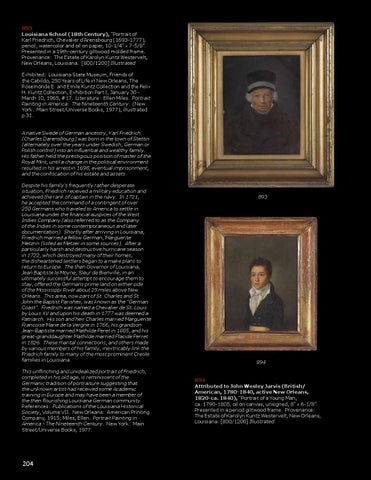
893 Louisiana School (18th Century), “Portrait of Karl Friedrich, Chevalier d’Arensbourg (1693‑1777), pencil, watercolor and oil on paper, 10‑1/4” x 7‑5/8”. Presented in a 19th-century giltwood molded frame. Provenance: The Estate of Karolyn Kuntz Westervelt, New Orleans, Louisiana. [800/1200] Illustrated Exhibited: Louisiana State Museum, Friends of the Cabildo, 250 Years of Life in New Orleans, The Rosemonde E. and Emile Kuntz Collection and the Felix H. Kuntz Collection, Exhibition Part I, January 30 March 10, 1965, #17. Literature: Ellen Miles. Portrait Painting in America: The Nineteenth Century. (New York: Main Street/Universe Books, 1977), illustrated p 31. A native Swede of German ancestry, Karl Friedrich (Charles Darensbourg) was born in the town of Stettin (alternately over the years under Swedish, German or Polish control) into an influential and wealthy family. His father held the prestigious position of master of the Royal Mint, until a change in the political environment resulted in his arrest in 1698, eventual imprisonment, and the confiscation of his estate and assets. Despite his family’s frequently rather desperate situation, Friedrich received a military education and achieved the rank of captain in the navy. In 1721, he accepted the command of a contingent of over 250 Germans who traveled to America to settle in Louisiana under the financial auspices of the West Indies Company (also referred to as the Company of the Indies in some contemporaneous and later documentation). Shortly after arriving in Louisiana, Friedrich married a fellow German, Marguerite Metzrin (listed as Metzer in some sources). After a particularly harsh and destructive hurricane season in 1722, which destroyed many of their homes, the disheartened settlers began to a make plans to return to Europe. The then Governor of Louisiana, Jean Baptiste le Moyne, Sieur de Bienville, in an ultimately successful attempt to encourage them to stay, offered the Germans prime land on either side of the Mississippi River about 25 miles above New Orleans. This area, now part of St. Charles and St. John the Baptist Parishes, was known as the “German Coast”. Friedrich was named a Chevalier de St. Louis by Louis XV and upon his death in 1777 was deemed a Patriarch. His son and heir Charles married Marguerite Francoise Marie de la Vergne in 1766, his grandson Jean-Baptiste married Mathilde Peret in 1805, and his great-granddaughter Mathilde married Placide Perret in 1826. These marital connections, and others made by various members of his family, inextricably link the Friedrich family to many of the most prominent Creole families in Louisiana. This unflinching and unidealized portrait of Friedrich, completed in his old age, is reminiscent of the Germanic tradition of portraiture suggesting that the unknown artist had received some Academic training in Europe and may have been a member of the then flourishing Louisiana German community. References: Publications of the Louisiana Historical Society, Volume VII. New Orleans: American Printing Company, 1915; Miles, Ellen. Portrait Painting in America - The Nineteenth Century. New York: Main Street/Universe Books, 1977.
204 204
893
894 894 Attributed to John Wesley Jarvis (British/ American, 1780‑1840, active New Orleans, 1820‑ca. 1840), “Portrait of a Young Man, ca. 1790‑1805, oil on canvas, unsigned, 8” x 6‑1/8”. Presented in a period giltwood frame. Provenance: The Estate of Karolyn Kuntz Westervelt, New Orleans, Louisiana. [800/1200] Illustrated