and the higher axis is the federal level where information obtained from both state and federal examinations may be shared with various governmental agencies. The streaming of regulatory information is becoming seamless. In May of this year, the Memorandum of Understanding (MOU) of 2011 between the CFPB, the Conference of State Bank Supervisors (CSBS), and various state financial regulatory authorities (i.e., state Regulators) was reaffirmed, establishing the agreement for coordination and information sharing in supervision and enforcement work. Specifically, that MOU promulgated a framework intended to establish a process for coordinated federal and state consumer protection supervision and enforcement of entities providing consumer products or services that are subject to concurrent jurisdiction of the CFPB and one or more state Regulators.7 So, whatever axis of that side-bound, capital “H” is the rightful place of a particular financial institution, the information derived from its regulatory examination has become transparent to the federal and state regulatory authorities.
Competent management
Where weaknesses exist, it is not unusual for an Examiner to use the exit interview as a means to highlight these defects and underscore the need for management to ensure compliance with consumer protection laws, regulations, or policy statements. Policies pertaining to both federal and state regulatory compliance guidelines that are not appropriate or sufficiently comprehensive may lead to adverse findings in the examination report.
Examination findings It should be evident that a lender should never wait for a notice from a banking
l Scope of Examination l Compliance Rating or Similar Description l Loan Sample Outline used for the Examination l Summary and Detail of Significant Violations (where applicable) l Evaluation of the Compliance Management System l Assessment of Policies and Procedures l Summary of the Exit Interview l Management Response to Findings and Corrective Actions (where applicable)
Policies and procedures The list of policies and procedures that I have outlined in this article are, or ought to be, a part of an overall culture of compliance that lenders must adopt in order to run a safe and sound firm. Here’s another analogy: Policies and procedures are like an automobile’s chassis; implementation of policies is the car’s superstructure; and, the employee is the driver who takes (and passes) the road test. All three must be intact and reliable for the car to be considered safe to be driven, and all of these components depend on one another to effectuate the vehicle’s purpose. All three deserve equal emphasis! Policy statements must address the financial institution’s business philosophy, goals, objectives, procedures, required actions, remedies, and, of course, the metrics with which to judge them. They do not have to be extensive in length, but they certainly do have to be comprehensive in detail, and based on the size, complexity, and risk profile of the company. Further, I believe certain policy statements should be converted into Employee Manuals, such as an Advertising Manual or a Social Media Manual, with attestation of receipt thereof by, and distributed to, all affected employee. Each policy statement should be reinforced with training–not generic, out-of-the-can training, but training on the company’s actual policy itself. Additionally, a policy and procedure must be updated immediately when regulations change or the company changes its way of doing business with respect to legal and regulatory compliance requirements. This means that not only should citations and definitions be included, where needed, but also procedures should highlight forms, disclosures, ‘chain of command’ guidelines, and any other areas inherent in carrying out management’s expectations and directives.
45
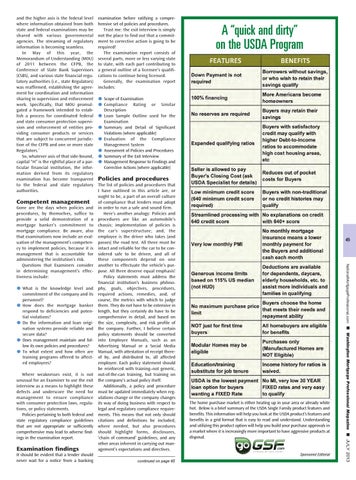
The home purchase market is either heating up in your area or already white hot. Below is a brief summary of the USDA Single Family product features and benefits. This information will help you look at the USDA product’s features and benefits in a grid format that is easy to read and understand. Understanding and utilizing this product option will help you build your purchase approvals in a market where it is increasingly more important to have aggressive products at disposal.
Sponsored Editorial continued on page 65
n Washington Mortgage Professional Magazine n JULY 2013
l What is the knowledge level and commitment of the company and its personnel? l How does the mortgage banker respond to deficiencies and potential violations? l Do the information and loan origination systems provide reliable and secure data? l Does management maintain and follow its own policies and procedures? l To what extent and how often are training programs offered to affected employees?
A “quick and dirty” on the USDA Program
NationalMortgageProfessional.com
Gone are the days when policies and procedures, by themselves, suffice to provide a solid demonstration of a mortgage banker’s commitment to mortgage compliance. Be aware, also that examinations now include an evaluation of the management’s competency to implement policies, because it is management that is accountable for administering the institution’s risk. Questions that Examiners consider in determining management’s effectiveness include:
examination before ratifying a comprehensive set of policies and procedures. Trust me: the exit interview is simply not the place to find out that a commitment to corrective action is going to be required! The examination report consists of several parts, more or less varying state to state, with each part contributing to a general outline of a licensee’s qualifications to continue being licensed. Generally, the examination report includes: