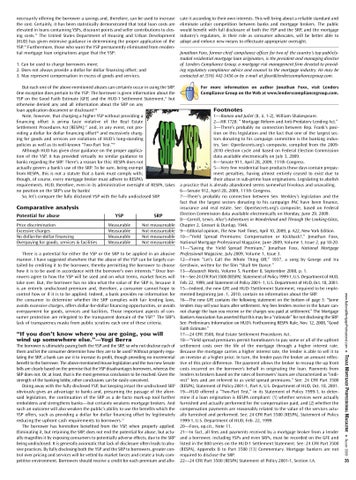
necessarily offering the borrower a savings and, therefore, can be used to increase the cost. Certainly, it has been statistically demonstrated that total loan costs are elevated in loans containing YSPs, discount points and seller contributions to closing costs.13 The United States Department of Housing and Urban Development (HUD) has given extensive guidance in determining the proper application of the YSP.14 Furthermore, those who want the YSP permanently eliminated from residential mortgage loan originations argue that the YSP: 1. Can be used to charge borrowers more; 2. Does not always provide a dollar for dollar financing offset; and 3. May represent compensation in excess of goods and services. But each one of the above-mentioned abuses can certainly occur in using the SRP. One exception does pertain to the YSP: The borrower is given information about the YSP on the Good Faith Estimate (GFE) and the HUD-1 Settlement Statement,15 but otherwise denied any and all information about the SRP on any loan application document or disclosure!16 Note, however, that charging a higher YSP without providing a financing offset is prima facie violative of the Real Estate Settlement Procedures Act (RESPA);17 and, in any event, not providing a dollar for dollar financing offset18 and excessively charging for goods and services are violations of HUD’s long-standing policies as well as its well-known “Two-Part Test.”19 Although HUD has given clear guidance on the proper application of the YSP, it has provided virtually no similar guidance to banks regarding the SRP. There’s a reason for this: RESPA does not actually govern a bank’s use of the SRP. To be sure, being exempt from RESPA, this is not a statute that a bank must comply with; though, of course, every mortgage broker must adhere to RESPA’s requirements. HUD, therefore, even in its administrative oversight of RESPA, takes no position on the SRP’s use by banks! So, let’s compare the fully disclosed YSP with the fully undisclosed SRP.
Comparative analysis Potential for abuse Price discrimination Excessive charges No dollar-for-dollar financing Overpaying for goods, services & facilities
YSP
SRP
Measurable Measurable Measurable Measurable
Not measureable Not measureable Not measureable Not measureable
“If you don’t know where you are going, you will wind up somewhere else.”—Yogi Berra
For more information on author Jonathan Foxx, visit Lenders Compliance Group on the Web at www.lenderscompliancegroup.com.
Footnotes
O AUGUST 2009
1—Romeo and Juliet (II, ii, 1-2), William Shakespeare. 2—HR 1728: “ Mortgage Reform and Anti-Predatory Lending Act.” 3—There’s probably no connection between Rep. Frank’s position on this legislation and the fact that one of the largest sectors donating to his campaign committee is the banking industry. See: OpenSecrets.org’s composite, compiled from the 20092010 election cycle and based on Federal Election Commission data available electronically on July 3, 2009. 4—Senate 911, April 28, 2009, 111th Congress. 5—Very few residential loan products these days contain prepayment penalties, having almost entirely ceased to exist due to their abuse in sub-prime loan originations. Legislating to abolish a practice that is already abandoned seems somewhat frivolous and unavailing. 6—Senate 912, April 28, 2009, 111th Congress. 7—There’s probably no connection between Sen. Merkley’s legislation and the fact that the largest sectors donating to his campaign PAC have been finance, insurance and real estate. See: OpenSecrets.org’s composite, based on Federal Election Commission data available electronically on Monday, June 29, 2009. 8—Carroll, Lewis. Alice’s Adventures in Wonderland and Through the Looking-Glass, Chapter 2, Grosset & Dunlap, 1946. 9—Editorial opinion, The New York Times, April 10, 2009, p. A22, New York Edition. 10—“Yield Spread Premiums: Compensation or Kickback?,” Jonathan Foxx, National Mortgage Professional Magazine, June 2009, Volume 1, Issue 2, pp 18-20. 11—“Saving the Yield Spread Premium,” Jonathan Foxx, National Mortgage Professional Magazine, July 2009, Volume 1, Issue 3. 12—From “Let’s Call the Whole Thing Off,” 1937, a song by George and Ira Gershwin, written for the film “Shall We Dance.” 13—Research Works, Volume 5, Number 8, September 2008, p. 1. 14—See 24 CFR Part 3500 (RESPA): Statement of Policy 1999-1, U.S. Department of HUD, Feb. 22, 1999, and Statement of Policy 2001- 1, U.S. Department of HUD, Oct. 18, 2001. 15—Indeed, the new GFE and HUD-1Settlement Statement, required to be implemented beginning Jan. 1, 2010, contain no information about the SRP. 16—The new GFE contains the following statement on the bottom of page 3: “Some lenders may sell your loans after settlement. Any fees lenders receive in the future cannot change the loan you receive or the charges you paid at settlement.” The Mortgage Bankers Association has asserted that this may be a “rationale” for not disclosing the SRP. See: Preliminary Information on HUD’s Forthcoming RESPA Rule, Nov. 12, 2008, “Good Faith Estimate.” 17—24 CFR 3500, Real Estate Settlement Procedures Act. 18—“Yield spread premiums permit homebuyers to pay some or all of the upfront settlement costs over the life of the mortgage through a higher interest rate. Because the mortgage carries a higher interest rate, the lender is able to sell it to an investor at a higher price. In turn, the lender pays the broker an amount reflective of this price difference. The payment allows the broker to recoup the up front costs incurred on the borrower’s behalf in originating the loan. Payments from lenders to brokers based on the rates of borrowers’ loans are characterized as “indirect” fees and are referred to as yield spread premiums.” See: 24 CFR Part 3500 (RESPA), Statement of Policy 2001-1, Part A, U.S. Department of HUD, Oct. 18, 2001. 19—HUD offered a “Two-Part Test,” in its Statement of Policy 1999-1, to determine if a loan origination is RESPA compliant: (1) whether services were actually furnished and actually performed for the compensation paid, and (2) whether the compensation payments are reasonably related to the value of the services actually furnished and performed. See: 24 CFR Part 3500 (RESPA), Statement of Policy 1999-1, U.S. Department of HUD, Feb. 22, 1999. 20—Foxx, op.cit., Note 11. 21—In fact, all fees and payments received by a mortgage broker from a lender and a borrower, including YSPs and even SRPs, must be recorded on the GFE and listed in the 800 series on the HUD-1 Settlement Statement. See: 24 CFR Part 3500 (RESPA), Appendix B to Part 3500 (13) Commentary. Mortgage bankers are not required to disclose the SRP. 22—24 CFR Part 3500 (RESPA) Statement of Policy 2001-1, Section I.A.
TEXAS MORTGAGE PROFESSIONAL MAGAZINE
The borrower is ultimately paying both the YSP and the SRP, so why not disclose each of them and let the consumer determine how they are to be used? Without properly regulating the SRP, a bank can use it to increase its profit, though providing no incremental benefit to the borrower. The above-mentioned House legislation and the two new Senate bills are clearly based on the premise that the YSP disadvantages borrowers, whereas the SRP does not. Or, at least, that is the most generous conclusion to be reached. Given the strength of the banking lobby, other conclusions can be easily conceived. Doing away with the fully disclosed YSP, but keeping intact the undisclosed SRP obviously gives an advantage to banks and, presuming the passage of the aforesaid legislation, the continuation of the SRP as a de facto mark-up tool further emboldens and strengthens banks—but certainly weakens mortgage brokers. And such an outcome will also weaken the public’s ability to use the benefits which the YSP offers, such as providing a dollar for dollar financing offset by legitimately reducing the upfront cash requirements to borrowers.22 The borrower has heretofore benefited from the YSP, when properly applied. Eliminating it, but retaining the SRP, does not end the potential for abuse, but actually magnifies it by exposing consumers to potentially adverse effects, due to the SRP being undisclosed. It is generally axiomatic that lack of disclosure often leads to abusive practices. By fully disclosing both the YSP and the SRP to borrowers, greater control over pricing and services will be vetted by market forces and create a truly competitive environment. Borrowers should receive a credit for each premium and allo-
Jonathan Foxx, former chief compliance officer for two of the country’s top publiclytraded residential mortgage loan originators, is the president and managing director of Lenders Compliance Group, a mortgage risk management firm devoted to providing regulatory compliance advice and counsel to the mortgage industry. He may be contacted at (516) 442-3456 or by e-mail at jfoxx@lenderscompliancegroup.com.
www.NationalMortgageProfessional.com O
There is a potential for either the YSP or the SRP to be applied in an abusive manner. I have suggested elsewhere that the abuse of the YSP can be largely curtailed by crediting it to the borrower, thereby permitting the borrower to choose how it is to be used in accordance with the borrower’s own interests.20 Once borrowers agree to how the YSP will be used and on what terms, market forces will take over. But, the borrower has no idea what the value of the SRP is, because it is an entirely undisclosed premium and, therefore, a consumer cannot hope to control how or if it is to be applied. Indeed, a bank provides no information for the consumer to determine whether the SRP complies with fair lending laws, avoids excessive charges, offers dollar-for-dollar financing opportunities, or avoids overpayment for goods, services and facilities. Those important aspects of consumer protection are relegated to the transparent domain of the YSP.21 The SRP’s lack of transparency masks from public scrutiny each one of these criteria.
cate it according to their own interests. This will bring about a reliable standard and eliminate unfair competition between banks and mortgage brokers. The public would benefit with full disclosure of both the YSP and the SRP, and the mortgage industry’s regulators, in their role as consumer advocates, will be better able to adopt and enforce new means to effectuate appropriate oversight.
35