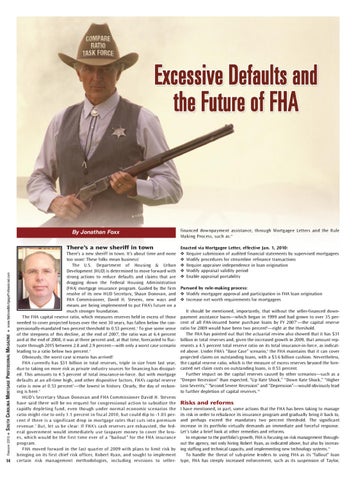
By Jonathan Foxx
FEBRUARY 2010
SOUTH CAROLINA MORTGAGE PROFESSIONAL MAGAZINE
www.NationalMortgageProfessional.com
There’s a new sheriff in town
14
There’s a new sheriff in town. It’s about time and none too soon! These folks mean business! The U.S. Department of Housing & Urban Development (HUD) is determined to move forward with strong actions to reduce defaults and claims that are dragging down the Federal Housing Administration (FHA) mortgage insurance program. Guided by the firm resolve of its new HUD Secretary, Shaun Donovan, and FHA Commissioner, David H. Stevens, new ways and means are being implemented to put FHA’s future on a much stronger foundation. The FHA capital reserve ratio, which measures reserves held in excess of those needed to cover projected losses over the next 30 years, has fallen below the congressionally-mandated two percent threshold to 0.53 percent.1 To give some sense of the steepness of this decline, at the end of 2007, the ratio was at 6.4 percent and at the end of 2008, it was at three percent and, at that time, forecasted to fluctuate through 2015 between 2.8 and 2.9 percent—with only a worst case scenario leading to a ratio below two percent.2 Obviously, the worst case scenario has arrived! FHA currently has $31 billion in total reserves, triple in size from last year, due to taking on more risk as private industry sources for financing has dissipated. This amounts to 4.5 percent of total insurance-in-force. But with mortgage defaults at an all-time high, and other dispositive factors, FHA’s capital reserve ratio is now at 0.53 percent3—the lowest in history. Clearly, the day of reckoning is here.4 HUD’s Secretary Shaun Donovan and FHA Commissioner David H. Stevens have said there will be no request for congressional action to subsidize the rapidly depleting fund, even though under normal economic scenarios the ratio might rise to only 1.1 percent in fiscal 2010, but could dip to -1.03 percent if there is a significant drop in mortgage rates that cuts into premium revenue. 5 But, let us be clear: If FHA’s cash reserves are exhausted, the federal government would immediately use taxpayer money to cover the losses, which would be the first time ever of a “bailout” for the FHA insurance program. FHA moved forward in the last quarter of 2009 with plans to limit risk by bringing on its first chief risk officer, Robert Ryan, and sought to implement certain risk management methodologies, including revisions to seller-
financed downpayment assistance, through Mortgagee Letters and the Rule Making Process, such as:6 Enacted via Mortgagee Letter, effective Jan. 1, 2010: Require submission of audited financial statements by supervised mortgagees Modify procedures for streamline refinance transactions Require appraiser independence in loan origination Modify appraisal validity period Enable appraisal portability Pursued by rule-making process: Modify mortgagee approval and participation in FHA loan origination Increase net worth requirements for mortgagees It should be mentioned, importantly, that without the seller-financed downpayment assistance loans—which began in 1999 and had grown to over 35 percent of all FHA-insured home purchase loans by FY 20077—the capital reserve ratio for 2009 would have been two percent8—right at the threshold. The FHA has pointed out that the actuarial review also showed that it has $31 billion in total reserves and, given the increased growth in 2009, that amount represents a 4.5 percent total reserve ratio on its total insurance-in-force, as indicated above. Under FHA’s “Base Case” scenario,9 the FHA maintains that it can cover projected claims on outstanding loans, with a $3.6 billion cushion. Nevertheless, the capital reserve ratio, which is the measure of excess reserves beyond the forecasted net claim costs on outstanding loans, is 0.53 percent. Further impact on the capital reserves caused by other scenarios—such as a “Deeper Recession” than expected, “Up Rate Shock,” “Down Rate Shock,” “Higher Loss Severity,” “Second Severe Recession” and “Depression”—would obviously lead to further depletion of capital reserves.10
Risks and reforms I have mentioned, in part, some actions that the FHA has been taking to manage its risk in order to rebalance its insurance program and gradually bring it back to, and perhaps exceed the mandatory two percent threshold. The significant increase in its portfolio virtually demands an immediate and forceful response. Let’s take a brief look at other remedies and reforms. In response to the portfolio’s growth, FHA is focusing on risk management throughout the agency, not only hiring Robert Ryan, as indicated above, but also by increasing staffing and technical capacity, and implementing new technology systems.11 To handle the threat of sub-prime lenders to using FHA as its “fallout” loan type, FHA has steeply increased enforcement, such as its suspension of Taylor,