first example of an applicant submitting published work as part of her bid to attend the school. Jessie wished to follow her older sister Evelyn to Northfield, though poor health had forced Evelyn to leave the Seminary after a single semester. Perhaps worried that the same fate awaited Jessie, the school declined to admit her. A young Northfield alumna intervened and pleaded with the principal, Miss Hall, who relented and allowed Jessie to come. It wouldn’t be long before Hughan would see her name in the newspaper with regularity. She joined the staff of The Hermonite, a biweekly campus paper that purported to “serve the interests” of both Northfield and Mount Hermon, but clearly did a better job of serving the interests of the boys’ school, since only one in nine pages was devoted to news of the Seminary. Hughan and her co-editors successfully lobbied to triple the space allotted to Northfield news. After graduating from Northfield, she returned to her native New York City, where she would spend nearly all of her life. As an undergraduate at Barnard, Hughan and three close friends established the first of her legacies, the Alpha Omicron Pi sorority. Thriving today with over 100 active chapters, its mission is the same as it was 120 years ago: “Women enriched through lifelong friendship.” The three strands of Hughan’s religious, intellectual, and political interests wove more tightly into a single braid as she pursued graduate degrees during
“ She ran for political office on the Socialist ticket 18 times, and though she had little hope of winning, she used her attempts to draw attention to pacifism.” the first decade of the 20th century. Her early religious upbringing in the Episcopal Church had been tempered by the evangelical atmosphere at Northfield, and, at her sister’s urging, she joined the Unitarian Church in the mid-1890s. Becoming a pacifist and later joining the Socialist Party in 1907 were, according to her biographer Scott Bennett, rooted in her lifelong religious faith: Following the dictates of Christ meant empathy for her neighbor and turning the other cheek. Hughan lived these virtues, and sought them as matters of public policy. Meanwhile, after her doctoral dissertation was published in 1911 under the title “American Socialism of the Present Day,” she found that her political leanings kept her out of the upper echelon of the academy. Instead, she taught
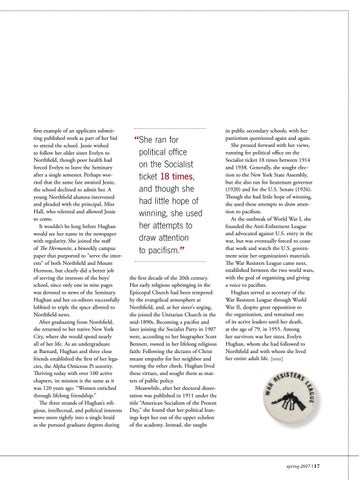
in public secondary schools, with her patriotism questioned again and again. She pressed forward with her views, running for political office on the Socialist ticket 18 times between 1914 and 1938. Generally, she sought election to the New York State Assembly, but she also ran for lieutenant governor (1920) and for the U.S. Senate (1926). Though she had little hope of winning, she used these attempts to draw attention to pacifism. At the outbreak of World War I, she founded the Anti-Enlistment League and advocated against U.S. entry in the war, but was eventually forced to cease that work and watch the U.S. government seize her organization’s materials. The War Resisters League came next, established between the two world wars, with the goal of organizing and giving a voice to pacifists. Hughan served as secretary of the War Resisters League through World War II, despite great opposition to the organization, and remained one of its active leaders until her death, at the age of 79, in 1955. Among her survivors was her sister, Evelyn Hughan, whom she had followed to Northfield and with whom she lived her entire adult life. [NMH]
spring 2017 I 17