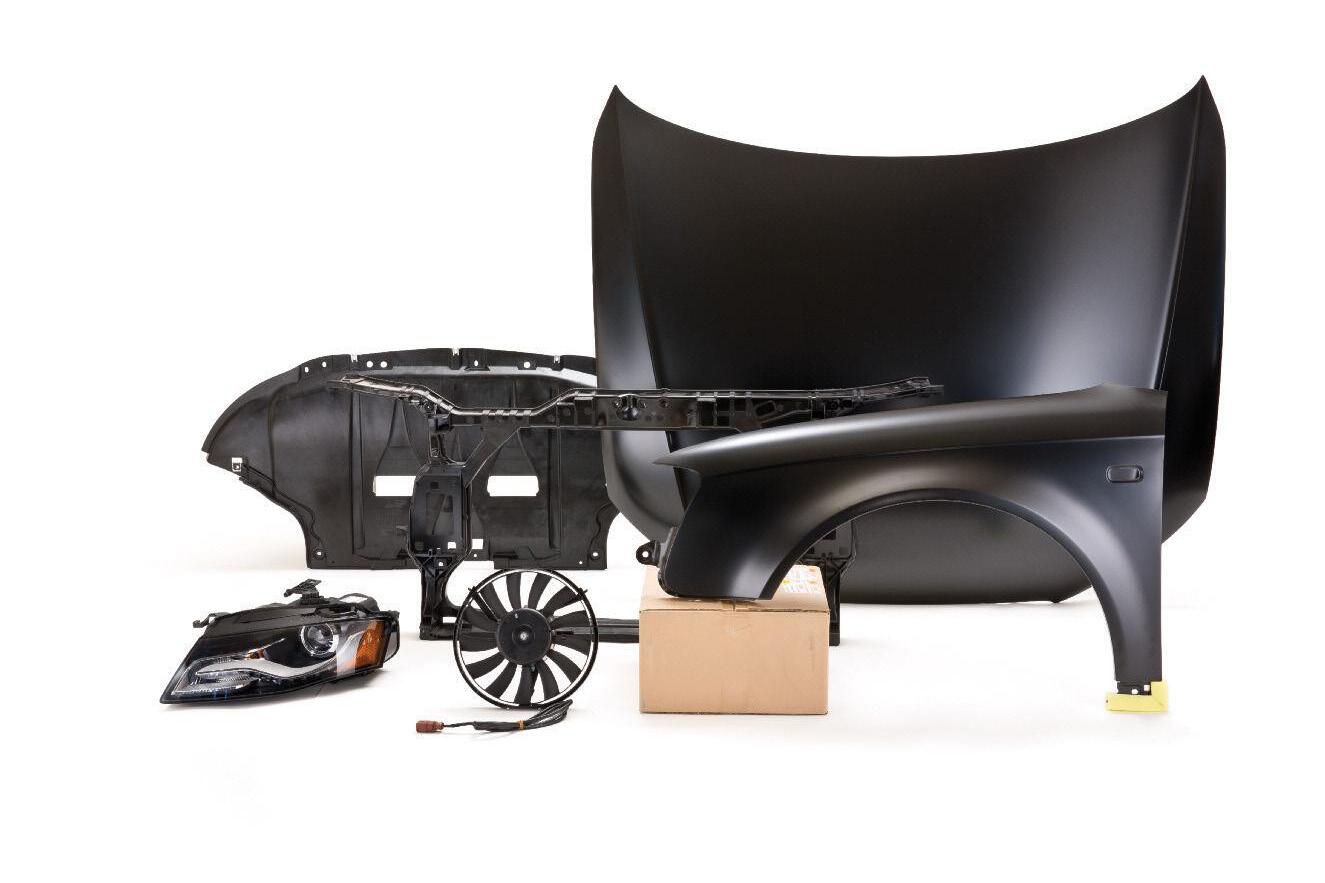
You’ve got the right tools, staff, technology and procedures to give your customers the best repair possible. The missing piece of the puzzle? Genuine Volkswagen Collision Parts. Contact an authorized dealer today and find your perfect fit.
PRESIDENT Jerry McNee, Ultimate Collision Repair, Inc. 732-494-1900 / ultimatecollision@att.net
COLLISION CHAIRMAN
Dennis Cataldo, Jr., D&M Auto Body 732-251-4313 / jr@dnmautobody.com
MECHANICAL CHAIRMAN
Keith Krehel, Krehel Automotive Repair, Inc. 973-546-2828 / krehelauto@aol.com
TREASURER
Tom Elder, Compact Kars, Inc. 609-259-6373 / compactkars@aol.com
SECRETARY
Thomas Greco, Thomas Greco Publishing, Inc. 973-667-6922 / thomas@grecopublishing.com
BOARD
Brad Crawford, Livingston Collision, Inc. 973-992-5274 / livingston.collision@gmail.com
Gary Gardella, Jr., County Line Auto Body 732-363-5904 / countylineautobody@gmail.com
Dave Laganella, Peters Body and Fender 201-337-1200 / petersbandf@gmail.com
Sam Mikhail, Prestige Auto Body 908-294-1985 /prestige@goldcar.us
Ken Miller, 821 Collision, LLC (973) 949-3733 / kmiller@821collision.com
Ted Rainer, Ocean Bay Auto Body 732-899-7900 / ted@oceanbayautobody.com
Anthony Trama, Bloomfield Auto Body 973-748-2608 / anthony@bloomfieldautobody.com
BOARD ALLIED
Joe Amato, The Amato Agency 732-530-6740 / joesr@amatoagency.com
Mike Kaufmann, Advantage Dealer Services 973-332-7014 / mkaufmann@advantageds.com
PAST PRESIDENT ATTENDING Jeff McDowell, Leslie’s Auto Body 732-738-1948 / chacki@aol.com
PUBLISHER
Thomas Greco / thomas@grecopublishing.com
SALES DIRECTOR
Alicia Figurelli / alicia@grecopublishing.com
SALES REPRESENTATIVE
Bill Moore / bill@grecopublishing.com / (201) 209-1989
EDITORIAL/CREATIVE COORDINATOR
Alana Bonillo / alana@grecopublishing.com
MANAGING EDITOR
Chasidy Rae Sisk / chasidy@grecopublishing.com
OFFICE MANAGER
Donna Greco / donna@grecopublishing.com
PRODUCTION COORDINATOR
Joe Greco / joe@grecopublishing.com
CONTRIBUTING EDITORS Charles Bryant • Mario DeFilippis • Dennis Cataldo • Mitch Portnoi • Ron Ananian • Keith Krehel • Jerry McNee • Jacquelyn Bauman
Published by: Thomas Greco Publishing, Inc. 244 Chestnut Street, Suite 202, Nutley, NJ 07110
Corporate: (973) 667-6922 / FAX: (973) 235-1963
www.grecopublishing.com
Nick Kostakis
Jim Kowalak
Keith Krehel
Joe Lubrano
Michael Lovullo
Jeff McDowell
Sam Mikhail
Ron Mucklow
George Petrask
Russ Robson
Jerry Russomano
George Threlfall
Cynthia Tursi
Lee Vetland
Paul Vigilant
Rich Weber
Brian Vesley
Glenn Villacari
Stan Wilson
An Inconvenient Truth?
I don’t really remember when I first heard the term “climate change.” For some reason, I think it was around the time Al Gore was vice president or maybe right after that. But I know that he was one of the first “famous” people to speak about it. Now to begin with, ever since his wife Tipper set out to put warning labels on albums and CDs, I never liked the guy. In fact, I was a big Clinton supporter until he named Gore as VP. So when he started talking about the “inconvenient truth” of climate change, I honestly tuned him out.
But climate change has not gone away. And at my age, I am more worried about underwear change than climate change. So I will not claim to be pro, against or even educated about it. Yet, like everything else these days, my opinion on it doesn’t matter, because it’s going to get shoved down our throats either way.
Just look at that progressively wonderful state of California. The country’s most populous state is banning the sale of new gasoline-powered vehicles starting in 2035. The
by THOMAS GRECO, PUBLISHER
rule will force automakers to speed up production of cleaner vehicles beginning in 2026. Now, maybe you don’t think that will affect repairers in New Jersey, so allow me to remind you that our current Governor once said he wanted to make New Jersey “the California of the east coast.”
I also know that 2035 seems like a long time from now, but I think it’s naive to believe that it will take 10 years for regulations to be implemented. So, are you ready to repair these electric vehicles? My guess is most of you are about as ready to fix them as I am to drive one.
BUT that’s a whole ‘nother story. Getting back to climate change, the one question I always ask those better educated than me is: Even if we go full electric in the US, how much is that really going to change things?
Since I never get a straight answer, I did some research. Turns out, the US contributes a little over 14 percent of worldwide CO2 emissions. Fourteen percent?! So we are to upset a trillion dollar industry to reduce emission by – at best – 14 percent? Isn’t that like saying we’re going to cut out 14 percent of the cancer in your toe…but it will make a huge difference? That just doesn’t add up. Okay, so maybe we’ll get Canada to join us in this. That’s another whopping TWO percent! “That’s right. Now we got the cancer out of one and a half toes. But we can’t do much more.”
And I know, I know. You have to start somewhere. And everyone wants a healthier world, right? Current events tell us that Russia, China, India, North Korea, Iran (combined, almost 50% of the world’s CO2 emissions) will definitely all come aboard, right?
Please.
Again. I am not saying I am pro or against any of this. I mean, sure, I don’t want to get caught in a snowstorm on the Turnpike and run out of juice. And I’m sure you guys don’t want to spend hundreds of thousands of dollars on new equipment, permits and training. But if it actually made sense, the sacrifices and inconveniences might be worth it. Right now, it’s just a bunch of politicians telling us the sky is falling. Maybe the sky literally is crashing down on us, but you have to do more than tell me all of this adds up to only 14 percent.
Because they don’t make extension cords that long.
Sweet Spot
“I think I’ll start a business, but I don’t really care if I make any money,” said no one ever. Let’s face it: We’re all in business for a return on our investment (ROI), but in this industry, the ROI is minimal compared to all other fields. So, what do we do?
We take on more jobs. We work 18 hours a day, killing ourselves as we try to get enough done. Kudos on having so much work, but if nine of those hours are for free, you’re doing yourself a disservice. Or maybe you’re compensated for all your time, but you’re not making enough to hire another employee to offset your workload.
If you want to fix every vehicle for next-to-nothing and work yourself into an early grave, that’s certainly your prerogative, but there’s a better way. Why don’t you slow down and figure out what you actually need to be successful?
Grabbing every vehicle that comes in the door doesn’t benefit you. Be more selective. Educate your customers, and identify those who are willing to commit. What is your time worth? We need to know our value if we want to know our business, and that means tracking various metrics.
It’s great that you wrote 100 estimates, but how many of those turned into paying jobs? Statistically, 35-50 percent of estimates turn into customers; the rest are merely wasting our time. Yet we’re allowing it, and as long as we let it happen, it’ll continue. Even though we’re completely overwhelmed with the existing backlog, we stop what we’re doing to run out front and try to capture a tirekicker’s keys who’s only in our lot because their insurance company told them to get estimates. They need their vehicle fixed, not an estimate! Is the vehicle owner price shopping? Everyone these days is a price shopper, but if your services are worthy, those prices become a secondary thought.
How about charging for the estimate? You already have 100 things to do, and I’m not about to push to complete 101 tasks for no reason. Price shoppers who only want the estimate aren’t worth our time unless they are committed to your service. At the end of the repair, refund the money paid for the estimate, but it’s about getting the commitment – customers don’t want an estimate; they want a repair. And we want the same thing.
Do you know your shop’s closing ratio? Although it’s probably not possible to achieve a 100 percent closing ratio, you’re spinning your wheels if you’re only at 35-50 percent.
Running a good business means knowing your business. A guy I know recently sold his business to a MSO. When he ran the shop, he understood that he was profitable when he hit his sweet spot of 45-50 cars.
by JERRY MCNEE
Well, the new MSO manager comes from the mentality of keeping the lot full at all times, so they’ve doubled their intake to take in 90 vehicles on-site. Things happen: parts get lost, vehicles are damaged, and cars are being put on extended hold because they just don’t have enough time to get to them. Not to mention your cash flow crunch. Bringing in all these cars that you can’t work on doesn’t benefit you or the customer…you have to know your sweet spot where you’re most effective and profitable.
Working 18 hours a day so you can get through 90 cars may seem like success, but concentrating on 50 cars will be worthwhile. We have to understand that we can’t be everything to everyone. We cannot fix every vehicle, and every customer doesn’t deserve to be our customer. It’s ok to fire the customer. Grabbing another car just to have the keys and fill the lot now means that you have to explain to the customer why their repair is taking so long.
Some refuse to give up a job, no matter what it is, but working yourself to death with bags under your eyes isn’t the answer; you’re enslaving yourself to your business. You deserve a life outside the shop. Would you rather fix 50 cars or 100 cars if you’re making the same amount of money? Who doesn’t want to earn more? But many of us are so busy fixing cars that we’re not even paying attention.
We need to slow it down so that we better understand our business and its needs. And if we slow it down up front, it’ll certainly speed up the rest of the process. Once we identify how many cars allow us to achieve our optimal ROI, we can find our sweet spot, the place where everything comes together to produce the best possible result, and that’s definitely a return worthy of our investment.
BEST OVERALL: KRIS DIAZ DESIGNS (INSTAGRAM.COM/KRISDIAZDESIGNS) BEST AIRBRUSH: SHINE DESIGNS (INSTAGRAM.COM/SHINE_ZAMORA) BEST FINISH: D.JAY GILLESPIE (INSTAGRAM.COM/D.JAYS.ART)
PINSTRIPING: MR. WIM (INSTAGRAM.COM/MR_WIM) BEST CONCEPT & PEOPLE’S CHOICE: UNCLE PAT (INSTAGRAM.COM/GOTHEET67) RISING STAR: TONY TAYLOR (INSTAGRAM.COM/TONYT462)
by CHARLES BRYANT
Now Is the Time!
As many of you have called and wondered where Charlie Bryant’s article was last month, no worries! Charlie is fine. We just decided to give him a break and run it every other month.
As many in the industry may already know, AASP/NJ has been running a Hotline for many years, which members can call any day, all day, to get answers to industry questions. If, for some reason we do not have the answer, we will do the research while you go back to work. There are no restrictions on the type of automotive questions you can seek from the Hotline, ie. questions related to the regulations governing fair claim settlement practices, the rights of consumers when bringing their vehicle into a repair facility, the requirements of a collision shop when preparing to repair a customer’s damaged vehicle – basically any question related to the industry. Again, if we don’t have an immediate answer, we will research and get back to you with the answer.
AASP/NJ has been answering these questions for basically as long as I can remember and we have provided members with sections of the regulation that govern the practices of insurers which would most often result in insurers getting back in line when doing something that was not in compliance with the regulations. However, since the pandemic, it appears that insurers are taking the position they no longer have to follow the regulations. Now, consumers’ vehicles are often left sitting in collision shops for weeks waiting for insurers to inspect
them and negotiate an agreement so the repairs can commence. Then, once the repairs have commenced and the repair shop discovers additional or hidden damage and calls the insurer for a supplement, it often takes weeks to get the insurer out to inspect the vehicle and reach an agreement on the cost of the supplemental damage.
The regulations are clear that if – and I repeat: IF – the insurer intends to inspect a damaged vehicle before the repairs commence, they must do so within seven working days, in addition to commencing negotiations and making a good faith offer of settlement. (See provision below.)
Section 11:3-10.3 - Adjustment of partial losses
(a) If the insurer intends to exercise its right to inspect, or cause to be inspected by an independent appraiser, damages prior to repair, the insurer shall have seven working days following receipt of notice of loss to inspect the insured’s damaged vehicle, which is available for inspection, at a place and time reasonably convenient to the insured; commence negotiations; and make a good faith offer of settlement.
Although I feel like I am starting to sound like a broken record, I can’t stress enough just how important this section of the regulation is, especially at the present time. Damaged vehicles that could most likely be repaired in a few days are sitting in shops for weeks before the insurer even comes out to see the vehicle. It has become obvious that there is a method to the madness we are presently
seeing. For some time now, insurers have wanted to have estimates prepared based on photos, instead of actually performing a personal inspection of the damaged vehicle. Insurers claim the purpose of going to photo estimating is to expedite the repair procedure. Well, in reality, it is the photo estimating process causing extreme delays. It is not uncommon for a collision shop to go along with the insurer and send photos of the damage to the insurer along with an estimate for, let’s say $10,000 and then get an estimate back from the insurer for just $1,500.
From there, it goes to one supplement after the other, often taking weeks to even get close to the actual cost to repair the damage. The insurer keeps saying over and over, “That is all we can see based on the images sent.” So, rather than getting the damaged vehicle repaired and back to the owner in a reasonable amount of time, it takes weeks or months to get the repairs completed and back to the owner. The reality is, it is impossible to prepare a realistic estimate on a severely damaged vehicle based on photos. It was for this exact reason that the regulation governing collision shops practices forbids a collision shop from preparing an estimate on a damaged vehicle based on photos, phone calls or any other means than the personal inspection of the vehicle:
The following is one of the violations of the NEW JERSEY AUTO BODY REPAIR FACILITY ACT OF 1983 (N.J.S.A.39:13-1 et seq.):
(6) Making appraisals of the cost of repairing an automobile, which has been damaged as a result of a collision, through the use of photographs, telephone calls or any manner other than personal inspection.
Since this is the standard that governs the people who are actually licensed to repair damaged vehicles, it certainly should be the standard that insurers follow, as well; however, it appears that insurers are ignoring current rules in all areas, and they are basically doing whatever they
feel like. Listen, I am not attempting to stand in the way of progress, and as technology progresses, I am sure that photo estimates will be the way of the future…one day; however, once again, that time is not now!
Long story short, AASP/NJ is constantly addressing things like the issues mentioned in this article. But – like the old saying goes ––power is in numbers. With all that is presently going on, there could not be a better time to join AASP/NJ. We
are fighting for the rights of members of the industry and addressing the issues referenced in this article on a daily basis. Based on the foregoing, I am once again pleading with the members of the industry who are not part of AASP/NJ to join today. Stop being part of the problem, and become part of the solution. Anyone interested in joining can contact AASP/NJ Executive Director, Charles Bryant on the AASP/NJ Hotline at (732) 922-8909.
Women’s Industry Network Opens 2023 Scholarship Applications
Obtaining a collision repair education can be costly, but as part of its commitment to supporting women pursuing a career in this industry, the Women’s Industry Network (WIN) will be awarding up to 20 scholarships to provide tuition assistance, educational opportunities and enrichment activities to qualified applicants.
To ensure that these awards remain relevant and beneficial to recipients, WIN has revitalized their scholarship program for the coming year and will be offering awards in two separate categories. Stars will receive a $500 scholarship, while Champions receive a $2,500 scholarship and access to monthly student engagement activities.
All scholarship recipients will be given a free virtual pass to the 2023 WIN Educational Conference, plus they’ll be granted membership to WIN’s exclusive student Facebook group. Additionally, each young lady will be given the opportunity to be mentored by a WIN member.
Applications for the 2023 program will be accepted from September 12 through October 28, 2022 with winners announced in January 2023. Access the application or obtain more information at bit.ly.com/WINsch23
THOMAS GRECO PUBLISHING
Robin Ricca, Voyager of the Sea
Robin Ricca (Ricca’s Auto Body) surely knows how to navigate his way through the auto body world. He’s been doing so for over 46 years at the helm of his Hackensackbased shop which he owns and operates with his brother/ partner, Carl.
But when he’s not on the phone talking to customers and insurers about the status of cars, Robin can most likely be found navigating something quite different – the mighty sea.
Robin is a master sailor with a national title under his belt – he has led a crew of eight plus the skipper to win the 2005 Soverel 33 National Championship title.
He’s considered a semi-professional sailor since time does not afford him the ability to do it full time, but he spends as much time on the water as possible.
When he’s not behind his desk at the shop, Robin can be found racing, cruising or even fly fishing. He’s taken week-long voyages down the East Coast, helping to deliver yachts and boats for the multitude of people he has met through the sailing world. Other times, he may just spend the weekend on his power boat – the “Bel Sogno,” which means “beautiful dream” in Italian.
Robin was practically born on the sea, he says of his upbringing. His parents introduced him to the water at a young age, long before Carl, who is six years younger, was born.
“We learned how to boat on the Hudson River,” reflects Robin of his introduction to the sea. “When I was 10 and Carl was four, we started boating down the shore or on Long Island Sound which has so many yacht clubs where we could go sailing, fishing and power boating.
“The Long Island Sound is really a treasure,” he adds of his favorite nautical escape.
Since he was born with a love for sailing, it’s not
surprising that Robin was destined to get even deeper into the sport years later when a neighbor introduced him to racing in 1982.
“I had raced small sailboats since I was 12, but once I raced with my neighbor, I wound up taking it to a level I had never expected.”
Finding time outside the body shop for hobbies and pastimes can be challenging in the body shop world, but the team at Ricca’s Auto Body makes it work. Robin is on the water three days a week; two of those days, he can be found racing on Long Island Sound.
For years, the shop wasn’t open on Saturdays, but these days, duty calls. Robin and Carl – who has his own set of hobbies, including freshwater fishing at their father’s old home in the Catskills, golfing and devoting time to his work with UNICO – rotate Saturdays along with Greg Gere, the shop’s office manager. Meanwhile, their production manager, Shameer Baksh, keeps the shop running at 100 percent productivity after 31 years of employment. This gives everyone some time for life outside the body shop.
Robin enjoys talking about his time at sea. When asked what he loves most about it, he’ll get a twinkle in his eye when he says: “Peace. Whales. Dolphins. Fishing. Quiet. It’s a journey. It’s a passage. It’s really great out there. It really is.”
Weekends are a “beautiful dream” when Robin spends them on his power boat, the “Bel Sogno.”
“As long as you don’t get caught in bad weather. And if you do get caught in bad weather, that’s your fault,” he advised.
He can operate a small boat independently, but for large 60-foot long vessels, Robin assembles a crew. He’s done so for the many trips he’s taken by boat to Bermuda, British Virgin Islands, Bahamas or down to Florida when
In addition to being partners in their Hackensack-based shop, Robin Ricca (right) & brother Carl also share a love for the water.
What Makes a Good...
It’s true what they say: Relationships are a two-way street. Good partnerships rely on what both sides put in. One of the most important relationships in the auto body world is the one between collision repair shops and their parts suppliers.
Both need each other to survive. Shops can’t repair vehicles without parts, and suppliers cannot operate without clients buying their products.
Last month, New Jersey Automotive heard from body shops who shared what they seek and want most from their parts suppliers. (See bit.ly/NJA0822.) When we asked body shops what makes a good parts supplier,
good communication and customer service seemed to be at the top of their list.
This month, we set out to find what parts suppliers believe make the ideal customer.
Not surprisingly, parts suppliers agree that good communication is key.
“To me, the ideal customer is someone we can have open communication with,” shares Christine RizzoDonaruma of Ciocca/NJ Parts of Flemington. “That is the biggest thing for me. I’d like to think body shops want the same. Having clear communication makes everything flow smoothly.
by ALANA QUARTUCCIO
...Parts Customer?
“We like to have fun with our customers, and we want to develop friendships,” adds Rizzo-Donaruma. “When I go on the road, I develop friendships with our customers, and they become part of our family. It’s great walking into a shop where everyone knows who you are and is happy to see you.”
On the flip side, zero or ineffective communication can spell trouble for suppliers.
Mike Kaufmann of the Mike Kaufmann Dealer Group has witnessed this a number of times where customers will order parts they wind up not needing. Many factors can lead to that happening, but when they fail to cancel the
order, they compromise the dealer who went out of their way to obtain and deliver the part.
“It would make things better if they simply told the dealer, ‘I located the part. Please cancel the order,’” Kaufmann suggests. “That way, the dealer doesn’t have to deliver the part – they can put it back in their stock and maybe deliver it to someone else if it’s a hard-to-get part.
“Shops want communication from the dealer; well, it goes the other way too. Shops need to communicate back,” adds Kaufmann.
The concept of a direct repair program (DRP) seemed pretty great when insurers first introduced it: They’d refer claimants to a contracted shop in exchange for certain concessions, such as reduced labor rates or free storage. But as insurers sought to expand their control over the cost of claims, their practice of “recommending” direct repair facilities reduced the amount of work available for non-DRP shops, sounding the death knell for more than a few…as though the Grim Reaper himself had come calling for or independent auto body shops in the form of insurers, yielding a scythe molded from direct repair programs (DRPs).
“One shop rejected DRP contracts for years, but it got so bad – because insurers kept steering work away from him and to their contract shops – that he considered closing down the shop,” AASP/NJ Executive Director Charles Bryant recalled. “Two weeks later, an insurer offered to put him on their program, and despite how much he hated it, it was better than going bankrupt. A lot of guys hate being on the programs, but they sign on to prevent work from being steered away from them. How many times can a shop allow insurers to take jobs away?”
“Insurers direct their insureds to the DRP shop down the street and neglect to tell them they can go to any licensed body shop they want,” lamented an Essex County shop owner, who has never participated in any DRP because “I don’t want an insurer telling me how to fix the car. I don’t want them telling me what procedures should be completed or not. They’re not going to tell me how to run my business.”
Being a non-DRP shop also means “you’re not a priority,” he added. “An insurance claim can sit in my lot for three weeks, and though I see the appraiser drive by every day to go to the DRP shop down the street, he claims to be too busy to come see my customer’s car. It’s hard enough to get the job, and then they make it harder to do your job.”
To avoid that conundrum, a large number of shops opted to give DRPs a try, and many reaped the promised rewards.
Participating in over a dozen DRPs has provided one Bergen County shop owner with a “steady flow of clients” since signing onto his first program in the 1990s, but he acknowledged, “If you’re not on the lists, the work gets steered someplace else. You’re either on the inside…or the outside. As lousy as that sounds, it’s reality, and I chose the path of least resistance.”
That seemed to be the case for many shops, and the number of US shops contracted with insurers grew to over 90 percent in the 2010s. In the New Jersey Automotive 2014 Industry Survey, 92 percent of Garden State shops reported being a DRP facility (bit.ly/ NJA2014survey).
But over time, carriers grew more demanding,
mandating which parts should be used and dictating aspects of the repair process. As a result, shops began withdrawing from programs…and many found life after death (of DRP relationships, that is).
Secaucus Autobody initially signed on with two insurers, but after one company got bought out and the other reduced the number of DRP shops in that market, owner Rick Symons saw no reason to pursue any new programs.
“I didn’t really see any benefit to them, so it wasn’t a big deal,” he said. “I built my business on my reputation. All our work comes from client referrals and word of mouth. We’ve been here 32 years, and people come back because they know us. They’re typically not even aware of whether I’m a DRP or not.”
“You don’t need DRPs if you do good work and treat people well,” agreed Daniel Hawtin (Auto Body Craftsman; Island Heights), who dropped his last DRP contract a decade ago. “My philosophy is that I repair every vehicle like it’s my granddaughter’s car; I fix vehicles the way they should be repaired. With DRPs, you have to compromise too much, and that’s not something I’m willing to do. I’m not a good soldier; I don’t like to be bullied.”
In recent years, more shop owners seem to be deciding that DRPs just aren’t right for their business model. Recent responses to New Jersey Automotive’s Annual Industry Surveys have indicated a significant decline in the number of DRP shops in New Jersey, polling at 68 percent, 78 percent and 64 percent in 2019, 2020 and 2021, respectively.
“Insurers control the labor rate through various tactics, but where they used to add hours to compensate for certain program restrictions, they’re now cutting hours on certain tasks, like only paying five hours on a quarter panel that was billed at 8.5 hours,” Bryant pointed out. “Many insurance companies have become so restrictive that even DRP shops can’t survive, and that’s one factor driving shops away from direct repair programs.”
“It was kind of like, ‘This is what your labor has to be. This is what we’ll pay you,’” Symons recounted. “In my experience, it wasn’t profitable.”
“They want to share your labor and parts profit, and they want too many free and discounted labor items. We just couldn’t possibly do all that for free,” Hawtin shared. “I don’t quite understand how anyone can make money that way, but I guess it must be profitable to some shops. If you repair enough vehicles each week – even if you’re giving a bunch away – you have to make money somewhere, right?
“I’m not willing to compromise my standards to save billionaires’ money. Insurers’ only concern is the money; that’s what matters most to them,” he continued. continued on pg. 38
Audi dealers strive to make you an Audi Genuine Par ts fan
• Audi Parts Professionals are your subject matter experts on collision parts, replacement components and mechanical items.
• Many Audi dealers offer technical service support hotline access that can reduce your repair times and help you meet an on-time promised delivery
• Installing Audi Genuine Parts contributes towards improved cycle time that makes both your customer and their insurance company happier
Helping you do business is our business. Order Audi Genuine Parts from these select dealers.
Flemington Audi
213 Route 202/31
Flemington, NJ 08822
Toll Free: 877 657 2787
Fax: 908 782 1795
email: rmuir@flemington com www.NJPARTS.com
DCH Millburn Audi
2211 Millburn Ave
Maplewood, NJ 07040
Toll Free: 800 553 9250
Direct: 973.762.0262
Fax: 973 762 2381 www dchmillburnaudi com
Paul Miller Audi
179 Route 46 East Parsippany, NJ 07054
Toll Free: 800 35 MILLER
Parts Direct: 973 575 7793 Fax: 973 575 5911 www.paulmiller.com
Audi Brooklyn 211 63rd Street
Brooklyn, NY 11220
Phone: 718 492 6400
Fax: 718 492 8899
rmerchant@audibrooklyn com www audibrooklyn com
Bell Audi
782 Route 1 Edison, NJ 08817
732 396 9360
Fax: 732 396 9090 www bellaudi com
Town Motors Audi
400 South Dean Street
Englewood, NJ 07631
201 227 6506/6536
Fax: 201 541 0314
www townmotors com
Jack Daniels Audi of Upper Saddle River 243 Route 17
Audi Bridgewater 701 Route 202-206 N B ridgewater, N J 08807
929 600 9156
F ax: 908 595 0237 parts@audibridgewater com www audibridgewater com
Welcome to New Jersey Automotive’s latest feature, “Small...Medium...Large,” where we will present the same scenario to one small, one medium and one large shop and share their response verbatim. Does size really matter? Decide for yourself...
THERE’S A DISPUTE BETWEEN YOUR SHOP AND THE
INSURANCE COMPANY. WHEN YOU TRY TO EXPLAIN TO THE CUSTOMER, THEY SAY
“JUST FIX MY CAR.” WHAT
DO YOU DO?
Sq. Footage: 3,000
Employees: 5
0% DRP
In our case, we can’t just fix the car, so it will generally get moved to another facility that will agree to just fix the car for what the insurance company says they want to pay.
When the customer says “just fix my car” and they don’t want to hear about it or they don’t want to participate in paying for the repairs, they leave.
Is fixing the car improperly or cutting into your profitability a good solution? I don’t believe so. But if we can’t get them to do a Right to Appraisal or some other method that works for us and works for them, that’s how it goes.
It really depends on the customer and the insurer and how far away the deficit is – what they’re not agreeing to pay. We’ll explain exactly what we are doing and why we’re doing it. The OE recommendations that require us to do it. Then we will explain what the insurer has paid for or hasn’t paid for. Then the decision is theirs. Quite honestly, the large majority of the customers just pay it out of pocket. Thankfully, those who leave are never upset with us. We’lll expose the insurer for what they’re doing, but at the end of the day, if the people don’t have the extra $2,000 or whatever it is, you know, well I understand that totally.
Sq. Footage: 10,000
Employees: 10 80% DRP
You have to find a balance between having the car fixed for the customer easily, and an easy repair. That means on time, profitable for you and the customer leaves with the shop in high regard and a solid review. The customer doesn’t want to hear about your loss of profit.
My customers don’t want to know what’s involved in repairs. When my customers pull in with their cars, the sun rises and sets on their vehicle. And they want nothing to do with the repair process. Zero. They want their car back, safely repaired, cleaned and detailed.
And that’s between you and the insurance company to make that happen. Not the freaking customer.
Sq. Footage: 25,000
Employees: 25 90% DRP
Our writers go out and review the assignment with the customers and make sure what the assignment reads matches up to what they’re saying. We review it with the customer and then send it up to get reviewed by the insurance company.
For a DRP, what we do is if we don’t see it on a claim, we will have the customer contact their inside adjuster and review that. If it’s a non-DRP, we will review their estimate. And if it’s not on there, then we’ll just tell them to reach out to their agent or their adjuster.
I rarely find that the customers want to know much about the claim process. We’ll help them break it down if they have questions.
Most people have been coming to us for 30 years, so they obviously have some trust in the company.
The Blueprint is Right in Front of You.
The Spanesi® Touch
Electronic Measuring System and Multibench
Structural Repair Workstation are designed to work together seamlessly.
The Multibench allows technicians to drive most vehicles directly onto its low-profile ramps. After the vehicle is disassembled to evaluate the damage, the Touch rolls right up, letting the technicians gather measurement data in no time.
With its 10-ton pulling column, the Multibench also serves as a single-bay repair solution. Finally, technicians use Touch to check structural repairs and ensure proper OEM specifications are achieved.
The Status of Diminished Value Cases in New Jersey
Diminished value claims occur due to a loss in motor vehicle value – when a vehicle’s market value decreases following an accident caused by a defendant’s negligence if the vehicle is not restored to its pre-accident value during the subsequent repair.
In New Jersey, the time has never been better to bring about a diminished value case than the present. The law is particularly clear that if an individual’s personal property is damaged because of a defendant’s negligence, then that person would be entitled to money damages from the defendant for the amount of the loss suffered. Recentlydeveloped case law entitles a person to – not just the amount of the repair costs – but also the amount of the reduced value of the damaged automobile. New Jersey law has repeatedly enforced the concept of diminished value. While the courts may recognize the concept of diminished value, it does not necessarily follow that the courts always recognize the proof necessary to put forth the diminished value claim.
I have been filing claims for diminished value in New Jersey for approximately 20 years. I have appeared before judges who were quite reluctant to recognize these claims, especially at the inception of these cases. Judges, though they have grown more receptive to these cases over the years, are often skeptical of the proof put before them to prove the loss in value. While a plaintiff can testify as to the
continued on pg. 37
Law Office of Mitchell H. Portnoi
Decades of Experience in Personal Injury and Workers’ Compensation
The Law Office of Mitchell H. Portnoi is centrally located in Mountainside, New Jersey. Our Firm concentrates on handling cases throughout Northern and Central New Jersey. We specialize in serious motor vehicle accidents, slip and fall injuries, work-place accidents and workers’ compensation cases. We have recovered millions of dollars for our clients throughout our combined years practicing law; which are a million reasons why you should retain the attorneys at The Law Office of Mitchell H. Portnoi, P.C.!
MITCHELL H. PORTNOI is a Certified Civil Trial Attorney, certified by the New Jersey Supreme Court licensed to practice in New Jersey and New York.
KYLE S. REED is an Associate in the Firm, licensed to practice law in New Jersey in 2018. Kyle has already litigated numerous cases to a verdict or towards a favorable resolution for the clients he has represented.
To Schedule a Free Consultation: Call 908-228-8800 and ask for either Mitchell H. Portnoi or Kyle S. Reed, or contact our office online at mportnoi@portnoilaw.com or kreed@portnoilaw.com. Many people worry about the cost of hiring an attorney to represent them in their personal injury or workers’ compensation cases. We will charge you no attorney’s fee unless we recover a settlement for you.
The Law Office of Mitchell H. Portnoi P.C. 1199 US-22, Suite 301 | Mountainside, NJ 07092 | (908) 228-8800 | Fax (908) 228-8115 | www.portnoilaw.com
Superior customer service starts with Town Audi and Audi Genuine Parts.
• Our expert parts staff is ready to serve you with over $500,000 in inventory and a fleet of trucks to help ensure same-day delivery on most orders
• We respect your time, and offer a quick and accurate order process to help meet your needs
• Proudly serving the Tri-State area with Audi Genuine Parts since 1970
• Same-day delivery on stocked items, next-day availability on most non-stocked items
Town Audi
400 South Dean Street Englewood, NJ 07631
Parts Direct: 888 779 6792
Fax: 201 541 0314 Email: audiparts@townmotors com
Hours: Monday-Friday 7am-7pm Saturday: 8am-5pm
Maint ain Originalit y.
It’s always been about communication for Rick Weber of Maxon Buick-GMC-Hyundai; however, he misses the days of connecting with customers on the phone.
“Years ago, I developed relationships on the phone with my customers. The internet has changed a lot of things. The personal relationship is disappearing. It’s all electronic now. It seems like things are going in a direction where it’s all faceless, nameless entities, and it’s really changing the business. Hand-shake agreements don’t exist anymore.”
Rizzo-Donaruma has witnessed customers become frustrated with some of the web-based tools used in today’s world. She wants shops to know that these things aren’t there to make their world harder; it’s actually intended to make the process easier.
“A lot of people don’t like change,” she admits. “If a customer has a return that needs to be picked up, we ask them to go on our website. It’s not to make the process painful…it’s to let the dispatcher know, so if they are in the area, they can send the right size truck to pick up the order. We try to help our customers as we know there can be a lot of stress for them.”
Another issue can stem from how shops place their orders. If they don’t place their order accurately, there will be problems getting what they want, when they want it.
“You have to be well organized,” says one supplier. “You can’t place an order in two or three requests and expect to get everything at the same time if we only have the capabilities of making one delivery.”
It’s no secret that supply chain issues causing parts delays has had a severe effect on body shops, but the parts suppliers have been on the receiving end of the shops’ frustrations all this time.
“We constantly hear complaints about everything being on backorder, but it’s not our fault,” says RizzoDonaruma about the effects of current events. “We have to rely on the manufacturers, and we wish we could get the parts in faster too! Unfortunately, it doesn’t always happen. It’s very important to us when shops can be understanding about it. We know their frustrations. We know they are under pressure, but we are too, just on a different level.”
“The dealers are going through the same trouble as the shops with backordered parts,” offers Kaufmann.
These challenges have been hard on both sides, which is why working together is key.
“We need to be together in this. We all need each other,” states Rizzo-Donaruma.
“Without communication, things will just get worse, and both sides will get bent out of shape,” Kaufmann advises.
One of Weber’s biggest frustrations is the customer who tries to play a game using the parts supplier as the pawn. His delivery drivers have witnessed shops try to file fraudulent claims by ordering a part, copying the invoice upon delivery and then sending the driver back with the part for return. “If you aren’t buying the part, you aren’t getting the invoice.”
One supplier spoke of another game where he’s seen shops turn parts ordering into a contest. “Don’t order from us and another company to see who gets there fastest. That’s a waste of our time.”
Another no-no for suppliers is bounced checks. In the words of Weber: “They are just difficult to deal with. It’s not a fun thing.”
So, what does his ideal customer look like?
“I say it all the time. Order the right parts, don’t return anything unnecessarily, and pay your bill on time,” according to Weber.
Kaufmann has taken the brunt of frustrations from customers, especially due to supply chain woes, but he’s finding most are starting to ease up and accept the way things are.
In his eyes, “a good customer will be calm and professional in handling things. There is no blame put on the supplier unless the supplier didn’t communicate correctly.”
Just like shops cited many factors in what makes a “good” supplier, the suppliers have many ideas about what makes a good parts customer, as well. But there’s one thing both sides agree on, and it’s pretty clear:These relationships work best when both sides communicate well. Afterall, it does take two to tango.
AFTER HOURS
continued from pg. 20 he’s been commissioned to deliver boats. To date, he has sailed 30,000 miles in the open ocean.
Robin has been a member of AASP/NJ since shortly after the shop opened in 1977. He served on the board from 1979-1991 and has remained an active member ever since.
“We love our Charlie Bryant,’ he says of the association’s longtime executive director.
It is no surprise that Robin’s career as an auto body professional has indeed lent a hand to his voyages at sea.
Robin has restored five boats to date, including the boat which won him his national title back in 2005. He had owned it only seven days before it was destroyed by an accident. It took six months and the help of five others to restore it to brand new condition.
While shop owners often own many cars, Robin has had many boats instead. He’s owned seven sailboats and five power boats “so far.”
At age 74, Robin shows no signs of slowing down and intends to continue to enjoy life – or in his case, the voyage.
LEGAL PERSPECTIVE
continued from pg. 34
loss in value, it is strongly encouraged to provide expert testimony about the loss in value of the auto. A failure to provide this testimony can lead to a dismissal via motion of the defendant. Additionally, a plaintiff who relies on either a verbal offer or offers, or a written estimate, risks the exclusion of this evidence as hearsay testimony.
As of July 1, 2022, a diminished value claim of under $20,000 can be brought in the Law Division, Special Civil Part which has a reduced discovery period, and the case can be heard within two to four months, whereas a loss of over $20,000 needs to be brought to Superior Court with a longer discovery period, the possibility of depositions and more significant discovery among the parties. A jury trial can be utilized in both courts; however, doing so necessitates a much more time-consuming endeavor. A case heard by a judge alone obviously allows for the judge’s own personal bias to play a role in the decision.
The cases my office has taken tend to favor higherend cars and more significant monetary losses. I also combine personal injury cases along with diminished value cases when the need arises. For more information about either your diminished value case or those of your clients, please call Mitchell Portnoi or Kyle Reed at (908) 228-8800.
no wonder they’re the driving force behind the most exhilarating vehicle on the road
7 experienced countermen and 12 drivers ready to serve
Parts: 800-782-7597
E-mail: John@lynnes com www.lynnesnissan.com
Why Join WIN?
WIN offers education, mentoring and leadership development opportunities to build critical skills for success in the collision repair market.
• Local/Regional Networking Events
• Annual Education Conference
• Educational Webinars
• Mentoring Opportunities
womensindustrynetwork.com
• Scholarship Program
• School Outreach Program
• Most Influential Women (MIW) Award
Hours: M-F 7:30am - 6pm, Sat 7:30am - 2pm 5 Alva Street | Bloomfield, NJ 07003 Our wholesale parts team is here to make sure you find the exact Genuine Subaru Parts you need for every repair
• Competitive prices
• Fast, accurate deliveries
• Genuine Subaru Parts that drive your business
973-658-5714
Fax: 973-402-9591
mdaltilio@paulmiller com www paulmillersubaru com/parts
continued from pg. 29
“There’s a fine line you have to walk to be profitable and still do the quality job you’re obligated to do for your customers. I couldn’t figure that out, so I’d rather not participate. It didn’t work for me, but it’s a business decision that a lot of good guys make in good faith, and I hope they’re more successful in the venture.”
“There’s a DRP down the street, and I’d be a fool to believe they’re not profitable,” admitted the Essex County repairer. “There’s too many DRPs out there for them not to be profitable, but I don’t know what the secret sauce is since I’m on the other side of the fence. My customers don’t understand why there are so many delays, so I have to explain to them that the DRP works for the insurance company; their loyalty is to repairing the car as cheaply as possible to keep the insurer happy. My priority is safely repairing the car and retaining the customer for the future. Supposedly, there’s a lot of oversight for DRPs, but I can’t imagine what methodology they’re using to repair today’s high-tech cars safely under so many restrictions…and still make a profit.”
According to Dennis Cataldo, Jr., it is possible. D&M Auto Body (Old Bridge) participates in one DRP for a regional carrier.
“If you can find a relationship with an insurer that is reasonable and willing to work with shops, you can be profitable and fix cars correctly.”
“Yeah, it’s been profitable,” acknowledged the Bergen County auto body professional. “The flow of work coming through the shop has helped us grow. We’ve worked hard and done well.
“Do we make more money on non-DRP work? Yes, we do,” he admitted. “But our country has gone into a Walmart mentality of high production, and if anyone hasn’t realized it yet, it may be time to accept that reality. At the same time, we recognize that insurers are not our partners. Our relationship with them is a vendorship, not a partnership.”
Industry experts have suggested that a new type of partnership may be helping kill off DRPs. “You need to be cognizant of the fact that OEs are playing – and will continue to play – a much bigger role in how their brand is being repaired, and that momentum will continue,” Pete Tagliapietra (Data Touch LLC) predicted at SEMA 2021. “You will also see further relationship-building between insurance companies and manufacturers. There’s an argument to be made that OEs will have greater influence over insurers as things move on.”
Bryant agrees that OEM certification is going to play a role.
“As advanced as cars are these days, shops have to get the training. It’s not even a matter of ‘should’ anymore; you can’t even buy certain parts without having the right training and equipment. It seems like we’re moving away from DRPs and going toward certified shops.”
“There’s no doubt that we’re moving toward a certified shop environment,” added the Bergen county shop owner. His facility holds one certification, and although he’d like
to pursue more, there are some obstacles. “To become certified, OEMs ask for a larger building footprint than New Jersey shops traditionally have. On average, a shop in this area is 2,300-5,000 square feet, so if you have to commit a large portion of that to an aluminum section to prevent material migration, it makes it difficult to have more than one certification. Our building is too small for a large certification program.”
He also identified two more challenges to becoming certified: “Dealers can only sponsor two shops, so shops’ ability to become certified is limited to that dealer sponsorship. Shops also have to realize the expense of a certification program that has some teeth to it. It takes a solid commitment to send your guys to training every year, purchase the latest welder, maintain your I-CAR certifications, etc. It’s very expensive to complete a highend OEM program, and that leaves a lot of shops unable to afford it, and they feel alienated as a result.”
When New Jersey Automotive first asked Garden State shops about their plans for OEM certification in the 2017 Industry Survey, 47 percent indicated their intent to obtain certification, while 14 percent indicated that they would not be pursuing OEM relationships and felt it would have no impact on their business. The 2021 survey iteration saw a reduction to 32 percent of shops chasing their certification, while 41 percent do not believe OEM certification will have enough of an impact on their business to warrant the investment.
“I’m not sure what direction the industry is moving, but I’m unsure how shops can be OEM-certified and have DRP relationships…and satisfy the requirements of both relationships,” offered Cataldo, whose shop currently does not have any OEM certifications.
The Essex County shop owner doesn’t believe DRPs will go away, even if OEM certification becomes more prevalent. “There are theories, and then there’s reality. In reality, I’ve seen a lot of anti-DRP shops jump on board when the opportunity arises. So, as some shops get off the DRPs, that’s just going to leave room for others to sign onto those contracts.”
“I see more guys moving away from DRPs because they think they’ll be able to charge better labor rates with OEM certification,” Symons said, predicting, “I think the OEMs are going to be just like the DRPs. They’re going to flood the market out in some areas, making that certification less meaningful.”
Hawtin believes consolidation will prevent certification from overtaking DRPs. “The conglomerates are coming around, buying as much as they can. And they thrive on DRPs.”
Is it time for the Grim Reaper to come calling for DRPs, or are DRPs still alive and thriving? We’d love to hear what you think. Reach out to chasidy@grecopublishing.com to share your thoughts!
ARANJ Board of Directors
David Yeager - EL & M Auto (800) 624-2266 / elandmauto@aol.com
Ed Silipena - American II Autos (609) 965-0987 / esilipena@yahoo.com
Norm Vachon - Port Murray Auto (908) 689-3152 / portmurrayauto@yahoo.com
Dillon Rinkens - East Brunswick Auto (732) 254-6501 / ebautonj@comcast.net
ARANJ Officers
President - Rodney Krawczyk Ace Auto Wreckers (732) 254-9816 / aceautonj@comcast.net
1st Vice President - Daryl Carman Lentini Auto Salvage (908) 782-4440 / darryl@las-parts.coms
2nd Vice President - Mike Ronayne Tilghmans Auto Parts (609) 723-7469 / tilghmans@snip.net
Past President - Bob Dirkes Dirkes Used Auto Parts (609) 625-1718 / dirkesauto@gmail.com
ARANJ
The Automotive Recyclers Association of New Jersey
Wharton Insurance Briefs
Building owners beware! If you own a building and lease/rent it to tenants, please take note of the “vacancy” provision in your policy. There are many building owners who rent out building space. During the pandemic, many businesses shut down, and buildings became vacant. The standard “Insurance Services Office” policy wording limits coverage for buildings that have been vacant for more than 60 days. Such limitations of coverage are theft, vandalism, sprinkler leakage, building glass, water damage, etc. Alternative policies are available, although coverage on these policies may not be the same. For example, they may be on an actual cash value as opposed to a replacement cost basis. If your building is vacant or less than 30 percent occupied, contact your agent to make sure they’re providing you with the right coverage. Any questions, please feel free to contact me.
Mario DeFilippis AAI Vice President
Wharton Insurance Group (732) 686-702 (908) 513-8588 (cell) mdefilippis@whartoninsurance.com
CENTRAL AVENUE
CHRYSLER JEEP
1839 Central Park Avenue Yonkers, NY 10710
Order Hot Line: (800) 967-5298 Fax: (914) 361-1508 www.centralave.com
COLLISION LINK, REPAIR LINK AND PARTS TRADER
DOVER DODGE
158 S. Salem St. Dover, NJ 07801
Order Hot Line: (888) 676-6727 Fax: (973) 366-0757
EASTCHESTER
CHRYSLER JEEP DODGE
4007 Boston Road Bronx, NY 10466
Order Hot Line: (914) 597-7018 Fax: (718) 881-3014
WE COMPETE WITH AFTERMARKET PRICES! FREE DELIVERY!