53
Defining an application’s microservice architecture
Capability hierarchy
Services
Supplier management Courier management
Courier Service
Restaurant information management
Restaurant Service
Consumer management
Consumer Service
Couriers and restaurants are very different kinds of suppliers => different services.
Order taking and fulfillment Order management
Order Service
Restaurant order ticket management
Kitchen Service
Three different services handling different phases of the order taking and fulfillment
Logistics Courier availability management
Delivery Service
Delivery management
Accounting
Treat payments and billing the same for now.
Consumer accounting Restaurant accounting
Accounting Service
Courier accounting
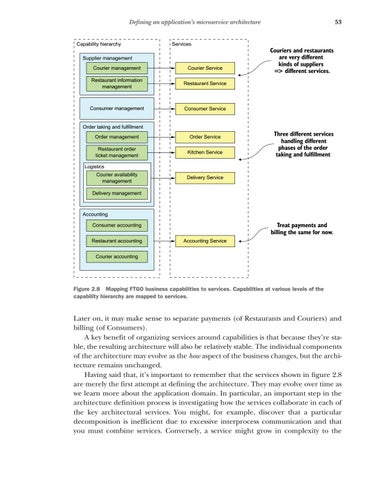
Figure 2.8 Mapping FTGO business capabilities to services. Capabilities at various levels of the capability hierarchy are mapped to services.
Later on, it may make sense to separate payments (of Restaurants and Couriers) and billing (of Consumers). A key benefit of organizing services around capabilities is that because they’re stable, the resulting architecture will also be relatively stable. The individual components of the architecture may evolve as the how aspect of the business changes, but the architecture remains unchanged. Having said that, it’s important to remember that the services shown in figure 2.8 are merely the first attempt at defining the architecture. They may evolve over time as we learn more about the application domain. In particular, an important step in the architecture definition process is investigating how the services collaborate in each of the key architectural services. You might, for example, discover that a particular decomposition is inefficient due to excessive interprocess communication and that you must combine services. Conversely, a service might grow in complexity to the