11
Microservice architecture to the rescue
Y-axis scaling functionality decomposes an application into services.
Order service Order Service instance 1
Application
Order requests
Client
Customer requests
Review requests
Order Service
Customer Service
Request
Load balancer
Order Service instance 2 Order Service instance 3
Review Service
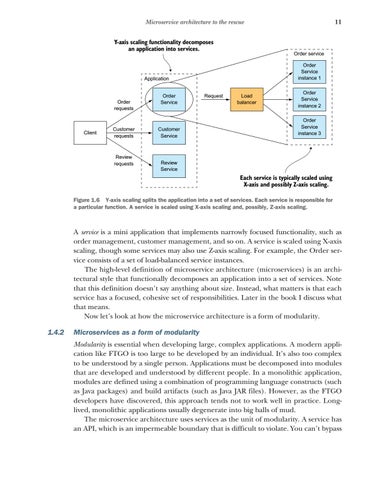
Each service is typically scaled using X-axis and possibly Z-axis scaling. Figure 1.6 Y-axis scaling splits the application into a set of services. Each service is responsible for a particular function. A service is scaled using X-axis scaling and, possibly, Z-axis scaling.
A service is a mini application that implements narrowly focused functionality, such as order management, customer management, and so on. A service is scaled using X-axis scaling, though some services may also use Z-axis scaling. For example, the Order service consists of a set of load-balanced service instances. The high-level definition of microservice architecture (microservices) is an architectural style that functionally decomposes an application into a set of services. Note that this definition doesn’t say anything about size. Instead, what matters is that each service has a focused, cohesive set of responsibilities. Later in the book I discuss what that means. Now let’s look at how the microservice architecture is a form of modularity.
1.4.2
Microservices as a form of modularity Modularity is essential when developing large, complex applications. A modern application like FTGO is too large to be developed by an individual. It’s also too complex to be understood by a single person. Applications must be decomposed into modules that are developed and understood by different people. In a monolithic application, modules are defined using a combination of programming language constructs (such as Java packages) and build artifacts (such as Java JAR files). However, as the FTGO developers have discovered, this approach tends not to work well in practice. Longlived, monolithic applications usually degenerate into big balls of mud. The microservice architecture uses services as the unit of modularity. A service has an API, which is an impermeable boundary that is difficult to violate. You can’t bypass