266
CHAPTER 8 External API patterns
Browser client team
Mobile client team
Browser JavaScript application
Mobile client
Owns Mobile API gateway
3rd-party application
Owns Browser API gateway
API layer
Public API team
API layer
Owns Public API gateway API layer
Mobile API
Browser API
Public API
Common layer
Common layer
Common layer
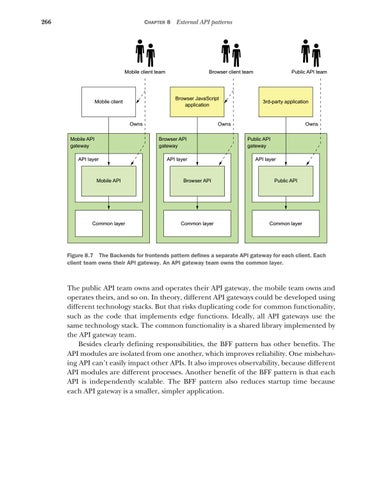
Figure 8.7 The Backends for frontends pattern defines a separate API gateway for each client. Each client team owns their API gateway. An API gateway team owns the common layer.
The public API team owns and operates their API gateway, the mobile team owns and operates theirs, and so on. In theory, different API gateways could be developed using different technology stacks. But that risks duplicating code for common functionality, such as the code that implements edge functions. Ideally, all API gateways use the same technology stack. The common functionality is a shared library implemented by the API gateway team. Besides clearly defining responsibilities, the BFF pattern has other benefits. The API modules are isolated from one another, which improves reliability. One misbehaving API can’t easily impact other APIs. It also improves observability, because different API modules are different processes. Another benefit of the BFF pattern is that each API is independently scalable. The BFF pattern also reduces startup time because each API gateway is a smaller, simpler application.