87
Communicating using the Asynchronous messaging pattern Sender
Receiver
Sending port
Business logic
Receiving port
Messaging infrastructure
Business logic
Service Message
invokes Message sender
Sends Header Body
Receives Message handler
invokes
Message channel
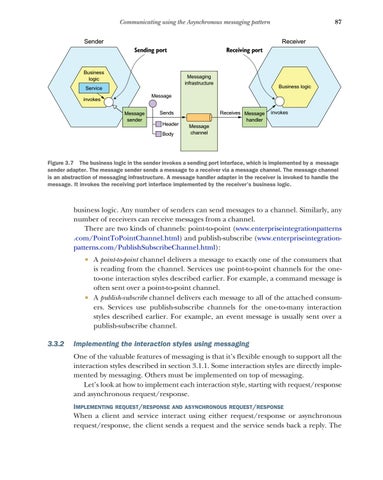
Figure 3.7 The business logic in the sender invokes a sending port interface, which is implemented by a message sender adapter. The message sender sends a message to a receiver via a message channel. The message channel is an abstraction of messaging infrastructure. A message handler adapter in the receiver is invoked to handle the message. It invokes the receiving port interface implemented by the receiver’s business logic.
business logic. Any number of senders can send messages to a channel. Similarly, any number of receivers can receive messages from a channel. There are two kinds of channels: point-to-point (www.enterpriseintegrationpatterns .com/PointToPointChannel.html) and publish-subscribe (www.enterpriseintegrationpatterns.com/PublishSubscribeChannel.html): A point-to-point channel delivers a message to exactly one of the consumers that
is reading from the channel. Services use point-to-point channels for the oneto-one interaction styles described earlier. For example, a command message is often sent over a point-to-point channel. A publish-subscribe channel delivers each message to all of the attached consumers. Services use publish-subscribe channels for the one-to-many interaction styles described earlier. For example, an event message is usually sent over a publish-subscribe channel.
3.3.2
Implementing the interaction styles using messaging One of the valuable features of messaging is that it’s flexible enough to support all the interaction styles described in section 3.1.1. Some interaction styles are directly implemented by messaging. Others must be implemented on top of messaging. Let’s look at how to implement each interaction style, starting with request/response and asynchronous request/response. IMPLEMENTING REQUEST/RESPONSE AND ASYNCHRONOUS REQUEST/RESPONSE
When a client and service interact using either request/response or asynchronous request/response, the client sends a request and the service sends back a reply. The