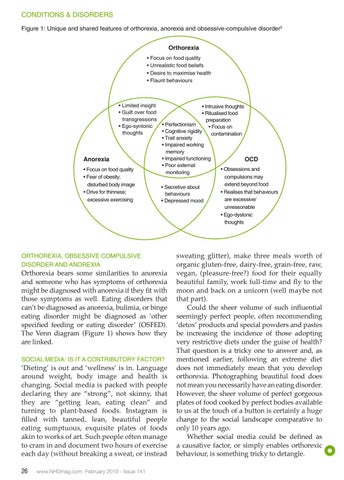
CONDITIONS & DISORDERS Figure 1: Unique and shared features of orthorexia, anorexia and obsessive-compulsive disorder3 Orthorexia • Focus on food quality • Unrealistic food beliefs • Desire to maximise health • Flaunt behaviours
• Limited insight • Intrusive thoughts • Guilt over food • Ritualised food transgressions preparation • Perfectionism • Ego-syntonic • Focus on • Cognitive rigidity thoughts contamination • Trait anxiety • Impaired working memory • Impaired functioning OCD Anorexia • Poor external • Obsessions and • Focus on food quality monitoring compulsions may • Fear of obesity; extend beyond food disturbed body image • Secretive about • Realises that behaviours • Drive for thinness; behaviours are excessive/ excessive exercising • Depressed mood unreasonable • Ego-dystonic thoughts
ORTHOREXIA, OBSESSIVE COMPULSIVE DISORDER AND ANOREXIA
Orthorexia bears some similarities to anorexia and someone who has symptoms of orthorexia might be diagnosed with anorexia if they fit with those symptoms as well. Eating disorders that can’t be diagnosed as anorexia, bulimia, or binge eating disorder might be diagnosed as ‘other specified feeding or eating disorder’ (OSFED). The Venn diagram (Figure 1) shows how they are linked. SOCIAL MEDIA: IS IT A CONTRIBUTORY FACTOR?
‘Dieting’ is out and ‘wellness’ is in. Language around weight, body image and health is changing. Social media is packed with people declaring they are “strong”, not skinny, that they are “getting lean, eating clean” and turning to plant-based foods. Instagram is filled with tanned, lean, beautiful people eating sumptuous, exquisite plates of foods akin to works of art. Such people often manage to cram in and document two hours of exercise each day (without breaking a sweat, or instead 26
www.NHDmag.com February 2019 - Issue 141
sweating glitter), make three meals worth of organic gluten-free, dairy-free, grain-free, raw, vegan, (pleasure-free?) food for their equally beautiful family, work full-time and fly to the moon and back on a unicorn (well maybe not that part). Could the sheer volume of such influential seemingly perfect people, often recommending ‘detox’ products and special powders and pastes be increasing the incidence of those adopting very restrictive diets under the guise of health? That question is a tricky one to answer and, as mentioned earlier, following an extreme diet does not immediately mean that you develop orthorexia. Photographing beautiful food does not mean you necessarily have an eating disorder. However, the sheer volume of perfect gorgeous plates of food cooked by perfect bodies available to us at the touch of a button is certainly a huge change to the social landscape comparative to only 10 years ago. Whether social media could be defined as a causative factor, or simply enables orthorexic behaviour, is something tricky to detangle.