SPRING 2015
To Vaccinate or Not to Vaccinate? to suggest that vaccines are both safe and effective in their current schedules to be given to any child. Only in the event of a particular contraindication based on disease or immunologic status should an exception be made. MCMS Physician: What are the community benefits to vaccinations? Dr. Shapiro: Immunizing large populations allows for protection of all of the individuals in that community, and assures that the particular disease being addressed will not easily be communicated into that population. Recognize however, that regardless of how effective any vaccine or vaccination program is in any part of the world, vaccines should never be considered 100 percent effective, thus making the case for every member of that community to be involved in the effort. MCMS Physician: Should parents wait to vaccinate their children until they are older? Dr. Shapiro: Alternative schedules for immunization have been touted by others from the fringe of the pediatric community on many internet websites, by those individuals who are acting in contradistinction to best practices developed by the CDC and the ACIP (Advisory Committee on Immunization Practices) and by those who prey on the belief that there are still mysteries to the time proven techniques currently in place. MCMS Physician: What would happen if you stop vaccinating? Dr. Shapiro: We have already seen the jeopardy we place populations into when vaccines are withheld. The recent measles outbreak at Disneyland is proof positive that if vaccination programs are interrupted, diseases will re-emerge. MCMS Physician: If a parent chooses not to vaccinate, how do you treat the child’s medical needs? Dr. Shapiro: Since the most recent measles outbreak in Disneyland, there has been an awakening to the issues created by non vaccination. Many of those parents who have chosen not to vaccinate have faced the reality that the few practices that left their doors open to them are rapidly disappearing as the risk of contamination to their office spaces and personnel for an extended period of time. Many of us have become deeply disturbed by having to face the reality of not being able to offer these children a proper medical home in their respective community.
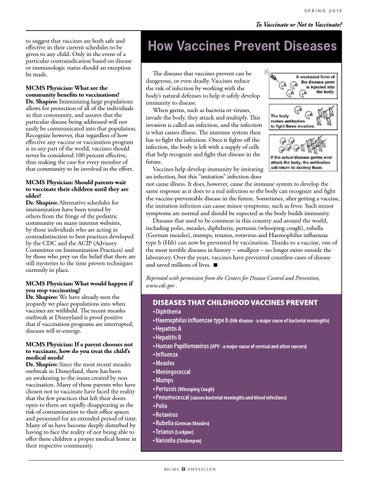
How Vaccines Prevent Diseases The diseases that vaccines prevent can be dangerous, or even deadly. Vaccines reduce the risk of infection by working with the body’s natural defenses to help it safely develop immunity to disease. When germs, such as bacteria or viruses, invade the body, they attack and multiply. This invasion is called an infection, and the infection is what causes illness. The immune system then has to fight the infection. Once it fights off the infection, the body is left with a supply of cells that help recognize and fight that disease in the future. Vaccines help develop immunity by imitating an infection, but this “imitation” infection does not cause illness. It does, however, cause the immune system to develop the same response as it does to a real infection so the body can recognize and fight the vaccine-preventable disease in the future. Sometimes, after getting a vaccine, the imitation infection can cause minor symptoms, such as fever. Such minor symptoms are normal and should be expected as the body builds immunity. Diseases that used to be common in this country and around the world, including polio, measles, diphtheria, pertussis (whooping cough), rubella (German measles), mumps, tetanus, rotavirus and Haemophilus influenzae type b (Hib) can now be prevented by vaccination. Thanks to a vaccine, one of the most terrible diseases in history – smallpox – no longer exists outside the laboratory. Over the years, vaccines have prevented countless cases of disease and saved millions of lives. Reprinted with permission from the Centers for Disease Control and Prevention, www.cdc.gov .
Diseases that childhood vaccines prevent • Diphtheria • Haemophilus influenzae type b (Hib disease - a major cause of bacterial meningitis) • Hepatitis A • Hepatitis B • Human Papillomavirus (HPV - a major cause of cervical and other cancers) • Influenza • Measles • Meningococcal • Mumps • Pertussis (Whooping Cough) • Pneumococcal (causes bacterial meningitis and blood infections) • Polio • Rotavirus • Rubella (German Measles) • Tetanus (Lockjaw) • Varicella (Chickenpox)
M C M S 33 P H Y S I C I A N