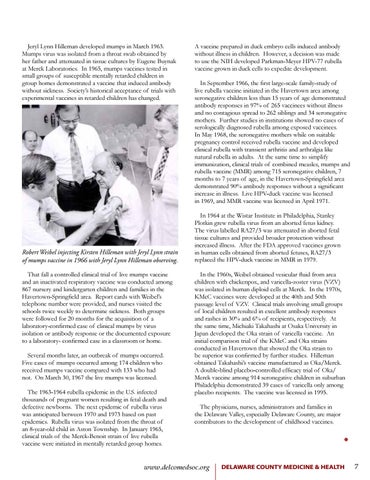
Jeryl Lynn Hilleman developed mumps in March 1963. Mumps virus was isolated from a throat swab obtained by her father and attenuated in tissue cultures by Eugene Buynak at Merck Laboratories. In 1965, mumps vaccines tested in small groups of susceptible mentally retarded children in group homes demonstrated a vaccine that induced antibody without sickness. Society’s historical acceptance of trials with experimental vaccines in retarded children has changed.
Robert Weibel injecting Kirsten Hilleman with Jeryl Lynn strain of mumps vaccine in 1966 with Jeryl Lynn Hilleman observing. That fall a controlled clinical trial of live mumps vaccine and an inactivated respiratory vaccine was conducted among 867 nursery and kindergarten children and families in the Havertown-Springfield area. Report cards with Weibel’s telephone number were provided, and nurses visited the schools twice weekly to determine sickness. Both groups were followed for 20 months for the acquisition of a laboratory-confirmed case of clinical mumps by virus isolation or antibody response or the documented exposure to a laboratory- confirmed case in a classroom or home. Several months later, an outbreak of mumps occurred. Five cases of mumps occurred among 174 children who received mumps vaccine compared with 133 who had not. On March 30, 1967 the live mumps was licensed. The 1963-1964 rubella epidemic in the U.S. infected thousands of pregnant women resulting in fetal death and defective newborns. The next epidemic of rubella virus was anticipated between 1970 and 1973 based on past epidemics. Rubella virus was isolated from the throat of an 8-year-old child in Aston Township. In January 1965, clinical trials of the Merck-Benoit strain of live rubella vaccine were initiated in mentally retarded group homes.
A vaccine prepared in duck embryo cells induced antibody without illness in children. However, a decision was made to use the NIH developed Parkman-Meyer HPV-77 rubella vaccine grown in duck cells to expedite development. In September 1966, the first large-scale family-study of live rubella vaccine initiated in the Havertown area among seronegative children less than 15 years of age demonstrated antibody responses in 97% of 265 vaccinees without illness and no contagious spread to 262 siblings and 34 seronegative mothers. Further studies in institutions showed no cases of serologically diagnosed rubella among exposed vaccinees. In May 1968, the seronegative mothers while on suitable pregnancy control received rubella vaccine and developed clinical rubella with transient arthritis and arthralgia like natural rubella in adults. At the same time to simplify immunization, clinical trials of combined measles, mumps and rubella vaccine (MMR) among 715 seronegative children, 7 months to 7 years of age, in the Havertown-Springfield area demonstrated 90% antibody responses without a significant increase in illness. Live HPV-duck vaccine was licensed in 1969, and MMR vaccine was licensed in April 1971. In 1964 at the Wistar Institute in Philadelphia, Stanley Plotkin grew rubella virus from an aborted fetus kidney. The virus labelled RA27/3 was attenuated in aborted fetal tissue cultures and provided broader protection without increased illness. After the FDA approved vaccines grown in human cells obtained from aborted fetuses, RA27/3 replaced the HPV-duck vaccine in MMR in 1979. In the 1960s, Weibel obtained vesicular fluid from area children with chickenpox, and varicella-zoster virus (VZV) was isolated in human diploid cells at Merck. In the 1970s, KMcC vaccines were developed at the 40th and 50th passage level of VZV. Clinical trials involving small groups of local children resulted in excellent antibody responses and rashes in 30% and 6% of recipients, respectively. At the same time, Michiaki Takahashi at Osaka University in Japan developed the Oka strain of varicella vaccine. An initial comparison trial of the KMcC and Oka strains conducted in Havertown that showed the Oka strain to be superior was confirmed by further studies. Hilleman obtained Takahashi’s vaccine manufactured as Oka/Merck. A double-blind placebo-controlled efficacy trial of Oka/ Merck vaccine among 914 seronegative children in suburban Philadelphia demonstrated 39 cases of varicella only among placebo recipients. The vaccine was licensed in 1995. The physicians, nurses, administrators and families in the Delaware Valley, especially Delaware County, are major contributors to the development of childhood vaccines.
www.delcomedsoc.org
DELAWARE COUNTY MEDICINE & HEALTH
7