Feature
Reading
Resilient
Advancing Economic Development through Commercial Building Revitalization By Laura J. Ellis, Vice President of Communications, Green Building Alliance
Local building owners looking for guidance on improving their properties and upgrading their building systems to better serve their tenants, reduce operating costs and improve their ability to serve and/or market to their customers can now find trusted technical assistance through Resilient Reading. The new program, launched by Green Building Alliance (GBA) in partnership with the City of Reading, is made possible with support from the Met-Ed/ Penelec Sustainable Energy Fund.
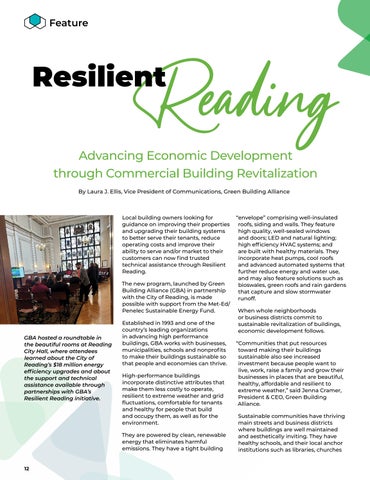
GBA hosted a roundtable in the beautiful rooms at Reading City Hall, where attendees learned about the City of Reading’s $18 million energy efficiency upgrades and about the support and technical assistance available through partnerships with GBA’s Resilient Reading initiative.
Established in 1993 and one of the country’s leading organizations in advancing high performance buildings, GBA works with businesses, municipalities, schools and nonprofits to make their buildings sustainable so that people and economies can thrive. High-performance buildings incorporate distinctive attributes that make them less costly to operate, resilient to extreme weather and grid fluctuations, comfortable for tenants and healthy for people that build and occupy them, as well as for the environment. They are powered by clean, renewable energy that eliminates harmful emissions. They have a tight building
12
“envelope” comprising well-insulated roofs, siding and walls. They feature high quality, well-sealed windows and doors; LED and natural lighting; high efficiency HVAC systems; and are built with healthy materials. They incorporate heat pumps, cool roofs and advanced automated systems that further reduce energy and water use, and may also feature solutions such as bioswales, green roofs and rain gardens that capture and slow stormwater runoff. When whole neighborhoods or business districts commit to sustainable revitalization of buildings, economic development follows. “Communities that put resources toward making their buildings sustainable also see increased investment because people want to live, work, raise a family and grow their businesses in places that are beautiful, healthy, affordable and resilient to extreme weather,” said Jenna Cramer, President & CEO, Green Building Alliance. Sustainable communities have thriving main streets and business districts where buildings are well maintained and aesthetically inviting. They have healthy schools, and their local anchor institutions such as libraries, churches