SPRING 2022
Welcome to the Great Outdoors
Member Events Are Back! 10 STOPS FOR A SPRING GETAWAY BCBA’S NEWEST BOARD MEMBERS WHAT’S YOUR FAVORITE THING ABOUT SPRING?
contents SPRING 2022
CONTACT INFO President Julie D. Goldstein Vice President/President Elect Lawrence R. Scheetz, Jr.
What would you do for Bucks County? If you asked the above question of our newly elected Honorable Stephen A. Corr, he may answer by saying
................................................................................................. Page 10
Mock Trial 2022
Secretary R. Tyler Tomlinson Treasurer Jeremy D. Puglia
The end of the holiday season and beginning of the new year brought with it the start of the 2022 Mock Trial competition. The annual competition is
................................................................................................. Page 12
A Fresh Perspective On PFAs
Immediate Past President Sean M. Gresh Past Presidents’ Representative David J. Truelove Board of Directors Erin K. Aronson Brendan M. Callahan Susan E. Dardes Jeffrey G. DiAmico Kimberly Litzke Christopher S. Mahoney Bianca A. Roberto Francis J. Sullivan Tiffany Thomas-Smith Jason R. Weiss Megan Weiler Melanie J. Wender Writs Editor Melanie J. Wender Writs Photographer Dylan Gilheany Bar Association Office Greg Nardi, Executive Director 135 East State Street Doylestown, PA 18901 215.348.9413 • www.bucksbar.org
Bucks County has possibly one of the smoothest Protection From Abuse hearing day systems across the state. As many of you know, Kim Litzke has spent
e................................................................................................ Page 16
PA Supreme Court on Parents’ Rights In December 2021, the Pennsylvania Supreme Court issued a decision that strengthens Fourth Amendment protections against unlawful searches. Attorneys from
................................................................................................. Page 18
Getting to Know Fatih Oguz, Esq. When I set out to the Ulmer Law offices at 87 North Broad, their most recent satellite office, I had no idea how fascinating the next hour or so would be. I had a
................................................................................................. Page 20
Life of a Clerk Law school is an amalgamation of abstract classes on abstract cases with abstract parties. Towards the end of my law school career, I focused on
................................................................................................. Page 22
10 Stops for a Spring Getaway There’s lots to do and see in Bucks County in the springtime this year. How many can you check off your list?
................................................................................................. Page 24
Shamrock Reins Shamrock Reins is a non-profit organization, dedicated to helping our veterans, with its home right here in Plumsteadville, Bucks County. Its founder is Janet
................................................................................................. Page 27
email submissions to WritsEditor@BucksBar.org PUBLISHER Hoffmann Publishing Group, Inc. 2669 Shillington Road, #438 Sinking Spring, PA 19608 610.685.0914 x201 HoffPubs.com
Advertising Contact Tracy Hoffmann 610-685-0914 x201 • tracy@hoffpubs.com
Also in This Issue: • President’s Letter . . . . . . . . . . . . . . . . . . • From the Editor… . . . . . . . . . . . . . . . . . • We asked, you answered . . . . . . . . . . . . • New Board Members . . . . . . . . . . . . . . .
4 5 6 8
• BCBF St. Patrick’s Day Event . . . . . . . . . 28 • Pro Bono Honor Roll . . . . . . . . . . . . . . 30 • New Member Highlights . . . . . . . . . . . 31
SEE PAST ISSUES AT bucksbar.org/attorney-resources/the-writs OR BW.HoffmannPublishing.com SPREAD THE WORD #BucksWrits & #BucksBar The written and visual contents of this magazine are protected by copyright. Reproduction of print or digital articles without written permission from Hoffmann Publishing Group, Inc., and/ or the Bucks County Bar Association is forbidden. The opinions expressed in this publication are for general information only and are not intended to provide specific legal or other advice or recommendations for any individuals. Additionally, the placement of editorial content, opinions and paid advertising does not imply endorsement by the Bucks County Bar Association.
10% Post Consumer Waste Please Recycle
$10,000,000 Recovered for Local First Responder After Truck Collision Our client, a local tow truck driver was working in an Emergency Response Zone on the side of a disabled tractor trailer when he was struck by another truck driven by an improperly trained driver. The passing truck’s passenger side mirror struck our client and knocked him to the ground while he was providing assistance to the disabled vehicle. The impact caused serious injuries to our client, including a neck fracture with initial quadriplegia, traumatic brain injury with a subdural hemorrhage, multiple facial fractures and scarring, and psychological injuries including post-traumatic stress disorder and sleep disorders.
The passing driver’s recklessness will have a significant lifelong impact on our client, including total occupational disability causing loss of wages, required relocation to a modified home, as well as need for a modified handicap vehicle and other accommodations. Following significant discovery, submission of multiple expert reports, multiple motions for summary judgment by the defense, and mediation, the case resolved in a settlement of $10,000,000.
Contact Us Today Regarding: Brain Injuries (TBI) | Spinal Cord Injuries | Serious Orthopedic Injuries
Bensalem | Newtown/Langhorne | Doylestown | Bristol | Quakertown | Bethlehem | Norristown
Call: 215-543-6780 | Email: info@cordiscosaile.com | www.cordiscosaile.com
CORDISCO & SAILE
ISSUE: 2203 ORG/PUB: Bucks Writs
President’s Message
There are many fun events and programs on the horizon for the next couple of months. The Opening of the Assizes is scheduled for April 28th. The theme this year is “Oh, the Places You’ll Go.”
My Fellow Members of the Bar: Sitting down to write my first President’s Message for the Writs gave me the opportunity to reflect on the first couple months of my Presidency and how those months have passed so quickly. We all experience time flying by because of our constant busy days and weeks.
to have a wonderful Executive Director and staff in Bucks County, who are always working hard to provide the best possible experience and services for members. Thankfully (fingers crossed) we are moving forward and the Covid numbers are declining. Even though we have been running in-person programs here at the Bar Association since the middle of 2020, my hope is that, moving forward, we can welcome everyone back and feel safe doing so (if you haven’t been back already).
Julie D. Goldstein Bucks County Bar Association President
This year, so far, I have seen the wonderful work that our Sections, Committees, and Divisions do. I have enjoyed meeting and seeing people, old friends and new. The Bar Association has been bustling with meetings and CLEs being held.
There are many fun events and programs on the horizon for the next couple of months. The Opening of the Assizes is scheduled for April 28th. The theme this year is “Oh, the Places You’ll Go.” I’m sure each of us have had plans that were cancelled or changed and now we can finally get out there and go where we want to go!
I had the pleasure of attending several statewide conferences with the leaders in the different bar communities. It has confirmed for me how we are lucky
Each Section, Division and Committee will be designing drinks and food of a place or location that you would go. I am looking forward to seeing the creativity of our members and, hopefully, the weather gods smile upon us on that day. There will be awards for best drink, best food, and best in show. Definitely mark your calendar for this free event and bring a potential member! To keep informed about all of our upcoming events, make sure to check out our new Bar Association website. This website is very user friendly and makes it even easier to find and register for events. Finally, this year’s Bench Bar Conference will be in Hershey on September 22–24, 2022. It promises to be a wonderful event, so make sure to mark your calendars now. I hope to see everyone on April 28th at the Opening of the Assizes and I am looking forward to seeing old friends and meeting new ones. — Julie D. Goldstein, Esquire Bucks County Bar Association President 4
From the Editor… In this edition, there is an article dedicated to the newest member of our bench, the Honorable Stephen A. Corr. Welcome Judge Corr! As you can see, there are exciting things happening in the legal community of Bucks County and in the community at large.
Hello and welcome
Melanie J. Wender Editor, Bucks Writs
Hello and welcome to the 2022 spring edition of the Writs Magazine! A lot of changes have occurred, including myself as the new editor in chief of the Writs Magazine. My hope is that you will find that the magazine continues to provide fun and interesting material as it did in the past. There are some exciting pieces in this edition that I hope you will all enjoy.
Honorable Stephen A. Corr. Welcome Judge Corr! As you can see, there are exciting things happening in the legal community of Bucks County and in the community at large. I hope to see and meet many of the readers of this magazine at the upcoming events taking place at the Bar Association or in the community. The Bar Association has the Opening of the Assizes event scheduled for April 28th, with the theme of “Oh, the Places You’ll Go.” With Covid restrictions lifting and the beginning of the return to a sense of normalcy, there are so many places all of us would like to go. I know I have a list of places where I would like to go! I hope that many of you will attend this event as it promises to be very fun and likely very interesting.
With that said, I want to extend my deepest thanks to Jason Weiss, the prior editor in chief of this magazine. I want to thank him for his guidance during this transition and for his patience. Jason was an excellent editor and provided years of interesting material. I hope that I will continue to hold the Writs to the standards he established. I also have to thank the amazing staff of the Bucks County Bar Association, specifically Greg Nardi, Emily Norman and Dylan Gilheany. Without them, this magazine simply would not happen. They provide vital assistance in its creation.
Now, please enjoy the magazine!
I also want to extend my thanks to our Bar Association President, Julie Goldstein. Julie’s enthusiasm and energy has provided unending support. Additionally, Julie’s creativity has helped spur ideas for future articles, which I am extremely grateful for.
— Melanie J. Wender, Esquire
Need a Lawyer?
I am extremely honored to be the editor of this magazine. I am extremely proud of the new voices that are highlighted in this edition, as well as the new Bar Association members that are given a spotlight. In this edition, there is an article dedicated to the newest member of our bench, the
Welcome to the Bucks County Bar Association’s Lawyer Referral and Information Service (LRIS) serving all of Bucks County. The LRIS is a public service of the non-profit Bucks County Bar Association. Each year the LRIS responds to thousands of callers, referring them to attorneys with experience in the appropriate area of law or to area agencies able to provide assistance.
I am extremely honored to be the editor of this magazine. I am extremely proud of the new voices that are highlighted in this edition, as well as the new Bar Association members that are given a spotlight.
Persons identified as needing legal representation and who do not claim inability to pay an attorney will be referred by LRIS to a participating attorney. LRIS participation is open to all Bucks County Bar Association members having their primary office in Bucks County. You can contact the LRIS at 215-348-9413. 5
SPRING 2022
feature
WE ASKED, YOU ANSWERED:
What’s your favorite thing about spring? By Greg Nardi
As the calendar approaches the equinox and the promise of warmer weather, what do you look forward to the most with the coming of spring? As we approach the end of winter, we look forward to the end of the winter doldrums and hope for a hint of warmth in the air and perhaps start thinking about all of the reasons to look forward to spring. Many of us are looking forward to longer days, warmer weather, the shedding of layers, new life, barbecues, open windows and the reopening of Rita’s and our favorite ice cream shop.
Looking forward to warmer weather and outdoor activities! – Frank Mazzeo, Esq., RMKIP Law
We asked our readers “As the calendar approaches the equinox and the promise of warmer weather, what do you look forward to the most with the coming of spring?” and here are their answers.
Being outside! – Erin K. Aronson, Esq., Eastburn and Gray, P.C.
Overwhelmingly, many of us look forward to the improving weather and getting outdoors to enjoy it!
Warm weather, open windows, and the smell of fresh cut grass. – Russell J. Manning, Esq., Karen Ann Ulmer, P.C.
Those first few days of spring where you need a coat but not really as the sun hits your face in a walk and new plant life is sprouting all around you as you walk your dog for the first time in forever without gloves and boots. – Kristy L. Bruce, Esq., NJPA Law
I look forward to not leaving my office in total darkness. It is lighter longer and I love leaving in the light. – Chris L. Simcox, Esq., Begley Carlin
Being able to walk my dog in warmth and sunlight! – Dianne C. Magee, Esq., Grim Biehn, & Thatcher
I can’t wait to be able to go for long walks outside! It’s too cold, even in “warmer” TN!! – María Judith Rodríguez-Martyak, Esq., Law Office of Maria Judith Rodriguez-Martyak
Happy chirping birds and a warm sun in the morning. – Andrew D. Cotlar, Esq., Law Office of Cotlar & Cotlar Longer days and warmer weather. Leaving work in the dark is just too depressing! And, the arrival of warmer weather makes it so easy to go back to the normal social interactions we are all doing without these days. – Glenn Neiman, Esq., Brilliant & Neiman LLC Sitting outside with friends and family. – Jill M.V. Richter, Esq.
Spending more time outside. – Jeffrey C. McCullough, Esq.
Get outside and play with the grandkids. – Arthur Krevitz, Esq., Krevitz Law Tapping the maple trees in my woods, collecting sap, and making maple syrup. – Randal S. White, Esq., R. White Legal
6
Longer Daylight – The Honorable Robert O. Baldi, Bucks County Court of Common Pleas
I most look forward to more hours of daylight. – David Sowerbutts, Esq.
The promise of new life that goes along with the warming temperatures and longer days Flowering crabapples, cherries, and lilacs – Gregory Lawton, Esq. The colors and fragrances of Spring – Bonnie Stein, Esq., Curtin & Heefner LLP Warm sunshine, birdsong, flowers and (maybe) baseball??? – Michael H. Landis, Esq., Law Office of Michael H. Landis, LLC Spring things I look forward to most are verdant countryside, foliage, colorful flowers, and the promise of life renewed. – Bob Naragon, Esq.
Many of our members look forward to sports and other athletic endeavors such as golf, water sports, biking, running, hiking, and (maybe?) baseball. Kayaking, rowing and doing my first Dragon Boat race. – Karen A. Ulmer, Karen Ann Ulmer, P.C.
GOLF! Getting back to the golf course!! – Samuel C. Totaro, Jr., Esq., Curtin & Heefner LLP
The return of baseball. – Terry D Goldberg, Esq., Haggerty, Goldberg, Schleifer & Kupersmith, PC
PHILLIES and baseball! I look forward to getting home from work while it’s still light out as daylight savings time ends, and (hopefully) the start of another Phillies season full of promise. Hope “Spring”s eternal! – Matthew D. Weintraub, Esq., Bucks County District Attorney
Going out on my bike and hitting the roads and trails. – Richard L. Newman, Esq., Law Office of Richard L. Newman
Getting my training going again for my annual baseball camp in PNC Park in June! – Steve Kruman, Esq.
For me the coming of spring promises an opportunity to pull my golf clubs out of storage and “hit the links” for another season. Even though there is little chance of improving my game, especially as I am another year older, hope springs eternal — especially in spring, that this will finally be the year when my true potential is achieved! – Christopher J. Serpico, Esq.
Baseball season assuming that we have one with the lockout currently in place. – Solomon Weinstein, Esq.
I am looking forward to playing golf on my home course and to relax by having a nice cigar and cocktails with my neighbor outside on the deck after a bad day at the office. – Joseph J. Marinaro, Esq.
Dusting off the golf clubs! – Jeffrey A. Liebmann, Esq., Liebmann Family Law
I am looking forward to the Phillies home opener (lockout be gone), sitting on our deck listening to the swimming pool gurgle and planting flower seeds in our garden. – Steven Brush, Esq.
For many, the coming of warmer weather reminds us of the many other activities that are more possible (or pleasant) during the spring such as outdoor, live music, vacations, and driving with the windows down to get some fresh air! Live music in The Barn! – Eric Marttila, Esq. Going on vacation somewhere without COVID concerns. – Christopher J. Brill, Esq.
Driving with the windows down and everyone seems to be a little happier in the spring – Julie D. Goldstein, Esq., BCBA President, Fox Rothschild LLP
One step closer to that summer vacation! – Melanie Wender, Esq., Antheil, Maslow, MacMinn, LLP
I enjoy springtime’s abundance of “holidays” celebrated mainly through memes, such as Pi Day (3/14), ‘It’s Gonna Be May’ season full of throwback photos of Justin Timberlake (end of April), and Star Wars Day (May the 4th). – Nicole O’Hara, Esq. Cigars and bourbon on the deck. – Martin N. Ghen, Esq.
And while most of our members are looking forward to the changing of the season, for some, it was just too soon to think about anything but winter… I look forward to looking forward to spring. – Ron Smolow, Esq.
7
SPRING 2022
feature
Presenting…
BCBA’s New Board Members ERIN KERNAN ARONSON
BRENDAN M. CALLAHAN
Erin Kernan Aronson is a Shareholder at Eastbury & Gray who represents clients in a range of industries with regard to their transactional and litigation needs. In particular, Erin has a depth of experience meeting client needs in the areas of Real Estate, Corporate, Labor and Employment, Education and School Law. Erin is admitted to practice in both Pennsylvania and New Jersey as well as the United States District Court for the Eastern District of Pennsylvania, the United States District Court for the Middle District of Pennsylvania, and the United States Court of Appeals for the Third Circuit. Erin earned her law degree, cum laude, from Villanova University School of Law in Villanova, Pennsylvania, where she was Managing Editor of Symposia for Villanova Law Review. She earned her undergraduate degree in Sociology with a minor in Political Science from the University of Delaware in Newark, Delaware. Prior to practicing law, Erin’s career focused on public service in both state government and politics, including positions with both Delaware’s current governor, the Honorable John C. Carney, and lieutenant governor, the Honorable Bethany Hall-Long. She also worked in the Office of the Cabinet Secretary for the Delaware Department of Health and Social Services, and the Delaware State Senate. Erin grew up in Bucks County and is a Council Rock School District alum. She resides in Doylestown with her husband and daughter.
Brendan M. Callahan is a Partner at Begley, Carlin & Mandio, LLP and concentrates his practice in the area of family law handling all issues related to divorce, child custody and child support. Brendan is a Bucks County native and a graduate of Central Bucks High School West. He received a Bachelor of Science from Virginia Tech in 2007 and a Juris Doctorate from Widener University School of Law in 2011. Brendan is admitted to the state bars in Pennsylvania and New Jersey. Mr. Callahan has also been admitted to practice before the U.S. District Court for the Eastern District of Pennsylvania.
JEFFREY G. DiAMICO Jeffrey G. DiAmico concentrates his practice at Semanoff Ormsby Greenberg & Torchia, LLC in business/ corporate law and real estate law. Often serving as “outside” general counsel to his business clients, he advises on general business planning and counseling, transactions, contracts and commercial litigation; with extensive experience in mergers and acquisitions, business formation and succession planning. His real estate practice includes commercial, industrial and retail real estate purchases, sales, leases and tax assessment appeals, community association law, and real estate litigation. Jeff graduated from The Pennsylvania State University in 1994, receiving his B.S. in Administration of Justice, and a minor in Business Administration. He graduated cum laude from the New England School of Law, Boston in 1999, where he was managing editor of The New England International and Comparative Law Annual, a founding member of the NESL Business Law Center and a recipient of the New England Scholar Award. Jeff serves as Chair of the BCBA Business 8
Law Section and serves the Pennsylvania Bar Association on the Civility in the Profession Committee. Jeff resides in Bucks County with his wife and three children and enjoys coaching both his son’s and daughter’s soccer teams, fly-fishing and skiing.
member of Phi Alpha Delta, the largest international legal fraternity, and previously served as Vice Justice of the New Jersey Alumni Chapter. Chris is also a member of the Rotary Club of Newtown. He also serves on the Board of Directors of the Bucks County Opportunity Council and the Bucks County Curling Club. Prior to joining Stuckert & Yates, Chris gained invaluable experience litigating on behalf of clients in municipal, state, and federal courts. Chris’ practice includes the areas of business and commercial transactions and litigation, estate planning and administration, and real estate.
KIMBERLY LITZKE Kimberly Litzke, a Shareholder and member of the management committee at Easburn & Gray, has been practicing family law in Bucks County since 1994. She is well-versed in family law issues including divorce, custody, support, alimony and equitable distribution. Kim is at the forefront of family law issues in Southeastern Pennsylvania, with an emphasis on local Bucks County issues. She regularly lectures on matters related to family and matrimonial law, including many CLEs at the BCBA. Kim is an active member of the Bar Association having served for more than a decade as the seasoned lawyers’ softball captain at the BCBA’s annual softball game; she is active in mock trial where she has served in various capacities; she previously served on the BCBA Board of Directors and on various BCBA committees; and she is the proud recipient of the 2021 BCBA Harriet Mims Award for her work mentoring younger lawyers in Bucks County. Since 2011, she has spearheaded the pro bono volunteer program for Protection From Abuse (PFA) representation at hearings. This is a cooperative effort of the Legal Aid of Southeastern Pennsylvania and the BCBA. She is also a member of the Pennsylvania Bar Association Family Law Section where she currently serves on Council, the governing body of the Section. Kim received her B.A. from Muhlenberg College and her J.D. from Rutgers University School of Law.
MEGAN WEILER Prior to joining Repko Law, Megan Weiler served as a judicial law clerk to the Honorable Raymond F. McHugh of the Bucks County Court of Common Pleas, after which she was Assistant District Attorney with the Bucks County District Attorney’s Office. While working in the District Attorney’s Office, Megan prosecuted both felony and misdemeanor cases through all stages of the criminal justice system, including before judges and juries. Megan was also a member of the Special Victims Unit, where she prosecuted crimes involving the sexual assault of both adults and minors and coordinated the Youthful Offender Program for the District Attorney’s Office, which was designed as an alternative diversionary program for first time non-violent offenders. Megan is a graduate of James Madison University and the Syracuse University College of Law, from which she graduated Magna Cum Laude. While attending law school, Megan served on Law Review, the University’s Moot Court team, and was named a member of the Justinian Honorary Law Society, which is reserved for the recognition of the top 10% of law school graduates in the nation. Megan is licensed to practice law in both Pennsylvania and New Jersey, primarily in the areas of family law and criminal defense, including in the areas of divorce, child custody, support, Protection from Abuse, DUI/DWI, criminal defense matters, juvenile matters, traffic offenses and drivers licensing issues.
CHRISTOPHER S. MAHONEY Christopher S. Mahoney is a partner with Stuckert & Yates and has been with the firm since 2016. Chris received his law degree from Seton Hall University in 2008. Prior to law school, he obtained a Bachelor of Science in Criminology and Justice Studies from The College of New Jersey in Ewing, New Jersey. He currently resides with his wife in Jamison. Chris is licensed to practice law in Pennsylvania and New Jersey. He is a 9
SPRING 2022
By Robbie L. Cain, Esquire
If you asked the above question of our newly elected Honorable Stephen A. Corr, he may answer by saying — whatever it needs. The eighth-born of 11 children, Judge Corr understands the importance of family. He radiates a sense of contentment when telling of his weekly Sunday night Zoom meeting with his siblings, and glows with pride discussing the achievements of his three daughters. Michelle, the oldest, graduated from Fordham University, and is pursuing a career as an actress. Julia and Maria graduated from their father’s alma mater, the University of Notre Dame. Julia is an accountant. Working toward her master’s degree, Maria is currently a teaching fellow serving underfunded Catholic schools. It is clear that Judge Corr is the archetypical family man. Alongside his wife, Lisa, they have carved out a quiet, enviable life. So what spurred him to run for a judgeship here in Bucks County? Simply put, he believes he has the experience and ability to assist the place he calls home. After graduating from Villanova School of Law in 1992, he began working at his family practice. Judge Corr recalled his first trial, before the Honorable Ward F. Clark, Sr. He gained a bit of wisdom that would help guide his nascent career — be prepared, things will work out if you take the time to plan them out. Judge Corr spent his most recent years at the firm of Begley, Carlin & Mandio, LLP. Here, Judge Corr practiced in the areas of insurance defense, medical
10
malpractice, civil tort litigation, and numerous class action law suits. A few notable defendants that Judge Corr conducted major complex cases against are the 9/11 Terrorists including the Taliban, Big Oil, and Big Tobacco. Judge Corr has also volunteered his time as an elected school director for the Central Bucks
Judge Corr noted that when all is said and done and he is looking back on his judgeship, he will not be concerned with his own legacy. He is more focused on the results he can get for Bucks County. He feels that justice and fairness is best facilitated through cooperation and compromise. He believes that justice comes from lawyers working together and that from the bench he hopes to mentor parties in civility.
School District. The reason he ran, he says, is because he saw a need in his community. Judge Corr also volunteered his time on the Bike and Hike Committee in Warrington. Judge Corr enjoys public service because he loves being immersed in his surrounding community. When asked about how attorneys in Bucks County can build comradery and civility, Judge Corr remarked that the Bar Association is important. He explained that he has made many personal friendships through the bar association. He believes that it is especially important for young attorneys to participate and have an active presence at social and professional events to learn the ropes and glean wisdom from their more seasoned colleagues. Judge Corr emphasized the fact that at Begley, Carlin & Mandio, LLP, everyone worked together and helped each other. Judge Corr noted that when all is said and done and he is looking back on his judgeship, he will not be concerned with his own legacy. He is more focused on the results he can get for Bucks County. He feels that justice and fairness is best facilitated through cooperation and compromise. He believes that justice comes from lawyers working together and that from the bench he hopes to mentor parties in civility — “It’s supposed to be adversarial, but it’s not a war.” Judge Corr has done much for Bucks County. He has taken on the 9/11 Terrorists and the Taliban, Big Oil, and Big Tobacco and has won. During his judgeship which Judge Corr believes is the ultimate public
service, he will continue to serve the County by giving each person their day in court, reinforcing the laudable qualities of its attorneys, and encouraging technological updates within the court system. Judge Corr sets a spirited example of what you can do for this County and we look forward to following his lead.
11
SPRING 2022
feature
MOCK TRIAL 2022
Back in the Saddle Again By Elaine T. Yandrisevits
T
he end of the holiday season and beginning of the new year brought with it the start of the 2022 Mock Trial competition. The annual competition is administered by the Pennsylvania Bar Association and coordinated locally by the Young Lawyers Division. This year’s case asked students from fourteen local Bucks County high schools and middle schools to portray prosecutors, defense attorneys, and an interesting cast of witnesses in the fictional trial of Edi Arcaro, a racing horse groom accused of first degree murder in the death of Jonathan Pollard, a horse breeder with connections to organized crime who was stabbed to death with a bayonet after having a heated argument with Arcaro at the Black Tie and Boots Gala.
due to the Covid-19 pandemic. Despite the disappointment at not being able to resume in-person competition, the Young Lawyers Division recruited members of the Bench, the Bar Association, and local legal community to serve as presiding judges for the trials and jurors to score the students’ performances. Over eighty-five members of the Bar Association served as presiding judges, jurors, or bailiffs over the five weeks of competition and were treated to outstanding competition. The feedback provided to the students by attorneys at the conclusion of each trial is invaluable in helping the students improve their skills as they move on throughout the competition. The district final featured Central Bucks South Team #1 as the prosecution facing off against Central Bucks East as the defense, with Central Bucks East winning by a jury vote of 7-4. Good luck to Central Bucks East in the regional competition!
The YLD held its annual Mock Trial Kickoff Happy Hour on January 5th at the bar association to allow for social distancing. Members who signed up to serve as jurors at or in advance of the happy hour were entered in a raffle to win prizes sponsored by Antheil Maslow & MacMinn, LLP and Repko Law, LLC. Raffle prizes included as basket of cheer and gift cards to Monkey’s Uncle, McCaffrey’s, Wawa, and the Philadelphia Phillies.
The Young Lawyers Division would like to thank everyone who made this year’s competition a success, including Greg Nardi, Emily Norman, and Dylan Gilheany; the teacher-coaches and attorney-coaches for the participating schools; the members of the Bench and Bar who volunteered their time as presiding judges and jurors; and the students themselves for all their hard work. Here’s to another great competition in 2023!
For the second year, the PBA made the difficult decision that the Mock Trial competition would be held virtually
12
Mock Trial 2022 Participants Hon. Denise M. Bowman Hon. Jeffrey L. Finley Hon. C. Theodore Fritsch, Jr. Hon. Brian T. McGuffin Hon. James M. McMaster Hon. Jeffrey G. Trauger Hon. Jordan B. Yeager Maureen Anderson Erin Aronson Mitch Baylarian Tiffanie Benfer Ron Bolig Lisa Bothwell Dina Brilliant Abby Bukowski Andrew Bukowski Melissa Cantwell Bob Cavalieri Joe Chellew Patty Collins Susan Dardes Jeff DiAmico Kate DiAmico
Jennifer Dickerson Tom Donnelly Alice Douglas Tim Duffy Obadiah English Scott Feldman Elizabeth Fineman Rachel Fingles Amanda Frett Lisa Gaier Lynelle Gleason Steve Goldblum Julie Goldstein Sean Gresh Kyong Growney David Hamilton John Hart Emma Kline Katie Liebhaber Kim Litzke Christopher Mahoney Lauren Majewski Kevin Malloy
Bryce McGuigan John McShea Adrian Meyer Michael Mills Gabe Montemuro Joanne Murray Alexa Neitfield Brooke Newborn Jeff Norcross Nicole O’Hara Renata Pabisz Cassidy Page George Patsalosavvis Jennifer Pierce Justin Pilchman Jocelin Price Jess Pritchard Jeremy Puglia Joseph Ramagli Emily Rehmet Megan Reinprecht Bob Repko Bianca Roberto
REACH 25,000
+
Hannah Rogers Jennifer Ryan Aimee Schnecker Kelsey Schwartz Christopher Serpico Maureen Serpico EJ Setar Michael Shelton Stephanie Shortall Pete Smith Mindy Snyder Frank Sullivan Joseph Sulon Adam Tanker Tyler Tomlinson April Townsend Christopher Wagner Alan Wandalowski Megan Weiler Melanie Wender Caroline Zook
Engaged Business and Community-minded Leaders in Bucks County
Advertise in the Writs, the Official Publication of the Bucks Bar Association
theWRITS ION THE BUCKS COUNTY BAR ASSOCIAT THE OFFICIAL PUBLICAT ION OF
FALL 2016
SPRING 2022
Welcome to the Great Outdoors ges’ Jud
Portraits Collection Grows
District Attorney Matt Weintraub
The Hungry Lawyer
Get your ad in front of the decision-makers in Bucks County! The Writs is mailed to more than 3500 Bucks County attorneys, C-level decision makers, civic, social and municipal community leaders, and placed in hundreds of high-traffic locations throughout the county.
ADVERTISING CONTACT: Alicia Lee | Alicia@HoffPubs.com | 610.685.0914 x210 Member Events Are Back!
10 STOPS FOR A SPRING GETAWAY BCBA’S NEWEST BOARD MEMBERS WHAT’S YOUR FAVORITE THING ABOUT SPRING
HOFFMANN
ISSUE: 2203 ORG/PUB: Bucks Writs
13
SPRING 2022
feature
MOCK TRIAL 2022 Spotlight on Attorney Coach John Shaffer By Chris Serpico
This year’s Mock Trial District Finals pitted perennial powerhouse CB South (coached by John Shaffer, staff attorney for Nationwide) against CB East (coached by Debby Weinman from the Bucks County Public Defender’s Office). In a real “nail-biter,” CB East prevailed. For Shaffer, coaching Mock Trial is a labor of love. As CB South’s coach for the past twelve years, he and his assistant coach, South teacher Tara Brouda, have steadily built the team into a juggernaut. The team has been a state finalist twice; won four regional championships; and been District Champs six times! South’s mock trial team consists of twelve members, however, there were twenty-seven students who tried out for this year’s team. Students were assigned to either Varsity or Junior Varsity, and those who failed to make either squad were assigned as “Paralegals” to help their teammates prepare for this year’s tournament, as well as other mock trial contests. Competitions that CB South participated in this past year included not only the Statewide Mock Trial competition, but also four pre-season tournaments held at Penn State, LaSalle, Pittsburgh, and University of Pennsylvania. There’s even a week-long Mock Trial Summer Camp open to 7th thru 11th graders that prepares
Despite the more than 200 hours of time that he invests each year in coaching his team, John told me that he “gets more out of it than he puts into it.” future mock trial participants. Little wonder that being part of the Mock Trial Team has come to be recognized as a prestigious accomplishment at CB South.
in their second and third years of law school, and four other former students have applied to law school as they get ready to graduate from their undergraduate colleges.
In recognition of the time and effort he has put into coaching future barristers, John was awarded the Mark Goldberg Award at this past year’s Annual Meeting of the Bucks County Bar Association. Yet despite the more than 200 hours of time that he invests each year in coaching his team, John told me that he “gets more out of it than he puts into it.” He is also grateful that his employer, Nationwide Insurance, considers his efforts worthwhile and encourage him to continue to coach.
Certainly, John’s colleagues in the Bar Association also benefit from the time that he, and other lawyers, dedicate to coaching area high school students. As Judge Brian McGuffin once remarked, “(the) high school mock trial competition is the best way for the Bar Association to show the benefits of the legal profession to the community at large.”
When I asked him whether any of his students have decided to become lawyers, he told me that two of his former students are now
14
The BCBA is indeed fortunate to have John Shaffer and others like him willing to share their time and talents year in and year out to ensure that the annual mock trial competition is a successful and fun experience for all.
PA’s BEST AND
BIGGEST
Online CLE Selection Get UNLIMITED Online CLE with ProPass and earn all your 2022 credits for one low price!
Visit pbi.org/propass for more info.
feature
A FRESH PERSPECTIVE ON PFAs By Abigail Bukowski, Esquire
Bucks County has possibly one of the smoothest Protection From Abuse hearing day systems across the state. As many of you know, Kim Litzke has spent more than a decade or so recruiting volunteers to represent parties in these Wednesday PFA proceedings. This is because Legal Aid and the Bar Association ensure that parties receive representation. As a new associate with Eastburn and Gray, P.C. working with Kim, it was only a matter of time until I began volunteering. I am writing this article just days after my first day as a volunteer PFA attorney. Defense attorneys who volunteer through the Bar Association are assigned clients the morning of the hearing. The benefit with this being that if you are an attorney seeking to volunteer but do not have time to direct towards this other than Wednesday morning you still have an opportunity to volunteer. If you are comfortable with meeting your client and learning your facts that morning, volunteering for defense is a great way to be involved.
sent me the names of the clients I was being assigned, as well as packets of case information which included a contact sheet, the initial petition, and any temporary Orders that had been entered. This allowed me to contact my clients before the hearing to explain the proceedings and work together to prepare their case. Additionally, as a plaintiffs’ attorney it is important to know the status of service on the defendant and on the day before my hearing Legal Aid sent a list to each of the volunteers with the status of service in all cases.
Plaintiff attorneys are assigned by volunteering through Legal Aid. I volunteered through Legal Aid. This meant that approximately a week before the day I was volunteering, Legal Aid
16
The Bucks County Mediation and Arbitration Center (BCMAC) is owned and operated by Barbara N. Lyons, Esq. She is certi ed, skilled and experienced in neutral arbitration, mediation and case evaluation. Attorneys work closely with Barbara from initial contact to the conclusion of their case.
It was exciting to have the opportunity to work with my colleagues in the bar, many of whom I expect to continue interacting with throughout my career. I was excited to have the opportunity to assist people through a difficult situation and help the Court address each case expediently, but there were even more benefits of volunteering. I had the opportunity to be before a Judge and learn her stylistic preferences. It was exciting to have the opportunity to work with my colleagues in the bar, many of whom I expect to continue interacting with throughout my career. There was a general collegiality among the attorneys and I appreciated the feeling that if something unexpected arose there were many people who would be willing to help. There was also an expeditor on hand specifically to keep the day running smoothly and answer any questions that might arise.
BCMAC is a full-service ADR provider addressing issues involving, but not limited to:
BCMAC is a full-service ADR provider addressing issues involving: • Medical malpractice • Personal injury premises and • Equity matters product liability • Employer/employee disputes • Commercial and insurance • Underinsured and uninsured motorist cases matters • Business mergers and dissolutions Real estate •• Personal injuryand equity disputes • Contract and real estate disputes
• Municipal matters
BCMAC providescost-effective cost-effective BCMAC provides andand real-world real-world attorneys and their solutions to solutions attorneys, for consumers, business and industry professionals, employees, clients, business and industry professionals.
A huge benefit of Bucks County’s system of providing representation to all PFA parties is that many cases resolve by agreement without the need for a hearing. While this is often true, one of my cases did go to a hearing. The hearing was a valuable learning experience. Overall, the day was a meaningful experience in supporting people in stressful and sometimes scary situations, meeting my local colleagues, and gaining experience in the practice of law.
employers and government agencies.
For more information call Bucks County Mediation and (215) 340-7655 Arbitration Center or visit www.bcmac.org. The Farm, 220 Farm Lane, Doylestown, PA 18901 Bucks County Mediation and For more information call (215) 340-7655 Arbitration Center visit www.bcmac.org. The Farm,or 220 Farm Lane, Doylestown, PA 18901
There is a need for more volunteers. If you have any questions or concerns I would be happy to talk to you if you wanted to contact me. It is my hope that I meet you at a future PFA Wednesday. 17
BUCKS COUNTY
ISSUE: 2109 2203 1711 1708 1705 SPRING 2022 ORG/PUB: Bucks Writs
feature
PA Supreme Court ruling protects Fourth Amendment rights of parents in child welfare cases [ Summary of In the Interest of Y.W.-B., 265 A.3d 602 ]
By Katrina Ihrer, Legal Aid of Southeastern PA (LASP) Staff Attorney, and Kasey Daniel, LASP Doylestown Managing Attorney
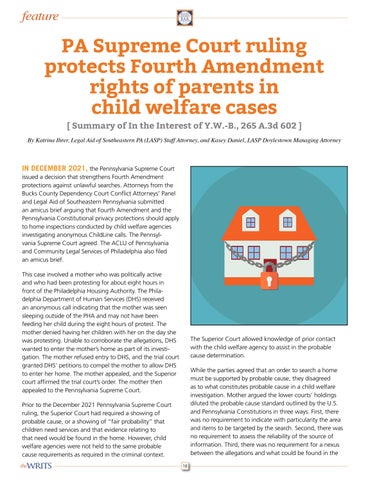
IN DECEMBER 2021, the Pennsylvania Supreme Court issued a decision that strengthens Fourth Amendment protections against unlawful searches. Attorneys from the Bucks County Dependency Court Conflict Attorneys’ Panel and Legal Aid of Southeastern Pennsylvania submitted an amicus brief arguing that Fourth Amendment and the Pennsylvania Constitutional privacy protections should apply to home inspections conducted by child welfare agencies investigating anonymous ChildLine calls. The Pennsylvania Supreme Court agreed. The ACLU of Pennsylvania and Community Legal Services of Philadelphia also filed an amicus brief. This case involved a mother who was politically active and who had been protesting for about eight hours in front of the Philadelphia Housing Authority. The Philadelphia Department of Human Services (DHS) received an anonymous call indicating that the mother was seen sleeping outside of the PHA and may not have been feeding her child during the eight hours of protest. The mother denied having her children with her on the day she was protesting. Unable to corroborate the allegations, DHS wanted to enter the mother’s home as part of its investigation. The mother refused entry to DHS, and the trial court granted DHS’ petitions to compel the mother to allow DHS to enter her home. The mother appealed, and the Superior court affirmed the trial court’s order. The mother then appealed to the Pennsylvania Supreme Court.
The Superior Court allowed knowledge of prior contact with the child welfare agency to assist in the probable cause determination. While the parties agreed that an order to search a home must be supported by probable cause, they disagreed as to what constitutes probable cause in a child welfare investigation. Mother argued the lower courts’ holdings diluted the probable cause standard outlined by the U.S. and Pennsylvania Constitutions in three ways. First, there was no requirement to indicate with particularity the area and items to be targeted by the search. Second, there was no requirement to assess the reliability of the source of information. Third, there was no requirement for a nexus between the allegations and what could be found in the
Prior to the December 2021 Pennsylvania Supreme Court ruling, the Superior Court had required a showing of probable cause, or a showing of “fair probability” that children need services and that evidence relating to that need would be found in the home. However, child welfare agencies were not held to the same probable cause requirements as required in the criminal context. 18
loss of their children, which the U.S. Supreme Court has recognized as a fundamental liberty protected by the Constitution. With such great consequences at stake, the Pennsylvania Supreme Court found that nothing less than probable cause, with all the traditional principles found in the criminal context, could suffice when determining whether or not to authorize a home visit. Those traditional principles include the existence of a nexus between the areas to be searched and the suspected wrongdoing, an assessment of the veracity and reliability of anonymous sources of evidence, and consideration of the age of the facts. The Pennsylvania Supreme Court expressly found there is no “social worker exception” to these constitutional requirements.
With such great consequences at stake, the Pennsylvania Supreme Court found that nothing less than probable cause, with all the traditional principles found in the criminal context, could suffice when determining whether or not to authorize a home visit. home. The Department of Human Services disagreed with a nexus requirement, arguing they could not ensure adequate care is being provided to children without searching the home. Further, the Department of Human Services argued anonymous reports are an irreplaceable part of child welfare investigations and therefore should not be given less weight in the determination of probable cause.
This decision secures parents’ constitutional right to be free from unreasonable searches, and more importantly, protects their constitutional and fundamental right to care for their children.
The Pennsylvania Supreme Court recognized the potential harm that could result from a home search conducted pursuant to a child welfare investigation, including criminal charges for child abuse or evidence of any other criminal activity in the home. Perhaps most significantly, the parents could face termination of their rights and
Katrina (Kaytee) Ihrer and Kasey Daniel are based in Legal Aid of Southeastern PA’s Doylestown Almshouse office. They can be reached at 215-340-1818. Their emails are kihrer@lasp. org and kdaniel@lasp.org, respectively.
DEDICATED TO
ROXBOROUGH,
ISSUE: 2203 ORG/PUB: Bucks Writs
ALWAYS READY TO PUT YOU FIRST
19
SPRING 2022
feature
Getting to Know Fatih Oguz, Esq. By Susan E. Dardes, Esq.
When I set out to the Ulmer Law offices at 87 North Broad, their most recent satellite office, I had no idea how fascinating the next hour or so would be. I had a meeting with Fatih Oguz, the newest associate in the firm, who joined them in October of 2021. Fatih (pronounced “fah- tee”) Oguz (“Owes”) is a warm and unassuming attorney, who quickly brought me into his journey here from his native country, as a first generation emigrant. Fatih and his wife are both Turkish nationals, who emigrated from Turkey in 2017, living first in Cherry Hill, New Jersey, before making his way to live and work in Pennsylvania. Fatih actually went to law school twice, once in Turkey, right after high school, when he matriculated at the Istanbul University School of Law and received an undergraduate degree in Law. Then, later, at Temple University in Philadelphia, he was awarded an LLM degree. While at Temple, Fatih was awarded the coveted Professor Samuel Gyandoh Award, given to an international LLM candidate, who renders “outstanding professional and personal service” to the law school community. I asked him how he learned English and he said, by going to an English speaking middle school, high school, and University. After his undergraduate studies at Istanbul
Fatih and his wife, Gonca, a pre-school teacher, left their families and their home in Turkey in the belief that the United States would afford them and their daughters a better life. 20
Fatih with daughters Nora, 18 months, and Zeynep, 16.
Fatih has already embraced the call for advocacy and pro bono work, having represented about a dozen plaintiffs at PFA hearings before our bench. So much so, that Legal Aid of Southeastern Pennsylvania has awarded him a badge for his time and service. University, he went and got his Masters in International Business Law from Yeditepe University, also in Istanbul. Yeditepe afforded him the chance to improve his English, which he speaks fluently. In Turkey, as with most European countries, except those under the Commonwealth umbrella, an undergraduate four years of training would suffice to start an attorney on his or her practice. In 1992, Fatih began at the University of Istanbul, to achieve his lifelong dream of becoming a lawyer, like his father. After graduation, he completed a mandatory six month internship with the Turkish court system, and then another six month apprenticeship with an attorney who would track his progress with the local Bar. One of his first jobs was what Americans would refer to as an in house counsel position to a large pharmaceutical company in Turkey, Eczacibasi Pharmaceuticals, where he specialized in trademark and patent law. He received a patent attorney license in Turkey and a European patent attorney license in 2001. In 2003, he established a commercial law practice, which steadily grew
until he left the country after it experienced some political unrest in 2017. He had done some criminal defense work in Turkey — all at bench trials. The Court system in that country does not have trial by jury. Turkish people consider their system of government to be a democratic republic, and they have a Constitution, but they are not fortunate enough to have the equivalent of the Sixth Amendment. He and his wife, a pre-school teacher, left their families and their home in Turkey in the belief that the United States would afford them and their daughters a better life. Their daughters are 16 years old and 18 months. The younger one, Nora, was born in the States; teenager Zeynep goes to Radnor High School. Right now, Fatih and his family live on the Main Line, but they will be settling on a house in Royersford, in neighboring Montgomery County, at the end of this month. While he’s not really reinventing himself (once a lawyer, always a lawyer!), Fatih says this is the second part of his life, and he is happy here. Karen has been a wonderful law partner and mentor to him, as
21
he navigates the way of the Courts here in Bucks County. But he also went on to say that while he is learning our ways, he also wants to learn estate and probate law, since a civil practice is what he’s most comfortable with. And, new to the Bucks Bar or not, Fatih has already embraced the call for advocacy and pro bono work, having represented about a dozen plaintiffs at PFA hearings before our bench. So much so, that Legal Aid of Southeastern Pennsylvania has awarded him a badge for his time and service. He’s at home with Karen’s firm because the practice of divorce law in the United States is similar to the practice in Turkey, and child custody disputes consume a lot of the practice. Fatih has represented several family law clients, both in Bucks and in Montgomery County, at the conference level, to resolve custody matters. You may have had the pleasure of meeting Fatih at the recent St. Patty’s Day fundraiser for the Bar Foundation. If not, please keep an eye out for him at our next function and welcome him personally, to Pennsylvania’s most collegial group of attorneys. SPRING 2022
feature
LIFE OF A CLERK By Hannah B. Rogers, Esquire
LAW SCHOOL IS AN AMALGAMATION OF ABSTRACT CLASSES ON ABSTRACT CASES WITH ABSTRACT PARTIES. Towards the end of my law school career, I focused on one career path, and one career path only, as a means to seeking the connection with clients I had so missed in school. I spent countless hours scouring job postings for what I thought I wanted. I avoided clerkship postings because I thought the job would be more of the same: abstract rules applied to abstract cases and abstract parties. As time progressed and my stringent search came up short, I took the experience as another symptom of my tendency to put tunnel vision towards what I thought I wanted. The next time I looked for jobs, I widened my search criteria and saw a position as a clerk for the Bucks County Court of Common Pleas.
Hannah Rogers and Judge Jordan B. Yeager
EACH CASE PRESENTED MATTERED TO AN INDIVIDUAL, TO A FAMILY. EACH RULE PRESENTED POSED CONCRETE QUESTIONS TO THE COURT.
To be candid, when Judge Yeager told me I would be observing an equitable distribution hearing on my first day, my apprehension about clerkships reappeared. I skimmed the case materials, quizzing myself on contract law and trial strategy, but struggling to find the right answers in my head. Contracts was my worst class in law school, and I knew nothing about family law. The mental gymnastics only fed my anxiety about whether this clerkship was the right fit.
Sitting in the courtroom for the equitable distribution hearing planted the seed for the most drastic evolution of my professional and personal life. The fog always surrounding Contracts principles suddenly dissipated because real lawyers representing real parties argued for real consequences. Each case presented mattered to an individual, to a family. Each rule presented posed
22
ATTORNEY DISCIPLINARY AND ETHICS MATTERS STATEWIDE PENNSYLVANIA MATTERS NO CHARGE FOR INITIAL CONSULTATION
concrete questions to the Court. The parties I had confusingly read about in books for years suddenly sat before my Judge, desperate for a ruling in their favor.
Representation, consultation and expert testimony in disciplinary matters and matters involving ethical issues, bar admissions and the Rules of Professional Conduct
Each week in my clerkship profoundly built upon this foundation. I found myself eager to dive into research to take seemingly distant puzzle pieces and fit them into the case at hand. Instead of hoping the next assignment involved a subject I felt comfortable with, I looked forward to learning more about another area of law that I had not known to exist before my clerkship. Judge Yeager’s desire to always reach the just and proper conclusion only stoked this professional growth.
James C. Schwartzman, Esq.
• Judge, Court of Judicial Discipline • Former Chairman, Judicial Conduct Board of Pennsylvania • Former Chairman, Disciplinary Board of the Supreme Court of Pennsylvania • Former Chairman, Continuing Legal Education Board of the Supreme Court of Pennsylvania • Former Chairman, Supreme Court of Pennsylvania Interest on Lawyers Trust Account Board • Former Federal Prosecutor • Selected by his peers as one of the top 100 Super Lawyers in PA and the top 100 Super Lawyers in Philadelphia • Named by his peers as Best Lawyers in America 2022 and 2015 Philadelphia “Lawyer of the Year” Ethics and Professional Responsibility Law and Legal Malpractice Law
Aside from the rules I have learned and the cases I have read, this clerkship has and will have personal implications beyond my physical time in the courthouse. In the best way, I now question thought processes I considered to be concrete and foolproof before my clerkship. I no longer look at one type of law and assume that I will not like or enjoy learning more about that area. I instead consider how I felt before my clerkship and look at how I now feel about my professional and personal trajectory. I am overall much more willing to try anything and everything and to know that my preconceived ideas are not always correct.
1500 Market Street, East Tower, Suite 1800 • Philadelphia, PA 19102 (215) 751-2863
SCHWARTZMAN
ISSUE: 2203 ORG/PUB: Bucks Writs CAMERA READY: 2203
Of course, I would be remiss to write this article and give the impression that I am growing alone. My fellow clerks and I frequently talk about how this experience is unique. I am so lucky to go to work every day with people who can make my belly hurt from laughing and edit my memos to protect me from making an unfounded recommendation. The connections I have made here will forever play a role in my future.
Keep Us in Your Sights for Spring! AD SIZE CONTRACTED: 1/4 V DIMENSIONS: 3.5625" w x 4.833" h Come Visit Our Newly Renovated Gun Store 39 Years est. + Growing!
AD EXPORTED BY BECKY WEAVER DESIGN / BECKY@BECKYWEAVER.COM / 717-615-2243 PDF EXPORT SETTINGS
COMPATABILITY: Acrobat 5 (PDF 1.4) | STANDARDS COMPLIANCE: None | GENERAL: Optimize PDF: Off; Create Acrobat Layers: N/A; Export Layers: New Pistol/Rifle Ranges Visible and Printable Layers; Include Bookmarks: Off; Include Hyperlinks: Off; Export Nonprinting Objects: Off; Export Visible Guides and Baseline Grids: Off; CreateNew Tagged PDF: Off; Interactive Elements: Do Not IncludeSystem | COMPRESSION: COLOR IMAGES: Bicubic Downsample at: 300 ppi for images above: 450 Hepa Ventilation ppi; Compression: ZIP; Tile Size: N/A; Quality: 8 Bit GRAYSCALE IMAGES: Bicubic Downsample at: 300 ppi for images above: 450 ppi; Compression: ZIP; Tile Size: N/A; Quality: 8 Bit MONOCHROME IMAGES: No Sampling Change for images above: 1250 ppi; Compression: CCITT Group 4; Compress Text and Line Art: We On; Crop ImageTarget Data to Frames:All On | The OUTPUT:Outdoor Color Conversion: Convert to Destination; Destination: Document CMYK - U.S. Web Coated (SWOP) v2; Profile Inclusion Policy: Don’t Include Profiles;needs… Simulate Overprint: N/A; Output Intent Profile Name: N/A; Output Condition: N/A; Output Condition Identifier: N/A; Registry Sportsman’s Name: N/A | ADVANCED: Subset Fonts Below: 0%; Omit PDF: Off; Omit EPS: Off; Omit Bitmap Images: Off; Transparency Flattener Preset: N/A
• We offer one of the largest selection of guns, safes and Sporting goods and accessories in the Delaware Valley.
Without Judge Yeager’s guidance, I can wholeheartedly say this clerkship would not be the experience it has been and will continue to be. He has demonstrated, both through explicit advice and implicit action, the importance of looking at every issue from every angle. Most importantly, I learned from him that justice can be achieved through many paths. This alone is an invaluable life lesson to me.
NEW Lower Pricing • Compare + SAVE! – Shop Online! • Over 1600 firearms in Stock • Custom orders welcome • Over 250 Gun Safes in stock • We offer Pistol & Rifle Shooting Classes
529 W. Butler Ave., Chalfont, PA 18914
To anyone who is wondering, a clerkship is a job unlike any other in the best possible way. And to any lawyer who wants to know, yes, we deeply appreciate when
(5 minutes north of Montgomery Mall)
215.822.3900 | TargetWorldInc.com We accept all major credit cards
you pincite your cases.
Open: Tues-Fri 9-9 • Sat. & Sun. 9-5, Closed Mon. 23
TARGET WORLD
SPRING 2022 ISSUE: 2203 ORG/PUB: Bucks Writs
feature
10 Sfi pfl o Sp G fi
By Visit Bucks County
THERE’S LOTS TO DO AND SEE IN BUCKS COUNTY IN THE SPRINGTIME THIS YEAR. HOW MANY CAN YOU CHECK OFF YOUR LIST? 1. Take a PEEP® into Spring Fun at Peddler’s Village
2. Paint at the Wineries for the NEW Bucks County Wine & Art Trail
There is so much fun to be had at Peddler’s Village this spring! Starting with the annual PEEPS® in the Village competition and display featuring everyone’s favorite marshmallow animals. Stick around for Spring FunFest, a fun-packed weekend filled with outdoor food and drink, sidewalk sales, live entertainment, and kids’ activities. Finally, see a Sherlock Holmes Murder Mystery show at the Cock ‘n Bull Restaurant on select dates throughout the spring!
The Bucks County Wine & Art Trail is a new partnership between Visit Bucks County (VBC) and the Arts & Cultural Council of Bucks County (A&C). Artists working in all mediums and styles are invited to visit participating wineries throughout Bucks County between April 1 – July 1, 2022 to create works for the Bucks County Wine & Art Trail. Artists may work on site en plein air or may visit wineries to photograph and/or sketch in preparation for works to be created in their studios. The final, curated works will be displayed at the wineries on professionally printed weatherproof display panels and at an in-person exhibition, sale, and community reception at Freeman Hall in Doylestown in July 2023. Similar to VBC’s Bucks County Ale Trail, the Wine & Art Trail will have a mobile passport component where participants must check-in digitally at 3 or more
WHEN: March 11 – April 24 (PEEPS® in the Village); April 23 – 24 (Spring Fun Fest); March 5, 12, 19, April 2, 9 (Sherlock Holmes Murder Mystery) WHERE: Peddler’s Village
24
© Allan Tannenbaum
© Meredith Edlow
participating wineries to get a FREE set of limited edition Bucks County fine art notecards featuring works of art created at the wineries. Each notecard will have the artist’s contact information printed on the back. The passport will go live in October. WHEN: April 1 – July 1, 2022 WHERE: Sand Castle Winery, Crossing Vineyards & Winery, Bishop Estate Vineyard & Winery, Buckingham Valley Vineyards, Rose Bank Winery, Wycombe Vineyards & Rushland Ridge Winery
3. Celebrate Pride This year’s theme for New Hope Pride is Dancing in the Streets. The Annual Pride Parade will begin at 11:00 a.m. in Lambertville on Saturday, May 21 and cross the bridge into New Hope. Special events, like the annual Cocktail Competition, parties and educational activities, culminating with the parade and fair with Live Entertainment will take place May 20 – 22. Doylestown Pride will take place from June 11 – 19. WHEN: May 20 – 22, 2022 and June 11 – 19 WHERE: New Hope and Doylestown
4. Ride the new Big Bird’s Tour Bus ride at Elmo’s Spring Spectacular Elmo’s Springtacular at Sesame Place is filled with furry fun and exciting events! Join in on the fun with an exciting line-up of meet & greets, music, magic, pirate adventures, and fireworks. It’s a great time to get back to fun in our spacious outdoor park. Beep, beep! Buckle up and get ready to take a ride on the ALL-NEW Big Bird’s Tour bus! The whole family will enjoy a ride on this oversized, red double-decker bus with Big Bird and some of his furry friends. The bus goes around and around with a Sesame Street-inspired cityscape as the backdrop bringing smiles to everyone on board!
6. View the exhibit “Keith Haring: A Radiant Legacy” at the Michener Art Museum Keith Haring (1958 – 1990) was arguably the most accomplished and prominent American artist of the 1980s. Born in Reading, PA, and raised in nearby Kutztown, Haring developed an early love for drawing. A private collection of more than 100 works, the show contains unique and notable pieces, including two rare Subway drawings, complete suites (including Ludo, Free South Africa, The Story of Red and Blue, Apocalypse, Stones, Icons, White Icons, Bad Boys, Kalish), Medusa Head (the largest print in the artist’s oeuvre), Growing #2.
WHEN: April 23 – June 19, 2022 (weekends only) WHERE: Sesame Place® Philadelphia
5. Celebrate berry sweet traditions with Strawberry Month Stop by on weekends in May for live entertainment and family activities. Savor strawberry-themed food and drink specials all month long at our restaurants and eateries.
WHEN: March 12 – July 31, 2022 WHERE: Michener Art Museum
WHEN: May 7 – 29, 2022 WHERE: Peddler’s Village 25
SPRING 2022
feature
7. Ride the rails on the Buckingham Valley Excursion or Grapevine Express
9. Take a photo and a tour of the gardens at Andalusia
On the Buckingham Valley Excursion, passengers will enjoy a 2-hour round-trip train ride through scenic Bucks County on the “New Hope Branch” route, originally the North-East Pennsylvania Railroad and later part of the Reading Railroad. Passengers will ride aboard beautifully restored vintage (early 1900s) passenger coaches while a narrator will provide you with interesting historical facts and stories of significant cultural locations along the route. On the Grapevine Express, enjoy an adults-only Wine and Cheese Excursion and enjoy fine gourmet cheese, artisan crackers, meats, fruit, and our featured local wines.
Tour the lush, stunning florals property overlooking the Delaware River at Andalusia. The 65-acre picturesque estate contains the Biddle family’s early 19th-century Greek Revival mansion, surrounded by stunning, native woodlands and spectacular formal gardens. WHEN: April 4 – October 30, 2022 WHERE: Andalusia Historic House, Gardens & Arboretum
10. See a spring show at the Bristol Riverside Theatre
WHERE: New Hope Railroad
There are so many entertaining shows to see at the Bristol Riverside Theatre this year! The mainstage lineup includes A Comedy of Tenors (March 8 – 27) and A Few Good Men (May 3 – 22). Special event showings include Menopause: The Musical (March 30 – April 3) and Live from New York: It’s Comedy Night (May 28).
8. Get up to see “Awaken: An Experimental Exhibit” at the Mercer Museum Awaken: An Experimental Exhibit offers visitors a reimagined and awakened Mercer Museum experience, reinventing unused museum spaces into areas in which to engage more deeply with the collections and one another. It will reintroduce the Mercer Museum in a fresh, unexpected and exciting way. These exhibits are meant to be working prototypes, not polished exhibits in the traditional sense, and are designed to offer “mini-excursions” adjacent to the larger experience of the Mercer Museum core.
WHERE: Bristol Riverside Theatre
WHEN: Beginning March 1, 2022 WHERE: Mercer Museum 26
Shamrock Reins By Arlene Glenn Simolike, Esq.
Shamrock Reins is a non-profit organization, dedicated to helping our veterans, with its home right here in Plumsteadville, Bucks County. Its founder is Janet Brennan. A Board of Directors works with her to govern the organization of which she is President.Her background was in ER trauma nursing and clinical research enterprises that took her all over the world. Her experiences at work and at home, where there were vets in the family, led her to realize there was a need for therapy services for U.S. veterans. She believed it should offer help outside the conventional mental health counselling and medications route. Suicide rates among U.S. vets were climbing during and after the Middle East deployments of American soldiers to Iraq, Afghanistan and other hot spots. Ms. Brennan felt compelled to meet the growing need for therapeutic services for these veterans.
Paddy
Having bought her own horse in 1997, she quickly realized the mental health benefits of riding and caring for and interacting with a horse on a personal level. She thought about horses being valuable therapeutic tools for our veterans. Putting her thoughts into action, she left the business world and bought the site of Shamrock Reins in February 2014. Then she spent a year to get the program designed and ready to operate. Her first veterans enrolled in October 2014. By January 2015, the program was fully operational. At Shamrock Reins, there is a professional staff consisting of professional mental health therapists, certified equine therapists and a site manager.
used to lower the anxiety and stress levels of the veteran. On self-assessments scales, 90% of the vets report a decrease in anxiety, fatigue and pain after 8 sessions. Standard Mental Health Scale Tests like the Beck scale are also administered to see how each vet is doing. Improvement is the norm. There is also a Therapeutic Horsemanship Program for the veterans where he gets to understand the elements of caring for and training a horse; he will learn about characteristics and behaviors of horses. Grooming, bonding, Desensitizing, and leading of the equine are also taught. Sessions are paced to suit each veteran’s learning curve and to allow time for the vet and the horse to bond. Eventually the vet will work with and ride the horse in the outdoor arena and eventually, on the trails and on the extreme mountain obstacle course.
The organization sits on 22 acres, organized into seven pastures, a large outdoor riding arena, and an extreme mountain trail obstacle course. The horses live in a barn with eighteen (18) stalls. Currently there are only 12 horses and more are needed. A mini-lounge for relaxation and socializing among the vets is also open, along with a pool. Food is served and veterans eating with other veterans get another opportunity to sharpen their socialization skills during the meals.
The program at Shamrock Reins is one of only a few therapeutic equestrian programs for adults in this country. Most are for children with special physical and emotional needs. To continue its unique work, Shamrock Reins relies on a small budget from the U.S. Veterans Administration, fundraising efforts and special events, donations and some grant money. Many planned events in 2020–21 were unfortunately cancelled by covid-19 shut downs. AS a 501 (C) (3) organization it is also recognized by the state government. Its founder would love to build an indoor riding arena for the cold weather months and replace the horses the program has lost. The program hopes to grow and serve even more veterans in the future. To do so, it must obtain the resources needed to achieve all these goals. Shamrock Reins is a program worth supporting!
At Shamrock Reins, each vet works with the professional staff and his horse, building trust, communication skills and social interactions in private 90-minute sessions. The vet learns that his anxieties and tension can affect the horse’s behavior. He learns what his “triggers” are that cause his behavior to fluctuate outside the norm. The vet learns how to rein in and regulate his emotions and moods while with the horse in the Equine Facilitated Psychotherapy program. Assignments in mindfulness and coping strategies are tools 27
SPRING 2022
BCBA events
Bucks County Bar Foundation
Annual St. Patrick’s Day Event March 14th
28
29
community H
Pro Bono Honor Roll
Kevin Hand Linay Haubert Judith Hayman Neil Hoffman Teresa Holt Richard Howard Randall Hugo
4TH QUARTER 2021 THANK YOU for volunteering your valuable time to provide high quality legal representation to Bucks County residents.
J
Your efforts helped to ensure that there is justice for all. You
Gregory Javardian
obtained final Protection from Abuse (PFA) orders for victims of domestic violence, prepared wills for senior citizens, obtained
K
bankruptcies and expungements to provide someone a second
Morris Kaplan Marina Kats Robert Katzenstein Richard S. Kempes Dermot F. Kennedy John Kenney Barbara Kirk Michael Klimpl
chance, and so much more. Thank you, too, to all those who provide financial assistance through donations and arbitration allowances. Your support increases access to justice. Legal Aid of Southeastern PA (LASP) could not assist as many individuals without all of you. — Megan Reinprecht, LASP Community Engagement Unit Staff Attorney & Bucks County Pro Bono Coordinator
A Anonymous Lidia Alperovich B Cynthia Bashore Ronald R. Bolig H. Jeffrey Brahin Eric Brauer Christopher J. Brill C Jahn Chesnov Michelle Christian Michael P. Clarke Paul Cohen Patricia Cooley Joseph Cullen
L Gavin Laboski Michael Landis Jeffrey Liebmann Kimberly Litzke Barbara N. Lyons
D Jennifer Dickerson William Dudek
M Thomas MacAniff Lauren Majewski Joseph Marinaro Gail Marr Tina Mazaheri Barbara R. Merlie Kristine Michael Gabriel Montemuro Hillary Moonay Sandra W. Morris Kevin Murphy Patrick Murphy Daniel G. Murray
E Caroline A. Edwards Susan L. Eisenberg F Dawn Farrell Jill Fein Jacqueline Fishman Randall Clark Flager Kimberly Freimuth Elizabeth Wood Fritsch G
N
Richard Gennetti Martin Ghen Sean Gresh Garrett E. Gummer
Brooke Newborn Brian Newman O Fatih Oguz Ethan O’Shea Bonnie G. Ostrofsky 30
P Michael Parlow Catherine Porter Jessica A. Pritchard Hayley Purcell R Joseph Ramagli Robert Repko Andrew S. Riso Carla Risoldi Edward T. Rostick Jonathan J. Russell S Karen G. Salib Sara Salvo Michael Senoyuit III Christopher Serpico Paul Sheehan Carol A. Shelly Michael Shelton Linda Shick Adam Silverstein Theresa Simmons Susan Smith Ronald J. Smolow Mindy Snyder Amy Sokolson Stephanie Stecklair Michael Sternberg Francis J. Sullivan T Tiffany Thomas-Smith Elizabeth Tomlinson Jeffrey Toner Jill E. Trayer V Jessica VanderKam Joseph Visco W William Wall Keith Williams Shari Williams Donald Williford Josephine Wolf David Woosley
New Member Highlights Matthew Brittenburg, associate at Parlow & Lang, LLC
• Family: Katie’s husband is a Public Defender in Philadelphia and they have two cats, Ivy and Thicc Boi. • Interesting fact: Katie admits that she has an obscene number of houseplants, somewhere in the three-digit range.
• Practice Area: criminal defense, personal injury and family law. • Education: Undergraduate degree from University of Pittsburgh and law degree from Temple. • Previous jobs: Assistant District Attorney at the Montgomery County DA’s office from 2014 through 2020. Since 2020, Matt has been with Parlow & Lang, LLC. • What he does for fun: Spending time outdoors, including hiking, biking, skiing and golfing. • Family: Matt is married to Katie, who is a pediatric dentist and they have a one year old son named Ben. • Interesting fact: Matt’s wife, Katie, will be opening Bright Smiles Kids Dentistry in Doylestown this June.
Katie admits that she has an “obscene” number of houseplants, somewhere in the three-digit range. Chelsey Jackman, solicitor for Bucks County • Practice area: Dependency representing Children and Youth Agency • Education: Undergraduate degree from Penn State – University Park; law degree from Widener Law – Commonwealth Campus. • Previous jobs: Bucks County District Attorney from 2012–2021; Pharmaceutical sales representative for Pfizer from 2006–2009. • What she does for fun: DANCING! Also enjoys her Peloton and a good happy hour. • Family: Chelsey’s husband is Blake Jackman and they have two daughters, Jordan and Corey. • Interesting fact: Chelsey was a Penn State Varsity cheerleader for four years and was the captain her senior year. Chelsey is also an advance open water scuba diver and is not embarrassed to say that her husband makes all food better than she does.
For fun, Matt likes spending time outdoors, including hiking, biking, skiing and golfing. Katie Daley, associate at The Thomas Smith Firm, PC • Practice Area: family law • Education: Received her AA in Paralegal Studies from Bucks County Community College, a Bachelors Degree from Temple University and her law degree from Rutgers Law School. • Previous jobs: Katie has been with the Thomas Smith Firm since 2014, starting as a paralegal. Prior to that, she was a Girl Scout camp counselor and a deli associate at ShopRite. If you ordered a party platter between 2010 and 2014, there is a good chance that it was Katie making it! • What she does for fun: Painting by numbers or happy hour.
Chelsey was a Penn State Varsity cheerleader for four years and was the captain her senior year. 31
SPRING 2022
Your Trusted Referral Partner Since 1933 Stark & Stark’s Yardley office provides a full range of legal services for businesses and individuals in Bucks, Montgomery, Chester, Delaware, Philadelphia, Lehigh, and Northampton Counties. www.Stark-Stark.com • 1-800-53-LEGAL • 777 Township Line Road, Yardley, PA 19067