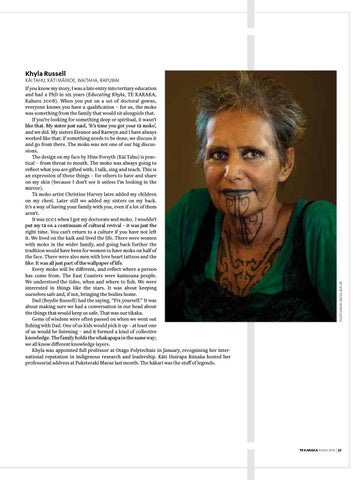
Khyla Russell If you know my story, I was a late entry into tertiary education and had a PhD in six years (Educating Khyla, Te Karaka, Kahuru 2008). When you put on a set of doctoral gowns, everyone knows you have a qualification – for us, the moko was something from the family that would sit alongside that. If you’re looking for something deep or spiritual, it wasn’t like that. My sister just said, ‘It’s time you got your tā moko’, and we did. My sisters Eleanor and Raewyn and I have always worked like that: if something needs to be done, we discuss it and go from there. The moko was not one of our big discussions. The design on my face by Hine Forsyth (Kāi Tahu) is practical – from throat to mouth. The moko was always going to reflect what you are gifted with. I talk, sing and teach. This is an expression of those things – for others to have and share on my skin (because I don’t see it unless I’m looking in the mirror). Tā moko artist Christine Harvey later added my children on my chest. Later still we added my sisters on my back. It’s a way of having your family with you, even if a lot of them aren’t. It was 2001 when I got my doctorate and moko. I wouldn’t put my tā on a continuum of cultural revival – it was just the right time. You can’t return to a culture if you have not left it. We lived on the kaik and lived the life. There were women with moko in the wider family, and going back further the tradition would have been for women to have moko on half of the face. There were also men with love heart tattoos and the like. It was all just part of the wallpaper of life. Every moko will be different, and reflect where a person has come from. The East Coasters were kaimoana people. We understood the tides, when and where to fish. We were interested in things like the stars. It was about keeping ourselves safe and, if not, bringing the bodies home. Dad (Boydie Russell) had the saying, “Fix yourself.” It was about making sure we had a conversation in our head about the things that would keep us safe. That was our tikaka. Gems of wisdom were often passed on when we went out fishing with Dad. One of us kids would pick it up – at least one of us would be listening – and it formed a kind of collective knowledge. The family holds the whakapapa in the same way; we all know different knowledge layers. Khyla was appointed full professor at Otago Polytechnic in January, recognising her international reputation in indigenous research and leadership. Kāti Huirapa Rūnaka hosted her professorial address at Puketeraki Marae last month. The hākari was the stuff of legends.
PHOTOGRAPH raoul butler
Kāi Tahu, Kāti Māmoe, Waitaha, Rapuwai
te Karaka kana 2012 23