Kiwi capers There are almost 25,000 kiwi on Stewart Island. Kaituhituhi Adrienne Rewi joins Ngäi Tahu tour guide Phillip Smith in search of our national manu.
10
te Karaka makariri 2010
would have a problem,” he says as he clicks on his torch and leads us back to MV Wildfire for the midnight cruise home. Phillip has lived on the island for 66 years and as he sits in his Half Moon Bay home overlooking the harbour and the village of Oban, he reflects on the high points of his 21-year career in tourism. Taking world-renowned naturalist David Attenborough and a BBC film crew on one of his kiwi spotting tours in 1996 is definitely ‘up there’ but you get the feeling that living on Rakiura is a highlight in itself for Phillip. He’s passionate about the place and he speaks with pride about tiny Bravo Island and Te Whaka a Te Wera (Paterson Inlet), which he considers his spiritual home. “That’s where my great-grandfather settled and my grandfather was born there. We still have a couple of cabins there; but really, the whole of Stewart Island is special to me. I know it all intimately,” he says. Phillip established his kiwi spotting tours when his charter boat customers started asking to see kiwi.
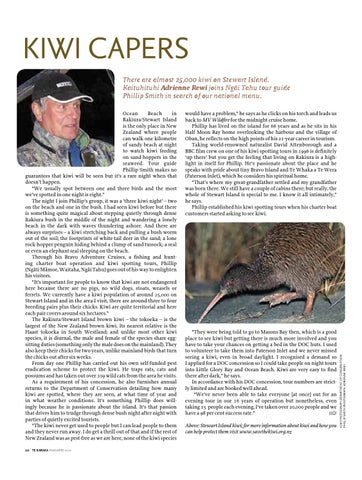
“They were being told to go to Masons Bay then, which is a good place to see kiwi but getting there is much more involved and you have to take your chances on getting a bed in the DOC huts. I used to volunteer to take them into Paterson Inlet and we never missed seeing a kiwi, even in broad daylight. I recognised a demand so I applied for a DOC concession so I could take people on night tours into Little Glory Bay and Ocean Beach. Kiwi are very easy to find there after dark,” he says. In accordance with his DOC concession, tour numbers are strictly limited and are booked well ahead. “We’ve never been able to take everyone [at once] out for an evening tour in our 16 years of operation but nonetheless, even taking 15 people each evening, I’ve taken over 20,000 people and we have a 98 per cent success rate.” Above: Stewart Island kiwi; for more information about kiwi and how you can help protect them visit www.savethekiwi.org.nz
kiwi photograph Department of Conservation phillip smith photograph adrienne rewi
Ocean Beach in Rakiura/Stewart Island is the only place in New Zealand where people can walk one kilometre of sandy beach at night to watch kiwi feeding on sand-hoppers in the seaweed. Tour guide Phillip Smith makes no guarantees that kiwi will be seen but it’s a rare night when that doesn’t happen. “We usually spot between one and three birds and the most we’ve spotted in one night is eight.” The night I join Phillip’s group, it was a ‘three kiwi night’ – two on the beach and one in the bush. I had seen kiwi before but there is something quite magical about stepping quietly through dense Rakiura bush in the middle of the night and wandering a lonely beach in the dark with waves thundering ashore. And there are always surprises – a kiwi stretching back and pulling a bush worm out of the soil; the footprints of white-tail deer in the sand; a lone rock-hopper penguin hiding behind a clump of sand tussock; a seal or even an elephant seal sleeping on the beach. Through his Bravo Adventure Cruises, a fishing and hunting charter boat operation and kiwi spotting tours, Phillip (Ngäti Mämoe, Waitaha, Ngäi Tahu) goes out of his way to enlighten his visitors. “It’s important for people to know that kiwi are not endangered here because there are no pigs, no wild dogs, stoats, weasels or ferrets. We currently have a kiwi population of around 25,000 on Stewart Island and in the area I visit, there are around three to four breeding pairs plus their chicks. Kiwi are quite territorial and here each pair covers around six hectares.” The Rakiura/Stewart Island brown kiwi – the tokoeka – is the largest of the New Zealand brown kiwi. Its nearest relative is the Haast tokoeka in South Westland; and unlike most other kiwi species, it is diurnal, the male and female of the species share eggsitting duties (something only the male does on the mainland). They also keep their chicks for two years, unlike mainland birds that turn the chicks out after six weeks. From day one Phillip has carried out his own self-funded pest eradication scheme to protect the kiwi. He traps rats, cats and possums and has taken out over 109 wild cats from the area he visits. As a requirement of his concession, he also furnishes annual returns to the Department of Conservation detailing how many kiwi are spotted, where they are seen, at what time of year and in what weather conditions. It’s something Phillip does willingly because he is passionate about the island. It’s that passion that drives him to trudge through dense bush night after night with parties of quietly excited tourists. “The kiwi never get used to people but I can lead people to them and they never run away. I do get a thrill out of that and if the rest of New Zealand was as pest-free as we are here, none of the kiwi species