which enable some testing of the reliability of traditional evidence.18 These involve analytical attention to separating prosaic from allegorical, symbolic or pedagogical intentions; to the chronology of different accounts of the same tradition; and to contexts of collection, including the status and reliability of informants. In fact, a specific methodology along those lines had been advocated by Edward Shortland, in 1843. He proposed that reliable traditions would be consistent across multiple sources; that they were likely to have been recorded early, if only in fragmentary form; and that they would have been referred to often on the marae and in judicial proceedings. Their reliability, in brief, had been underwritten by long-term Māori consensus.19 Of course, that does not explain how traditions could have avoided the potential pitfalls of oral transmission in order to be passed on with tolerable accuracy. In this regard, three characteristics were probably of particular importance. First, Māori traditions were often located geographically to quite specific places (the names of which have often survived in modern maps and other records). Traditions were also associated closely with particular individuals, also named. Place and person constituted the ‘immutable, tangible markers of tradition’.20 Second, the traditional method for holding on to knowledge by oral transmission was to package it in ways that reinforced memorisation, and to rehearse or perform those packaged pieces often. As Walter Ong wrote in 1982: Since in a primary oral culture conceptualized knowledge that is not repeated aloud soon vanishes, oral societies must invest great energy in saying over and over again what has been learnt arduously over the ages. This need establishes a tightly traditionalist or conservative set of mind that, with good reason, inhibits intellectual experimentation.21 Casting knowledge in formulaic or other standardised story forms, and the use of mnemonic devices, repetitive patterns, rhyme and so on, helped to fix the information in the minds of speakers and listeners. Further, the information was pared back to that which was essential for establishing genealogical proximity and the ownership of resources – the main social purposes of the traditions. Third, those who held and transmitted oral traditions had, or developed, extraordinarily well-organised capacities for memory. Father Servant remarked on the practised skill of Hokianga Māori, about 1840, ‘in recalling the memory of their ancestors, in giving the most minute details concerning their
46 TANGATA WHENUA AN ILLUSTRATED HISTORY
rights of possession; nothing escapes their memory’; and William Wade, at Manukau Harbour in 1842, also encountered some extraordinary examples of their ‘great power of memory’.22 Edward Shortland, whose duties variously as interpreter, magistrate and SubProtector of Aborigines took him through the Waikato, Coromandel, Bay of Plenty and the eastern South Island from 1842 to 1844, made the logical connection between trained memories, accurate transmission of oral learning and broad consistency of dispersed narratives: It was not until I had compared the accounts given by different persons, who resided in distant parts of the country, that I attached any particular value to . . . traditionary history. But I was then struck with the remarkable manner in which they coincided with each other, often when least expected, that I felt satisfied that dependence might be placed on their general accuracy . . . We, who have so long trusted to the authority of books, are, I am persuaded, too suspicious of the credibility of the traditionary history of a people who have not yet weakened their memories by trusting to a written language.23 In Shortland’s experience, three classes of oral tradition could be recognised: religious traditions that were seldom disclosed to foreigners; myths and legends about demigods and heroes that Māori themselves regarded as kōrero tara, or fables;24 and traditions about migration to New Zealand that ‘are looked on by the natives themselves . . . as tales founded on facts . . . [and it is these] that we have to trust for any history of this people’.25 Shortland and a critic, the missionary-printer William Colenso, were commissioned to write essays for the first transactions of the newly constituted New Zealand Institute in 1868, and these summed up the dichotomy of views about Māori tradition that emerged in the first century of contact. These were, on the one hand, that tribal traditions were historical, and consistent in describing initial settlement by various canoes about 500 years earlier;26 and, on the other hand, that tribal traditions were contrived, contained ‘scarcely a grain of truth’ and were never believed by Māori who, what is more, had lived in New Zealand far longer than their traditions implied.27 Thus were drawn the lines of a long debate, which was resolved largely by attention to genealogy. Differing nineteenth-century opinions about the historicity of Māori traditions arose largely from the tendency of some European scholars to emphasise the content of the narrative, which they often found confusing or
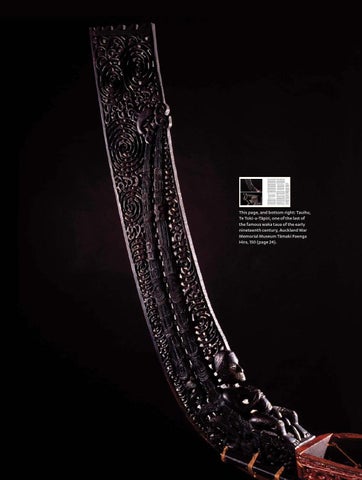
Opposite The taurapa or sternpost (top) and the tauihu or prow (below) of Te Toki-a-Tāpiri, one of the last of the famous waka taua of the early nineteenth century. These magnificent war canoes represented a significant investment for their owners, and their power to strike at the enemy was suggested in the name Te Toki-a-Tāpiri – Tapiri’s adze. The canoe’s history illustrates how the mana of a waka taua could underline the significance of political agreements and events. Tapiri was a prominent ancestor of Ngāti Matawhāiti, whose carvers made the hull about 1836. Before completion, the hull was gifted to Te Waaka Perohuka of Rongowhakaata in gratitude for assistance in battle. A famous korowai (cloak), Karamaene, was given in return. The prow and sternpost were then made by carvers of Ngāti Kaipoho, Perohuka’s hapū, near Manutuke on the Waipaoa River. In 1853 Perohuka presented Te Toki-a-Tāpiri to Tamati Waka Nene and Patuone of Ngāpuhi to celebrate a peace established earlier with this northern iwi. In return, Patuone gave him a stallion called Taika (Tiger), one of the first horses on the East Coast. The waka was taken to Waitematā and used there for some years until sold to Kaihau and Te Katipa of Ngāti Te Ata. In 1863, it was seized there by government forces during the Waikato hostilities. Ngāti Te Ata were compensated for this loss, but the canoe remained on the beach at Onehunga until restored to take part in a regatta in 1869, in honour of Prince Alfred, Duke of Edinburgh. The waka taua was then given into the care of Paora Tuhaere of Ngāti Whātua at Ōrākei, and in 1885 was presented by the government to the Auckland Museum. AWMM, 150
CHAPTER TWO | SPEAKING OF MIGRATION 47
This page, and bottom right: Tauihu, Te Toki-a-Tāpiri, one of the last of the famous waka taua of the early nineteenth century, Auckland War Memorial Museum Tāmaki Paenga Hira, 150 (page 24).
TE KARAKA RAUMATI 2014/15 43