Muscling & Skin Popping Definition Skin popping and muscling refer to two different injection practices. Skin popping is the injection of drugs into subcutaneous tissue or intradermal spaces, and muscling is the injection of drug intramuscularly. Due to the inflammatory nature of most drugs and their adjuvants, skin popping and muscling are generally damaging to body tissues. This is especially true for most stimulants, which also provoke vasoconstriction that in turn prevents absorption, prolongs inflammation, and delays wound healing. Heroin and morphine, on the other hand, are readily absorbed through intramuscular and subcutaneous routes and can significantly decrease risks of fatal overdose through delayed absorption. People may choose these injection practices for a variety of reasons, most commonly due to having collapsed, scarred, or difficult-to-find veins. People may also muscle as it offers an easier choice of sites to hide injection use, for a longer and more sustained high, or due to a lack of knowledge about basic injection/phlebotomy techniques.
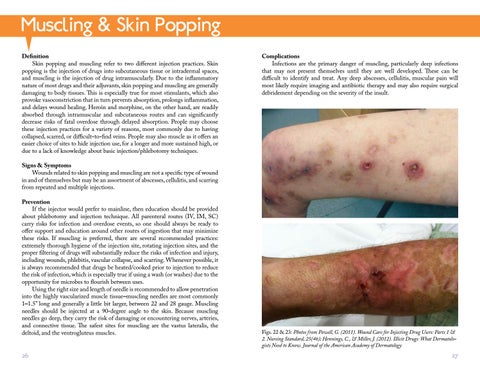
Complications Infections are the primary danger of muscling, particularly deep infections that may not present themselves until they are well developed. These can be difficult to identify and treat. Any deep abscesses, cellulitis, muscular pain will most likely require imaging and antibiotic therapy and may also require surgical debridement depending on the severity of the insult.
Signs & Symptoms Wounds related to skin popping and muscling are not a specific type of wound in and of themselves but may be an assortment of abscesses, cellulitis, and scarring from repeated and multiple injections. Prevention If the injector would prefer to mainline, then education should be provided about phlebotomy and injection technique. All parenteral routes (IV, IM, SC) carry risks for infection and overdose events, so one should always be ready to offer support and education around other routes of ingestion that may minimize these risks. If muscling is preferred, there are several recommended practices: extremely thorough hygiene of the injection site, rotating injection sites, and the proper filtering of drugs will substantially reduce the risks of infection and injury, including wounds, phlebitis, vascular collapse, and scarring. Whenever possible, it is always recommended that drugs be heated/cooked prior to injection to reduce the risk of infection, which is especially true if using a wash (or washes) due to the opportunity for microbes to flourish between uses. Using the right size and length of needle is recommended to allow penetration into the highly vascularized muscle tissue–muscling needles are most commonly 1–1.5” long and generally a little bit larger, between 22 and 28 gauge. Muscling needles should be injected at a 90-degree angle to the skin. Because muscling needles go deep, they carry the risk of damaging or encountering nerves, arteries, and connective tissue. The safest sites for muscling are the vastus lateralis, the deltoid, and the ventrogluteus muscles.
26
Figs. 22 & 23: Photos from Powell, G. (2011). Wound Care for Injecting Drug Users: Parts 1 & 2. Nursing Standard, 25(46); Hennings, C., & Miller, J. (2012). Illicit Drugs: What Dermatologists Need to Know. Journal of the American Academy of Dermatology
27