3
5
Bearcats ace Knights
Women’s volleyball victory raises Breast Cancer Awareness
Hunchback of Seville
Know Theater sheds light on New World genocide
THE NEWS RECORD / UNIVERSITY OF CINCINNATI MONDAY, OCT. 12, 2015
Event encourages LGBTQ members to come out KAILEY SCHNEIDER | STAFF REPORTER
In an effort to make the coming out process a little less scary, University of Cincinnati students created signs and decorated T-shirts announcing their sexuality and identities last Friday at the LGBTQ Center’s Artfully Out event. The event was a part of UC’s LGBTQ
history month and was a premature celebration of Sunday’s National Coming Out Day — a day in which closeted members of the LGBTQ community may find support in announcing and acknowledging their own sexuality and identity, perhaps for the first time in their life. Maria Merrill, a second-year graduate of
the women, gender, and sexuality studies program, said the event was created to give people an opportunity to come out or re-come out to celebrate their identities and sexualities all over again. “People walking on MainStreet who see the sign on our window don’t necessarily need to come out yet, but they see that sign and they know that there are people
CAMPUS PROMOTES COMMUNITY ENGAGEMENT
NATIONAL STUDENT DAY
on campus who are supportive of them,” Merrill said. To lure students to the event, the LGBTQ Center supplied T-shirts and signs for students to decorate and display their identities upon. “I’m no artist, but I’m trying to write an educational trans-friendly saying on my SEE COMING OUT PG 4
Democrats to debate, UC polls Sanders over Clinton STEVE BEYNON | COPY EDITOR
DAN SULLIVAN | PHOTO EDITOR
Danielle Kokochak, a fourth-year communication student, writes on a Free Speech ball in front of Tangeman University Center Friday as students celebrate National Student Day and enjoyed local cuisine, learned about community service opportunities and met animals from the Valley Exotics Zoo.
I
beyond, the Community Service Fair was a main event of the national celebration. The volunteer-oriented fair provided students with rows of informative booths to learn how to become involved in UC’s various organizations and additionally, how these groups better the community. “Students should come here to find out how they can get involved in our community,” said Fran Larkin, program coordinator of UC’s Center for Community Engagement. “We have a diverse set of wonderful nonprofit organizations that are here representing what they do, trying to get students involved in their mission.” Booth diversity made it possible for all students to find something
ISABELLA JANSEN | CONTRIBUTOR
n light of reveling appreciation for students’ social responsibility and volunteer efforts throughout the region, the University of Cincinnati joined over 1,500 other universities Thursday to celebrate National Student Day. The all-day festivity, sponsored by Camus Services and the UC Bookstore, brought with it a wide selection of events including giveaways of various freebies around campus, Zoo to You in Tangeman University Center’s Atrium and over 26 booths that occupied McMicken Commons for the annual Community Service Fair. Showcasing various community service organizations within the Cincinnati area and even a few
SEE STUDENT DAY PG 4
After months of Republican mudslinging the fight for the Democratic presidential nomination is set to kick off Tuesday on CNN, with Anderson Cooper moderating. The News Record conducted an online poll asking the University of Cincinnati’s choice for the next presidential candidate. Among Democrats, Sen. Bernie Sanders, I-VT, won 72.9 percent of the vote while former Secretary of State Hillary Clinton received 21.5 percent of support. The poll did not include Vice President Joe Biden, who has not declared his candidacy. According to Pew research, the issues young people are most concerned about are college affordability and minimum wage. Last year, the Department of Education reported the average student leaves college with $28,400 of debt, while the federal minimum wage currency sits at $7.25. Clinton trails behind Sen. Sanders in New Hampshire by 16 percent, according to a CNN poll. The Wall Street Journal reported the former Secretary of State has lost white female support by 10 percent and African-American support by 24 percent since June. A CBS poll shows Sanders leading in Iowa with 52 percent of Democratic support and Clinton trailing with 30 percent. However, Clinton still holds the vast majority of congressional and union endorsements and raised $28 million last quarter with Sanders raising $26 million, according to the FEC. Most polls have the bottom-tier candidates, Lincoln Chafee, Jim Webb and Martin O’Malley struggling to hold any support. Sanders represents the populist Left and often points to countries like Sweden, Norway and Finland as nations the United States should emulate in terms of economics and social services. The former Secretary of State mostly plays it down the middle, rarely being to the Left of other candidates. She has a track record of fighting for women’s rights at home and abroad, and has paid maternal leave as a major part of her platform. However, Clinton has come under fire from Democrats for flip-flopping on issues. It is possible Sanders or candidates looking for the spotlight, like O’Malley could argue against her opposition to marriage equality, her vote for the invasion of Iraq and support of debated trade deals from the past. In the wake of recent mass-shootings in Oregon and Sandy Hook, Clinton is positioning herself to the Left of Sanders. Clinton vows to repeal a 2005 law in which shields gun manufacturers from being legally liable for negligence when their weapons are used in crimes — Sanders supported the bill. Sanders voted against the 1993 Brady handgun bill and had support from the National Rifle Association for his first run for Congress in 1990. Each candidate supports an increase SEE DEBATE PG 2
5K obsticle course raises money for veterans CAMRI NELSON | STAFF REPORTER
Burnet Woods found Dog Tag 5K participants maneuvering through inflatable obstacle courses, rock walls and even moving boulders Sunday morning to make it to the first-annual event finish line. Hosted by the University of Cincinnati’s Veteran Services, the first ever Dog Tag 5K marathon and obstacle course helped raise money to support veterans in the Cincinnati community. Participants were challenged to navigate a series of inflatable obstacles while competing for the best 5K time, which added a unique twist to the local fundraiser that was separated by hour-long sessions to help ease congestion. “We wanted to create something different than the original 5K,” said Terrance Harrison, manager of UC veteran services. To show their support, each participant was given a dog tag with a sole Cincinnati veteran name on it to honor
their efforts at the Dog Tag 5K. Bottled water and bananas were also offered from a local Daisy Girl Scouts troop to participants completing the 5K run. As a newly organized event, UC Veteran Services was unsure what to expect in participants with only 60 people signed up during preregistration, Harrison said. Abigail Duncan, financial advisor for UC Veteran Services, said the event was important to her because she is a veteran. “We have people who come to the office who don’t have the money for school and who get the GI bill, but don’t get it in enough time,” Duncan said. Duncan hopes to raise enough money so she can provide local veterans with better job opportunities. Aaron Condia, a fourth-year communication student, discovered Saturday’s run through a friend who works for the veteran services office. SEE VETERANS PG 4
CAROLINE CORY | STAFF PHOTOGRAPHER
The Bearcat meets marathoners at the Dog Tag 5K finish line Saturday in Burnet Woods, the event was sponsored by UC Veteran Services.
THE STUDENT VOICE OF THE UNIVERSITY OF CINCINNATI
FREE
2 / NEWS MONDAY, OCT. 12, 2015
New program aims to bring students into film ALEX STONE | CONTRIBUTOR
With equipment ready for production and support of expert faculty moderators, the University of Cincinnati’s new Cinematic Arts Collaborative (CAC) aims to facilitate student collaboration in all types of cinematic projects from screenwriting to directing. The interdepartmental approach of the group brings students from different areas of study together to create and finish their own projects. Student diversity has led to the production of a myriad of concepts and ideas by CAC. This collaborative holds a focus of teaching every aspect of filmmaking. It is divided into eight student-led departments including screenwriting, direction, business, editing and production. CAC President Mary Monda and Vice President Colin MacGeorge see the group as a launch pad of sorts. “It is a safe space for students that are interested in filmmaking and cinema projects to come and find others to collaborate with,” Monda said. “We give students opportunities and confidence in their creative work.” The CAC was formed by two new faculty members: Kristyn Benedyk, chair of the screenwriting program, and Matt Irvine, director of the school of film. The husband and wife duo hails from Chicago’s famed DePaul University, which comfortably rests on the list of the top-20 film schools in the nation. Benedyk and Irvine essentially built DePaul’s film department and fostered it
into its prestigious ranking. UC brought the couple in to head the Digital Media Collaborative (DMC) — a joint effort by the College of Design, Architecture, Art and Planning (DAAP), the College-Conservatory of Music (CCM), the McMicken College of Arts & Sciences and UC libraries. With the goal to better the digital media arts, the departments
[Cinematic Arts Collaborative] is a safe space for students that are interested in filmmaking and cinema projects to come and find others to collaborate with. MARY MONDA
allocate necessary resources and secure opportunities for students, such as workshops and guest speaker presentations. After the CAC began as a screenwriting incubator for the DMC, Irvine and Benedyk saw an influx of great student ideas, but students seemingly lacked the means of production to make these ideas possible. As a remedy, the moderators sought to make CAC a student-led organization. In order to expose UC students interested in production to a real-world and professional work environment,
Monda hopes to bring in the production team from the upcoming film “Marauders,” starring Bruce Willis. The CAC also hopes to bring The Greater Cincinnati and Northern Kentucky Film Commission to campus. This commission facilitates the filming process for filmmakers in the tri-state area by connecting them with local talent, production crews and any other required resource. CAC members look to benefit from the commission’s internship program. Along with guest presentations the CAC also offers workshops in every area of study to consider allowing students to find their creative voice, whether it be by themselves or with the help of the faculty moderators. During the CAC’s biweekly screenwriting sessions, the writer of a piece or series can recruit any student willing to be a part of the production. The group then controls everything from casting to editing. To do this, the CAC has collected the necessary resources for filmmaking. With the help of aiding departments, students have the opportunity to use high-grade equipment. In the CSC’s arsenal are quality cameras, tripods, sound equipment, editing software, high-end computers and other crucial technology. With plenty of available space and enthusiasm to see where future of the organization stands, the CAC is currently looking for anyone ready to take initiative and seize collected opportunities. “Everyone is welcome,” Monda says. “Even if you’re unsure about it, just come and see what we’re about.”
Lecture talks state, federal relationships MALIA PITTS | CONTRIBUTOR
University of Cincinnati students gained perspective on how federal and state laws interfere with each other during Wednesdays’ 2015 William Howard Taft Lecture on Constitutional Law. The event, hosted by UC’s College of Law, featured guest speaker Heather Gerken, J. Skelly Wright Professor of Law at Yale Law School. Gerken specializes in election and constitutional law. Harvard University Press named her one of the nation’s 26best law teachers. She explained how federalism is commonly thought to be a single field of study, but it actually splits into two — relations between the states and the federal government, and the relations among the states. “We all know there is a Federalism problem,” Gerken said. “Most of us will say it’s a good thing that the states and the federal government are engaged in a turf war, and most of us have a sense of which side we’re on. Some of us have a theory about when courts should step in rest the battle between he states and the government.” Gerken also explained how “spillovers,” or different state laws intruding on each other, affect the society. She said federal has been designed to stop spillovers. For example, Colorado’s legalization of marijuana has spilled over into other states and Vermont’s regulation of food labels has had a major effect on food manufactures throughout the country. “These activities affected people in others states,” Gerken said. “It’s unsettling how, after all, one state’s polices reaches out state’s territories and affects citizens in those states. It’s the simple reason that no one wants to live under someone else’s law.”
Opinion: Will the next GOP Speaker please stand up? STEVE BEYNON | COPY EDITOR
Now Hiring! Position: Speaker of the United States House of Representatives Start date: October 31, 2015 The House is looking for a motivated Republican who has a passion for stagnation in federal government and traditional family values. Necessary qualifications: • Apathy for government • Unwillingness to compromise • A belief the federal government should do only two things: spread freedom and name buildings after Ronald Reagan • Preferably little or no experience in government • Willingness to shut down the federal government in the event Democrats support Socialist programs such as, but not limited to, Planned Parenthood and Obamacare • Keen on deregulating the free market while keeping jobs in the U.S. • A passion for big tax cuts and deficit reduction • Proficiency in Microsoft Excel Please note candidates may be disqualified for any positive statements said to or photos taken with President Obama. Those with a background in science could create conflicts of interest in regards to combating oppressive environmental regulations. Please send your resume and copy of your Concealed Carry Permit to: HouseSpeakerJob@gmail.com
PAUL PAN | CONTRIBUTOR
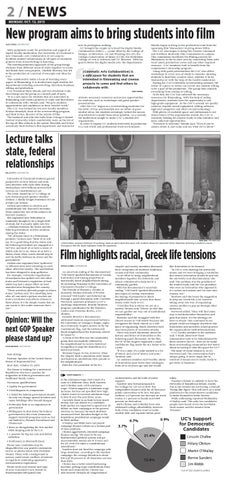
Littisha Bates, assistant professor of sociology, leads an open panel discussion with students about the racial and ethnic disparities affecting a student’s course throughout their life. Bates highlights Greek life opposition.
Film highlights racial, Greek life tensions SOPHIA GAINES | CONTRIBUTOR
An uncertain ending of the documentary “Old South” sparked discussions of racism, fraternities and buying properties in historically black neighborhoods during its screening Thursday in the University of Cincinnati’s Teacher’s College. The Friends of Women’s, Gender, & Sexuality Studies (Friends of WGSS) screened “Old South,” and followed up through a panel discussion with Carolette Norwood, associate professor in UC’s sociology department, Brandy Turnbow, program coordinator for the Women’s Center and Christina Brown, a UC alumna. Danielle Beverly’s documentary addressed tensions experienced between the University of Georgia’s Kappa Alpha (KA) fraternity chapter, known to fly the Confederate flag, and the historically black neighborhood the fraternity moved its house to. A focus of the film was the community group that successfully lobbied for the neighborhood to receive historical recognition to stop the demolition of a historical house. Tensions began to rise, however, when the chapter built a plantation-style house and hosted an antebellum-style parade in the neighborhood. Both the vice president of the KA
chapter and society members discussed their viewpoints on southern traditions, racism and their community. As an effort to bring neighborhood members together, the fraternity and others volunteered to help out in a community garden. With the documentary’s uncertain ending, “Old South” sparked discussion into topics of racism, fraternities, the buying of properties in black neighborhoods and, in turn, how these issues relate back to UC. “I feel like this is where we are as a society,” Brown said. “Where we feel like we can garden our way out of institutional responsibility.” Turnbow said she struggled with the church scenes in “Old South” because she recognizes the black church as a safe place of organizing. Black churches have also been places of terrorism attacks. There was much discussion about the history and future of fraternities in the following panel discussion. In the film, the VP of the chapter explained a small confederate flag inside the KA house to be a joke. “If it is a joke, it’s a joke soaked in a lot of blood, and a lot of misery and pain,” Turnbow said. An audience member said wealthy alums of fraternities pass down their ideologies from 30 to 40 years ago and she would
like fraternities to be banned. “In 1974 I was chairing the university senate and we were bringing a resolution that sexual orientation should be put into the university non-discrimination,” she said. “My problem was the president of the student body and the vice president who were in fraternities who opposed it. It’s racism and sexism and I’m sure antiwomen, too.” Turnbow said she hears the suggestion to strip out Greek life a lot, however taking away one way of organizing creates another to pop up through other initiatives. Norwood added, “They will find some way to institutionalize themselves and pass that down. It’s the ideology we have to attack.” She continued to say people could not imagine anywhere else fraternities and sororities would practice the organizations’ institutionalizations. A UC faculty member in the audience said, “I think about how these communities tend to be subordinated by these invasive forces…How do we make these surrounding communities feel better about us having to take the space for UC?” The issue of racial tension is, as Dr. Norwood said, “the conversation that’s always going. It never stops, but to confront it means you’re really ready to get down to business.”
endorsements and the bulk of union support. Sanders’ only formal proposal is his College for All Act of 2015. The Independent Senator calls for all four-year public universities to be free. His plan outlines a 0.5 percent tax increase on stock trades, 0.1 percent on bonds and 0.005 percent on derivatives. Both Clinton and O’Malley have also addressed college affordability, however both of the candidates want to tackle student debt and regulate tuition price
hikes. Tuesday’s debate is unlikely to have the fireworks of Republican debate, mostly due to the Democrats not having a Donald Trump-like figure. This will serve as a solid platform for the lesser-known candidates to make themselves better known. While addressing reporters Wednesday O’Malley said, “The only two candidates people have heard of are the inevitable front-runner and the senator from Vermont.”
FROM DEBATE PG 1
to the minimum wage, how much of a raise is a different story. Both Sanders and O’Malley seek a $15 minimum wage. Clinton supports a minimum wage increase, but has not specified how high. Chafee wants to increase minimum wage to $10.10 over the next three years. Currently there is no limit to how much money one can donate to a candidate. Both parties are expected to spend over $1 billion on their campaigns in the general election. In January, the Koch Brothers announced their donation budget to the Republican presidential campaign would be $889 million. O’Malley and Webb have not placed campaign finance reform as a serious part of their platform. Clinton aggressively attacked campaign finance saying, “We need to fix our dysfunctional political system and get unaccountable money out of it once and for all, even if it takes a constitutional amendment.” Sanders does not fund his campaign with large donations. According to the Sanders campaign, the average donation is about $30 and 99 percent of all donations are less than $100. Clinton has a better oiled fundraising machine, getting large contributions from banks and corporations. Clinton has also secured virtually all congressional
UC’s Support for Democratic Candidates 21.4%
72.8% *out of 522 students polled
SPORTS / 3 MONDAY, OCT. 12, 2015
Cyclones, CPD Teddy Bear Toss for children DAVID WYSONG | SPORTS EDITOR
FILE ART
UC baseball head coach Ty Neal released the 2016 baseball schedule this week highlighting the teams’ difficult upcoming opponents, like the nationally acclaimed LSU Tigers along with other SEC schools.
Baseball team releases tough 2016 schedule DAVID WYSONG | SPORTS EDITOR
With the spring season impending, the University of Cincinnati baseball team’s head coach Ty Neal released the Bearcats’ 2016 regular season schedule of 55 games. It is clear the Bearcats’ 2016 season will not be a cakewalk, as the Bearcats will face the likes of the University of Georgia, the University of Tennessee, the University of Mississippi, the University of Kentucky and a College World Series qualifier in Louisiana State University (LSU). “This is an exciting time to be a Bearcat,” Neal said. “We have been anxious to show our fans the competitive schedule we have pieced together. It is also a reminder that the start of season is right around the corner.” UC will kick off its season in Baton Rouge against the LSU Tigers. LSU ended its 2015 season ranked the nation’s fifth-best college baseball team with the Tigers’ All-American sophomore pitcher Alex Lange set to return in 2016. “This is the third year for our staff and we have put a very competitive schedule together,” Neal said. “This is all part of the
process to prepare this group to win a championship.” Out of these 55 games, 25 will be played at UC’s Marge Schott Stadium. The team will open its first set of home games March 11 with a 10-game home stand and its 2016 season facing Canisius College — 2015 NCAA regional team.
The conference was the third toughest in the nation last spring. The guys who choose to play in this program are hungry and embrace competition. TY NEAL
The Bearcats will play 24 games against American Athletic Conference (AAC) opponents, with conference play beginning April 1 when the team hosts the University of South Florida Bulls. UC will play a three-game series against
every AAC team for the upcoming season and hit the road to face NCAA regional participants Tulane University and East Carolina University “Just like our challenging early season schedule, The American is one of the top conferences in the country,” Neal said. “The conference was the third toughest in the nation last spring. The guys who choose to play in this program are hungry and embrace competition.” There are two other notable matchups this season for the Bearcats, including a midweek opponent in the Indiana University Hoosiers. Neal served as the top-assistant coach and recruiting coordinator for the Hoosiers from 2006 to 2013 and then was hired on as Bearcat in 2014. Neal’s return to Indiana is set for March 29. After winning the tournament last season, the Bearcats will travels to Oxford and play in the Joe Nuxhall Classic tournament April 12-13 to mark the second notable season matchup. UC will begin regular season play 9 p.m. Feb. 19 against LSU in Baton Rouge.
Men’s soccer up from 2014
The Cincinnati Cyclones organization annually partners with the Cincinnati Police Department (CPD) to raise awareness for young victims of accidents and fires in the region through the collaborative Teddy Bear Toss event Fans were encouraged Thursday to bring new or gently used teddy bears to the Cyclones game on Nov. 13 and throw the bears ice-bound after the first Cyclone goal hits the back of the net. “We are thrilled to continue our longstanding partnership with the Cincinnati Police Department for this fun event,” said Cyclones general manager Kristin Ropp. “Anything the Cyclones and U.S. Bank Arena can do for Cincinnati’s finest and this great community is a pleasure.” The event was first held in December 2011 and has occurred annually ever since. “We couldn’t be happier to extend our partnership with the Cyclones for a fifth season, said CPD Sgt. Tim Fritz. “The support of the Cyclones throughout the years have been huge for us, and it is great to see partners like the Cyclones step in and help our community.” In 2014 the Teddy Bear Toss saw over 4,000 stuffed animals thrown onto the ice as Cyclones’ fans watched their hometown team beat the Wheeling Nailers 3-2. The Nov. 13 version of the annual event will feature the Cyclones taking on the Quad City Mallards at 7:30 p.m., and will coincide with the team’s Throwback Night — featuring $10 tickets for fans and $1 hot dogs, pizza, soda and beer. Opening up 2015 preseason play Wednesday against the Wheeling Nailers, the Cyclones triumphed Weeling 6-1 after an unanswered six points. “These preseason games are a great chance to see if we have some chemistry and see some good line combinations, and some guys really had that tonight,” said Cyclones’ head coach Matt MacDonald. “We got a better feeling for things as the game went along, but we still have some things we need to work on and get better at.” The team will begin attempts to defend its 2014 Eastern Conference Championship title, with the puck dropping at the Cyclones’ first regular season game 7:30 p.m. Saturday against the Toledo Walleye at U.S. Bank Arena.
DAVID WYSONG | SPORTS EDITOR
With much of the season still underway, the University of Cincinnati men’s soccer team already sustains six wins for its record compared to the 2014 season’s final count of five victories. The Bearcats are 6-5-2 thus far, with big wins showing out against Temple University, Northern Kentucky University and Valparaiso University. “There is a lot more maturity on the team this year,” said UC head coach Hylton Dayes. “The chemistry is better this year and we have guys who have more experience.” Arguably the biggest win for the Bearcats was Sept. 26 against the No. 17 nationally ranked Temple Owls. UC beat the Owls 3-2 with the winning goal coming in the 85th minute of the game. Dayes has raved about multiple of his players’ performances so far this season, one being senior midfielder and forward Alejandro Garcia. Garcia is currently UC’s leading scorer with eight season goals so far and holds a second-place tie in the American Athletic Conference (AAC) for amount of goals scored, according to the AAC’s official site. Another player who has performed proficiently for the Bearcats is freshman midfielder Adam Wilson. “Adam Wilson has been a good set-up man by providing assists and creating opportunities for the team,” Dayes said. Wilson is first in the AAC with total assists of eight, according to the AAC’s official site. Despite the Bearcats improvement from its 2014 season, Dayes said there are a couple things the team could work on. “We could defend better,” Dayes said.“I would like to be tighter defensively and I would like to start faster. We could improve on not playing from behind.” The Bearcats currently are only above one team in the AAC for average goals scored against the team per game with an average of 1.69, according to the AAC’s official site. Despite poor defense, the Bearcats are tied at third in the conference in amount of total saves on the season with 40. This is partially due to UC sophomore goalie Pedro Diaz who recorded six saves in a draw with the University of Tulsa on Oct. 3. “He’s very competitive, he doesn’t get too high or too low,” Dayes said.“That’s what we expect from our goalkeeper. He’s shown that he’s up to the task, he’s just been playing pretty well.” The Bearcats fell to the University of South Florida 3-0 Saturday, and now hold onto third place in the AAC. Currently in first place of the AAC are the Southern Methodist University (SMU) Mustangs, with the Bearcats set up to play them at 7 p.m. Saturday. Along with SMU, the Bearcats have five more games this season with three being at home in UC’s Gettler Stadium. “It is hard to say what our potential the rest of the season is,” Dayes said.“Right now we are just taking it one game at a time.” The Bearcats will suit up for their next game against Indiana University – Purdue University Fort Wayne (IPFW) at 7 p.m. Wednesday in Gettler Stadium.
PAUL PAN | CONTRIBUTOR
Carly Nolan (12) racks up her fourth double-double of the 2015 season during Friday night’s game against the University of Central Florida when the Bearcats defeated the Knights at home 3-1.
Bearcat volleyball passes Knights, promotes breast cancer awareness JASON SZELEST | CONTRIBUTOR
The University of Cincinnati women’s volleyball team achieved a rare occurrence Friday evening by beating the Central Florida University (UCF) Knights for the second time in history. After the Bearcats lost the match’s first set, UC won in a come-from-behind fashion and took the game 3-1. The first set was a constant swing of momentum. Once one team took a lead throughout the set, the other would counter its charge. After a hard fought set, UCF rallied from behind to win 25-22. The second set would not be much different as the teams continued to ferociously battle back and forth, matching each other blow for blow. UC was able to hold off the Knights and took this set 25-22. UC freshman outside hitter Carly Nolan’s dominant performance led the Bearcats in the second set. “Throughout the season I’ve been working a lot on my offense, and it really showed how much I’ve been working on it,” Nolan said. “Changing up my shots really helped me score the ball.” In the third set fatigue appeared to take a toll on the Knights, as the Bearcats came out with a cohesive team performance and dominated the ball from first serve. The Knights continued struggling to stop Nolan while other Bearcats began to make their presence known, such as freshman setter Jade Tingelhoff and sophomore middle blocker Cortnee Bowser. The Bearcats would never trail in the set and took it over by a resounding 25-11
score. Desperation began to set in for the Knights due to a demanded fourth-set win to stay alive in the match. UCF fought hard using every bit of energy they had left, but ultimately fell short to the Bearcats’ strong team play and lost the set 25-23. The Bearcats’ head coach Molly Alvey said her team’s ability to play cohesively was a large factor in the game’s outcome. “I think it has everything to do with the outcome,” Alvey said. “It’s something we’ve really been working on. I’ve talked a lot about what’s our team identity, what we want to be known for out on the court, how hard we are going to play for each other, and I think you could really visibly see that tonight.” With the Bearcats sporting pink uniforms for Breast Cancer Awareness Month, this game had larger implications than two teams fighting to stay alive in a conference race. Alvey was pleased her team was able to play well in a game in which they were supporting something bigger than themselves. “We love this time of year,” Alvey said. “We have our own stories within the team and to be able to bring light to that, to be able to represent it. It’s always nice to represent the cause with the pink jerseys.” After going through a rough stretch when the team lost three of its first four conference games, the Bearcat win improves UC to 10-6, and 2-3 in the American Athletic Conference. The Bearcats travel to play Tulane University at 2 p.m. Friday in New Orleans.
DEMOCRATIC DEBATE VIEWING PARTY Mac’s Pizza Pub 8:30 PM — 11 PM Tuesday October 13
CHAFEE
|
CLINTON
SANDERS |
|
O’MALLEY
WEBB
CLASSIFIEDS PART-TIME SERVING OPPORTUNITY! Andy’s Mediterranean Grille is now hiring part-time servers! Andy’s is less than 2 miles from campus at 906 Nassau St. 45206. Andy’s is an equal-opportunity employer who offers flexible scheduling and a great working environment. For more information and to request an interview call 513-604-6686.
Hyatt Regency Cincinnati Hiring Front Office Agents & Restaurant Positions! We are looking for students that have a passion for customer service and want to work downtown in a fun environment! Front Office Agent, Barista, Bartender, Greeter, Server, Cook & Server Assistant ~ we have something for everyone! Apply online: www.cincinnati.hyatt.com EOE
4 / LIFE & ARTS MONDAY, OCT. 12, 2015 FROM STUDENT PG 1
compatible with their interests, whether it be tutoring children, building houses or promoting child health. The annual fair provided opportunities for student to learn more about Cincinnati, people who may come from different backgrounds and how to manage their time, talents and energy for the benefit of those in need, Larkin said. “I learned a lot about the opportunities Cincinnati has for not only jobs, but also places to volunteer and other organizations that I am really interested in,” said Kelsey Kurzhals, a first-year exploratory studies student. Aside from the community service fair, students could take advantage of various local food trucks lined outside of TUC ready for students to grab a quick, Cincinnatian lunch in between classes. In addition, many students were able to meet animals from the Cincinnati Zoo in TUC’s Atrium for the Zoo to You program, which featured a very popular young wallaby and several other foreign critters. “I like that they made us feel good,” said Megan Osswald, a third-year biomedical science student. “They make us feel like we are cared about… that’s why we’re here.” Osswald was one Bearcat of thousands enjoying the special treatment offered on National Student Day and simply came out to the events to see the opportunities UC offered to its students on the day. In addition to the vast selection of events around campus students could also take advantage of the free giveaways including tumbler glasses from Parking Services, T-shirts from the UC Bookstore and free showings of “Pitch Perfect 2” and “Jurassic World.” UC also provided free all-day laundry services, a 20 percent discount at the UC Bookstore and even the university’s largest-ever individual ice cream sundae at MarketPointe in the Siddall dining hall.
Q&A: Netflix, chill with comedy power-house Bill Burr’s new show MUHAMMAD PATEL | CONTRIBUTOR
Through his honest and irreverent comedy approach in performances across the country, Bill Burr has become one of modern stand-up comedy’s most esteemed idols in the business today. The News Record spoke with Burr in preparation for this Oct. 19 show at Cincinnati’s Taft Theatre about his new Netflix show, upcoming performance at Madison Square Garden and previous Cincinnati experiences. TNR: You are performing at the Taft Theatre on Oct. 19, how have your previous experiences in the city of Cincinnati been? Bill Burr: I didn’t know much about Cincinnati when I first got here. All I knew was the Big Red Machine from the ’70’s — the Cincinnati Reds — and I knew “WKRP in Cincinnati.” I was doing a college gig there and I drove into town and I saw the skyline and Riverfront Stadium was still up and I remember singing the “WKRP” song when I went in there, but I didn’t know your cuisine. I didn’t know anything about it. Anyway, I’m fascinated with the city in that it’s in the north but there’s that southern vibe, because Kentucky’s right there. I didn’t realize that it was the stop for the Underground Railroad. I went to that museum one of the last times I was there. I read up on the history and how there was a lot of bootlegging — you know any city that was along the river was a big gangster town and I’m really fascinated with all of
that, but I don’t know a whole hell of a lot about it. I do know the downtown area was frustrating to deal with because everything was cool up until five then everything shut down. So, if I didn’t order any food, I was kind of screwed. So, I had to go down and eat at the comedy club and that kind of sucks. But, the people were cool man and it had that blue-collar vibe. You’ve got the river there. The reds are the s—. TNR: Later this year you are performing at Madison Square Garden. How do you feel about that? BB: It’s ridiculous. I added a week onto this tour to make sure I was ready because I don’t think I have any jokes that are worthy doing in that building. But, comedy is huge right now and I can’t say, ‘no, man’ if someone asks me to do this. If I get to stand in the same area that John Bohnam played drums in. You know, Wayne Gretsky played there, the NBA, all those great hockey players and then all the great basketball players. Jordan played there. It’s unreal. It’s a shame to me that I’m going to get to do that. So, I’m actually trying not to think about it. TNR: You have your animated series “F is for Family” coming out later this year on Netflix, what motivated you to make this series and make it animated? BB: Well, all my ideas that I would take to networks and the way I would have people interact and everything were considered
— I don’t know, I always had something. It was always too big. It was too ‘that,’ or it was too ‘this.’ It was frustrating for me. So I was thinking, “How the hell can I get my s— on TV?” And, I was out walking my dog one day and I just started thinking, “What if I just do some animated shorts?” And, I was just going to do it on my website and I was just going to animate some childhood stories. I was just going to do these five-minute vignettes and they’d be over the top and I could exaggerate them even more and I just thought, “Yeah that would be cool.” Of course, I only thought about doing it I never got around to doing it and then one day I took a meeting with Vince Vaugn’s Wild West productions. It was just a general meeting and I said, “I don’t have an idea for a show, but I kind of have this idea for this cartoon thing,” and they were looking to do an animated show and that’s how it started. It’s about the Murphy family living in 1973. It’s on Netflix — got six episodes. I got to work with Mike Price from “The Simpsons,” one of the creators of the show and just an absolute creative force. He’s the guy driving the ship over there. Vince’s company is incredible. We had his sister Victoria, Mike Lagnese, Peter Billingsly, all of these guys and we had a monster writing room. The show comes out in December. So, we’ll wait for you college kids to be done with your finals. Tickets for his show are available now.
FROM COMING OUT PG 1
T-shirt,” said Maggie Smith, a fourth-year biology student. One such idea Smith threw around was the saying, “Pizza Rolls not Gender Roles” — a phrase quickly garnering popularity at Friday’s event. According to Smith, another important aspect of the national holiday is raising awareness and calling attention to people outside of the LGBTQ community. “Coming out is an event that everyone in the community has to go through,” Smith said. “People that are allies and heterosexuals can gain knowledge and perspective. They can learn how to help people through that.” Molly Bernfeld, a third-year communication student, also worked on a T-shirt to advocate for issues within the community. Written on the front were several hashtags listing various sexualities and genders and on the back was the phrase, “God made you here. You are not a mistake.” Bernfeld’s T-shirt addressed the preachers who make frequent visits and hateful remarks about LGBTQ community students and advocates in front of UC’s Tangeman University Center. “I think it’s important for you to know, if you believe in a higher power, that God made you this way and he didn’t make a mistake,” Bernfeld said. “You have a purpose here on Earth and that it will pay off in the end.” Bernfeld said she was proud to know events like National Coming Out Day help bring awareness to these issues faced within the LGBTQ community. “Coming here shows others that everyone here are people who are kind and haven’t done anything wrong by being themselves,” Bernfeld said. Andrew Welch, a fourth-year computer science student, said he was thrilled to have another opportunity to be in the LGBTQ Center, as the room has acted as a home for him throughout his UC experiences. “It’s somewhere where you know you’re going to be accepted, and somewhere where you know you’re not going to be judged for anything,”Welch said.
FROM VETERANS PG 1
Condia, who has multiple close family veterans, attended the veteran-support run as a chance to show his pride for family members and was just one of the many UC students flagging support at the run. “I enjoy running and thought that this would be a great opportunity to meet other people and do something other than school,” said Iyanulouwa Alade, a first-year information technology student. Alade ran alongside several classmates from the Gen 1 program, a program for first generation students to show their support. In addition to Dog Tag 5K, UC Veteran Services has multiple events planned for the coming months. Veteran Services will host a job fair in Tangeman University Center’s Great Hall from 3 p.m. to 6 p.m. on Oct 14, with employers from all over Cincinnati seeking to recruit local veterans. The fair will also offer a Question and Answer session to help veterans practice for potential interviews. “The job fair will help veterans translate their military skills into something that can go into a civilian resume,” Duncan said. UC Veteran Services will also host Soldier of Change on Oct. 26, which is an event partnered with the LGBTQ Center to raise awareness for the diversity of soldiers fighting for our country. The event will be part of UC’s LGBT history month, an ongoing series of events to bring awareness and show support to commnity members and affiliates.
PHOTO COURTESY OF KOURY ANGELO
Renowned comedian, Bill Burr, looks forward to the release of his upcoming Netflix original, “F is for Family,” an animated series featuring Burr’s blunt and irreverent comedic stylings.
Review: ‘Goodnight Mommy’ in town for Halloween RICHA KAVALEKAR | CONTRIBUTOR
During the time of year when everyone is itching for a good scare, “Goodnight Mommy” hits the Esquire Theater for the Halloween season. The Austrian thriller opens with a panoramic view of a simplistic and modern mansion seemingly in the middle of nowhere. Surrounding the house are endless fields of grass serving as a playground to the twin boys, played remarkably by nine-year-old Lukas and Elias Schwarz. Even though the film’s sunny picturesque landscape seems a paradise for any adolescent to spend their summer, there is a sense of a dark, palpable tension in the air as the twin boys frolicked through fields. As the movie shifts into gear, the twin boys’ mother — starred by Susanne Wuest — returns home bandaged up from an unexplained surgery. The twins grow more skeptical about their mother who is malicious and visibly distant. Meanwhile, the twins reminiscence about the good times they used to have with their mother before the surgery. Her brisk and abrupt movements paired with pursed lips and bloodshot eyes visible through the bandages evoke a sense of discomfort from the twins. Initially intended to be a silent movie, dialogue in “Goodnight Mommy” was minimal. Yet, each spoken line was crucial in adding to the films’ unsettling nature. Cinematographer Martin Gschlacht did justice with this visually striking masterpiece shot on a 35 mm. The suspense is essentially concentrated by the stillness of each seen through wideshots and cutaways. Veronika Franz, co-director of “Goodnight Mommy”, said the outdoor scenery characterized the twins’ personalities — alive and full of light, while the house reflected that of the mother — dark and imprisoned. In an otherwise still film, the mothers’ scarce dialogue and frenzied actions
served as a visual equivalent to nails across a chalkboard. The twins grow increasingly concerned about the intruder living under their roof with each punishment they receive. Initially the boys find solace in each other’s company and as the film goes on begin to retaliate against their mother. From unleashing cockroaches on their sleeping mother, to hiding a baby monitor under her bed their actions soon become less innocent and more heinous. Just when the audience thinks the plot could not get creepier, “Goodnight Mommy” takes a dark turn. The boys resort to tying up the woman and torturing her to admit she is not their actual mother. “Goodnight Mommy” seems to hold the intention of exploiting phobias. From a fish tank full of cockroaches, to the twins gluing their mothers’ mouth shut and eventually prying it open, this film does a stellar job of making its viewers’ skin crawl without the use of cheap tricks or gory scenes. A scene with the two Red Cross workers
is almost horrifyingly comedic. The boys attempted to distract the inquisitive donation collectors, all while making sure their mother remained tied up and gagged. It was a very unpleasant, yet unapologetically amusing considering the situation’s severity. It was a moment of reality figuratively and literally interrupting the boys’ sinisterdoings taking place behind closed doors. Apart from a devastatingly genius plot-twist, “Goodnight Mommy” has one superlative factor making it one of the best films of the year — the audience is forced to shift their perception the films’ villain. Viewers start off confident thinking the twins are the victims, yet the boys’ innately evil actions become less justified on their quest to finding out what happened to their mother in this nightmarish thriller. Tense and terrifying from start to finish, “Goodnight Mommy” is highly recommended to not only horror-movie enthusiasts, but also to anyone who enjoys twistedly ingenious films.
PROVIDED
Pairing striking cinematography with an unsettling plot, “Goodnight Mommy” kicks off October as a twisted and ingenious horror film keeping audiences tense and terrified from beginning to end.
LIFE & ARTS / 5 Review: Satirical play tackles New World genocide MONDAY, OCT. 12, 2015
DULCINEA RILEY | CONTRIBUTOR
Set in the wake of Christopher Columbus discovering the New World, the Know Theatre’s “Hunchback of Seville” by Charise Castro Smith is equal parts absurd and enlightening. Smith’s play sheds a light on the intimate world leading to one of the most horrific genocides in history, by offering a “what if” situation — what if rather than Queen Isabella passing the throne to her mad daughter Juana as history shows, Isabella also had a sister? Specifically a hunchbacked, agoraphobic, atheist “adopted” sister, who may have had the drive to stop Spain before it went too far in the name of God, gold and glory. This sister, Maxima Terrible Segunda, has been more or less hidden by her proud “adopted” family and thus far she has been content. Hiding away with her books, a brash lady-in-waiting and her secret Muslim lover Talib Furozh, Maxima has held little reason to venture out into the real world. This is until her dying, “adopted” sister, HRH Queen Isabella shows up, unhinged daughter Juana in tow, giving Maxima the chance to become Spain’s puppet master. Maxima, however, knows her ideals do not fit the mood of the rest of the world. Christopher Columbus runs on stage in
his foul narcissist glory. Absolutely drunk on the pride of discovering the “New F— ing World,” he is followed by two Native Americans. The duos’ culture is so efficiently wiped from history they point out no 2015 playwright knows what names or apparel would be even almost appropriate, therefore they are referred to as “1,” and “2.” Hispaniola is a blood bath and the Infanta Juana is eating ‘roasted peasant’ off a stick. No, she does not mean pheasant. The moments where the Queen, Juana, and Maxima are on stage are the absolute best. The audience could not stop laughing as the three women clambered around stage, trying to battle out who will end up on top. One dying, one crippled and one crazy, the three royals’ antics not only left the audience hysterical, but offered a new closer look at what the inner workings of absolute monarchies looked like behind the imagery of divine right. Talib Furozh is the only character that has firsthand seen the atrocities of Hispaniola. Now an enemy of the state for refusing to participate in mutilating slaves, he implores Maxima to take over the throne, listing the torture, disease and death he has seen corrode the native people. At one point, Talib looks toward the
audience to say, “All this really happened in history… I am not making it up.” From here, the absurdity only escalates. This satire is so masterful, Monty Python would only do it differently by having the corsets and Juana’s cheetah fur worn by men. Biting political and religious commentary made even better by drawing parallels between then and now — Fox News gets a mention — the characters argue with each other in different styles of language. The flow of the story is off-kilter, but absolutely works to its advantage. Maxima is faced with the poignant question, “Is Spain’s new day, borne from your blood?” Only the sudden ending will answer her question. When done right, satire offers the most effectively honest commentary to public about society with its ability to balance the somber and the absurd to shed light on our own flaws. Smith’s “The Hunchback of Seville” is an example of what true satire is capable of by tackling one of the darkest eras in world history in such a way that is both brutally honest, and absolutely hilarious. This play is a triumph, not only for the Know Theatre but also for UC’s CollegePHOTO COURTESY OF DANIEL R. WINTERS Conservatory of Music, whose actors “Hunchback of Seville” portrays satire by starred the magnificent driving force of the offering a humorous look into the dark era play. following the discovery of North America.
College living advice with Alberto Jones: Dealing with roommates ALBERTO JONES | STAFF REPORTER
Dear Alberto, My roommate is driving me crazy, kicking me out of our room every time I am on the phone with my boyfriend. In our roommate agreement we agreed it was OK to be on the phone in our room as long as it was at the appropriate time. I am not sure why she has such a problem with it now. It just came out of the blue. We have talked about it briefly and she said it is not fair she does not have someone to talk to, so for some reason I have to
leave the room. I am sick of it and really sad I will not be able to talk to my man in my own room. We are almost halfway through the semester, and I am not sure what I should do. -Agatha
a healthy relationship with each other. Also, do not let her bitterness of not having someone to talk to get you down. Talking to your R.A. is a good way to start back on a fresh track. You and your roommate should be able to agree to something and everything will work out for you.
Dear Agatha, The first thing I would do is set up a meeting with your R.A. and roommate. It is very important to do this to prevent further issues. You ladies will be living together for the next few months and it is important you maintain
To contact Alberto or to send in a question(s), send an email to his personal University of Cincinnati account, jones5ac@mail.uc.edu or to The News Record’s official Twitter account @NewsRecord_UC with the hashtag #askAlberto.
ADVERTISE
WITH US
To advertise, contact Natalie Sehweil Business and Advertising Manager P: 513-556-5902 F: 513-556-5908 newsrecordbiz@gmail.com newsrecord.org/advertise
2015 – 16 STAFF Editor-in-Chief
Fernanda Crescente
Managing Editor
Renee Gooch
News Editor
Cassandra Lipp
News Editor
Patrick Murphy
Sports Editor
David Wysong
College Life Editor
Matthew Nichols
Arts Editor
Russell Hausfeld
Online Editor
Molly Cohen
Photo Editor
Daniel Sullivan
Chief Photographer
Alexandra Taylor
Chief Reporter
Huy Nguyen
Chief Reporter
Maggie Heath-Bourne
Lead Designer
Lisa Cai
Sales Manager
Natalie Sehweil
Copy Editor
Steve Beynon
509 Swift Hall University of Cincinnati Cincinnati, Ohio 45221-0185
P: 556-5000 F: 556-5822
The News Record is the University of Cincinnati’s independent, student-run newspaper.
Papers printed Mondays and Thursdays with onlineexclusive features every Wednesday. Send questions, comments and news tips to manager.newsrecord@gmail.com. For more, visit www.newsrecord.org.
NewsRecord.org
@NewsRecord_UC
/TheNewsRecord