STEPHANIE
ZELMAN
Stephanie Zelman ’94, along with 12 friends who attended a girls’ high school together, recently launched Forgirlsake, a nonprofit dedicated to providing education for girls around the world. “We feel strongly about helping girls,” Stephanie explains, “because in many parts of the world, women are not considered full members of society and therefore are unable to make positive contributions. Educating girls, alongside boys, is a way to build healthier populations and faster-growing economies and to pave the way to a more equitable and secure world.” Stephanie attributes the organization’s success in part to her experience as a designer. “I didn’t know how to start a nonprofit, but I know how to design. We needed a name and a website to get started. Another founder came up with the name, and I went to work developing the identity with students at the Art Institute of Boston, where I teach.” In the last two years, 16 Ugandan recipients of scholar ships from Forgirlsake have started high school. Stephanie says, “Building a nonprofit with friends is much more gratifying than writing a check to an organization.” coinfo@forgirlsake.org
Parsons students and alumni are making headlines and winning awards for their forward-thinking, sociallyconscious designs. Not only are they creating beautiful, sought-after products, but their work is addressing some of today’s most formidable problems.
HILARY
BOYAJIAN
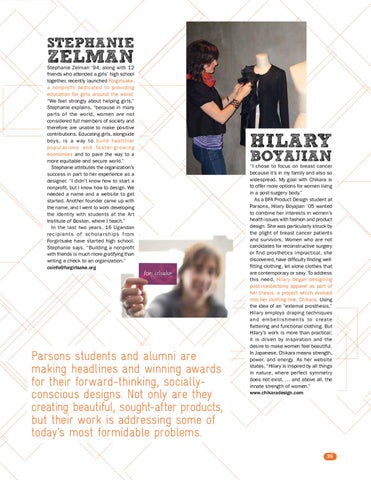
“I chose to focus on breast cancer because it’s in my family and also so widespread. My goal with Chikara is to offer more options for women living in a post-surgery body.” As a BFA Product Design student at Parsons, Hilary Boyajian ’05 wanted to combine her interests in women’s health issues with fashion and product design. She was particularly struck by the plight of breast cancer patients and survivors. Women who are not candidates for reconstructive surgery or find prosthetics impractical, she discovered, have difficulty finding wellfitting clothing, let alone clothes that are contemporary or sexy. To address this need, Hilary began designing post-mastectomy apparel as part of her thesis, a project which evolved into her clothing line, Chikara. Using the idea of an “external prosthesis,” Hilary employs draping techniques and embellishments to create flattering and functional clothing. But Hilary’s work is more than practical; it is driven by inspiration and the desire to make women feel beautiful. In Japanese, Chikara means strength, power, and energy. As her website states, “Hilary is inspired by all things in nature, where perfect symmetry does not exist, … and above all, the innate strength of women.” www.chikaradesign.com
25