06
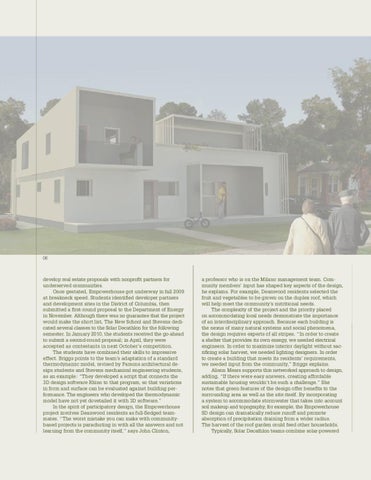
develop real estate proposals with nonprofit partners for underserved communities. Once gestated, Empowerhouse got underway in fall 2009 at breakneck speed. Students identified developer partners and development sites in the District of Columbia, then submitted a first-round proposal to the Department of Energy in November. Although there was no guarantee that the project would make the short list, The New School and Stevens dedicated several classes to the Solar Decathlon for the following semester. In January 2010, the students received the go-ahead to submit a second-round proposal; in April, they were accepted as contestants in next October’s competition. The students have combined their skills to impressive effect. Briggs points to the team’s adaptation of a standard thermodynamic model, revised by Parsons architectural design students and Stevens mechanical engineering students, as an example: “They developed a script that connects the 3D design software Rhino to that program, so that variations in form and surface can be evaluated against building performance. The engineers who developed the thermodynamic model have not yet dovetailed it with 3D software.” In the spirit of participatory design, the Empowerhouse project involves Deanwood residents as full-fledged teammates. “The worst mistake you can make with communitybased projects is parachuting in with all the answers and not learning from the community itself,” says John Clinton,
a professor who is on the Milano management team. Community members’ input has shaped key aspects of the design, he explains. For example, Deanwood residents selected the fruit and vegetables to be grown on the duplex roof, which will help meet the community’s nutritional needs. The complexity of the project and the priority placed on accommodating local needs demonstrate the importance of an interdisciplinary approach. Because each building is the nexus of many natural systems and social phenomena, the design requires experts of all stripes. “In order to create a shelter that provides its own energy, we needed electrical engineers. In order to maximize interior daylight without sacrificing solar harvest, we needed lighting designers. In order to create a building that meets its residents’ requirements, we needed input from the community,” Briggs explains. Alison Mears supports this networked approach to design, adding, “If there were easy answers, creating affordable sustainable housing wouldn’t be such a challenge.” She notes that green features of the design offer benefits to the surrounding area as well as the site itself. By incorporating a system to accommodate stormwater that takes into account soil makeup and topography, for example, the Empowerhouse SD design can dramatically reduce runoff and promote absorption of precipitation draining from a wider radius. The harvest of the roof garden could feed other households. Typically, Solar Decathlon teams combine solar-powered