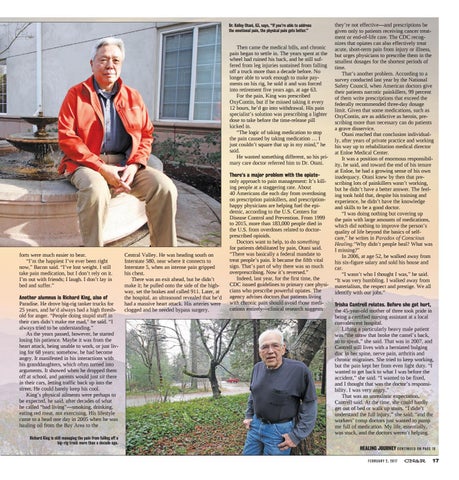
Dr. Kelley Otani, 63, says, “If you’re able to address the emotional pain, the physical pain gets better.”
Then came the medical bills, and chronic pain began to settle in. The years spent at the wheel had ruined his back, and he still suffered from leg injuries sustained from falling off a truck more than a decade before. No longer able to work enough to make payments on his rig, he sold it and was forced into retirement five years ago, at age 63. For the pain, King was prescribed OxyContin, but if he missed taking it every 12 hours, he’d go into withdrawal. His pain specialist’s solution was prescribing a lighter dose to take before the time-release pill kicked in. “The logic of taking medication to stop the pain caused by taking medication … I just couldn’t square that up in my mind,” he said. He wanted something different, so his primary care doctor referred him to Dr. Otani. There’s a major problem with the opiate-
forts were much easier to bear. “I’m the happiest I’ve ever been right now,” Bacon said. “I’ve lost weight. I still take pain medication, but I don’t rely on it. I’m out with friends; I laugh. I don’t lay in bed and suffer.” Another alumnus is Richard King, also of
Paradise. He drove big-rig tanker trucks for 25 years, and he’d always had a high threshold for anger. “People doing stupid stuff in their cars didn’t make me mad,” he said. “I always tried to be understanding.” As the years passed, however, he started losing his patience. Maybe it was from the heart attack, being unable to work, or just living for 68 years; somehow, he had become angry. It manifested in his interactions with his granddaughters, which often turned into arguments. It showed when he dropped them off at school, and parents would just sit there in their cars, letting traffic back up into the street. He could barely keep his cool. King’s physical ailments were perhaps to be expected, he said, after decades of what he called “bad living”—smoking, drinking, eating red meat, not exercising. His lifestyle came to a head one day in 2005 when he was hauling oil from the Bay Area to the Richard King is still managing the pain from falling off a big-rig truck more than a decade ago.
Central Valley. He was heading south on Interstate 580, near where it connects to Interstate 5, when an intense pain gripped his chest. There was an exit ahead, but he didn’t make it; he pulled onto the side of the highway, set the brakes and called 911. Later, at the hospital, an ultrasound revealed that he’d had a massive heart attack. His arteries were clogged and he needed bypass surgery.
only approach to pain management: It’s killing people at a staggering rate. About 40 Americans die each day from overdosing on prescription painkillers, and prescriptionhappy physicians are helping fuel the epidemic, according to the U.S. Centers for Disease Control and Prevention. From 1999 to 2015, more than 183,000 people died in the U.S. from overdoses related to doctorprescribed opioids. Doctors want to help, to do something for patients debilitated by pain, Otani said. “There was basically a federal mandate to treat people’s pain. It became the fifth vital sign. That’s part of why there was so much overprescribing. Now it’s reversed.” Indeed, last year, for the first time, the CDC issued guidelines to primary care physicians who prescribe powerful opiates. The agency advises doctors that patients living with chronic pain should avoid those medications entirely—clinical research suggests
they’re not effective—and prescriptions be given only to patients receiving cancer treatment or end-of-life care. The CDC recognizes that opiates can also effectively treat acute, short-term pain from injury or illness, but urges physicians to prescribe them in the smallest dosages for the shortest periods of time. That’s another problem. According to a survey conducted last year by the National Safety Council, when American doctors give their patients narcotic painkillers, 99 percent of them write prescriptions that exceed the federally recommended three-day dosage limit. Given that some medications, such as OxyContin, are as addictive as heroin, prescribing more than necessary can do patients a grave disservice. Otani reached that conclusion individually, after years of private practice and working his way up to rehabilitation medical director at Enloe Medical Center. It was a position of enormous responsibility, he said, and toward the end of his tenure at Enloe, he had a growing sense of his own inadequacy. Otani knew by then that prescribing lots of painkillers wasn’t working, but he didn’t have a better answer. The feeling took hold that, despite his training and experience, he didn’t have the knowledge and skills to be a good doctor. “I was doing nothing but covering up the pain with large amounts of medications, which did nothing to improve the person’s quality of life beyond the basics of selfcare,” he writes in Paradox of Conscious Healing.“Why didn’t people heal? What was I missing?” In 2006, at age 52, he walked away from his six-figure salary and sold his house and car. “I wasn’t who I thought I was,” he said. “It was very humbling. I walked away from materialism, the respect and prestige. We all identify with our jobs.” Trisha Cantrell relates. Before she got hurt,
the 45-year-old mother of three took pride in being a certified nursing assistant at a local convalescent hospital. Lifting a particularly heavy male patient was “the straw that broke the camel’s back, so to speak,” she said. That was in 2007, and Cantrell still lives with a herniated bulging disc in her spine, nerve pain, arthritis and chronic migraines. She tried to keep working, but the pain kept her from even light duty. “I wanted to get back to what I was before the accident,” she said. “I wanted to be fixed, and I thought that was the doctor’s responsibility. I was very angry.” That was an unrealistic expectation, Cantrell said. At the time, she could hardly get out of bed or walk up stairs. “I didn’t understand the full injury,” she said, “and the workers’ comp doctors just wanted to pump me full of medication. My life, essentially, was stuck, and the doctors weren’t helping. HEALING JOURNEY C O N T I N U E D FEBRUARY 2, 2017
O N PA G E 1 8
CN&R
17