30
5
SF | CPD: PATIENT SAFETY
May 2021 | Vol. 21 No. 5 www.medicalacademic.co.za
This article was independently sourced by Specialist Forum.
steps to creating a non-toxic healthcare environment
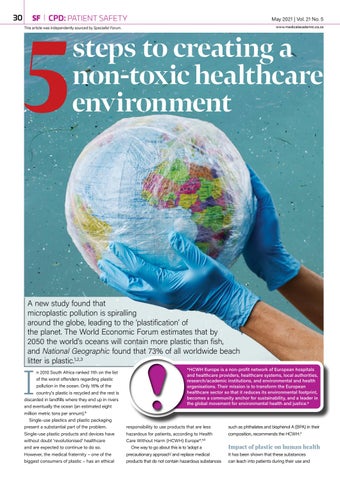
A new study found that microplastic pollution is spiralling around the globe, leading to the ‘plastification’ of the planet. The World Economic Forum estimates that by 2050 the world’s oceans will contain more plastic than fish, and National Geographic found that 73% of all worldwide beach litter is plastic.1,2,3
I
n 2010 South Africa ranked 11th on the list of the worst offenders regarding plastic pollution in the ocean. Only 16% of the country’s plastic is recycled and the rest is discarded in landfills where they end up in rivers and eventually the ocean (an estimated eight million metric tons per annum).9 Single-use plastics and plastic packaging present a substantial part of the problem. Single-use plastic products and devices have without doubt ‘revolutionised’ healthcare and are expected to continue to do so. However, the medical fraternity – one of the biggest consumers of plastic – has an ethical
*HCWH Europe is a non-profit network of European hospitals and healthcare providers, healthcare systems, local authorities, research/academic institutions, and environmental and health organisations. Their mission is to transform the European healthcare sector so that it reduces its environmental footprint, becomes a community anchor for sustainability, and a leader in the global movement for environmental health and justice.6
responsibility to use products that are less hazardous for patients, according to Health Care Without Harm (HCWH) Europe*.4,5 One way to go about this is to ‘adopt a precautionary approach’ and replace medical products that do not contain hazardous substances
such as phthalates and bisphenol A (BPA) in their composition, recommends the HCWH.4
Impact of plastic on human health It has been shown that these substances can leach into patients during their use and