26
SF | CPD: REPRODUCTIVE HEALTH
May 2021 | Vol. 21 No. 5 www.medicalacademic.co.za
This article was independently sourced by Specialist Forum.
Egg timer testing
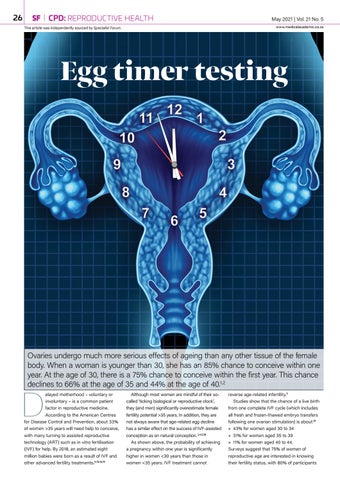
Ovaries undergo much more serious effects of ageing than any other tissue of the female body. When a woman is younger than 30, she has an 85% chance to conceive within one year. At the age of 30, there is a 75% chance to conceive within the first year. This chance declines to 66% at the age of 35 and 44% at the age of 40.1,2
D
elayed motherhood – voluntary or involuntary – is a common patient factor in reproductive medicine. According to the American Centres for Disease Control and Prevention, about 33% of women >35 years will need help to conceive, with many turning to assisted reproductive technology (ART) such as in vitro fertilisation (IVF) for help. By 2018, an estimated eight million babies were born as a result of IVF and other advanced fertility treatments 5,13,16,19
.
Although most women are mindful of their socalled ‘ticking biological or reproductive clock’, they (and men) significantly overestimate female fertility potential >35 years. In addition, they are not always aware that age-related egg decline has a similar effect on the success of IVF-assisted conception as on natural conception. 2,4,5,18 As shown above, the probability of achieving a pregnancy within one year is significantly higher in women <30 years than those in women <35 years. IVF treatment cannot
reverse age-related infertility. 5 Studies show that the chance of a live birth from one complete IVF cycle (which includes all fresh and frozen-thawed embryo transfers following one ovarian stimulation) is about:15 » 43% for women aged 30 to 34 » 31% for women aged 35 to 39 » 11% for women aged 40 to 44. Surveys suggest that 75% of women of reproductive age are interested in knowing their fertility status, with 80% of participants