12
SF | ENDOCRINOLOGY
May 2021 | Vol. 21 No. 5 www.medicalacademic.co.za
This article was independently sourced by Specialist Forum.
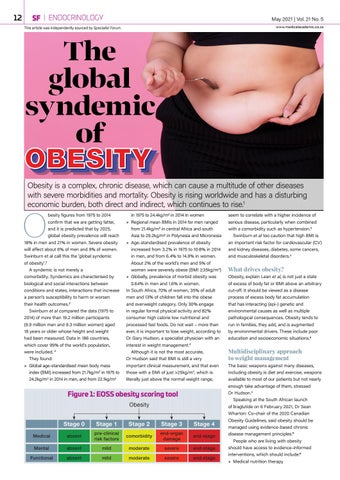
The global syndemic of OBESITY OBESITY Obesity is a complex, chronic disease, which can cause a multitude of other diseases with severe morbidities and mortality. Obesity is rising worldwide and has a disturbing economic burden, both direct and indirect, which continues to rise.1
O
besity figures from 1975 to 2014 confirm that we are getting fatter, and it is predicted that by 2025, global obesity prevalence will reach 18% in men and 21% in women. Severe obesity will affect about 6% of men and 9% of women. Swinburn et al call this the ‘global syndemic of obesity’. 2 A syndemic is not merely a comorbidity. Syndemics are characterised by biological and social interactions between conditions and states, interactions that increase a person’s susceptibility to harm or worsen their health outcomes. 3 Swinburn et al compared the data (1975 to 2014) of more than 19.2 million participants (9.9 million men and 9.3 million women) aged 18 years or older whose height and weight had been measured. Data in 186 countries, which cover 99% of the world’s population, were included. 2 They found: » Global age-standardised mean body mass index (BMI) increased from 21.7kg/m2 in 1975 to 24.2kg/m2 in 2014 in men, and from 22.1kg/m2
in 1975 to 24.4kg/m2 in 2014 in women » Regional mean BMIs in 2014 for men ranged from 21.4kg/m2 in central Africa and south Asia to 29.2kg/m2 in Polynesia and Micronesia » Age-standardised prevalence of obesity increased from 3.2% in 1975 to 10·8% in 2014 in men, and from 6.4% to 14.9% in women. About 2% of the world’s men and 5% of women were severely obese (BMI ≥35kg/m2) » Globally, prevalence of morbid obesity was 0.64% in men and 1.6% in women. In South Africa, 70% of women, 35% of adult men and 13% of children fall into the obese and overweight category. Only 30% engage in regular formal physical activity and 82% consumer high calorie low nutritional and processed fast foods. Do not wait – more than ever, it is important to lose weight, according to Dr Gary Hudson, a specialist physician with an interest in weight management.4 Although it is not the most accurate, Dr Hudson said that BMI is still a very important clinical measurement, and that even those with a BMI of just >25kg/m2, which is literally just above the normal weight range,
seem to correlate with a higher incidence of serious disease, particularly when combined with a comorbidity such as hypertension.4 Swinburn et al too caution that high BMI is an important risk factor for cardiovascular (CV) and kidney diseases, diabetes, some cancers, and musculoskeletal disorders. 2
What drives obesity? Obesity, explain Lean et al, is not just a state of excess of body fat or BMI above an arbitrary cut-off. It should be viewed as a disease process of excess body fat accumulation that has interacting (epi-) genetic and environmental causes as well as multiple pathological consequences. Obesity tends to run in families, they add, and is augmented by environmental drivers. These include poor education and socioeconomic situations. 5
Multidisciplinary approach to weight management The basic weapons against many diseases, including obesity is diet and exercise, weapons available to most of our patients but not nearly enough take advantage of them, stressed Dr Hudson.4 Speaking at the South African launch of liraglutide on 6 February 2021, Dr Sean Wharton: Co-chair of the 2020 Canadian Obesity Guidelines, said obesity should be managed using evidence-based chronic disease management principles.6 People who are living with obesity should have access to evidence-informed interventions, which should include:6 » Medical nutrition therapy