12
SF | GASTROENTEROLOGY
February 2022 | Vol. 22 No. 2 www.medicalacademic.co.za
Photo credit: Shutterstock.com
This article was independently sourced by Specialist Forum.
Reflux beyond the oesophagus
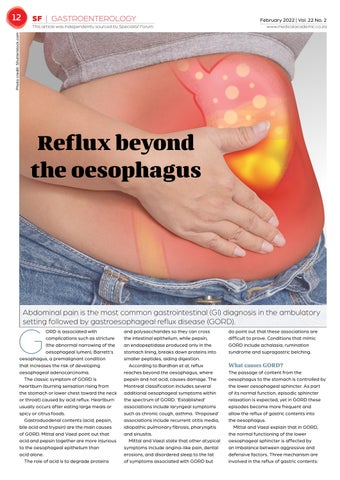
Abdominal pain is the most common gastrointestinal (GI) diagnosis in the ambulatory setting followed by gastroesophageal reflux disease (GORD).
G
ORD is associated with complications such as stricture (the abnormal narrowing of the oesophageal lumen), Barrett’s oesophagus, a premalignant condition that increases the risk of developing oesophageal adenocarcinoma. The classic symptom of GORD is heartburn (burning sensation rising from the stomach or lower chest toward the neck or throat) caused by acid reflux. Heartburn usually occurs after eating large meals or spicy or citrus foods. Gastroduodenal contents (acid, pepsin, bile acid and trypsin) are the main causes of GORD. Mittal and Vaezi point out that acid and pepsin together are more injurious to the oesophageal epithelium than acid alone. The role of acid is to degrade proteins
and polysaccharides so they can cross the intestinal epithelium, while pepsin, an endopeptidase produced only in the stomach lining, breaks down proteins into smaller peptides, aiding digestion. According to Bardhan et al, reflux reaches beyond the oesophagus, where pepsin and not acid, causes damage. The Montreal classification includes several additional oesophageal symptoms within the spectrum of GORD. ‘Established’ associations include laryngeal symptoms such as chronic cough, asthma. ‘Proposed’ associations include recurrent otitis media, idiopathic pulmonary fibrosis, pharyngitis and sinusitis. Mittal and Vaezi state that other atypical symptoms include angina-like pain, dental erosions, and disordered sleep to the list of symptoms associated with GORD but
do point out that these associations are difficult to prove. Conditions that mimic GORD include achalasia, rumination syndrome and supragastric belching.
What causes GORD? The passage of content from the oesophagus to the stomach is controlled by the lower oesophageal sphincter. As part of its normal function, episodic sphincter relaxation is expected, yet in GORD these episodes become more frequent and allow the reflux of gastric contents into the oesophagus. Mittal and Vaezi explain that in GORD, the normal functioning of the lower oesophageal sphincter is affected by an imbalance between aggressive and defensive factors. Three mechanism are involved in the reflux of gastric contents: