P r o je c t #3 C UR R O D UR B A N V IL L E
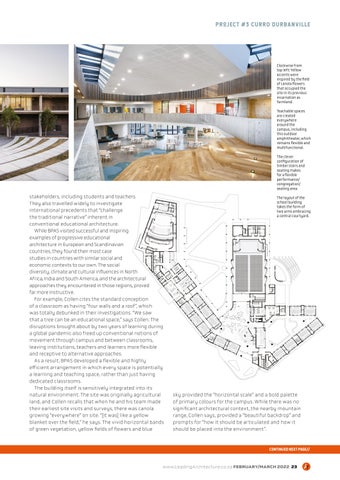
Clockwise from top left: Yellow accents were inspired by the field of canola flowers that occupied the site in its previous incarnation as farmland. Teachable spaces are created everywhere around the campus, including this outdoor amphitheater, which remains flexible and multifunctional. The clever configuration of timber stairs and seating makes for a flexible performance/ congregation/ seating area.
stakeholders, including students and teachers. They also travelled widely to investigate international precedents that “challenge the traditional narrative” inherent in conventional educational architecture. While BPAS visited successful and inspiring examples of progressive educational architecture in European and Scandinavian countries, they found their most case studies in countries with similar social and economic contexts to our own. The social diversity, climate and cultural influences in North Africa, India and South America, and the architectural approaches they encountered in those regions, proved far more instructive. For example, Collen cites the standard conception of a classroom as having “four walls and a roof”, which was totally debunked in their investigations. “We saw that a tree can be an educational space,” says Collen. The disruptions brought about by two years of learning during a global pandemic also freed up conventional notions of movement through campus and between classrooms, leaving institutions, teachers and learners more flexible and receptive to alternative approaches. As a result, BPAS developed a flexible and highly efficient arrangement in which every space is potentially a learning and teaching space, rather than just having dedicated classrooms. The building itself is sensitively integrated into its natural environment. The site was originally agricultural land, and Collen recalls that when he and his team made their earliest site visits and surveys, there was canola growing “everywhere” on site. “[It was] like a yellow blanket over the field,” he says. The vivid horizontal bands of green vegetation, yellow fields of flowers and blue
The layout of the school building takes the form of two arms embracing a central courtyard.
sky provided the “horizontal scale” and a bold palette of primary colours for the campus. While there was no significant architectural context, the nearby mountain range, Collen says, provided a “beautiful backdrop” and prompts for “how it should be articulated and how it should be placed into the environment”.
Continued next page//
www.LeadingArchitecture.co.za FEBRUARY/MARCH 2022 23